
Drill 414 n Why did the Munich Conference



- Slides: 51
Drill 4/14 n Why did the Munich Conference/ Appeasement policy fail?
World War II The Blitz
Objective n Students will be able to chronicle the events of Hitler’s early actions in Europe at the onset of World War II
September 1, 1939 n German forces invade Poland – Hitler once again claims that the region of Poland, that contains the important port of Danzig, rightfully belongs to Germany
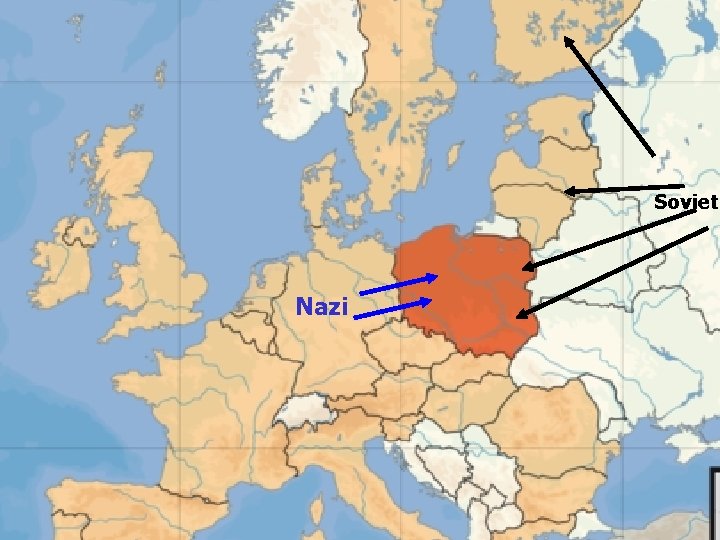
The Non-aggression Pact n Part of that non-aggression pact that was signed stated that the Germans and the Russians would divide up Poland – Also, other key areas in the Soviet’s “zone of interest” would be given up.
Soviet Nazi
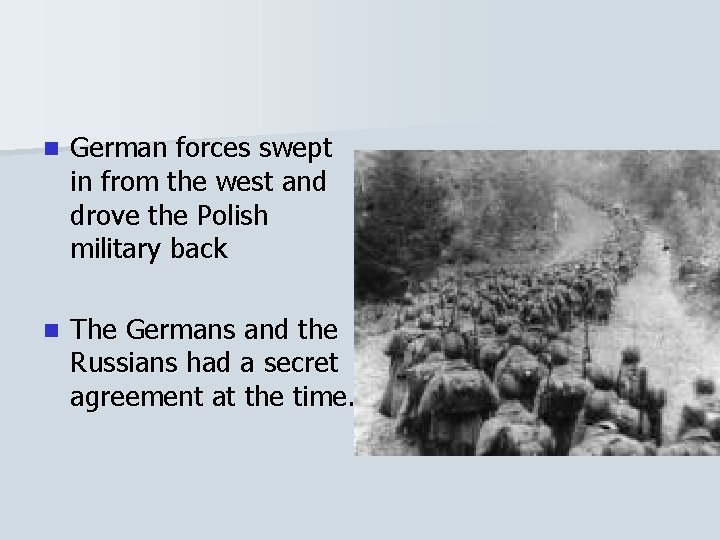
n German forces swept in from the west and drove the Polish military back n The Germans and the Russians had a secret agreement at the time.
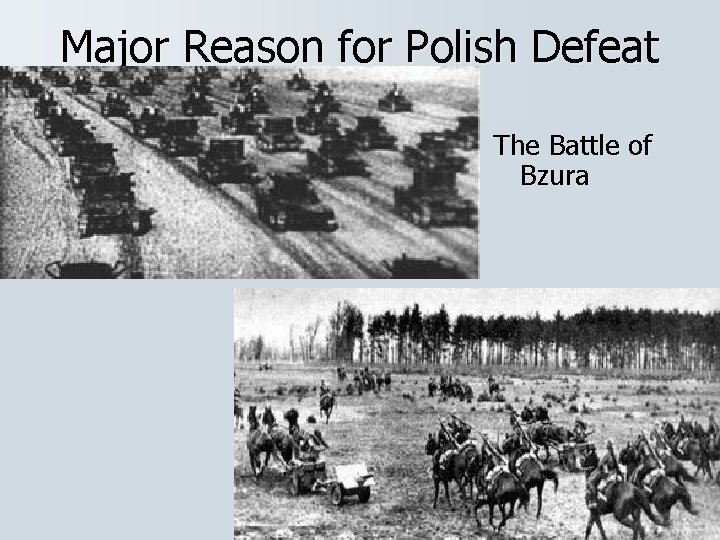
Major Reason for Polish Defeat The Battle of Bzura
Poland Falls n September 3, Britain and France declare war on Germany – But can do little to stop the attack on Poland falls in a matter of weeks n September 17, Germany and the Soviet Union divide up Poland – The USSR also receives the “Baltic States”
The Blitzkrieg n “Lightning war” n This was the first actions of Hitler’s war on Europe n By 1941, Axis forces will have made their way throughout Europe n Complete Guided Reading 16. 1
Summary n What were the characteristics of Hitler’s “Lightning war”? – How did he fight it? – Fast, violent § OVERWHELMING FORCES!!
Drill 4/15 n Why did Poland fall so easily to German forces? n Germany had superior tactics and weapons n Aided by the Soviets in the east
Objective n Students will be able to identify the causes for the fall of France during Hitler’s advance
World War II The Blitz: The Fall of France
The Phony War n. A period of quiet in Europe after the fall of Poland – Prior to Germany’s invasions of Denmark and Norway n France and Germany fortified their borders in preparation for an attack
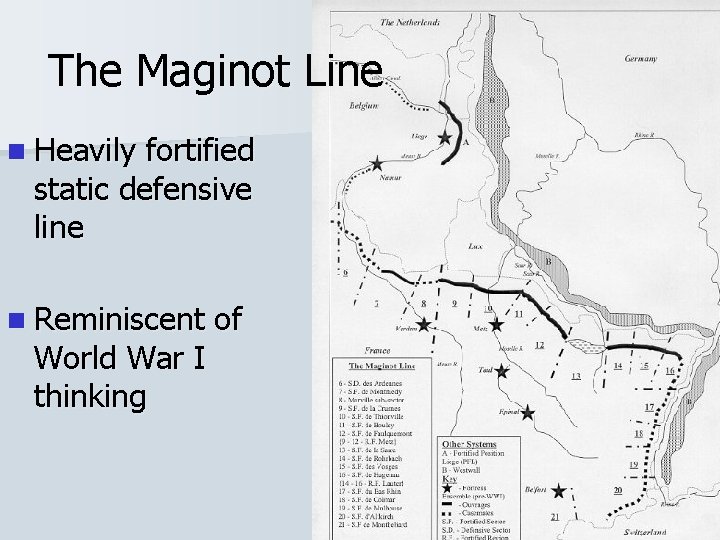
The Maginot Line n Heavily fortified static defensive line n Reminiscent World War I thinking of
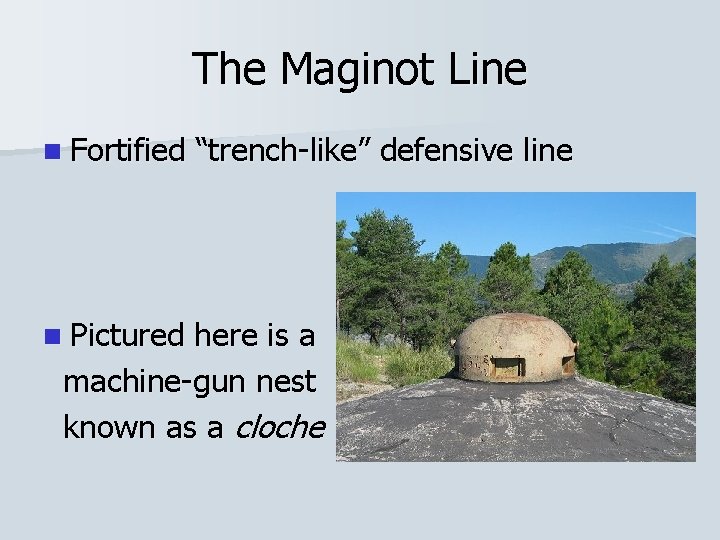
The Maginot Line n Fortified n Pictured “trench-like” defensive line here is a machine-gun nest known as a cloche
The Maginot line n Avoid a surprise attack n Give time for the main army to be mobilized behind it n Dissuade a direct assault – Force the Germans to go up through Belgium
The Line fails n May 1940 n Germany set up a decoy army directly opposite the line – Sent a second army to the north to battle the French forces along the border of Belgium n The French forces were outmatched and the Germans took Belgium – May 26, 1940
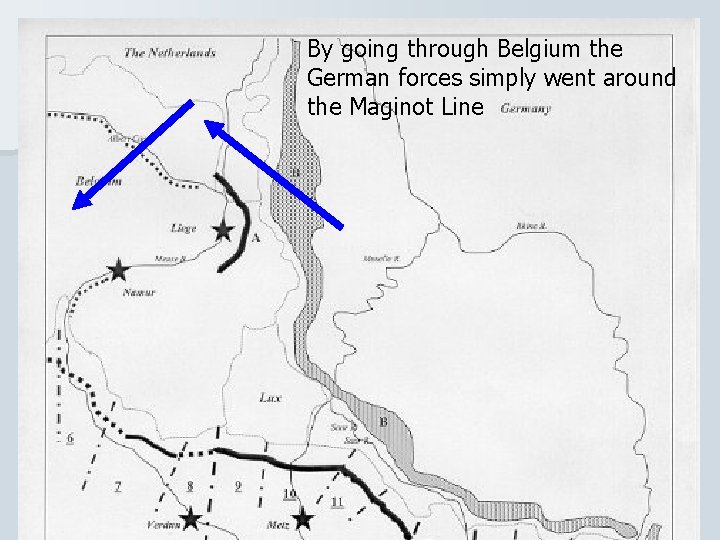
By going through Belgium the German forces simply went around the Maginot Line
Germany storms through France n June 10, 1940 – Mussolini (Italy) officially joins the German side of the war – Declares war on France and Britain and invades Southern France n June 14 – Paris Falls to German forces n June 20 – France surrenders to Germany
Blame n Why does the Maginot Line get the blame for the fall of France? n It DID force Germany to go through Belgium, what it was designed to do. n On the back of your Blitzkrieg paper from yesterday answer the following question
n Is the Maginot line itself the reason for France’s defeat? Does it deserve to be called one of history’s “greatest military mistakes”?
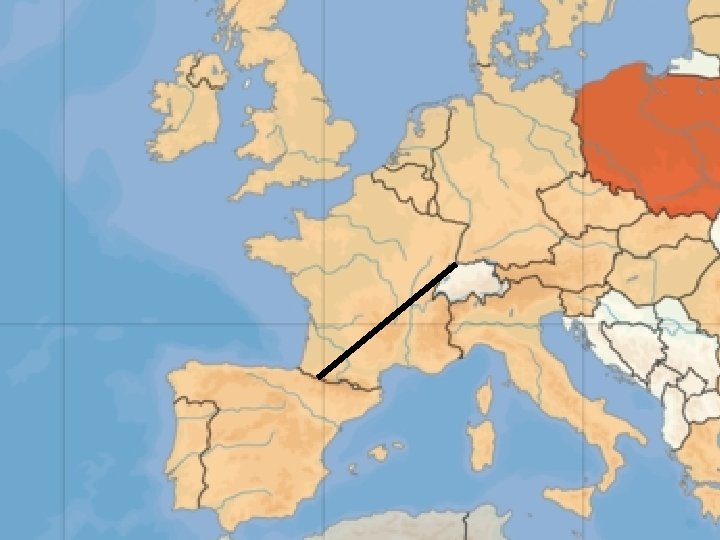
France fights back n Hitler divided France in half – Northern France was “Occupied” France – The Southern was “Unoccupied” France n The Southern half was controlled by a “puppet government” based in the French town of Vichy
Summary n Why does Hitler create the puppet government? n Why not just take over France like any other country?
Drill 4/16 n What is a “puppet government”? – A government that appears to be independent but is really being controlled by someone else or another government in another location – The Puppet Government in France was based in the city of Vichy (The Vichy Gov’t) n Why did Hitler set up the puppet government and divide France in half?
World War II The Blitz: The Battle of Britain
Objective n Students will be able to compare and contrast Hitler’s early victories with his defeats in Britain and the Soviet Union
Operation Sea-Lion n The plan: n Bomb key cities in England – Cutting off supply routes – Crushing overall morale n Then land roughly 250, 000 soldiers on England’s southern coast n This holds true to Hitler’s doctrine of overwhelming forces
September 1940 n German Luftwaffe (air force) begins bombing British cities – At first the Germans focused on Royal Air Force (RAF) hangars and bases – They would soon move onto major cities – Especially London
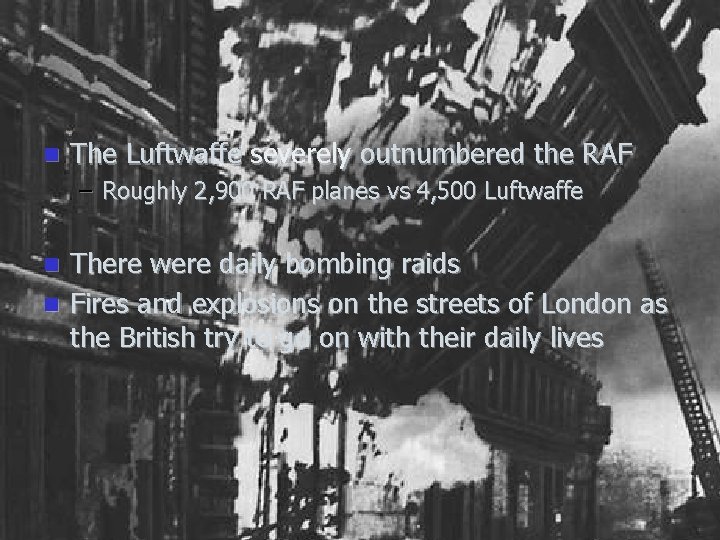
n The Luftwaffe severely outnumbered the RAF – Roughly 2, 900 RAF planes vs 4, 500 Luftwaffe There were daily bombing raids n Fires and explosions on the streets of London as the British try to go on with their daily lives n
The British Stand Tall n The British people adapt and refuse to give up n The RAF has two key inventions that help them survive – RADAR § Developed in the late 30’s § Used as an advance warning system to track planes in the air – Enigma § A codebreaking device. The British were now able to decipher secret German transmissions
The Battle of Britain In October Hitler switches to night bombings of England n The British refuse to give up n n The bombings would not stop until MAY 10, 1941 – Hitler decides that Britain can wait – It is costing too much money and taking too much time – He turns his attentions east
Results n For the better part of EIGHT MONTHS Britain endured nearly constant bombing – 27, 450 civilian deaths – Over 30 thousand wounded n Hitler would then fail in his attempt to invade the Soviet Union
Using your book n Read about Hitler’s failure in the Soviet Union (pgs 445 -446) n Answer the following question: – What factors allowed Leningrad and Great Britain to fight off German attacks while earlier cities and countries fell? § Consider these points in your answer: § The country’s ability to fight § The costs of resisting § The costs of surrendering n I will collect this response and the Guided Reading for 16. 1 at the end of class
Summary n What n How was the Atlantic Charter? did it get the USA involved in the war prior to Pearl Harbor?
Drill 4/17 n What n. A is the Atlantic Charter? declaration of principles between the US and UK.
Objective n Students will identify the reasons for US involvement in World War II
The United States and WWII n Officially the US is neutral – The Neutrality Acts of 1938, ’ 39 n Upper levels of government are growing more worried about the situation in Europe
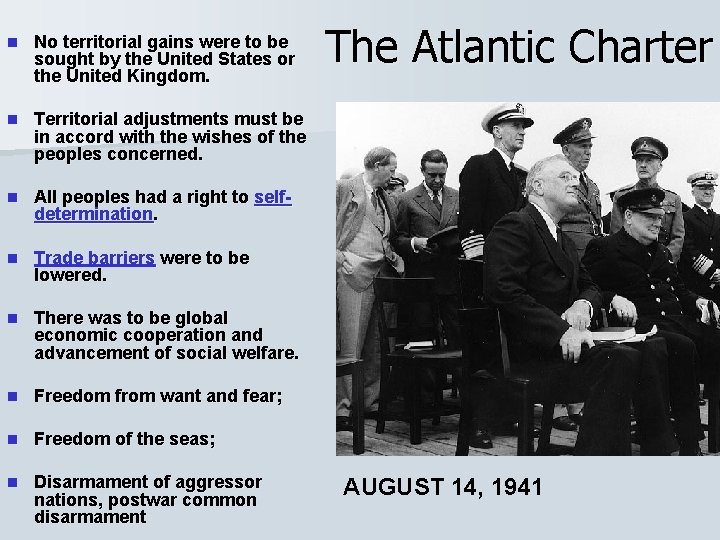
n No territorial gains were to be sought by the United States or the United Kingdom. n Territorial adjustments must be in accord with the wishes of the peoples concerned. n All peoples had a right to selfdetermination. n Trade barriers were to be lowered. n There was to be global economic cooperation and advancement of social welfare. n Freedom from want and fear; n Freedom of the seas; n Disarmament of aggressor nations, postwar common disarmament The Atlantic Charter AUGUST 14, 1941
International Reaction n UK – Loved the plan, sorry that the US was not getting involved in the war n US – Loved the plan – Worried that this would lead us INTO war n Germany and Japan – Took the agreement as basically a declaration of alliance against them – In Japan this would be used an excuse for increased hostilities for towards the United States
US + Japan Relations n Japan force had increasingly become an imperial – The invasion of Manchuria in 1931 n This made relations between the countries rather tense
Japan + US Relations n As Japan allied itself with Germany that made things worse n Japan’s islands have few natural resources – i. e. Oil – They would need to expand to get these goods or receive them from another source – For a time that was the US
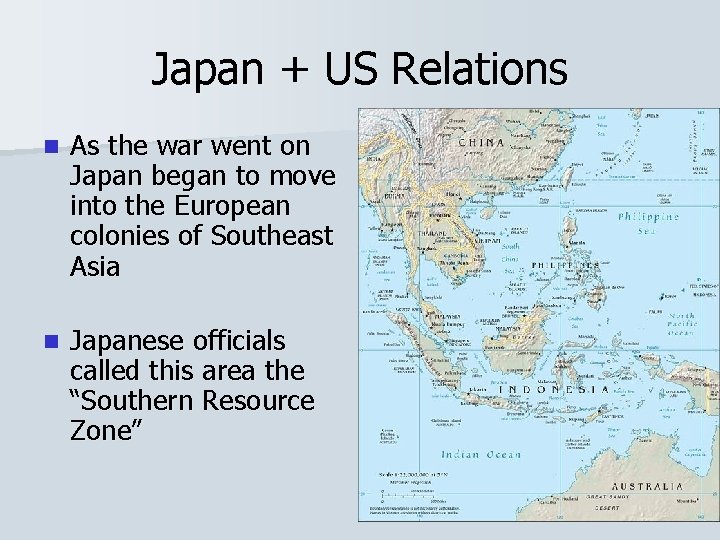
Japan + US Relations n As the war went on Japan began to move into the European colonies of Southeast Asia n Japanese officials called this area the “Southern Resource Zone”
The US Reacts n The United states reacted by cutting off all oil imports to Japan n Japanese officials realized at the rate of consumption they would only have enough reserves for another two years
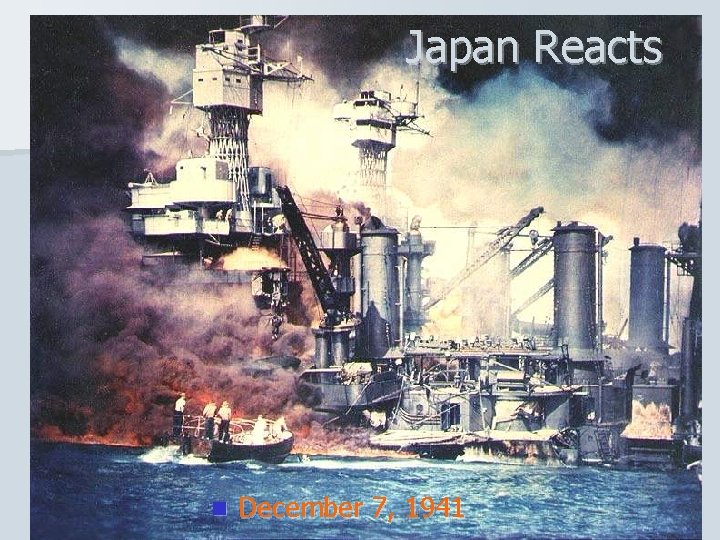
Japan Reacts n December 7, 1941
The Attack on Pearl Harbor Was not designed to begin a long, protracted conflict n It was intended to be one, swift, crushing blow to the US pacific fleet n – Take out the fleet then Japan can roll through Asia without too much resistance n Japan delivered an official declaration of war later that afternoon – The United States would declare war on Japan the next day
Classwork/ Homework n Complete Guided Reading 16. 2 – Parts a+b – It will be collected on Monday – Next week we will look at the war in the pacific and how the United States turns the tide of the conflict