
Drift from boom sprayers 2 Wind tunnel experiments
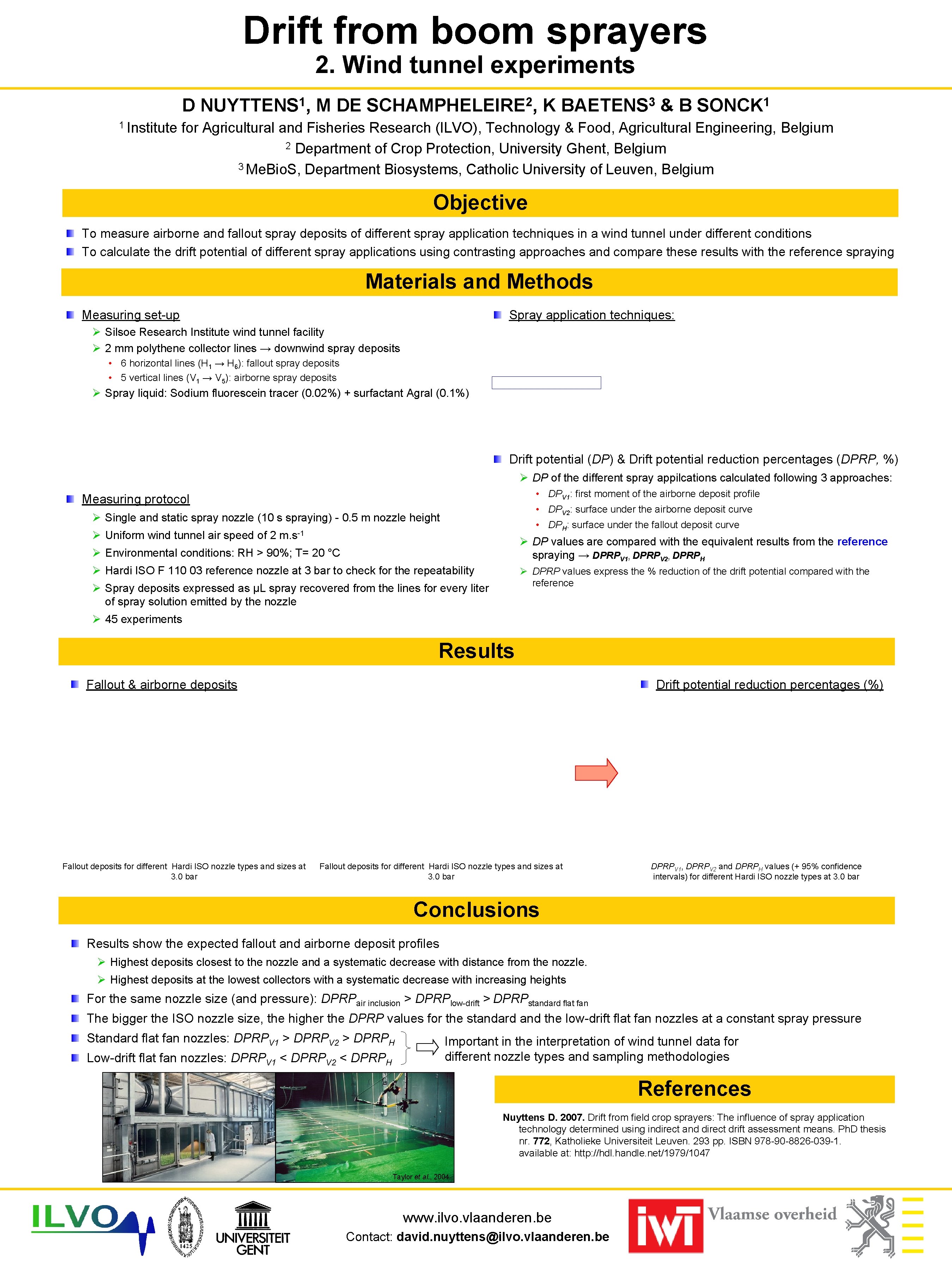
Drift from boom sprayers 2. Wind tunnel experiments D 1 Institute 1 NUYTTENS , M DE 2 SCHAMPHELEIRE , K 3 BAETENS &B 1 SONCK for Agricultural and Fisheries Research (ILVO), Technology & Food, Agricultural Engineering, Belgium 2 Department of Crop Protection, University Ghent, Belgium 3 Me. Bio. S, Department Biosystems, Catholic University of Leuven, Belgium Objective To measure airborne and fallout spray deposits of different spray application techniques in a wind tunnel under different conditions To calculate the drift potential of different spray applications using contrasting approaches and compare these results with the reference spraying Materials and Methods Measuring set-up Spray application techniques: Ø Silsoe Research Institute wind tunnel facility Ø 2 mm polythene collector lines → downwind spray deposits • 6 horizontal lines (H 1 → H 6): fallout spray deposits • 5 vertical lines (V 1 → V 5): airborne spray deposits Ø Spray liquid: Sodium fluorescein tracer (0. 02%) + surfactant Agral (0. 1%) Drift potential (DP) & Drift potential reduction percentages (DPRP, %) Ø DP of the different spray appilcations calculated following 3 approaches: • DPV 1: first moment of the airborne deposit profile Measuring protocol • DPV 2: surface under the airborne deposit curve Ø Single and static spray nozzle (10 s spraying) - 0. 5 m nozzle height • DPH: surface under the fallout deposit curve Ø Uniform wind tunnel air speed of 2 m. s-1 Ø DP values are compared with the equivalent results from the reference spraying → DPRPV 1, DPRPV 2, DPRPH Ø Environmental conditions: RH > 90%; T= 20 °C Ø Hardi ISO F 110 03 reference nozzle at 3 bar to check for the repeatability Ø DPRP values express the % reduction of the drift potential compared with the reference Ø Spray deposits expressed as µL spray recovered from the lines for every liter of spray solution emitted by the nozzle Ø 45 experiments Results Fallout & airborne deposits Fallout deposits for different Hardi ISO nozzle types and sizes at 3. 0 bar Drift potential reduction percentages (%) Fallout deposits for different Hardi ISO nozzle types and sizes at 3. 0 bar DPRPV 1, DPRPV 2 and DPRPH values (+ 95% confidence intervals) for different Hardi ISO nozzle types at 3. 0 bar Conclusions Results show the expected fallout and airborne deposit profiles Ø Highest deposits closest to the nozzle and a systematic decrease with distance from the nozzle. Ø Highest deposits at the lowest collectors with a systematic decrease with increasing heights For the same nozzle size (and pressure): DPRPair inclusion > DPRPlow-drift > DPRPstandard flat fan The bigger the ISO nozzle size, the higher the DPRP values for the standard and the low-drift flat fan nozzles at a constant spray pressure Standard flat fan nozzles: DPRPV 1 > DPRPV 2 > DPRPH Low-drift flat fan nozzles: DPRPV 1 < DPRPV 2 < DPRPH Important in the interpretation of wind tunnel data for different nozzle types and sampling methodologies References Nuyttens D. 2007. Drift from field crop sprayers: The influence of spray application technology determined using indirect and direct drift assessment means. Ph. D thesis nr. 772, Katholieke Universiteit Leuven. 293 pp. ISBN 978 -90 -8826 -039 -1. available at: http: //hdl. handle. net/1979/1047 Taylor et al. , 2004 www. ilvo. vlaanderen. be Contact: david. nuyttens@ilvo. vlaanderen. be
- Slides: 1