
Dremel Interactive Analysis of Web Scale Datasets Sergey
Dremel: Interactive Analysis of Web. Scale Datasets Sergey Melnik, Andrey Gubarev, Jing Long, Geoffrey Romer, Shivakumar, Matt Tolton, Theo Vassilakis (Google) VLDB 2010 Presented by Raghav Ayyamani
Speed matters Interactive Tools Spam Web Dashboards Trends Detection Network Optimization 2

Dremel system Trillion-record, multi-terabyte datasets at interactive speed Scales to thousands of nodes Fault tolerant execution Nested data model Complex datasets Columnar storage and processing Tree architecture (as in web search) Interoperates with Google's data mgmt tools In situ data access (e. g. , GFS, Bigtable) Map. Reduce pipelines 3
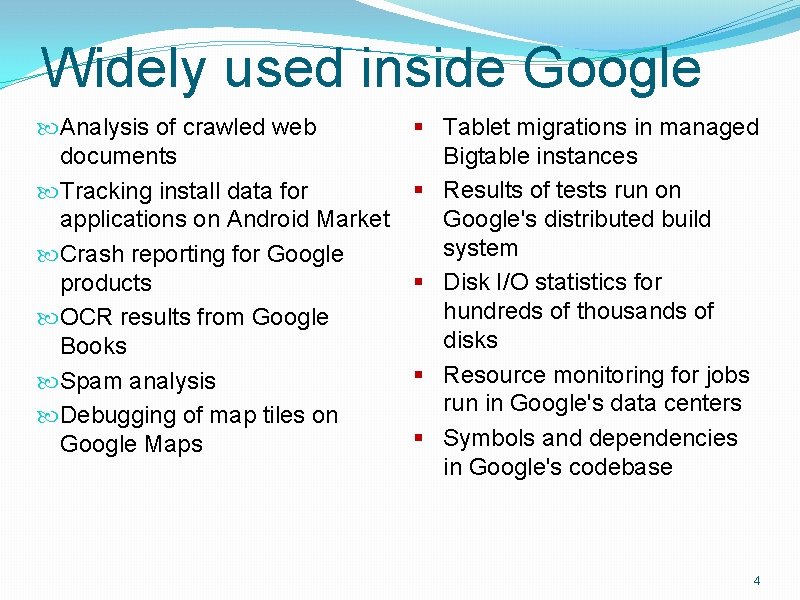
Widely used inside Google Analysis of crawled web documents Tracking install data for applications on Android Market Crash reporting for Google products OCR results from Google Books Spam analysis Debugging of map tiles on Google Maps § Tablet migrations in managed Bigtable instances § Results of tests run on Google's distributed build system § Disk I/O statistics for hundreds of thousands of disks § Resource monitoring for jobs run in Google's data centers § Symbols and dependencies in Google's codebase 4
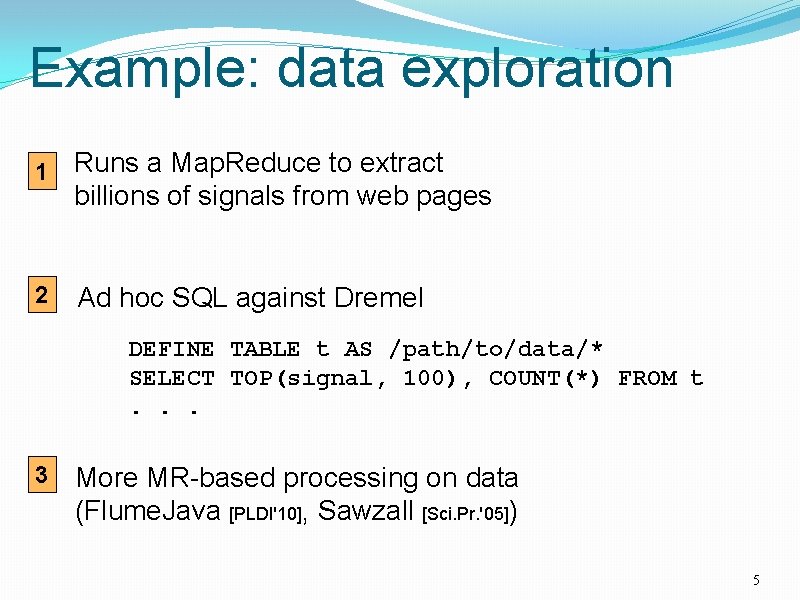
Example: data exploration 1 Runs a Map. Reduce to extract billions of signals from web pages 2 Ad hoc SQL against Dremel DEFINE TABLE t AS /path/to/data/* SELECT TOP(signal, 100), COUNT(*) FROM t. . . 3 More MR-based processing on data (Flume. Java [PLDI'10], Sawzall [Sci. Pr. '05]) 5
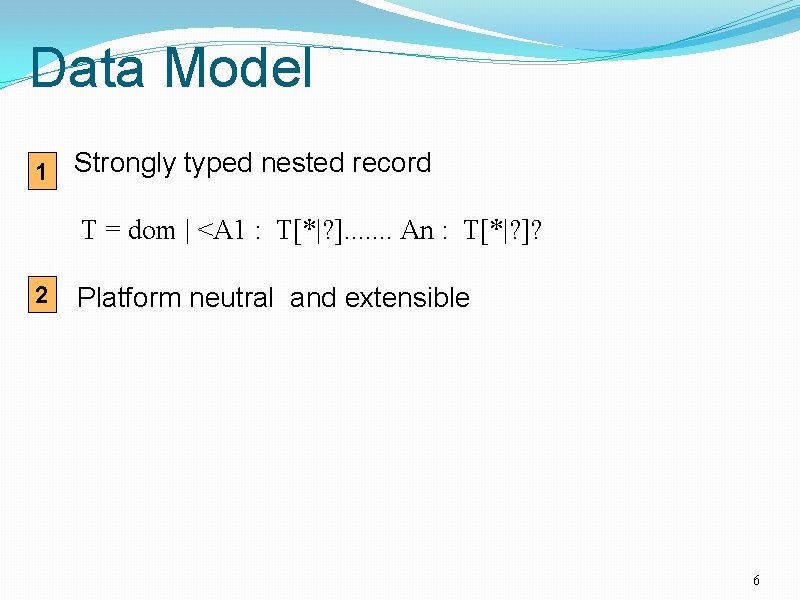
Data Model 1 Strongly typed nested record T = dom | <A 1 : T[*|? ]. . . . An : T[*|? ]? 2 Platform neutral and extensible 6
Outline Nested columnar storage Query processing Experiments Observations 7
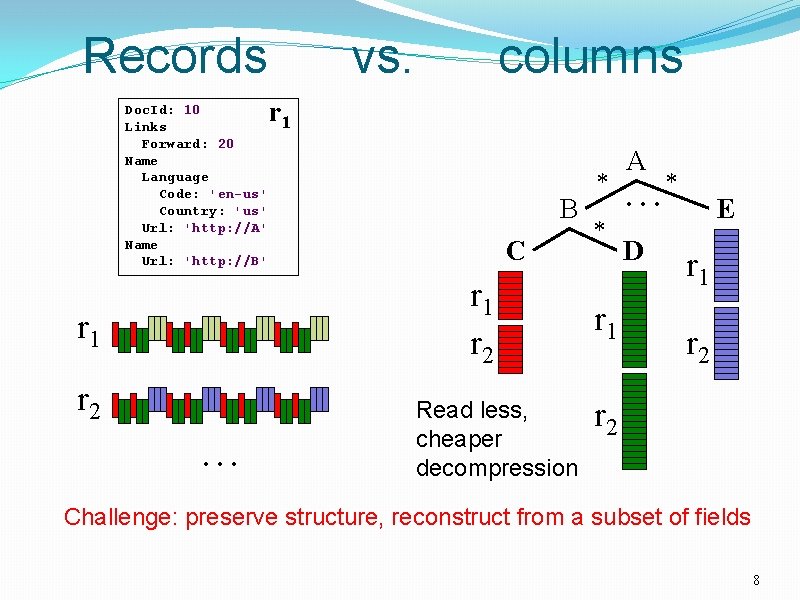
Records Doc. Id: 10 Links Forward: 20 Name Language Code: 'en-us' Country: 'us' Url: 'http: //A' Name Url: 'http: //B' vs. columns r 1 C A * *. . . B * D r 1 r 2. . . Read less, cheaper decompression r 1 E r 1 r 2 Challenge: preserve structure, reconstruct from a subset of fields 8
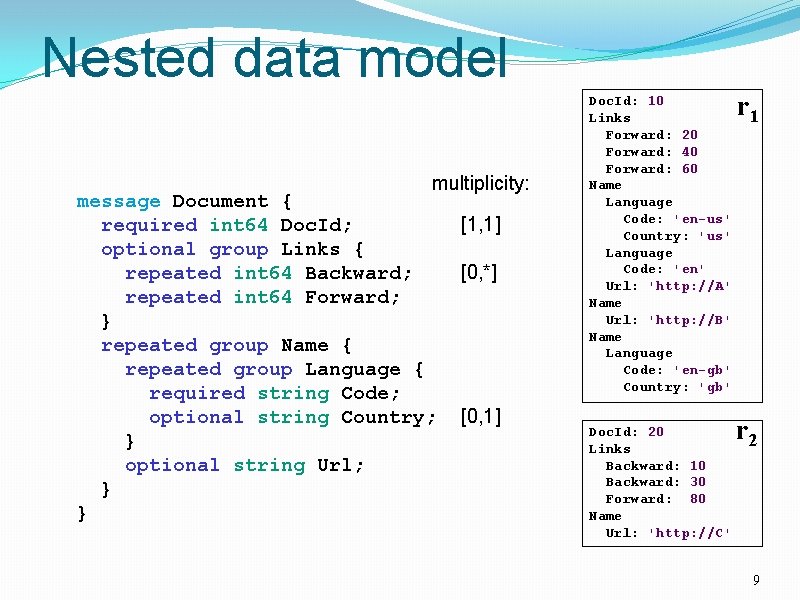
Nested data model multiplicity: message Document { required int 64 Doc. Id; optional group Links { repeated int 64 Backward; repeated int 64 Forward; } repeated group Name { repeated group Language { required string Code; optional string Country; } optional string Url; } } [1, 1] [0, *] [0, 1] Doc. Id: 10 Links Forward: 20 Forward: 40 Forward: 60 Name Language Code: 'en-us' Country: 'us' Language Code: 'en' Url: 'http: //A' Name Url: 'http: //B' Name Language Code: 'en-gb' Country: 'gb' Doc. Id: 20 Links Backward: 10 Backward: 30 Forward: 80 Name Url: 'http: //C' r 1 r 2 9
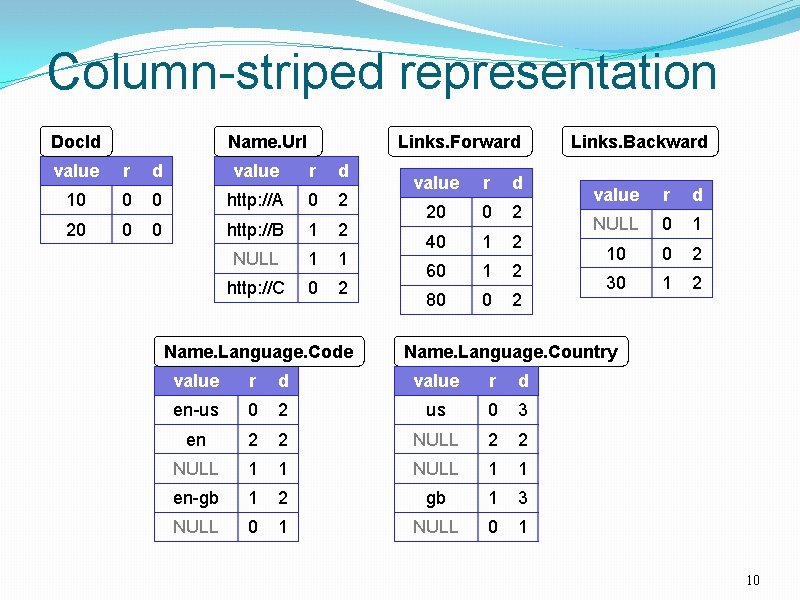
Column-striped representation Doc. Id Name. Url Links. Forward value r d 10 0 0 http: //A 0 2 20 0 0 http: //B 1 2 NULL 1 1 http: //C 0 2 Name. Language. Code value r d 20 0 2 40 1 2 60 1 2 80 0 2 Links. Backward value r d NULL 0 1 10 0 2 30 1 2 Name. Language. Country value r d en-us 0 2 us 0 3 en 2 2 NULL 1 1 en-gb 1 2 gb 1 3 NULL 0 1 10
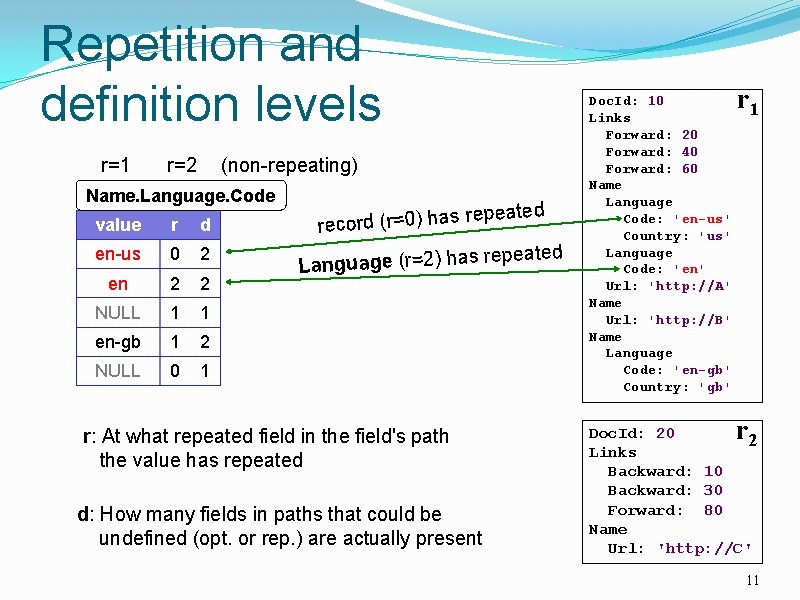
Repetition and definition levels r=1 r=2 (non-repeating) Name. Language. Code peated value r d re record (r=0) has en-us 0 2 en 2 2 re Language (r=2) has NULL 1 1 en-gb 1 2 NULL 0 1 r: At what repeated field in the field's path the value has repeated d: How many fields in paths that could be undefined (opt. or rep. ) are actually present peated Doc. Id: 10 Links Forward: 20 Forward: 40 Forward: 60 Name Language Code: 'en-us' Country: 'us' Language Code: 'en' Url: 'http: //A' Name Url: 'http: //B' Name Language Code: 'en-gb' Country: 'gb' r 1 r Doc. Id: 20 2 Links Backward: 10 Backward: 30 Forward: 80 Name Url: 'http: //C' 11
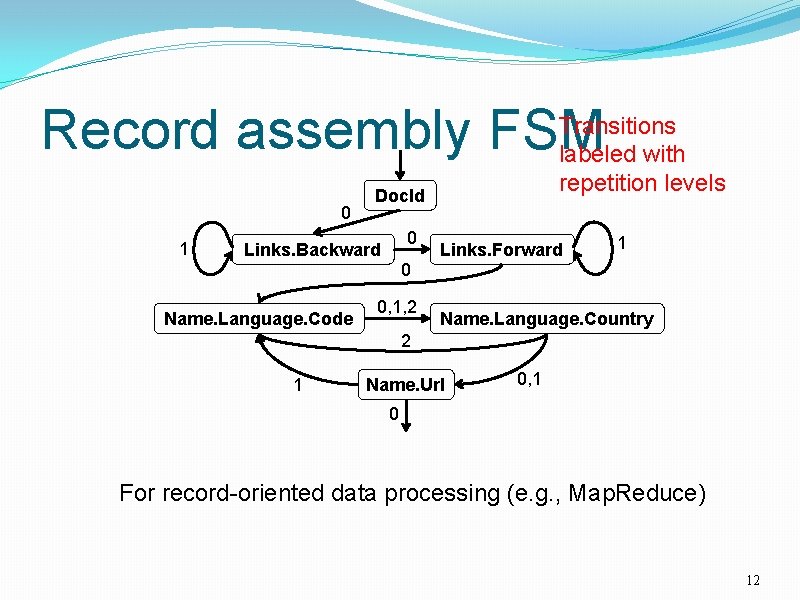
Record assembly FSM 0 1 Transitions labeled with repetition levels Doc. Id 0 Links. Backward Links. Forward 1 0 Name. Language. Code 0, 1, 2 Name. Language. Country 2 1 Name. Url 0, 1 0 For record-oriented data processing (e. g. , Map. Reduce) 12
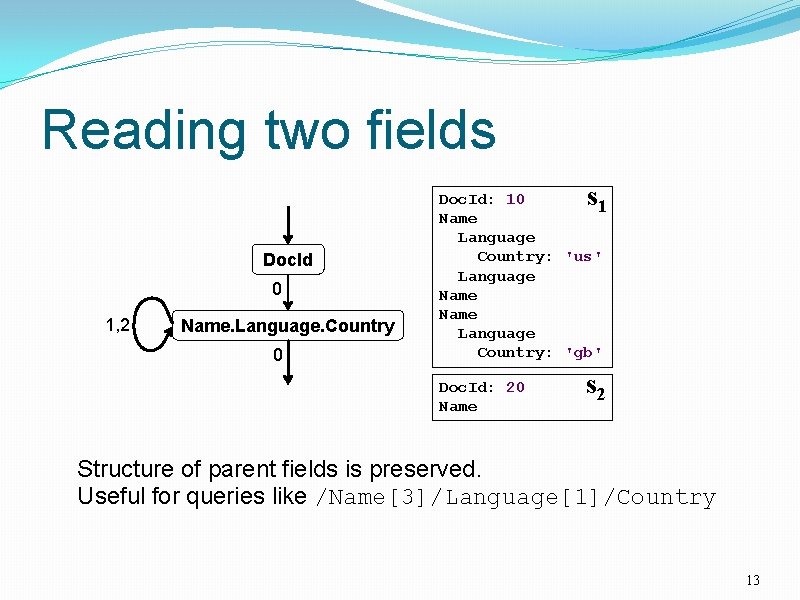
Reading two fields s Doc. Id 0 1, 2 Name. Language. Country 0 Doc. Id: 10 1 Name Language Country: 'us' Language Name Language Country: 'gb' Doc. Id: 20 Name s 2 Structure of parent fields is preserved. Useful for queries like /Name[3]/Language[1]/Country 13
Outline Nested columnar storage Query processing Experiments Observations 14
Query processing Optimized for select-project-aggregate Very common class of interactive queries Within-record and cross-record aggregation Approximations: count(distinct), top-k Joins, temp tables, UDFs, etc. 15
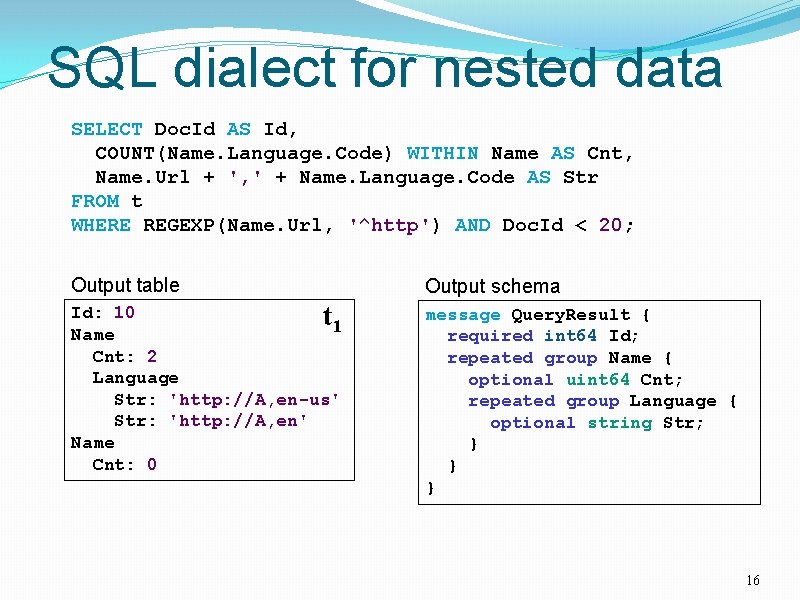
SQL dialect for nested data SELECT Doc. Id AS Id, COUNT(Name. Language. Code) WITHIN Name AS Cnt, Name. Url + ', ' + Name. Language. Code AS Str FROM t WHERE REGEXP(Name. Url, '^http') AND Doc. Id < 20; Output table Output schema Id: 10 t 1 Name Cnt: 2 Language Str: 'http: //A, en-us' Str: 'http: //A, en' Name Cnt: 0 message Query. Result { required int 64 Id; repeated group Name { optional uint 64 Cnt; repeated group Language { optional string Str; } } } 16
![Serving tree [Dean WSDM'09] client • Parallelizes scheduling and aggregation root server • Fault](http://slidetodoc.com/presentation_image_h2/c71d905197b6b98ed41fffd29e7be792/image-17.jpg "Serving tree [Dean WSDM'09] client • Parallelizes scheduling and aggregation root server • Fault")
Serving tree [Dean WSDM'09] client • Parallelizes scheduling and aggregation root server • Fault tolerance intermediate servers leaf servers (with local storage) . . . • Designed for "small" results (<1 M records) . . . histogram of response times storage layer (e. g. , GFS) 17
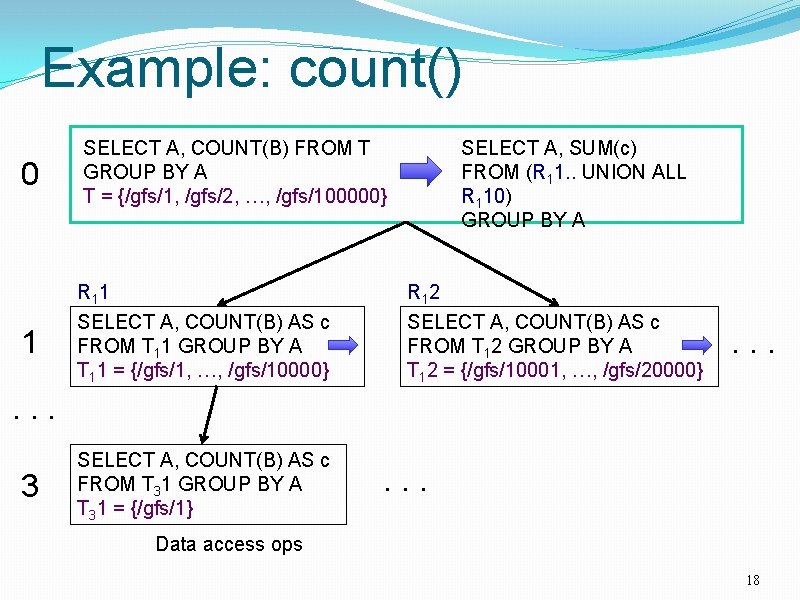
Example: count() 0 SELECT A, COUNT(B) FROM T GROUP BY A T = {/gfs/1, /gfs/2, …, /gfs/100000} 1 R 1 1 SELECT A, COUNT(B) AS c FROM T 11 GROUP BY A T 11 = {/gfs/1, …, /gfs/10000} SELECT A, SUM(c) FROM (R 11. . UNION ALL R 110) GROUP BY A R 1 2 SELECT A, COUNT(B) AS c FROM T 12 GROUP BY A T 12 = {/gfs/10001, …, /gfs/20000} . . . 3 SELECT A, COUNT(B) AS c FROM T 31 GROUP BY A T 31 = {/gfs/1} . . . Data access ops 18
Outline Nested columnar storage Query processing Experiments Observations 19
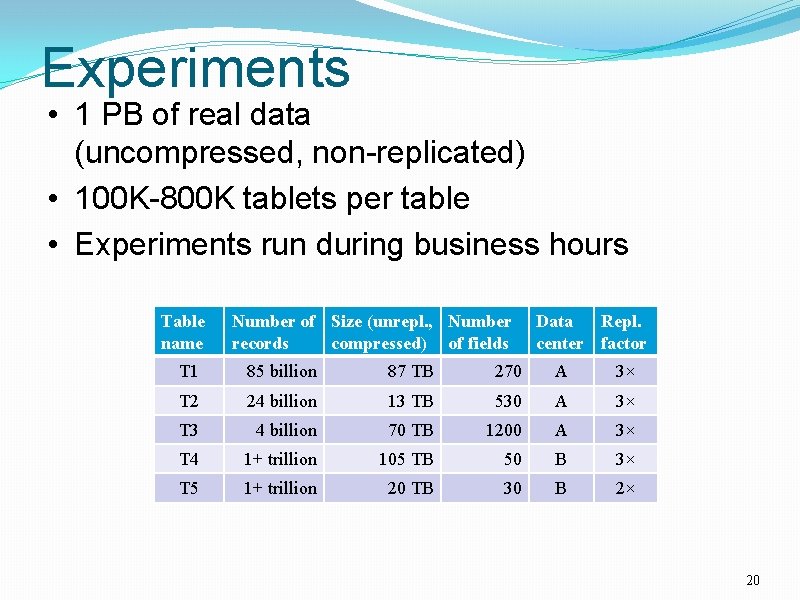
Experiments • 1 PB of real data (uncompressed, non-replicated) • 100 K-800 K tablets per table • Experiments run during business hours Table name Number of Size (unrepl. , Number records compressed) of fields Data Repl. center factor T 1 85 billion 87 TB 270 A 3× T 2 24 billion 13 TB 530 A 3× T 3 4 billion 70 TB 1200 A 3× T 4 1+ trillion 105 TB 50 B 3× T 5 1+ trillion 20 TB 30 B 2× 20
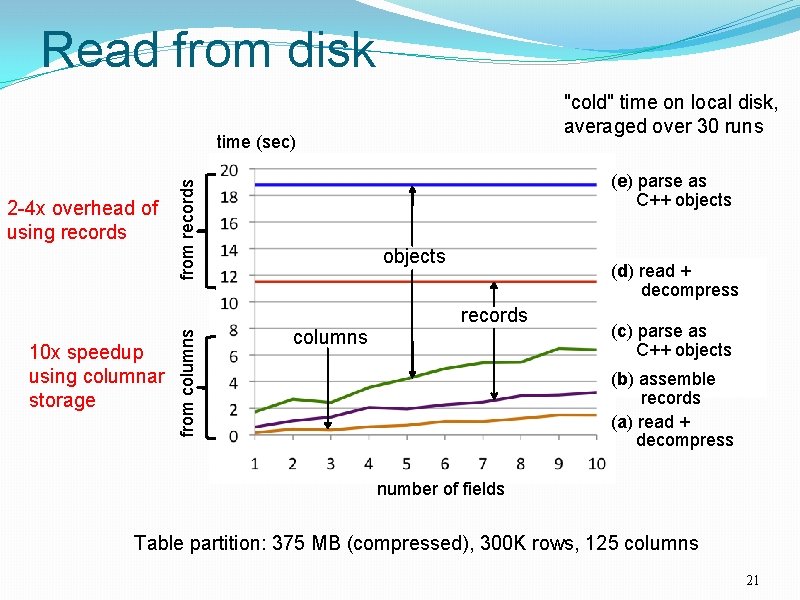
Read from disk "cold" time on local disk, averaged over 30 runs time (sec) from records 2 -4 x overhead of using records (e) parse as C++ objects (d) read + decompress 10 x speedup using columnar storage from columns records columns (c) parse as C++ objects (b) assemble records (a) read + decompress number of fields Table partition: 375 MB (compressed), 300 K rows, 125 columns 21
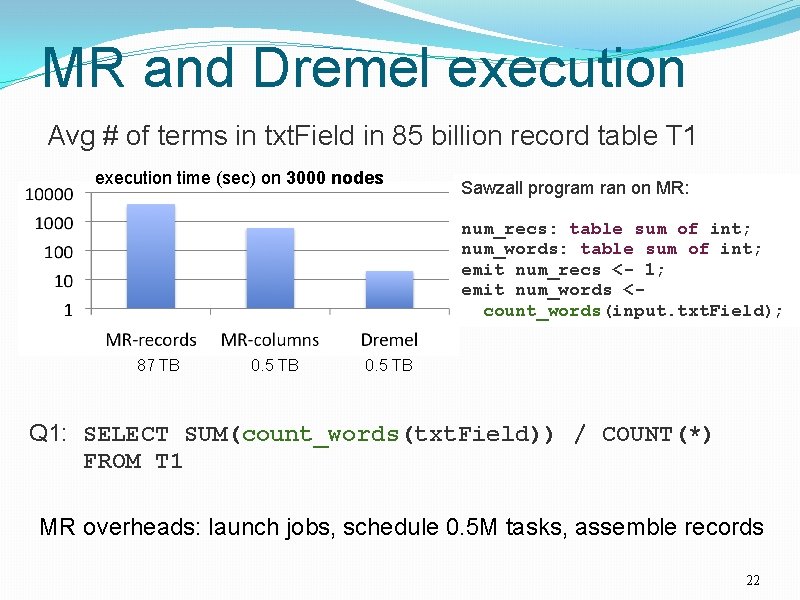
MR and Dremel execution Avg # of terms in txt. Field in 85 billion record table T 1 execution time (sec) on 3000 nodes Sawzall program ran on MR: num_recs: table sum of int; num_words: table sum of int; emit num_recs <- 1; emit num_words <count_words(input. txt. Field); 87 TB 0. 5 TB Q 1: SELECT SUM(count_words(txt. Field)) / COUNT(*) FROM T 1 MR overheads: launch jobs, schedule 0. 5 M tasks, assemble records 22
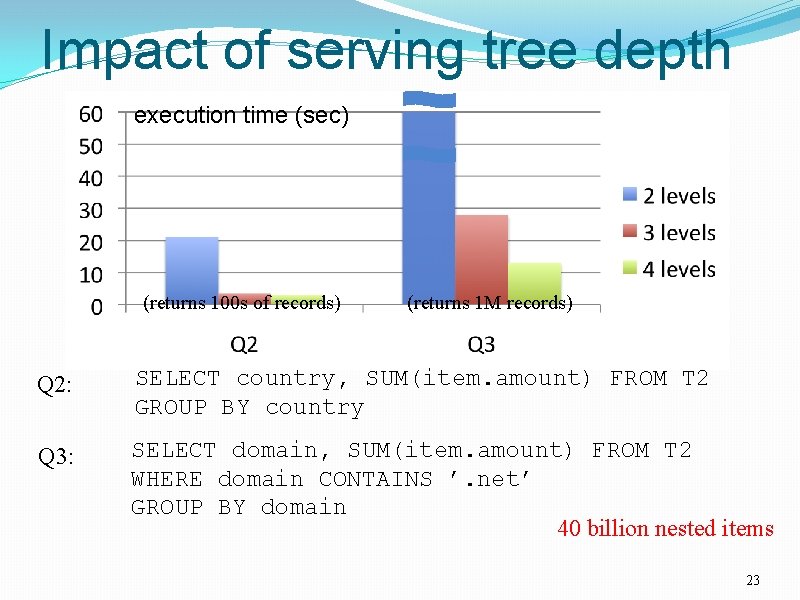
Impact of serving tree depth execution time (sec) (returns 100 s of records) (returns 1 M records) Q 2: SELECT country, SUM(item. amount) FROM T 2 GROUP BY country Q 3: SELECT domain, SUM(item. amount) FROM T 2 WHERE domain CONTAINS ’. net’ GROUP BY domain 40 billion nested items 23
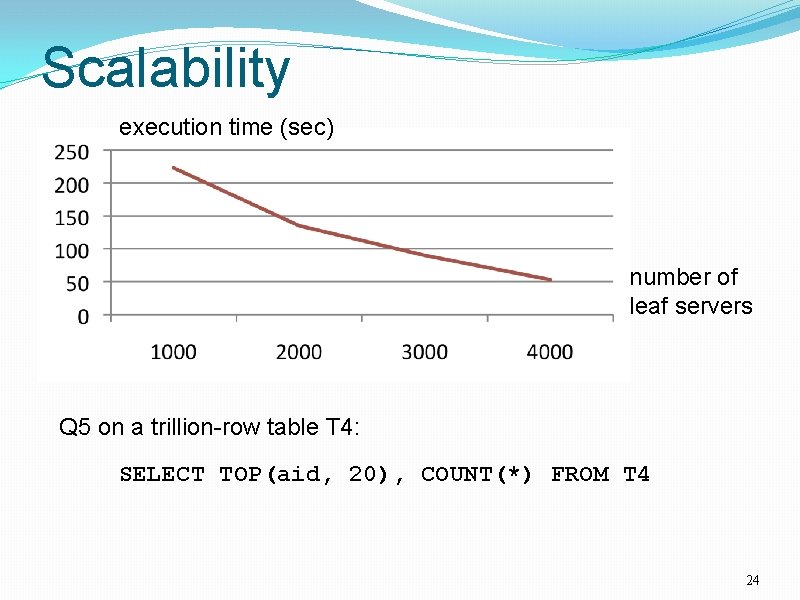
Scalability execution time (sec) number of leaf servers Q 5 on a trillion-row table T 4: SELECT TOP(aid, 20), COUNT(*) FROM T 4 24
Outline Nested columnar storage Query processing Experiments Observations 25
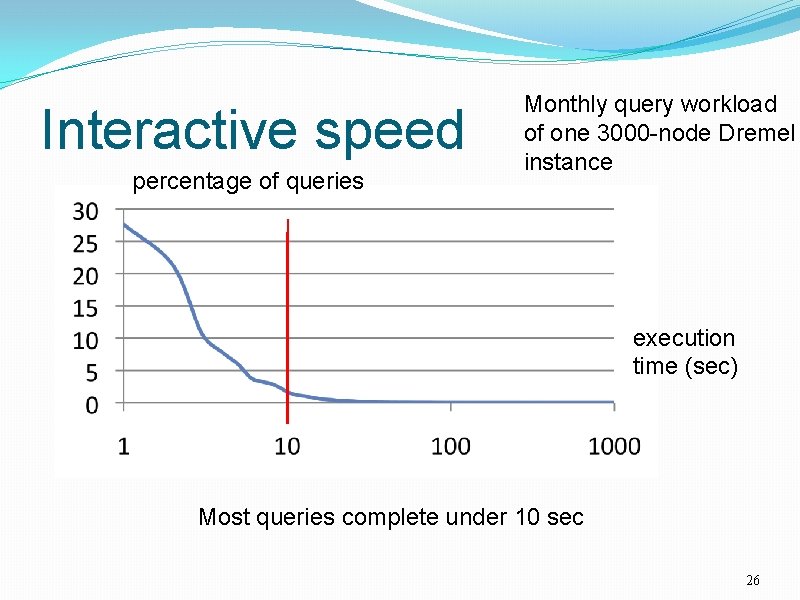
Interactive speed percentage of queries Monthly query workload of one 3000 -node Dremel instance execution time (sec) Most queries complete under 10 sec 26
Observations Possible to analyze large disk-resident datasets interactively on commodity hardware 1 T records, 1000 s of nodes MR can benefit from columnar storage just like a parallel DBMS But record assembly is expensive Interactive SQL and MR can be complementary Parallel DBMSes may benefit from serving tree architecture just like search engines 27
Related Systems Pig Scope XMill 28
Thank You 29
- Slides: 29