
Dreaming Research into the nature of dreaming Brain
Dreaming Research into the nature of dreaming Brain activity n Duration n Content n psychlotron. org. uk n
Dreams vs. Reality n Empson (1983) ‘Spectator’ perspective (usually) n Logic of waking consciousness does not apply n Quickly forgotten n Hobson (1995) Hallucinations n Cognitive abnormalities n Emotional intensity n psychlotron. org. uk n
Dreaming & REM Sleep n n REM sleep entered 4 -5 times every night REM periods lengthen towards waking REM is characterised by: Rapid, darting eye movements n Changes in heart rate, respiration n Muscular paralysis n Alterations in brain activity n psychlotron. org. uk n
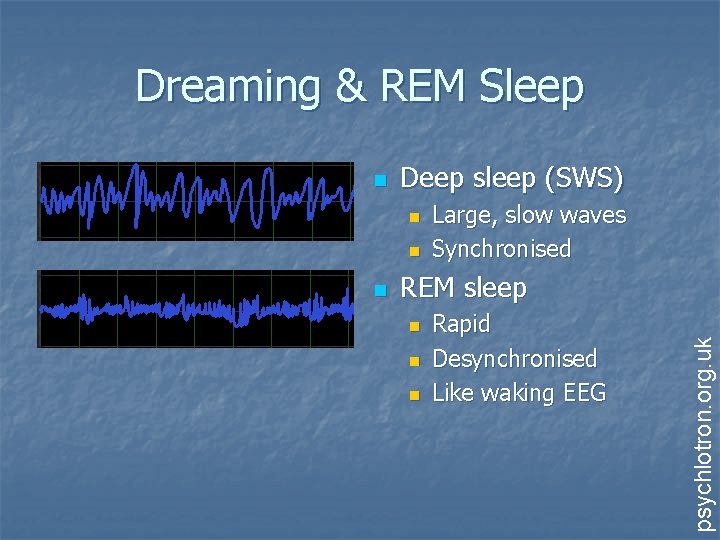
Dreaming & REM Sleep Deep sleep (SWS) n n n Large, slow waves Synchronised REM sleep n n n Rapid Desynchronised Like waking EEG psychlotron. org. uk n
Dreaming & REM Sleep n n Dement & Kleitman (1957) PPs woken in either REM or NREM sleep REM: reported dreaming 80% of time n NREM reported dreaming 15% of time n REM clearly associated with dreams n But may occur at other times (sleepwalking) psychlotron. org. uk n
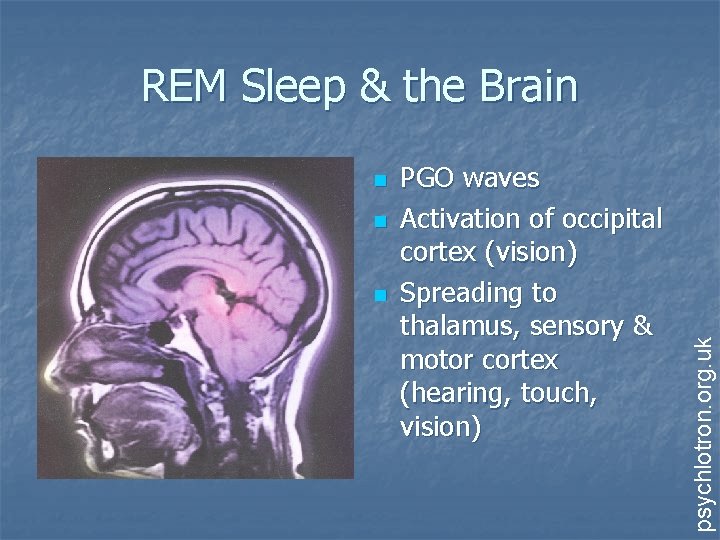
n n n PGO waves Activation of occipital cortex (vision) Spreading to thalamus, sensory & motor cortex (hearing, touch, vision) psychlotron. org. uk REM Sleep & the Brain
Dream Duration n Dement & Kleitman (1957) Relationship between REM duration and: (1) estimates of dream length n (2) length of dream descriptions n psychlotron. org. uk n
Dream Content n Kahn et al (2000) – people in dreams 50% known to sleeper n 30% generic roles e. g. police officer n Hardly any completely unknown n Cartwright et al (1984) n Relationship between life events (e. g. divorce) and dream content psychlotron. org. uk n
Dream Content Dement & Kleitman (1957) n n NREM dreams more mundane & more similar to waking thoughts than REM dreams Antrobus (1983) n REM dreams more likely to (1) have a storylike narrative; (2) include bizarre events psychlotron. org. uk n
- Slides: 9