
Dream like Marc Chagall Suea como Marc Chagall
- Slides: 19
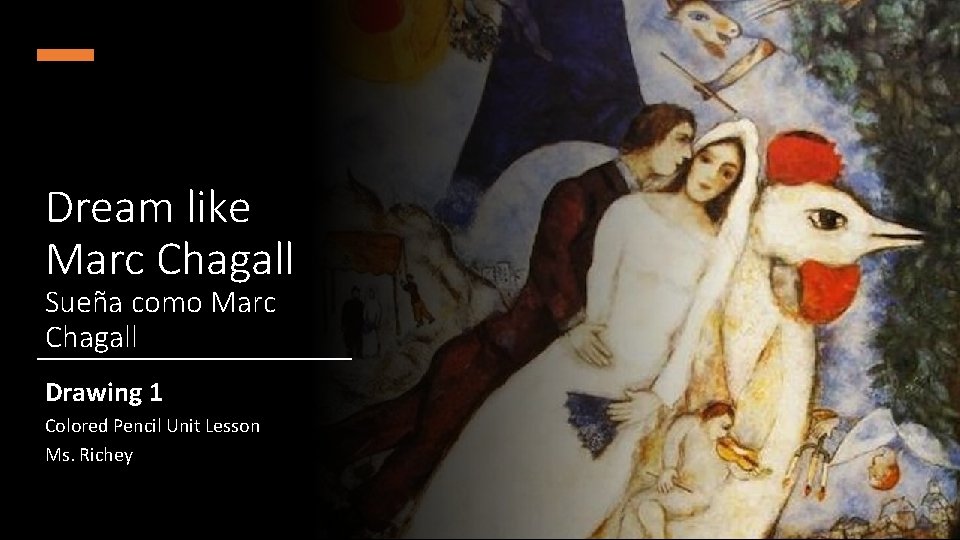
Dream like Marc Chagall Sueña como Marc Chagall Drawing 1 Colored Pencil Unit Lesson Ms. Richey
Drawing 1 - Colored Pencil Lesson unit / Dream like Marc Chagall Standard: • VAHSDR. CR. 2 Choose from a range of materials and methods of traditional and contemporary artistic practices to plan and create works of art. • d. Develop mastery of media (e. g. graphite, colored pencil, charcoal, conte, soft pastel, oil pastel, pen and brush, found mark-making tools). • VAHSDR. CR. 4 Incorporate formal and informal components to create works of art. • a. Use planning approaches (e. g. thumbnail sketches, viewfinders, sighting methods to develop compositions for drawing). • b. Apply compositional design concepts (e. g. elements and principles, activating negative space, visual weight, rule of thirds, color theories). • VAHSDR. CN. 2 Develop life skills through the study and production of art (e. g. collaboration, creativity, critical thinking, communication). • b. Use creativity and imagination in planning and development of products
Objectives: Students will: 1. Learn basic colored pencil techniques 2. Create thumbnail sketches while considering composition, elements and principles of art, foreground, middle ground and background 3. Create a final project using colored pencil and the techniques they learned 4. Write an artist statement Objetivos : Las estudiantes : 1. Aprenda cuatro técnicas básicas de lápiz de color 2. Cree al menos cuatro bocetos en miniatura teniendo en cuenta la composición, los elementos y los principios del arte, el primer plano, el término medio y el fondo. 3. Crea un proyecto final usando lápiz de color y sus técnicas.
• • Vocabulary: Composition: How the elements are arranged Foreground: Objects that appear to be closest to the viewer Middle ground: Objects depicted in between the foreground and background Background: Objects that appear the farthest in the picture plane Complementary colors: Two colors that are directly opposite on the color wheel Blending: A colored pencil technique that mixes two or more colors to create gradient colors Layering: A colored pencil technique to overlays two or more colors to create a different color Vocabulario: Composición: cómo se organizan los elementos Primer plano: objetos que parecen estar más cerca del espectador Terreno medio: objetos representados entre el primer plano y el fondo Fondo: objetos que aparecen más lejos en el plano de la imagen Colores complementarios: dos colores directamente opuestos en la rueda de colores Mezcla: una técnica de lápiz de color que mezcla dos o más colores para crear colores degradados Capas: una técnica de lápiz de color para superponer dos o más colores para
Students will be graded on: 1. Colored pencil technique practice paper 2. Thumbnail sketch (process grade) 3. Full-scale sketch (process grade) 4. Completed colored pencil work 5. Artist Statement Los estudiantes serán evaluados en base a : 1. Papel de práctica de técnica de lápiz de color 2. Corto miniatura 3. Boceto a escala completa 4. Trabajo completo con lápiz de color 5. Declaración del artista
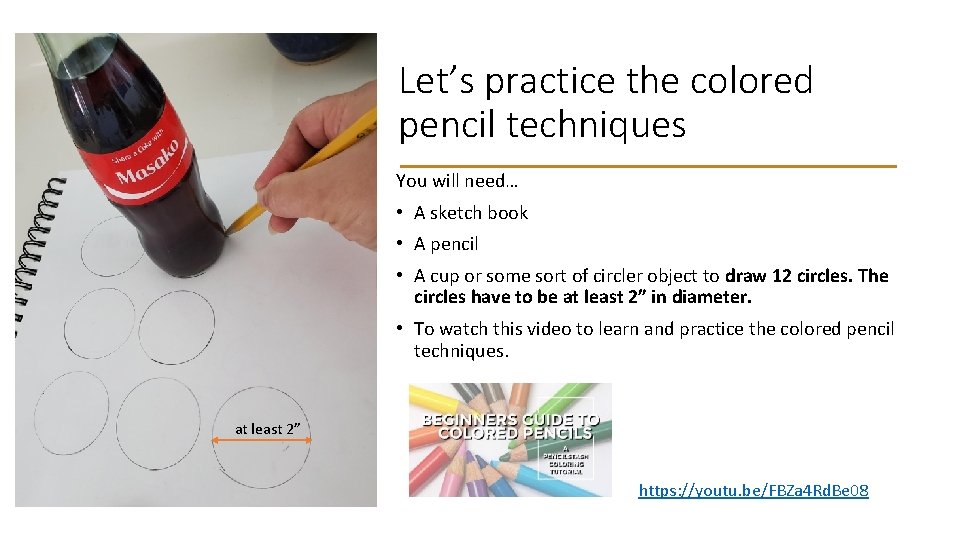
Let’s practice the colored pencil techniques You will need… • A sketch book • A pencil • A cup or some sort of circler object to draw 12 circles. The circles have to be at least 2” in diameter. • To watch this video to learn and practice the colored pencil techniques. at least 2” https: //youtu. be/FBZa 4 Rd. Be 08
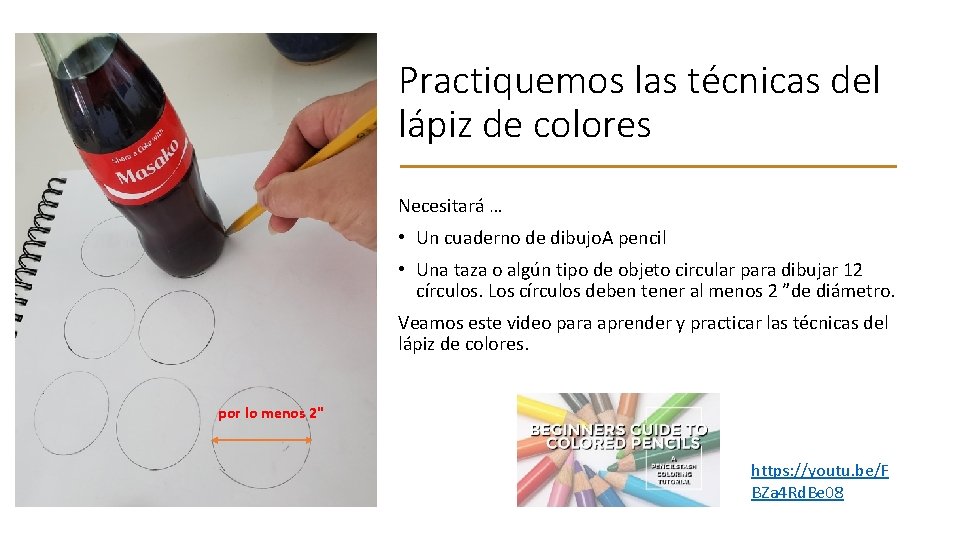
Practiquemos las técnicas del lápiz de colores Necesitará … • Un cuaderno de dibujo. A pencil • Una taza o algún tipo de objeto circular para dibujar 12 círculos. Los círculos deben tener al menos 2 ”de diámetro. Veamos este video para aprender y practicar las técnicas del lápiz de colores. por lo menos 2" https: //youtu. be/F BZa 4 Rd. Be 08
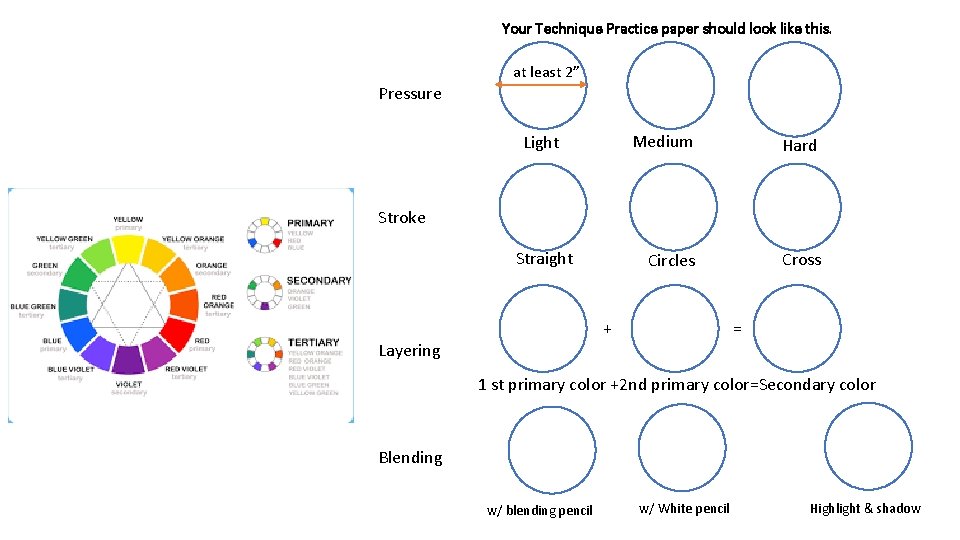
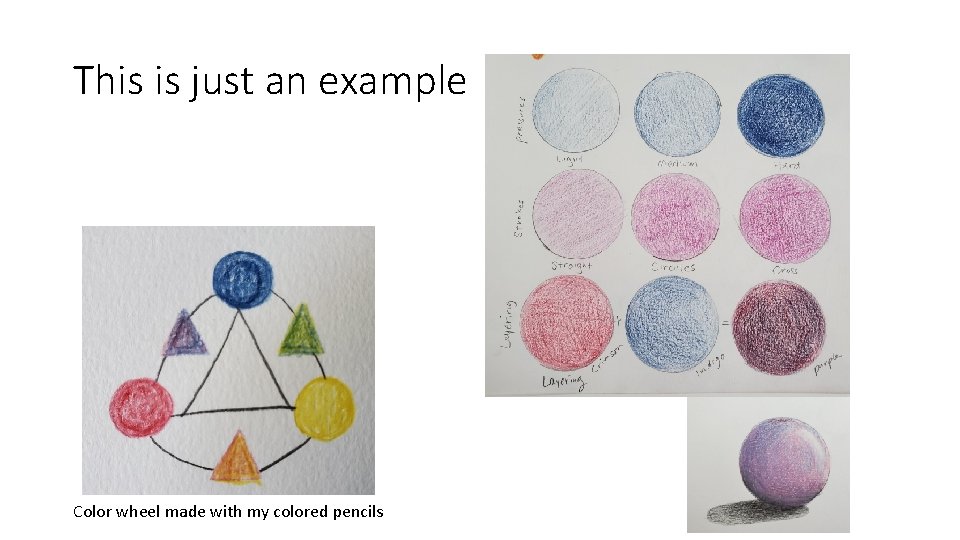
Your Technique Practice paper should look like this. at least 2” Pressure Light Medium Hard Circles Cross Stroke Straight + Layering = 1 st primary color +2 nd primary color=Secondary color Blending w/ blending pencil w/ White pencil Highlight & shadow
This is just an example Color wheel made with my colored pencils
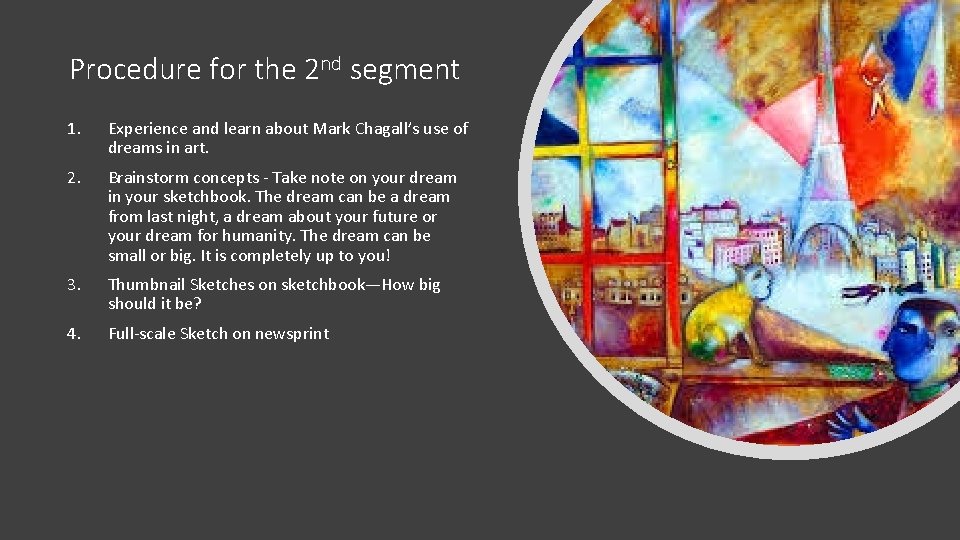
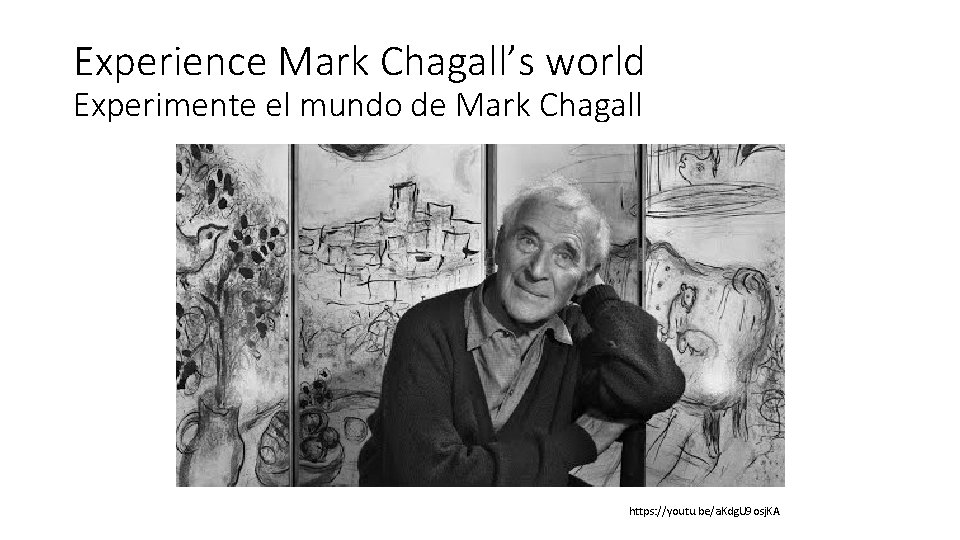
Procedure for the 2 nd segment 1. Experience and learn about Mark Chagall’s use of dreams in art. 2. Brainstorm concepts - Take note on your dream in your sketchbook. The dream can be a dream from last night, a dream about your future or your dream for humanity. The dream can be small or big. It is completely up to you! 3. Thumbnail Sketches on sketchbook—How big should it be? 4. Full-scale Sketch on newsprint
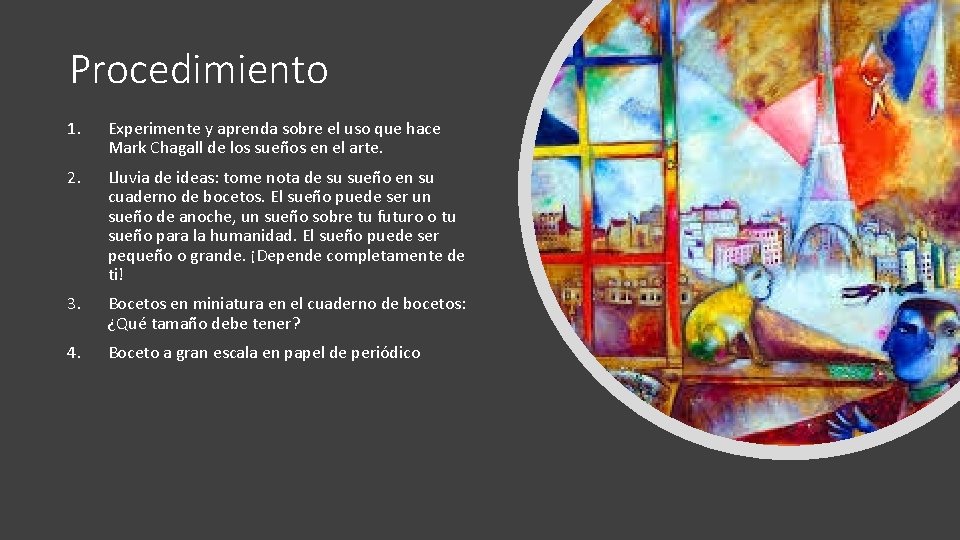
Procedimiento 1. Experimente y aprenda sobre el uso que hace Mark Chagall de los sueños en el arte. 2. Lluvia de ideas: tome nota de su sueño en su cuaderno de bocetos. El sueño puede ser un sueño de anoche, un sueño sobre tu futuro o tu sueño para la humanidad. El sueño puede ser pequeño o grande. ¡Depende completamente de ti! 3. Bocetos en miniatura en el cuaderno de bocetos: ¿Qué tamaño debe tener? 4. Boceto a gran escala en papel de periódico
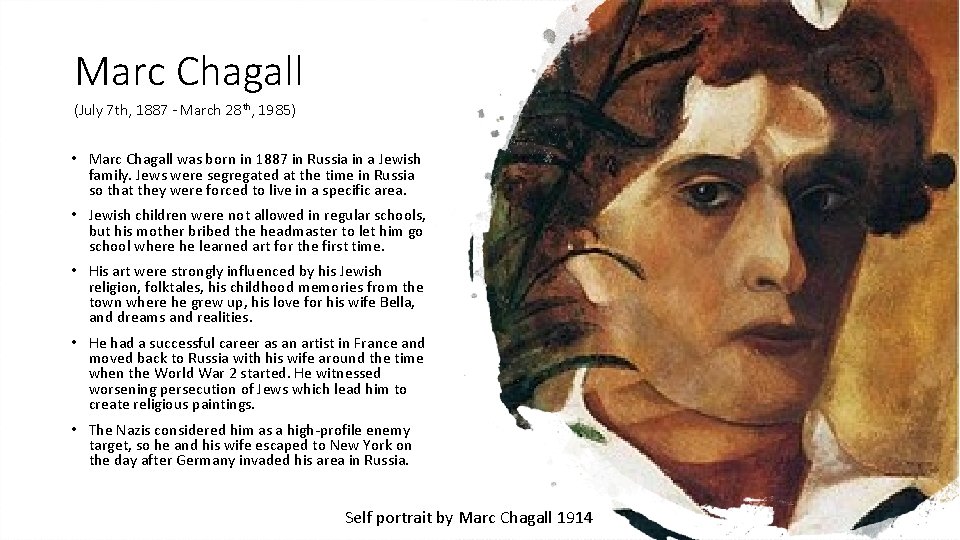
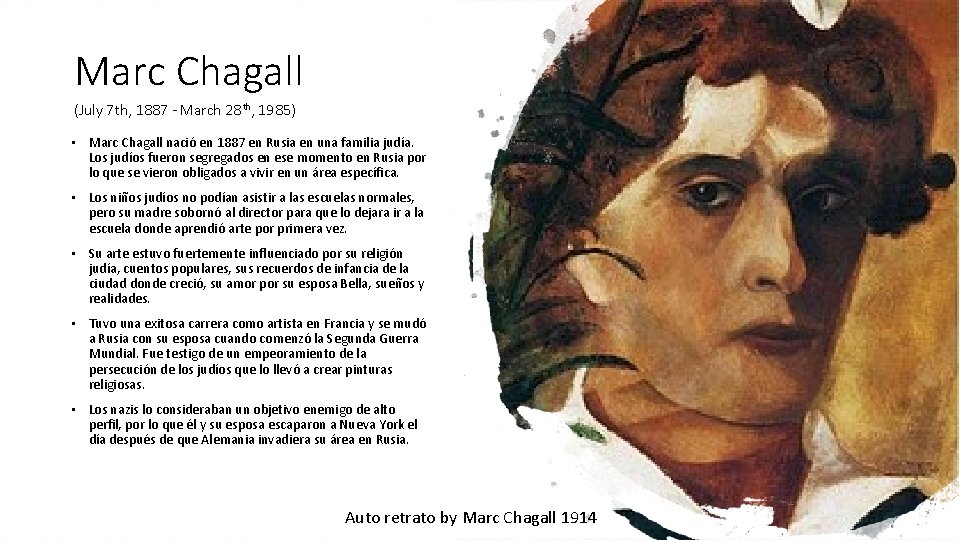
Marc Chagall (July 7 th, 1887 - March 28 th, 1985) • Marc Chagall was born in 1887 in Russia in a Jewish family. Jews were segregated at the time in Russia so that they were forced to live in a specific area. • Jewish children were not allowed in regular schools, but his mother bribed the headmaster to let him go school where he learned art for the first time. • His art were strongly influenced by his Jewish religion, folktales, his childhood memories from the town where he grew up, his love for his wife Bella, and dreams and realities. • He had a successful career as an artist in France and moved back to Russia with his wife around the time when the World War 2 started. He witnessed worsening persecution of Jews which lead him to create religious paintings. • The Nazis considered him as a high-profile enemy target, so he and his wife escaped to New York on the day after Germany invaded his area in Russia. Self portrait by Marc Chagall 1914
Marc Chagall (July 7 th, 1887 - March 28 th, 1985) • Marc Chagall nació en 1887 en Rusia en una familia judía. Los judíos fueron segregados en ese momento en Rusia por lo que se vieron obligados a vivir en un área específica. • Los niños judíos no podían asistir a las escuelas normales, pero su madre sobornó al director para que lo dejara ir a la escuela donde aprendió arte por primera vez. • Su arte estuvo fuertemente influenciado por su religión judía, cuentos populares, sus recuerdos de infancia de la ciudad donde creció, su amor por su esposa Bella, sueños y realidades. • Tuvo una exitosa carrera como artista en Francia y se mudó a Rusia con su esposa cuando comenzó la Segunda Guerra Mundial. Fue testigo de un empeoramiento de la persecución de los judíos que lo llevó a crear pinturas religiosas. • Los nazis lo consideraban un objetivo enemigo de alto perfil, por lo que él y su esposa escaparon a Nueva York el día después de que Alemania invadiera su área en Rusia. Auto retrato by Marc Chagall 1914
Experience Mark Chagall’s world Experimente el mundo de Mark Chagall https: //youtu. be/a. Kdg. U 9 osj. KA
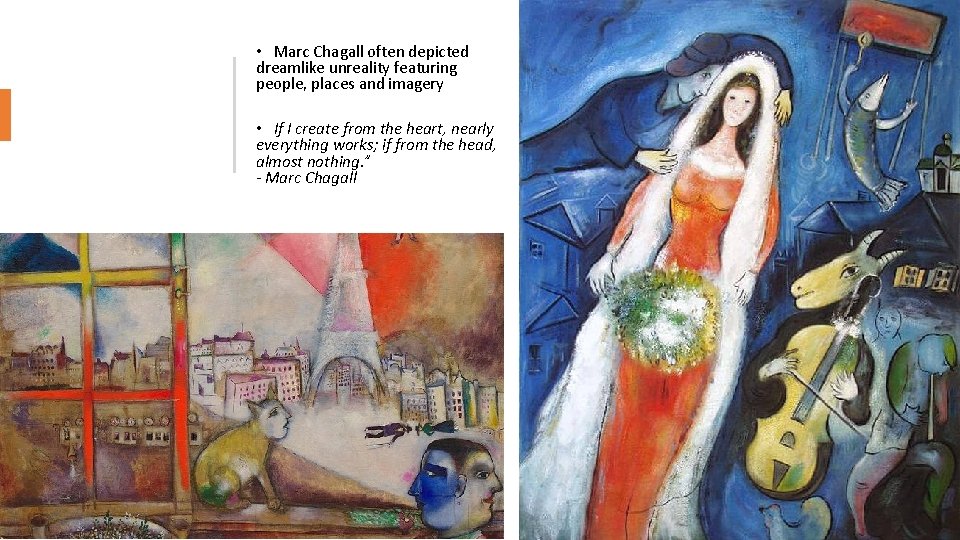
• Marc Chagall often depicted dreamlike unreality featuring people, places and imagery • If I create from the heart, nearly everything works; if from the head, almost nothing. ” - Marc Chagall
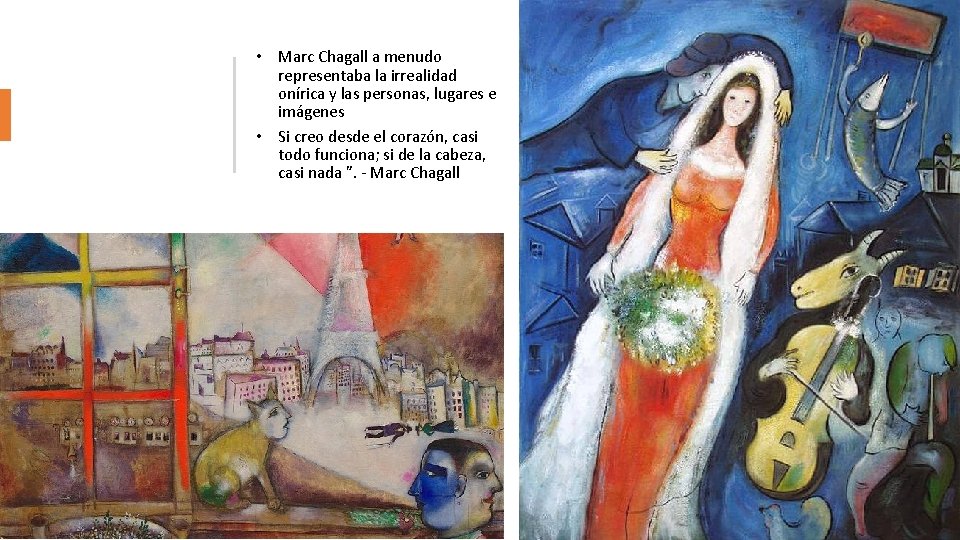
• Marc Chagall a menudo representaba la irrealidad onírica y las personas, lugares e imágenes • Si creo desde el corazón, casi todo funciona; si de la cabeza, casi nada ”. - Marc Chagall
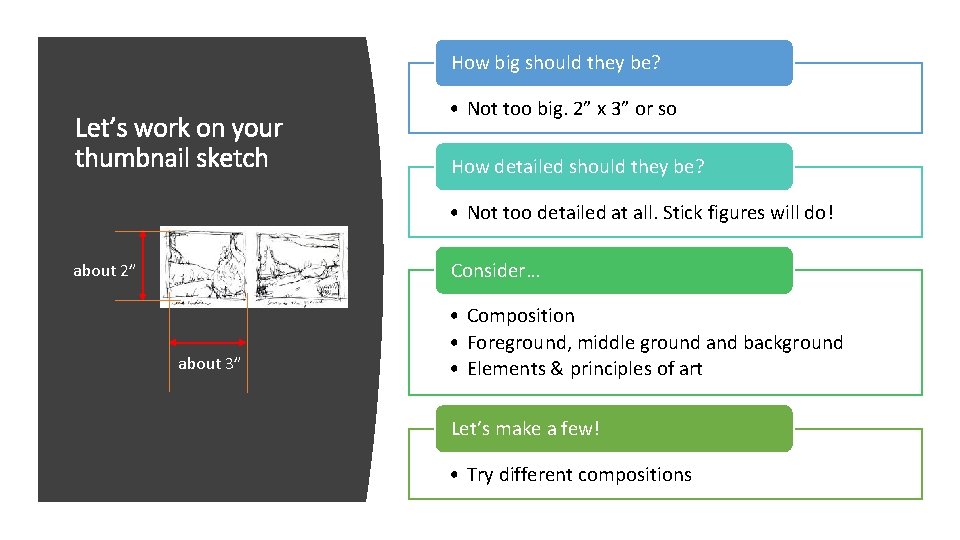
How big should they be? Let’s work on your thumbnail sketch • Not too big. 2” x 3” or so How detailed should they be? • Not too detailed at all. Stick figures will do! Consider… about 2” about 3” • Composition • Foreground, middle ground and background • Elements & principles of art Let’s make a few! • Try different compositions
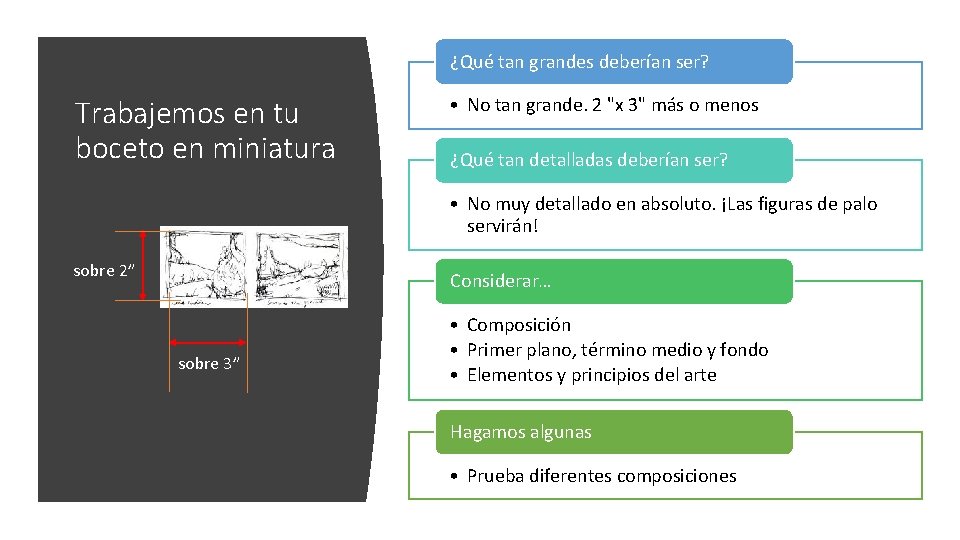
¿Qué tan grandes deberían ser? Trabajemos en tu boceto en miniatura • No tan grande. 2 "x 3" más o menos ¿Qué tan detalladas deberían ser? • No muy detallado en absoluto. ¡Las figuras de palo servirán! sobre 2” Considerar… sobre 3” • Composición • Primer plano, término medio y fondo • Elementos y principios del arte Hagamos algunas • Prueba diferentes composiciones
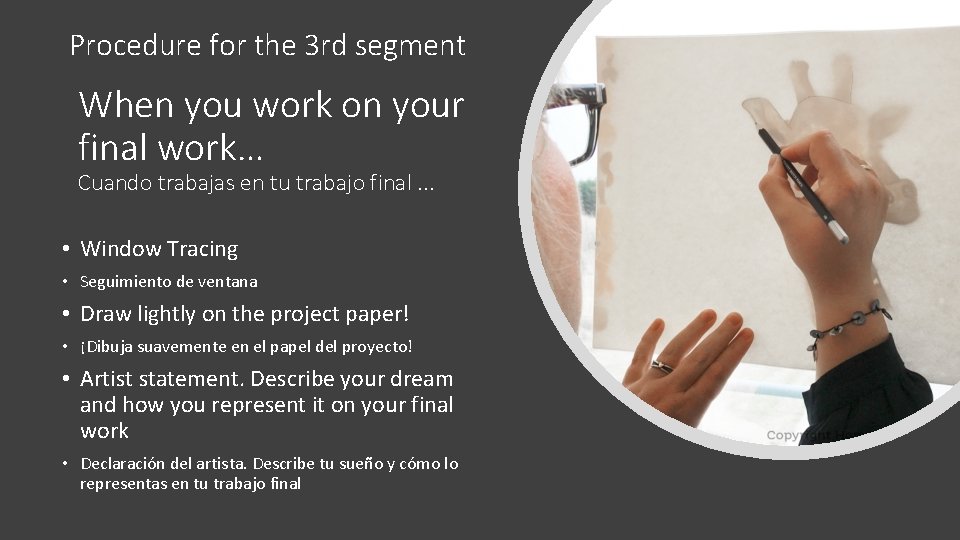
Procedure for the 3 rd segment When you work on your final work… Cuando trabajas en tu trabajo final. . . • Window Tracing • Seguimiento de ventana • Draw lightly on the project paper! • ¡Dibuja suavemente en el papel del proyecto! • Artist statement. Describe your dream and how you represent it on your final work • Declaración del artista. Describe tu sueño y cómo lo representas en tu trabajo final