
DRDP 2015 Whats It All About 152022 2015
DRDP (2015) What’s It All About? 1/5/2022 © 2015 California Department of Education - All rights reserved 1
2 Agenda • Overview of the DRDP • DRDP (2015): What’s the same/What’s new? • Professional Development and Resources Available 1/5/2022 © 2015 California Department of Education - All rights reserved
3 Outcomes • Learn about the DRDP (2015) including identify similarities and differences between the DRDP (2010) and DRDP (2015). • Learn about DRDPtech and how the results can be used for planning purposes. • Identify online resources to support implementing DRDP (2015). 1/5/2022 © 2015 California Department of Education - All rights reserved
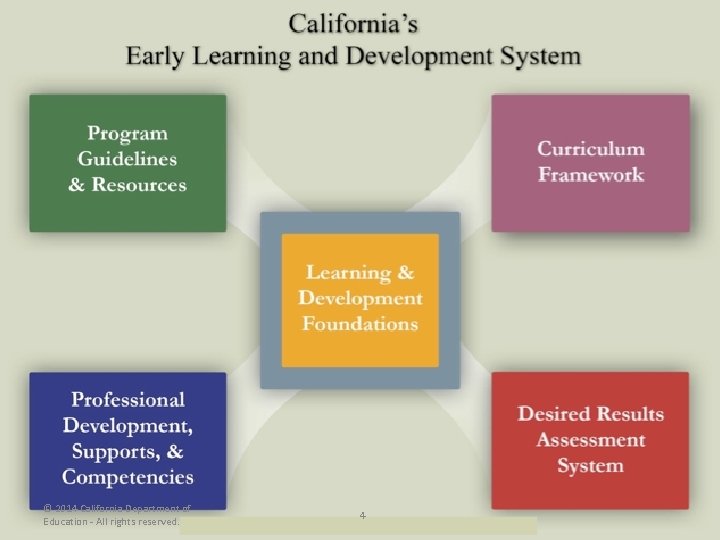
• © 2014 California Department of Education - All rights reserved. 2010 © California Department of Education 4 Desired Results T & TA Project 4
5 Overview of DRDP (2015) 1/5/2022 © 2015 California Department of Education - All rights reserved

6 What is the DRDP? • • Individual child assessment Observation-based assessment tool Based in developmental research and theory Includes developmental sequences of behavior • Based on ongoing activities and routines in the early care and education setting with familiar adults 1/5/2022 © 2015 California Department of Education - All rights reserved
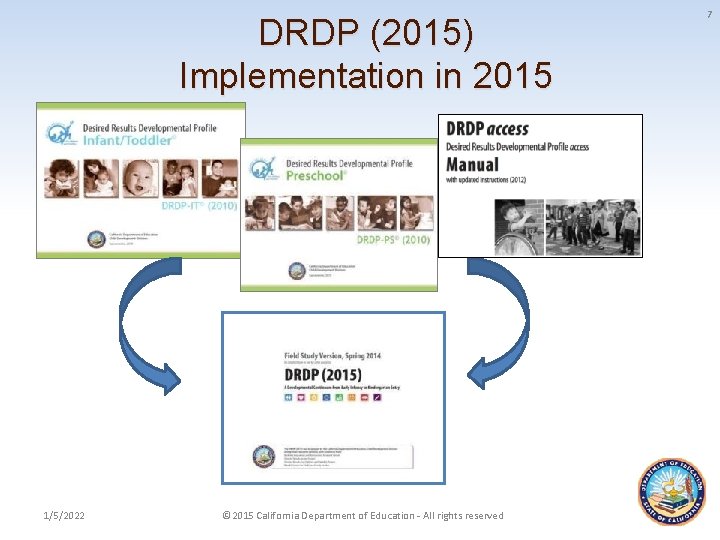
DRDP (2015) Implementation in 2015 1/5/2022 © 2015 California Department of Education - All rights reserved 7
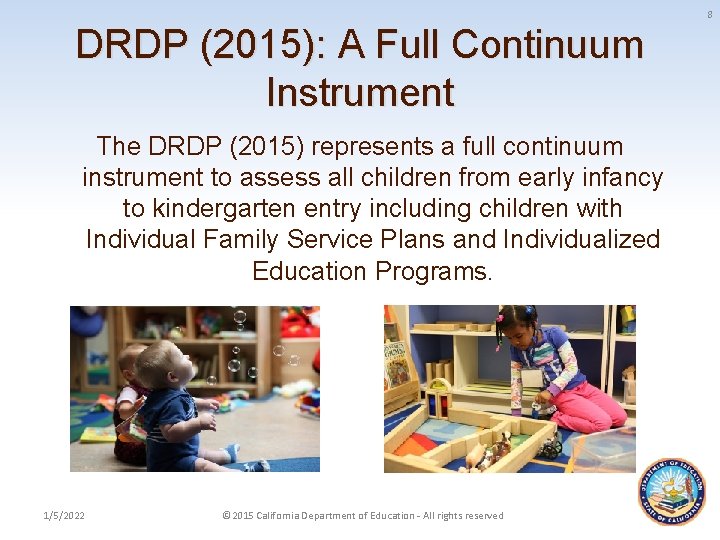
8 DRDP (2015): A Full Continuum Instrument The DRDP (2015) represents a full continuum instrument to assess all children from early infancy to kindergarten entry including children with Individual Family Service Plans and Individualized Education Programs. 1/5/2022 © 2015 California Department of Education - All rights reserved
9 The DRDP (2015) Instrument • Create a single DRDP instrument for all children infancy to kindergarten entry — typically developing and special needs • Add domains for all of the Early Learning Foundations (I/T & Preschool Vol. 1 – 3 ) • Comply with federal reporting requirements for the Special Education Division • Align to Head Start Early Learning Framework 1/5/2022 © 2015 California Department of Education - All rights reserved
10 Accommodating the Range of Abilities Accommodate the development of almost all children in the age range: Each measure was created to prevent ceiling or floor effects. – Preventing a floor effect: The earliest level of development on the continuum begins a little earlier than what would be expected for most children assessed by the instrument. – Preventing a ceiling effect: In the developmental continuum, the latest level is beyond the development of what would be expect of most children assessed by the instrument. © 2015 California Department of Education - All rights reserved
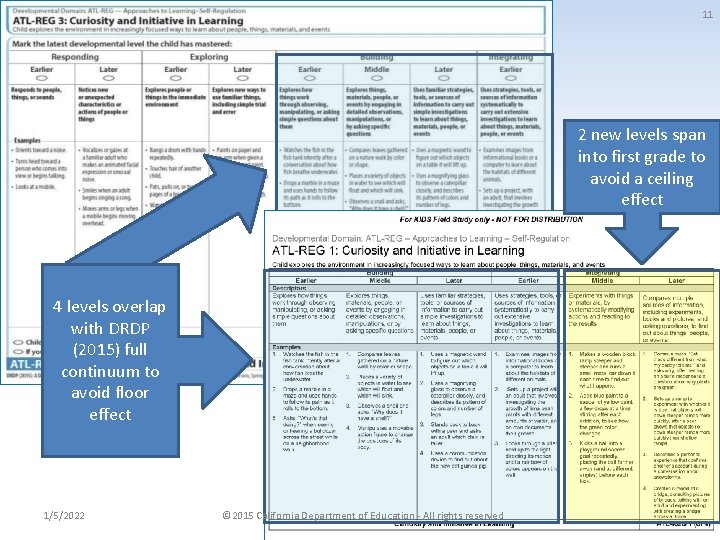
11 2 new levels span into first grade to avoid a ceiling effect 4 levels overlap with DRDP (2015) full continuum to avoid floor effect 1/5/2022 © 2015 California Department of Education - All rights reserved
12 1/5/2022 © 2015 California Department of Education - All rights reserved
13 DRDP (2015) 1/5/2022 © 2015 California Department of Education - All rights reserved

14 DRDP 2015 Table of Contents 1/5/2022 © 2015 California Department of Education - All rights reserved
15 Ask Siri…… • What is the important note on page xiii? • Do I need to see a child do all of the examples before rating a developmental level as mastered? • What dos the ; and mean? 1/5/2022 © 2015 California Department of Education - All rights reserved
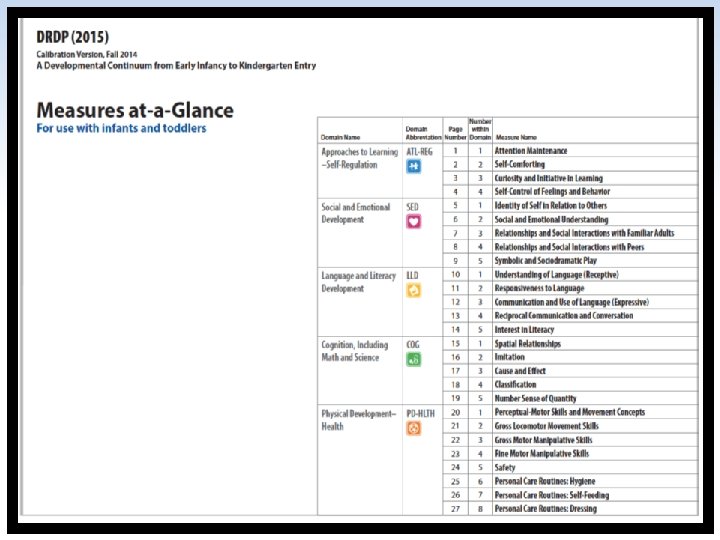
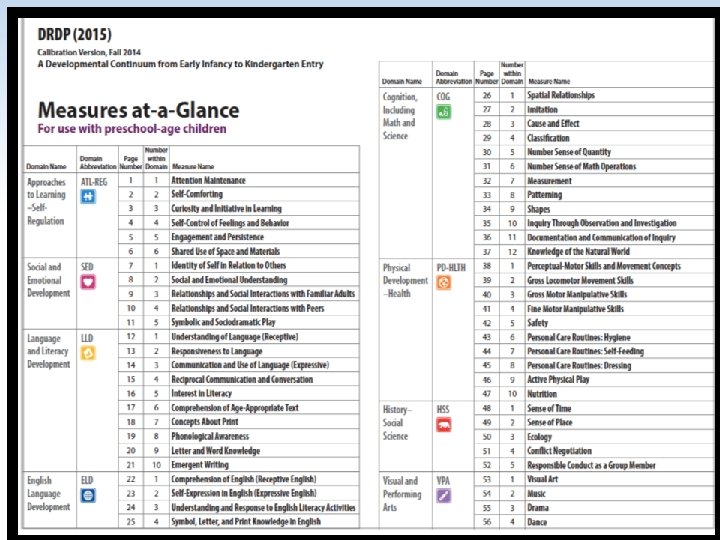
16 What’s new in the DRDP (2015) ? • • Domains Developmental levels Measure names Number of measures completed for each age group 1/5/2022 © 2015 California Department of Education - All rights reserved
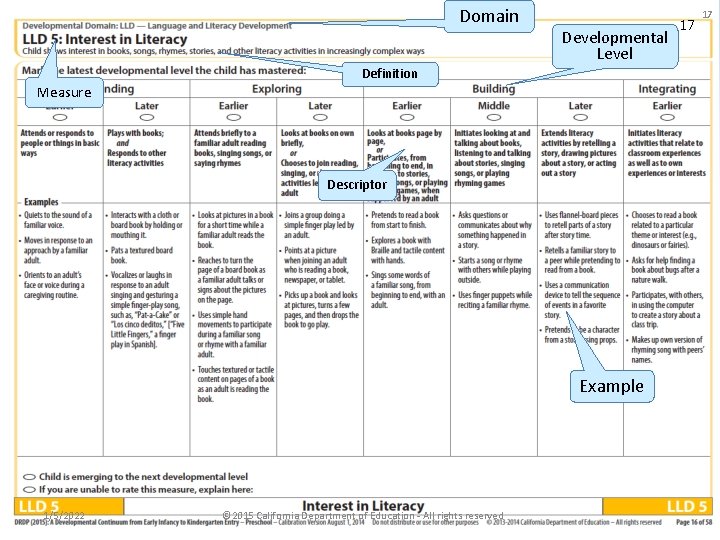
Domain Developmental Level DRDP (2015) Navigation Map Definition Measure Descriptor Example 1/5/2022 © 2015 California Department of Education - All rights reserved 17 17
18 DRDP (2015) Domains • • Approaches to Learning—Self-Regulation* Social and Emotional Development* Language and Literacy Development* English Language Development Cognition, Including Math and Science* Physical Development—Health* History—Social Science Visual and Performing Arts 1/5/2022 © 2015 California Department of Education - All rights reserved
19 Developmental Levels The full-range of developmental levels on the DRDP (2015) includes the following: Responding (Earlier, Later): Generally, knowledge, skills, or behaviors observed during early infancy Exploring (Earlier, Middle, Later): Generally, knowledge, skills, or behaviors observed in later infancy, toddlerhood, and early preschool Exploring Later/Building Earlier: Generally, knowledge, skills, or behaviors observed in later toddlerhood and early preschool Building (Earlier, Middle, Later): Generally, knowledge, skills, or behaviors observed in preschool Integrating Earlier: Generally, knowledge, skills, or behaviors observed in late preschool and early kindergarten 1/5/2022 © 2015 California Department of Education - All rights reserved
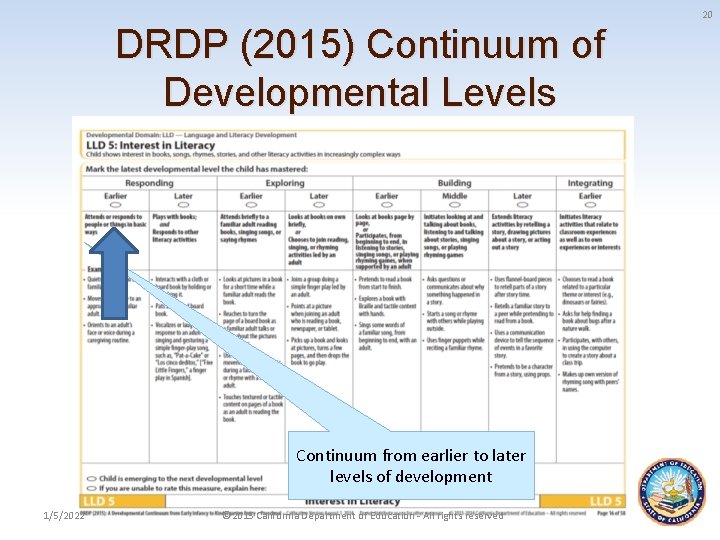
20 DRDP (2015) Continuum of Developmental Levels Continuum from earlier to later levels of development 1/5/2022 © 2015 California Department of Education - All rights reserved
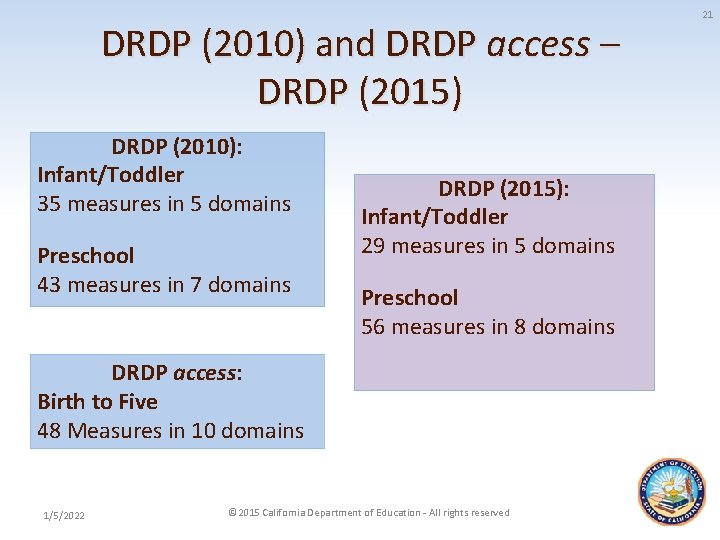
DRDP (2010) and DRDP access – DRDP (2015) DRDP (2010): Infant/Toddler 35 measures in 5 domains Preschool 43 measures in 7 domains DRDP (2015): Infant/Toddler 29 measures in 5 domains Preschool 56 measures in 8 domains DRDP access: Birth to Five 48 Measures in 10 domains 1/5/2022 © 2015 California Department of Education - All rights reserved 21
22 1/5/2022 © 2015 California Department of Education - All rights reserved
23 1/5/2022 © 2015 California Department of Education - All rights reserved
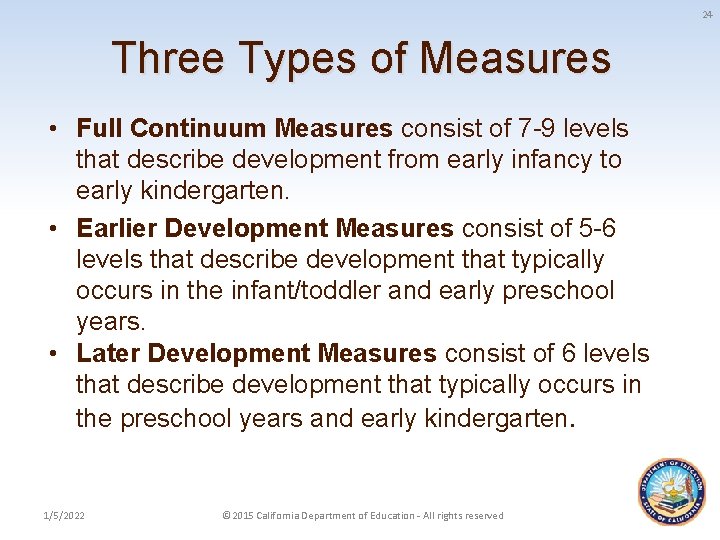
24 Three Types of Measures • Full Continuum Measures consist of 7 -9 levels that describe development from early infancy to early kindergarten. • Earlier Development Measures consist of 5 -6 levels that describe development that typically occurs in the infant/toddler and early preschool years. • Later Development Measures consist of 6 levels that describe development that typically occurs in the preschool years and early kindergarten. 1/5/2022 © 2015 California Department of Education - All rights reserved
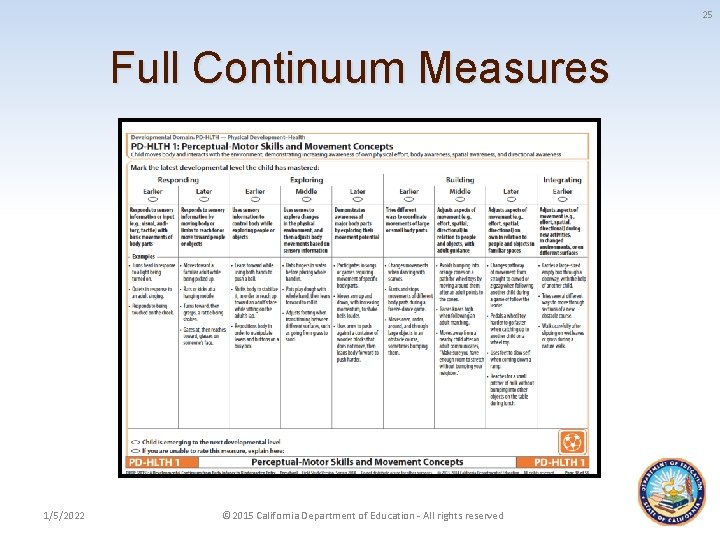
25 Full Continuum Measures 1/5/2022 © 2015 California Department of Education - All rights reserved
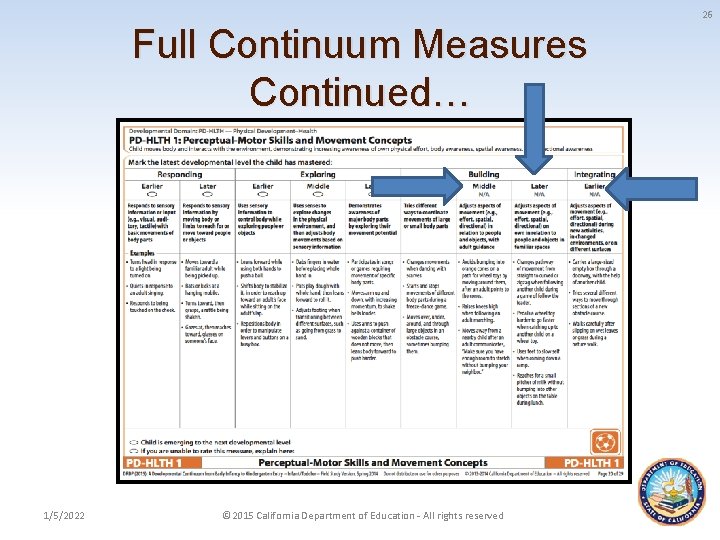
26 Full Continuum Measures Continued… 1/5/2022 © 2015 California Department of Education - All rights reserved
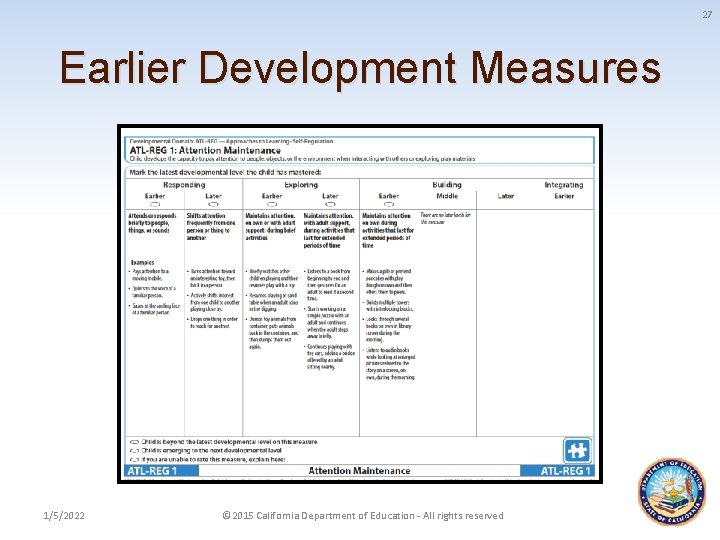
27 Earlier Development Measures 1/5/2022 © 2015 California Department of Education - All rights reserved
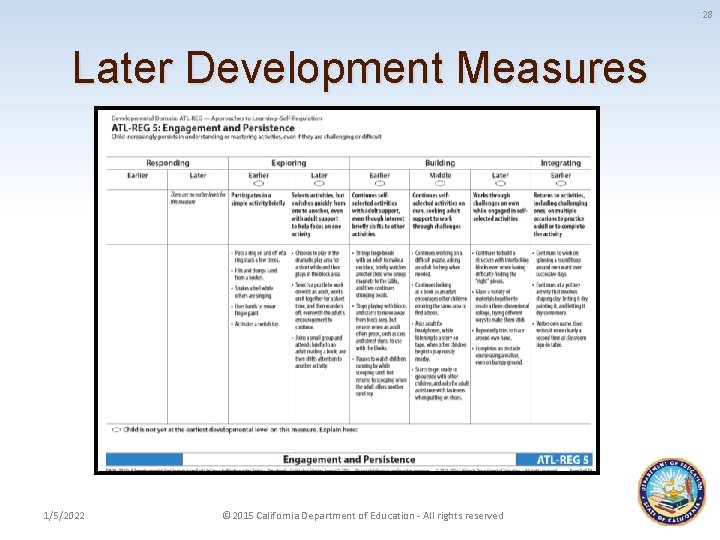
28 Later Development Measures 1/5/2022 © 2015 California Department of Education - All rights reserved
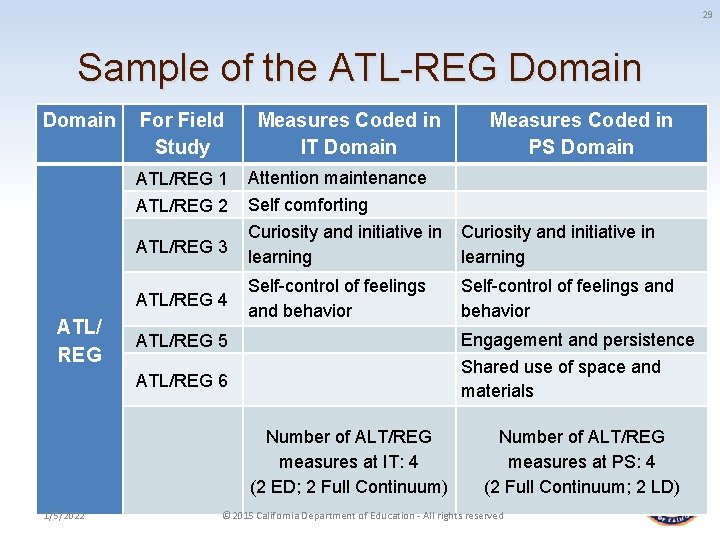
29 Sample of the ATL-REG Domain For Field Study Measures Coded in IT Domain ATL/REG 1 ATL/REG 2 Attention maintenance Self comforting Curiosity and initiative in learning Self-control of feelings and behavior ATL/REG 3 ATL/REG 4 ATL/ REG Engagement and persistence Shared use of space and materials ATL/REG 5 ATL/REG 6 Number of ALT/REG measures at IT: 4 (2 ED; 2 Full Continuum) 1/5/2022 Measures Coded in PS Domain Number of ALT/REG measures at PS: 4 (2 Full Continuum; 2 LD) © 2015 California Department of Education - All rights reserved
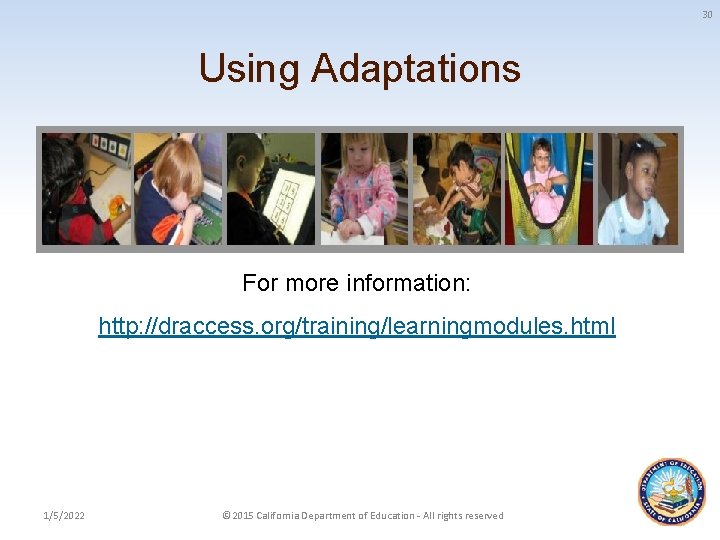
30 Using Adaptations For more information: http: //draccess. org/training/learningmodules. html 1/5/2022 © 2015 California Department of Education - All rights reserved
31 Adaptations • Are changes in the environment or differences in observed behavior that enable children with IFSPs and IEPS to be most accurately assessed in their typical settings • Used throughout the day to allow children more control in their environment • May be appropriate for other children in the classroom 1/5/2022 © 2015 California Department of Education - All rights reserved
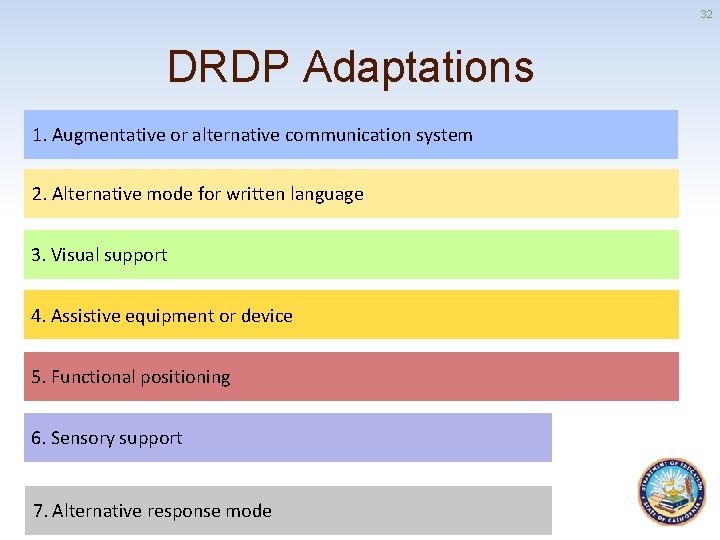
32 DRDP Adaptations 1. Augmentative or alternative communication system 2. Alternative mode for written language 3. Visual support 4. Assistive equipment or device 5. Functional positioning 6. Sensory support 7. 1/5/2022 Alternative response © 2015 mode California Department of Education - All rights reserved
33 The System of Adaptations • A set of adaptations was developed to use with the DRDP access, based on research and recommend practice. • The same set of adaptations will be integrated into the DRDP (2015). 1/5/2022 © 2015 California Department of Education - All rights reserved
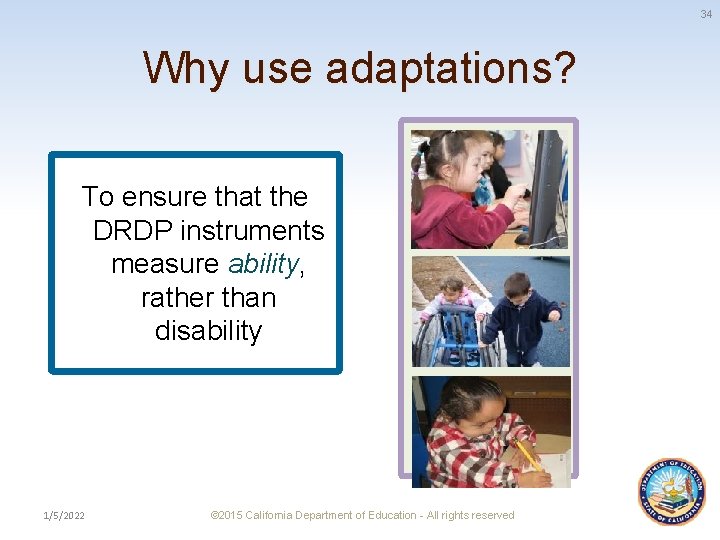
34 Why use adaptations? To ensure that the DRDP instruments measure ability, rather than disability 1/5/2022 © 2015 California Department of Education - All rights reserved
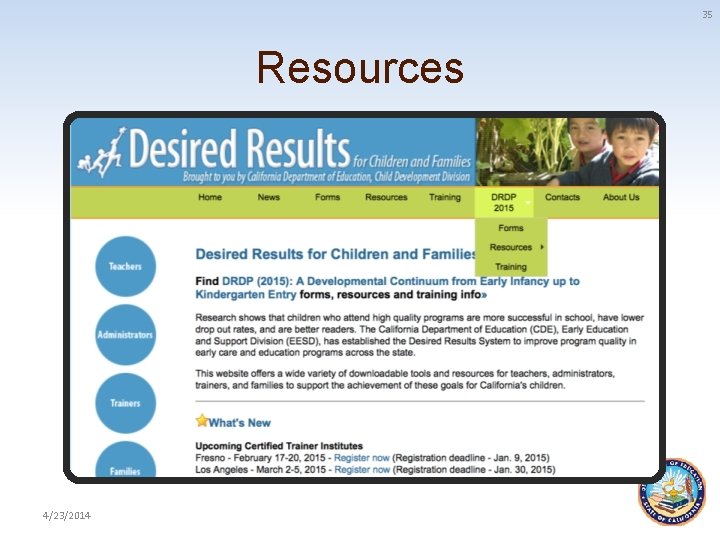
35 Resources 4/23/2014
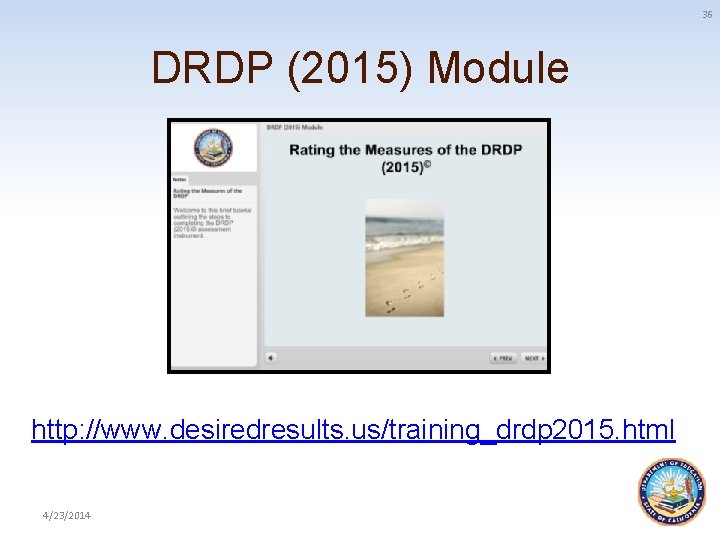
36 DRDP (2015) Module http: //www. desiredresults. us/training_drdp 2015. html 4/23/2014
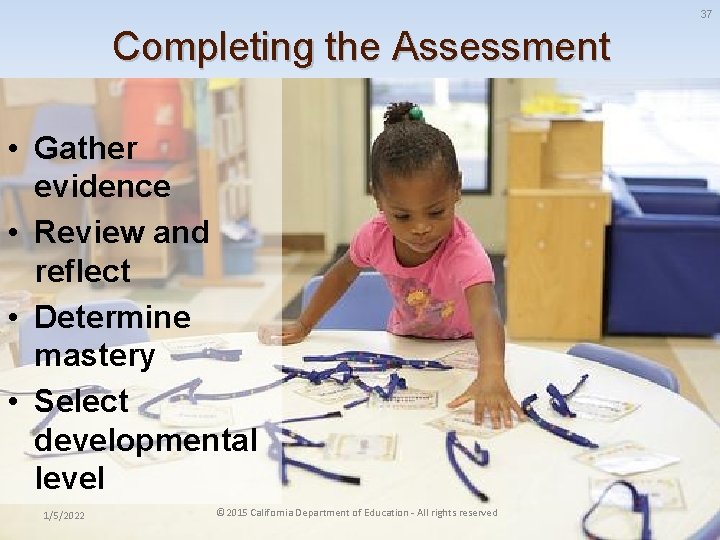
37 Completing the Assessment • Gather evidence • Review and reflect • Determine mastery • Select developmental level 1/5/2022 © 2015 California Department of Education - All rights reserved
38 Working with Special Education • With the DRDP (2015), assessments can be completed collaboratively. • Observations may be shared. • Conversations about ratings and results can lead to joint planning and ongoing communication. • Special educators will continue to submit data to the Special Education Division. 1/5/2022 © 2015 California Department of Education - All rights reserved
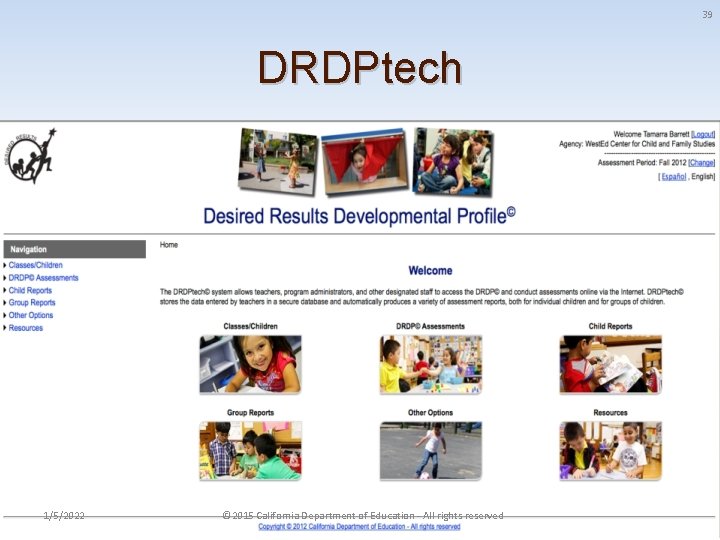
39 DRDPtech 1/5/2022 © 2015 California Department of Education - All rights reserved
40 DRDPtech Resources DRDPtech Webinars are provided twice a month for free. http: //www. desiredresults. us/trainings_opp_teacher. html 1/5/2022 © 2015 California Department of Education - All rights reserved
41 Putting It All Together 1/5/2022 © 2015 California Department of Education - All rights reserved
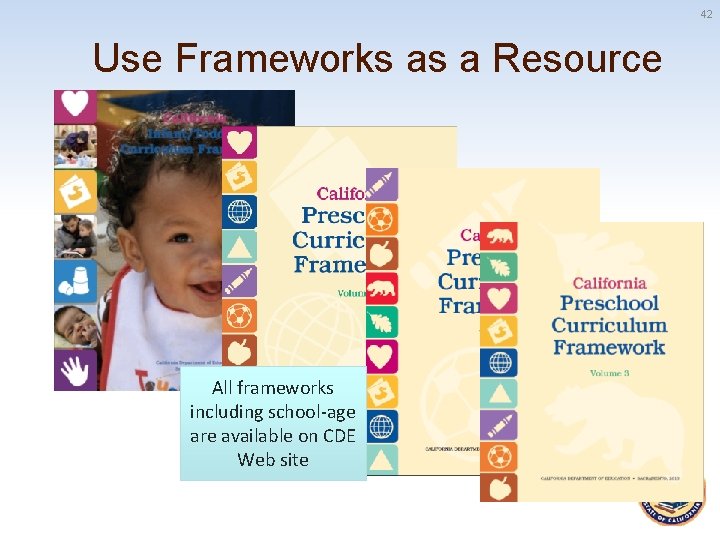
42 Use Frameworks as a Resource All frameworks including school-age are available on CDE Web site
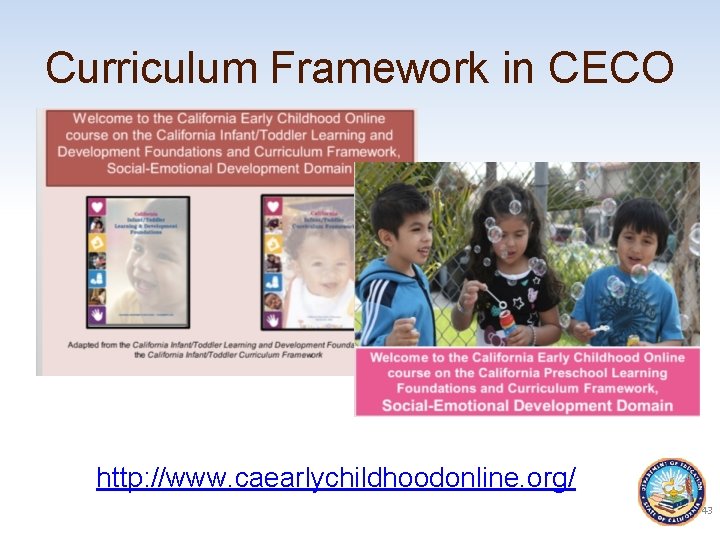
Curriculum Framework in CECO http: //www. caearlychildhoodonline. org/ 43
44 Language and Literacy “Children learn more when adults model language and literacy as well as provide playful, purposeful instruction. Play spaces with literacy props (e. g. , signs, lists) allow children to congregate and to make choices that foster rich language and literacy experiences. ” California Preschool Curriculum Framework, p. 103 1/5/2022 © 2015 California Department of Education - All rights reserved
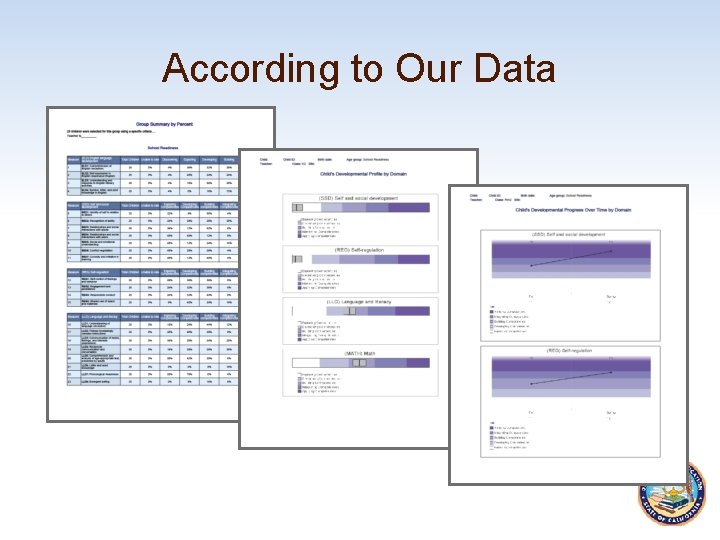
According to Our Data
46 Putting It All Together Let’s take a look at: • California Preschool Framework, Volume 1 for some ideas on strategies to implement 1/5/2022 • The ECERS item 15, for quality items and appropriate practice that support language and literacy © 2015 California Department of Education - All rights reserved
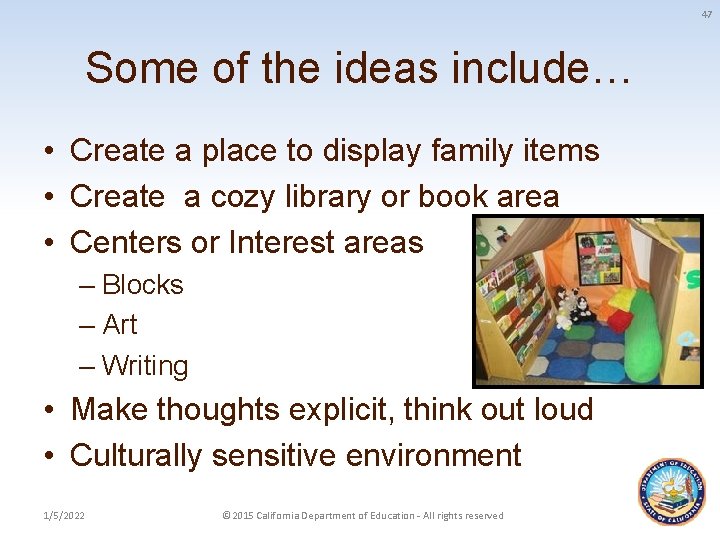
47 Some of the ideas include… • Create a place to display family items • Create a cozy library or book area • Centers or Interest areas – Blocks – Art – Writing • Make thoughts explicit, think out loud • Culturally sensitive environment 1/5/2022 © 2015 California Department of Education - All rights reserved
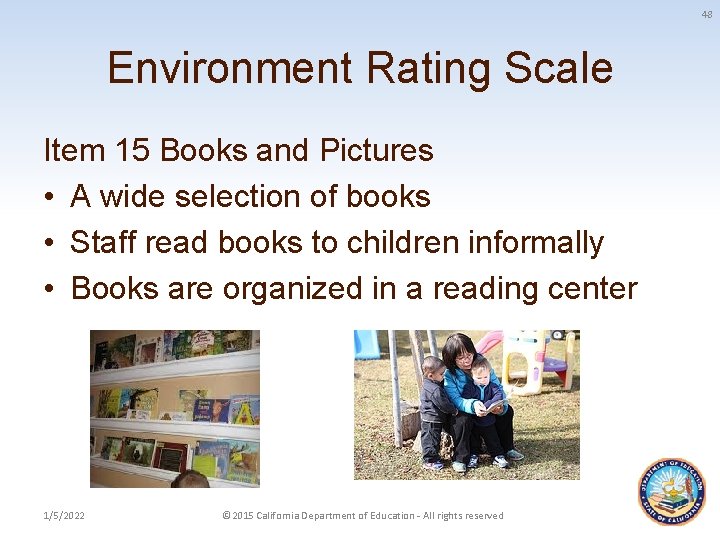
48 Environment Rating Scale Item 15 Books and Pictures • A wide selection of books • Staff read books to children informally • Books are organized in a reading center 1/5/2022 © 2015 California Department of Education - All rights reserved
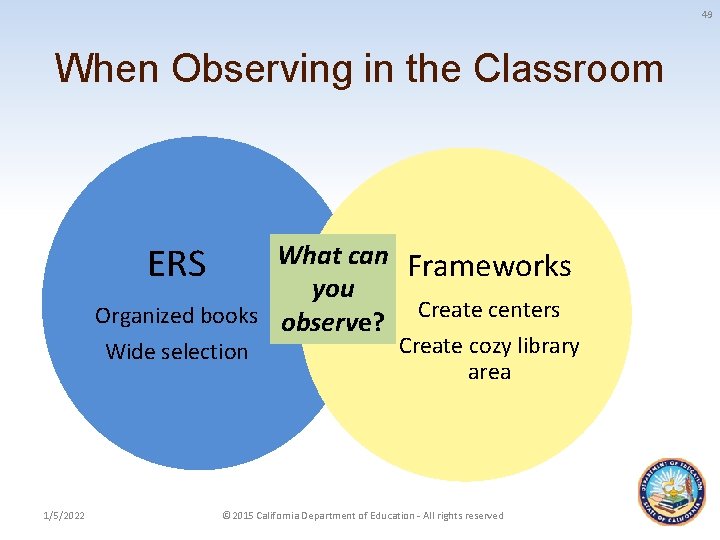
49 When Observing in the Classroom What can Frameworks ERS you Organized books observe? Create centers Wide selection 1/5/2022 Create cozy library area © 2015 California Department of Education - All rights reserved
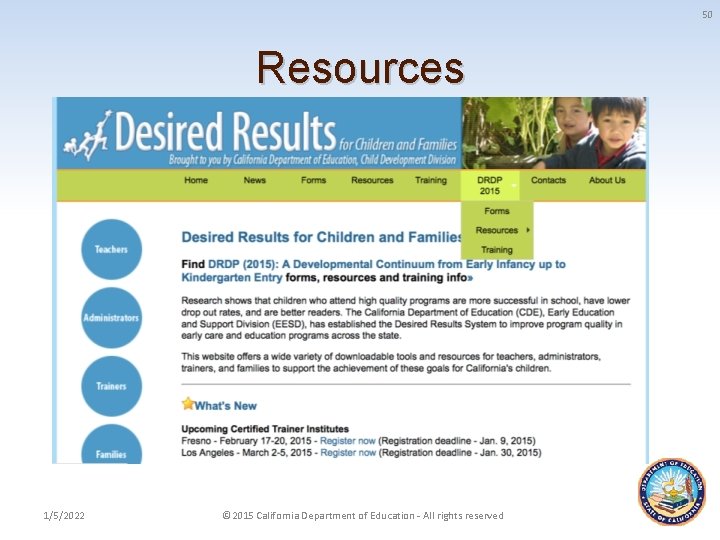
50 Resources 1/5/2022 © 2015 California Department of Education - All rights reserved
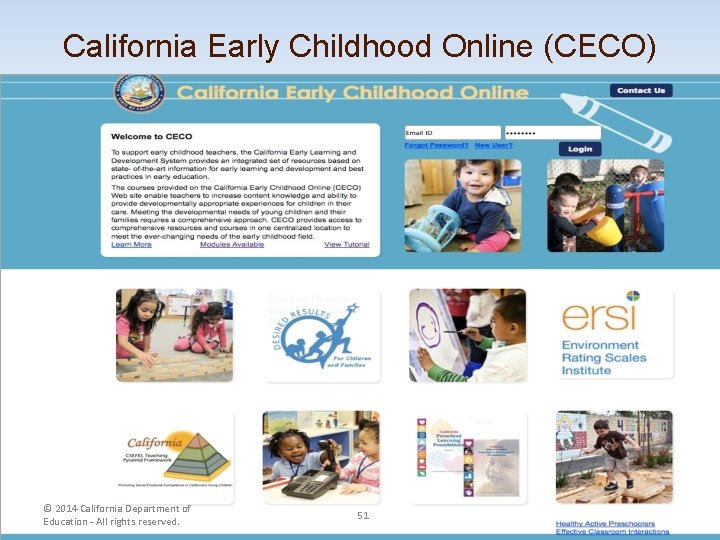
California Early Childhood Online (CECO) © 2014 California Department of Education - All rights reserved. 51
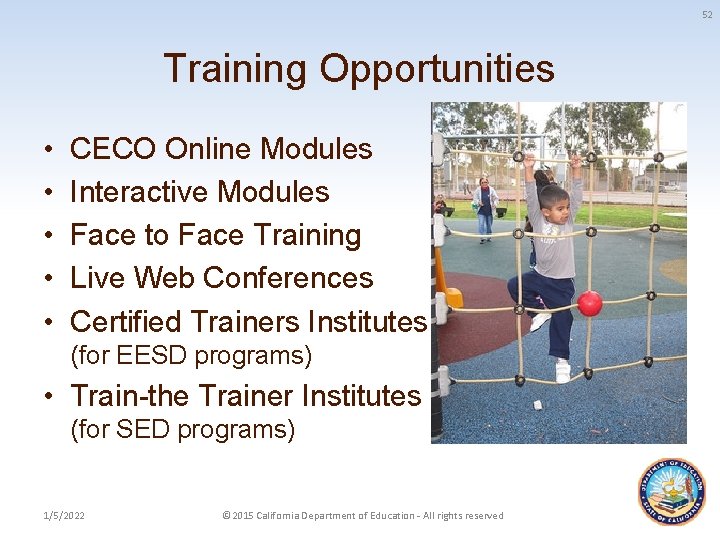
52 Training Opportunities • • • CECO Online Modules Interactive Modules Face to Face Training Live Web Conferences Certified Trainers Institutes (for EESD programs) • Train-the Trainer Institutes (for SED programs) 1/5/2022 © 2015 California Department of Education - All rights reserved
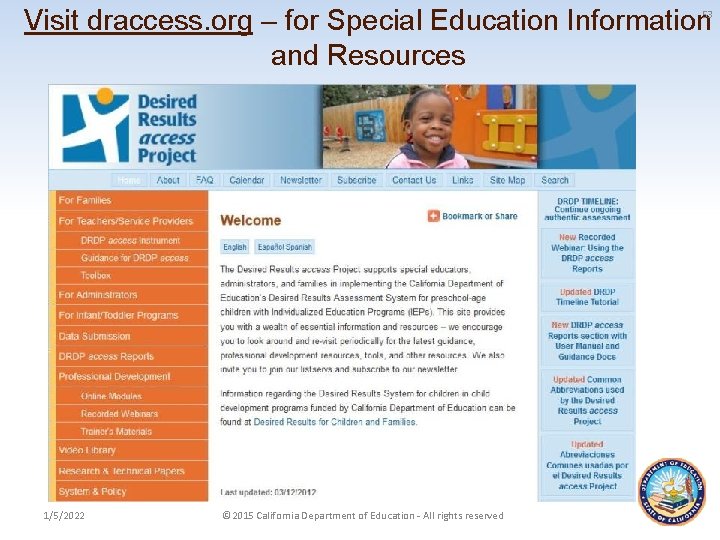
Visit draccess. org – for Special Education Information and Resources 53 1/5/2022 © 2015 California Department of Education - All rights reserved
54 Collaborative Team UC Berkeley – BEAR Center California Department of Education, Early Education and Support Division and Special Education Division 1/5/2022 © 2015 California Department of Education - All rights reserved
55 Questions? ? 1/5/2022 © 2015 California Department of Education - All rights reserved
56 Thank you!! 1/5/2022 © 2015 California Department of Education - All rights reserved
- Slides: 56