
Drawing upon Contemporary Risk Assessment and Management Principles



- Slides: 40
Drawing upon Contemporary Risk Assessment and Management Principles in the Revision of the HCR-20 Violence Risk Assessment Scheme Kevin S. Douglas Simon Fraser University
Why Revise the HCR-20? Things change 2500 studies published on violence since Version 2 was released in 1997 Conceptual developments in risk assessment We learned a lot about how the HCR-20 could be better
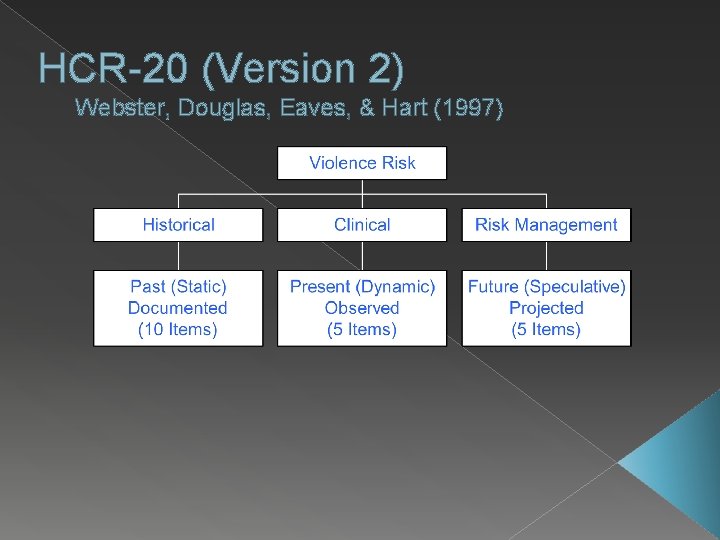
HCR-20 (Version 2) Webster, Douglas, Eaves, & Hart (1997)
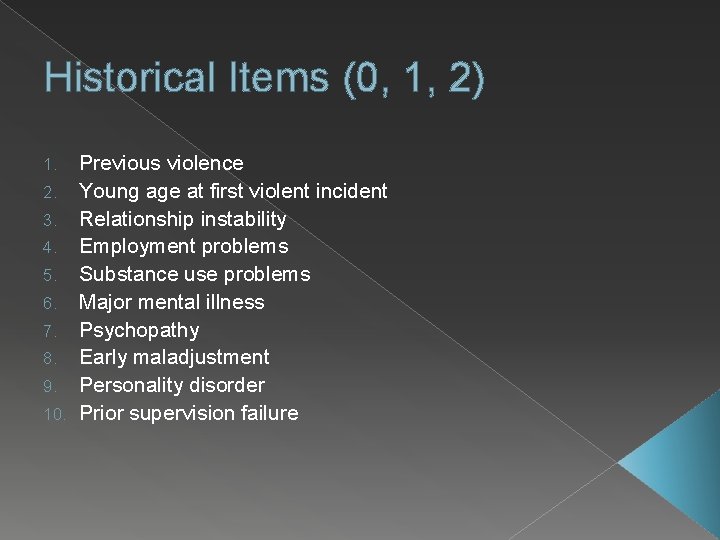
Historical Items (0, 1, 2) Previous violence 2. Young age at first violent incident 3. Relationship instability 4. Employment problems 5. Substance use problems 6. Major mental illness 7. Psychopathy 8. Early maladjustment 9. Personality disorder 10. Prior supervision failure 1.
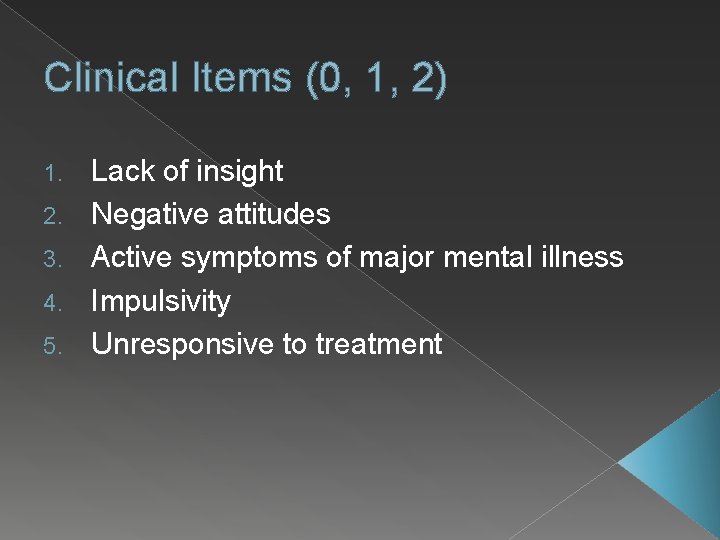
Clinical Items (0, 1, 2) 1. 2. 3. 4. 5. Lack of insight Negative attitudes Active symptoms of major mental illness Impulsivity Unresponsive to treatment
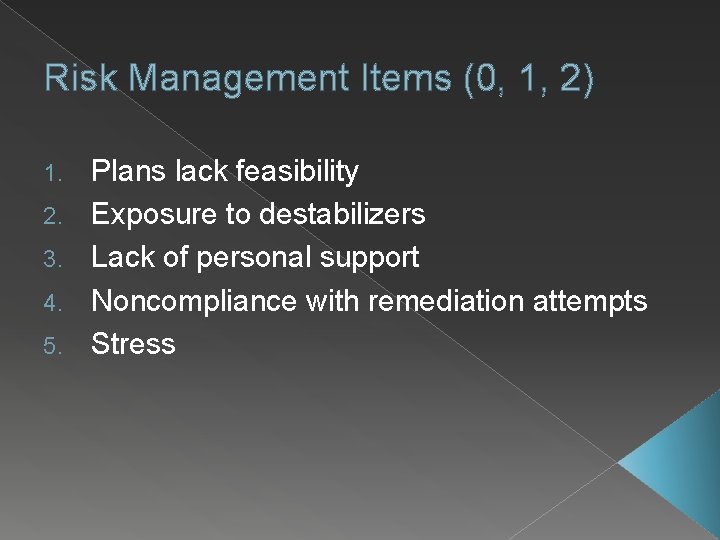
Risk Management Items (0, 1, 2) 1. 2. 3. 4. 5. Plans lack feasibility Exposure to destabilizers Lack of personal support Noncompliance with remediation attempts Stress
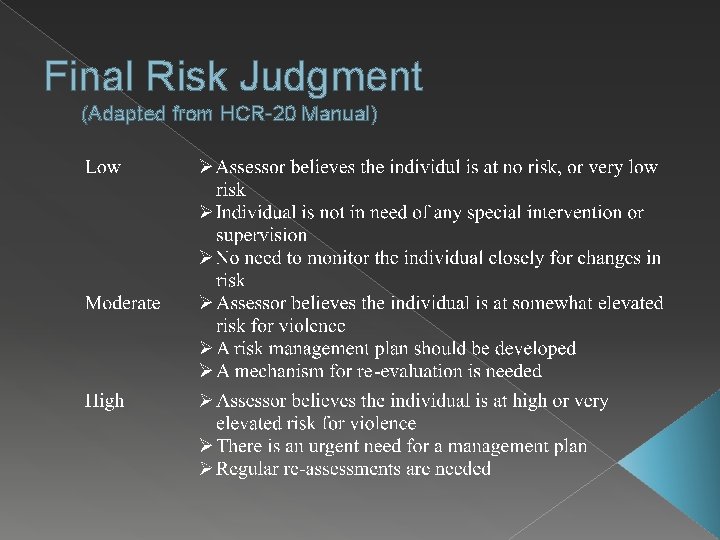
Final Risk Judgment (Adapted from HCR-20 Manual)
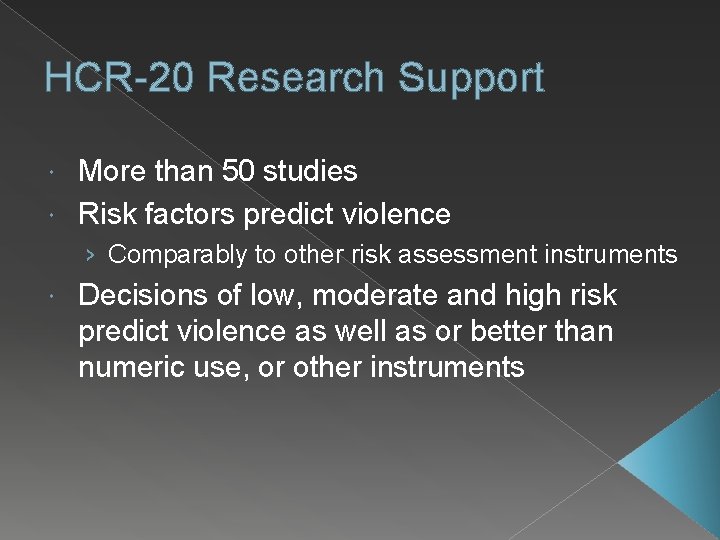
HCR-20 Research Support More than 50 studies Risk factors predict violence › Comparably to other risk assessment instruments Decisions of low, moderate and high risk predict violence as well as or better than numeric use, or other instruments
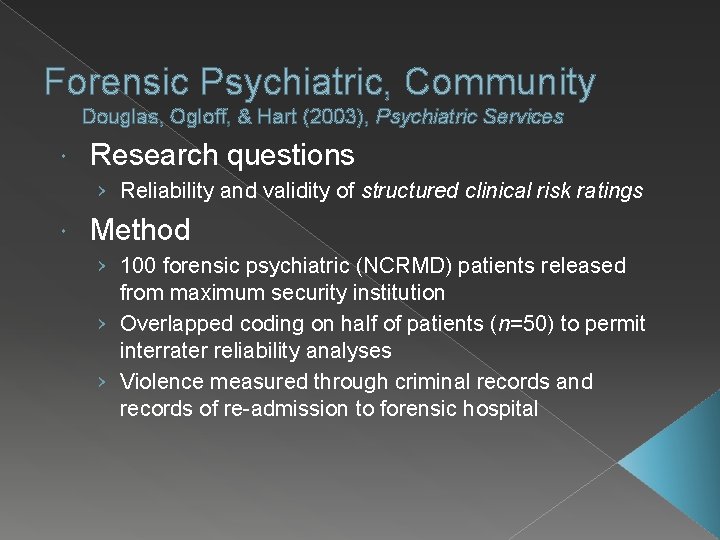
Forensic Psychiatric, Community Douglas, Ogloff, & Hart (2003), Psychiatric Services Research questions › Reliability and validity of structured clinical risk ratings Method › 100 forensic psychiatric (NCRMD) patients released from maximum security institution › Overlapped coding on half of patients (n=50) to permit interrater reliability analyses › Violence measured through criminal records and records of re-admission to forensic hospital
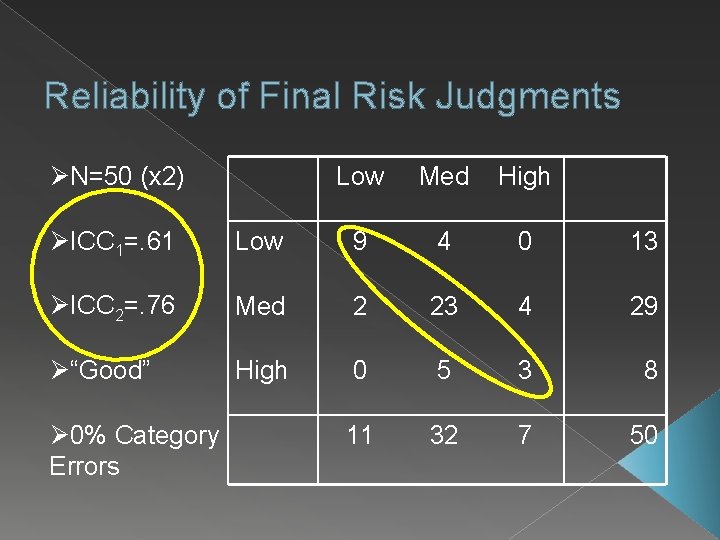
Reliability of Final Risk Judgments N=50 (x 2) Low Med High ICC 1=. 61 Low 9 4 0 13 ICC 2=. 76 Med 2 23 4 29 “Good” High 0 5 3 8 11 32 7 50 0% Category Errors
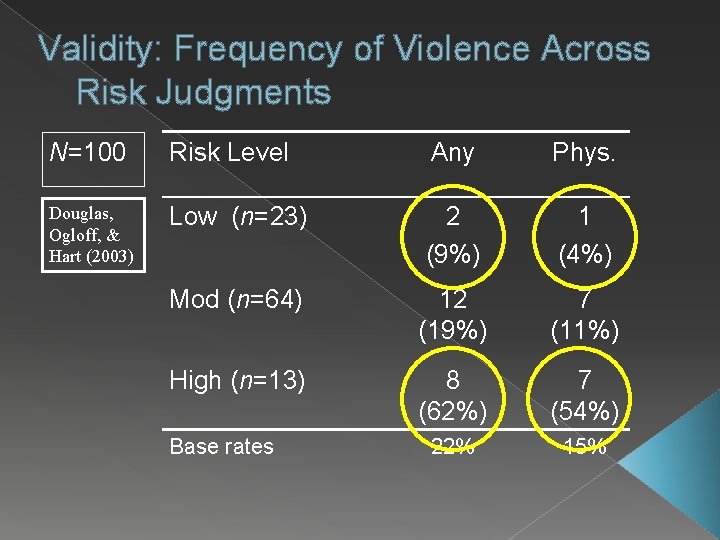
Validity: Frequency of Violence Across Risk Judgments N=100 Risk Level Any Phys. Douglas, Ogloff, & Hart (2003) Low (n=23) 2 (9%) 1 (4%) Mod (n=64) 12 (19%) 7 (11%) High (n=13) 8 (62%) 7 (54%) 22% 15% Base rates
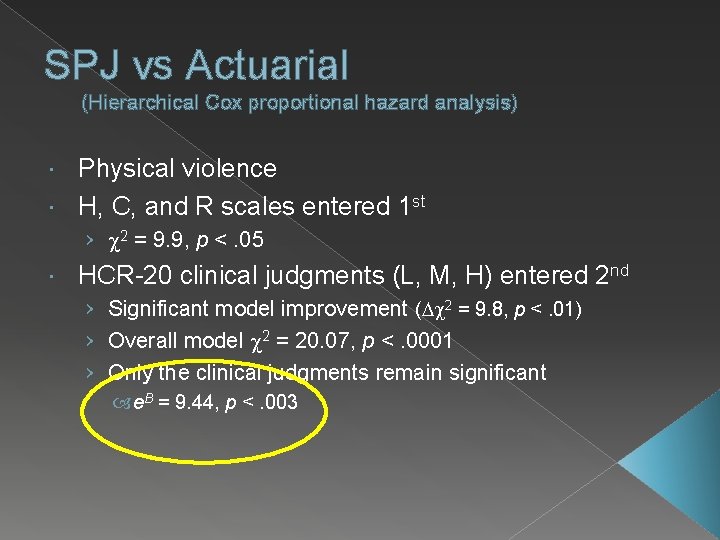
SPJ vs Actuarial (Hierarchical Cox proportional hazard analysis) Physical violence H, C, and R scales entered 1 st › 2 = 9. 9, p <. 05 HCR-20 clinical judgments (L, M, H) entered 2 nd › Significant model improvement ( 2 = 9. 8, p <. 01) › Overall model 2 = 20. 07, p <. 0001 › Only the clinical judgments remain significant e. B = 9. 44, p <. 003
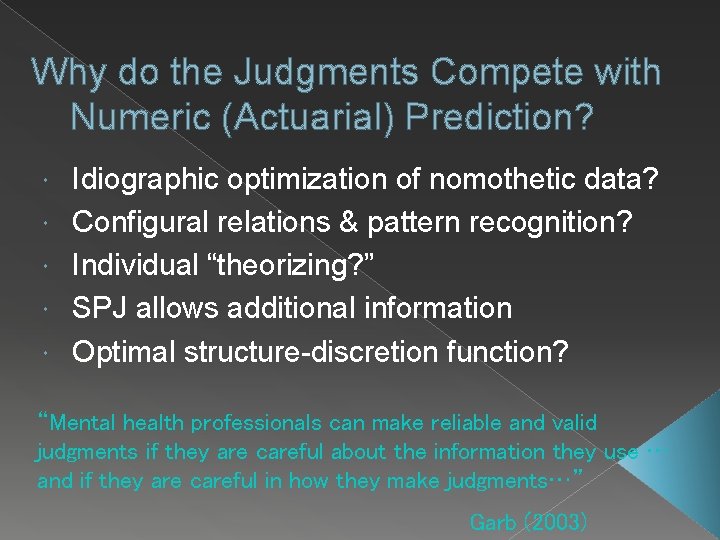
Why do the Judgments Compete with Numeric (Actuarial) Prediction? Idiographic optimization of nomothetic data? Configural relations & pattern recognition? Individual “theorizing? ” SPJ allows additional information Optimal structure-discretion function? “Mental health professionals can make reliable and valid judgments if they are careful about the information they use … and if they are careful in how they make judgments…” Garb (2003)
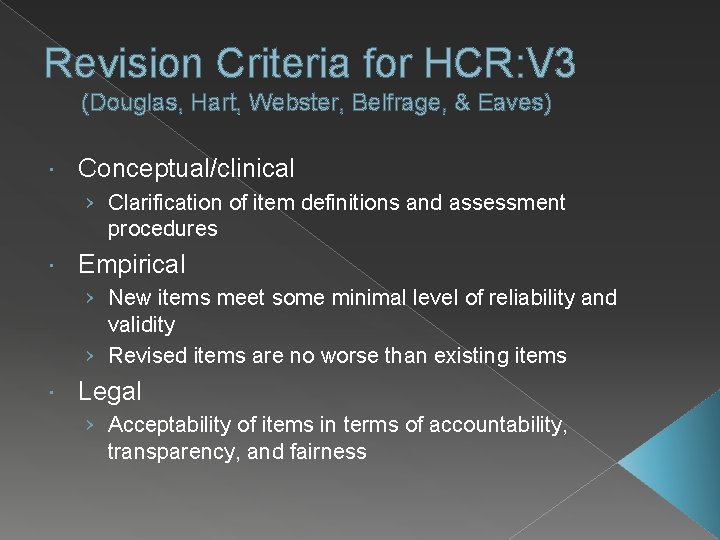
Revision Criteria for HCR: V 3 (Douglas, Hart, Webster, Belfrage, & Eaves) Conceptual/clinical › Clarification of item definitions and assessment procedures Empirical › New items meet some minimal level of reliability and validity › Revised items are no worse than existing items Legal › Acceptability of items in terms of accountability, transparency, and fairness
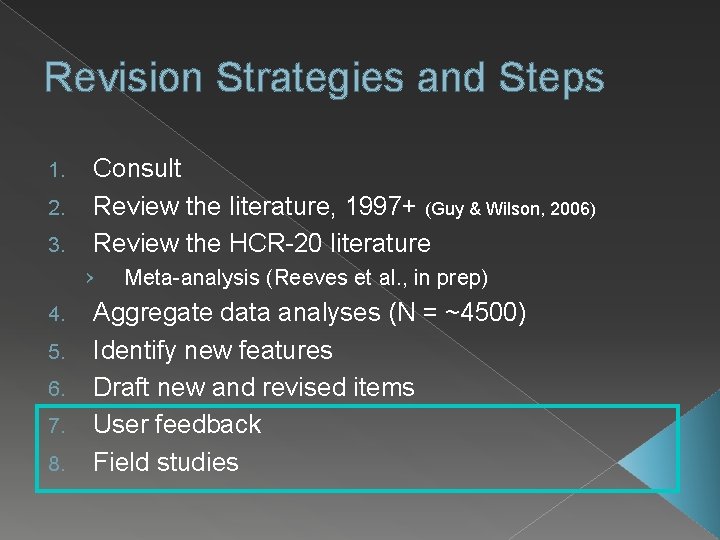
Revision Strategies and Steps 1. 2. 3. Consult Review the literature, 1997+ (Guy & Wilson, 2006) Review the HCR-20 literature › 4. 5. 6. 7. 8. Meta-analysis (Reeves et al. , in prep) Aggregate data analyses (N = ~4500) Identify new features Draft new and revised items User feedback Field studies
Limits, Weaknesses, and Remedies
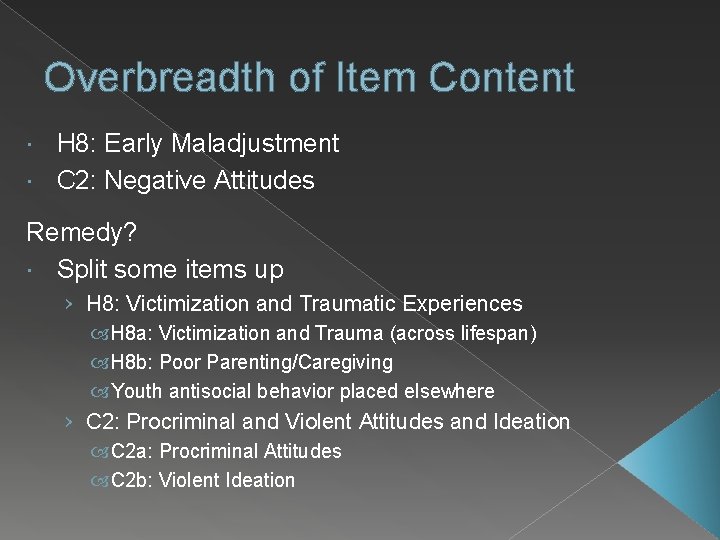
Overbreadth of Item Content H 8: Early Maladjustment C 2: Negative Attitudes Remedy? Split some items up › H 8: Victimization and Traumatic Experiences H 8 a: Victimization and Trauma (across lifespan) H 8 b: Poor Parenting/Caregiving Youth antisocial behavior placed elsewhere › C 2: Procriminal and Violent Attitudes and Ideation C 2 a: Procriminal Attitudes C 2 b: Violent Ideation
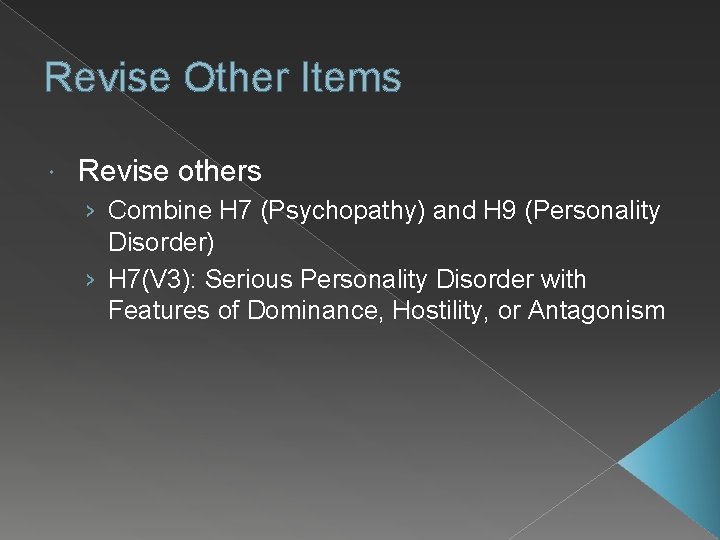
Revise Other Items Revise others › Combine H 7 (Psychopathy) and H 9 (Personality Disorder) › H 7(V 3): Serious Personality Disorder with Features of Dominance, Hostility, or Antagonism
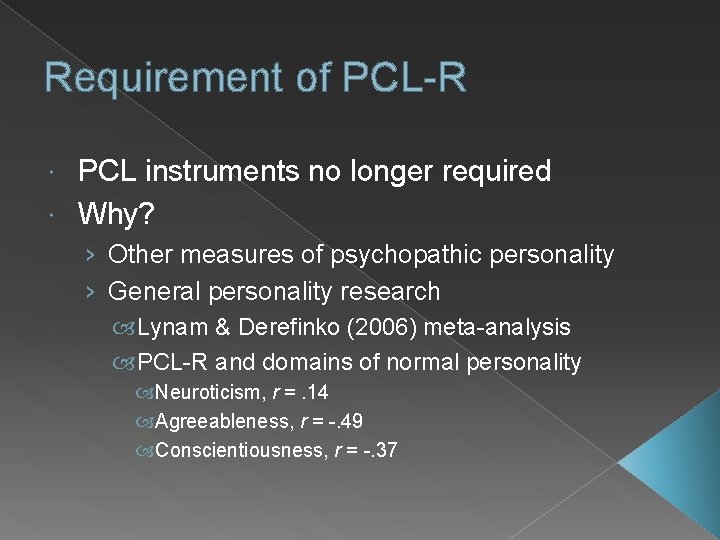
Requirement of PCL-R PCL instruments no longer required Why? › Other measures of psychopathic personality › General personality research Lynam & Derefinko (2006) meta-analysis PCL-R and domains of normal personality Neuroticism, r =. 14 Agreeableness, r = -. 49 Conscientiousness, r = -. 37
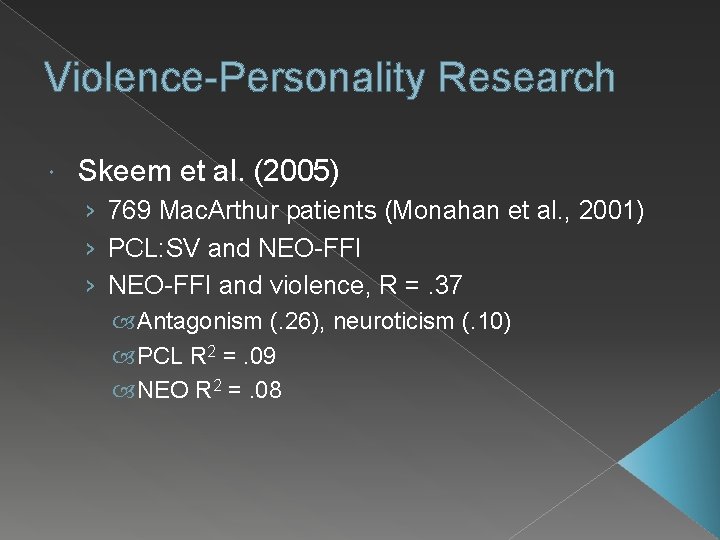
Violence-Personality Research Skeem et al. (2005) › 769 Mac. Arthur patients (Monahan et al. , 2001) › PCL: SV and NEO-FFI › NEO-FFI and violence, R =. 37 Antagonism (. 26), neuroticism (. 10) PCL R 2 =. 09 NEO R 2 =. 08
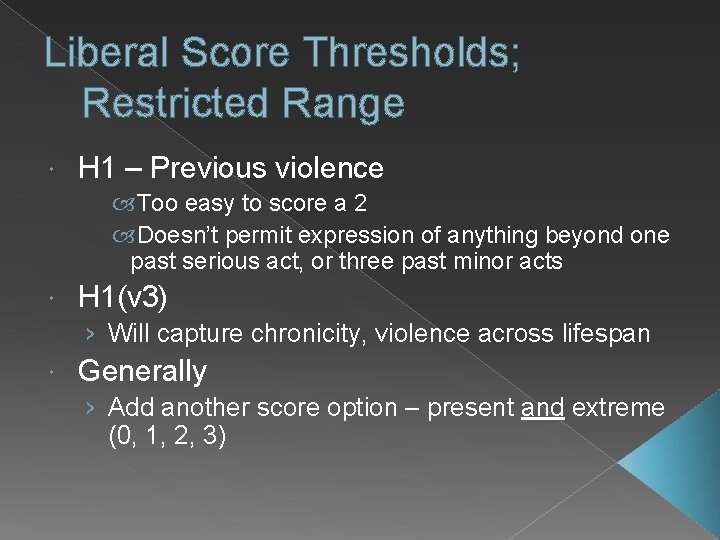
Liberal Score Thresholds; Restricted Range H 1 – Previous violence Too easy to score a 2 Doesn’t permit expression of anything beyond one past serious act, or three past minor acts H 1(v 3) › Will capture chronicity, violence across lifespan Generally › Add another score option – present and extreme (0, 1, 2, 3)
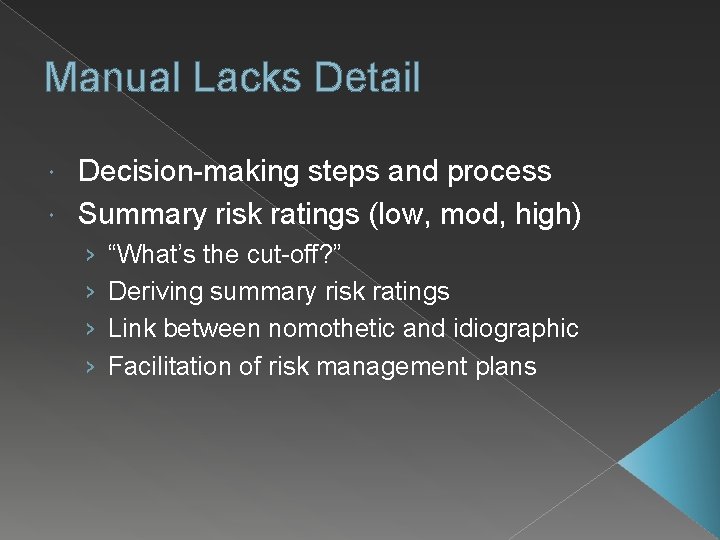
Manual Lacks Detail Decision-making steps and process Summary risk ratings (low, mod, high) › › “What’s the cut-off? ” Deriving summary risk ratings Link between nomothetic and idiographic Facilitation of risk management plans
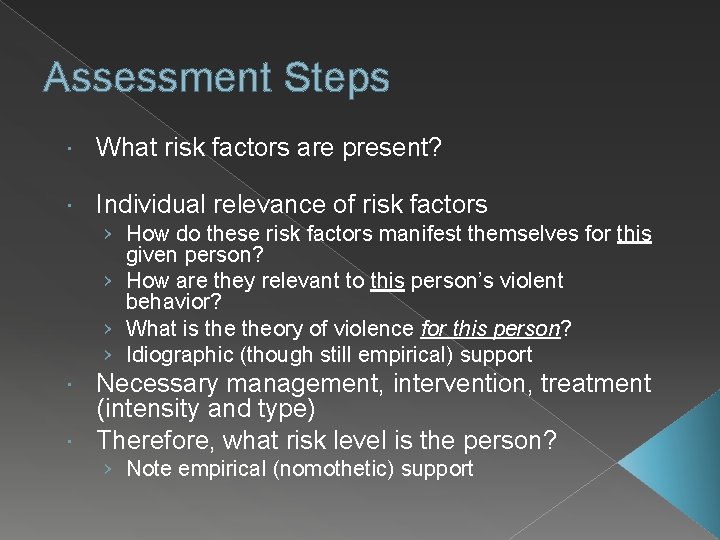
Assessment Steps What risk factors are present? Individual relevance of risk factors › How do these risk factors manifest themselves for this given person? › How are they relevant to this person’s violent behavior? › What is theory of violence for this person? › Idiographic (though still empirical) support Necessary management, intervention, treatment (intensity and type) Therefore, what risk level is the person? › Note empirical (nomothetic) support
Features to Retain or Enhance
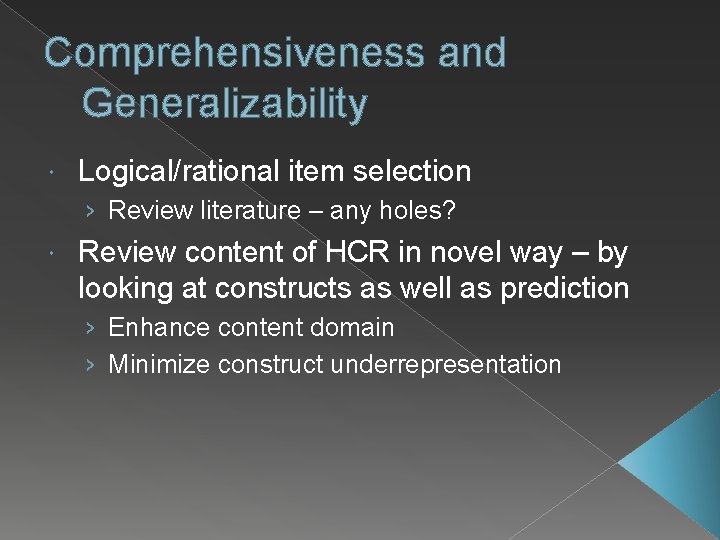
Comprehensiveness and Generalizability Logical/rational item selection › Review literature – any holes? Review content of HCR in novel way – by looking at constructs as well as prediction › Enhance content domain › Minimize construct underrepresentation
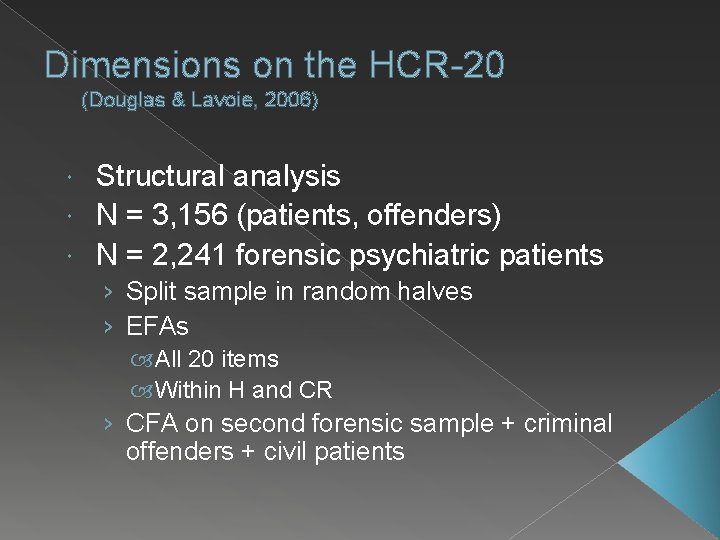
Dimensions on the HCR-20 (Douglas & Lavoie, 2006) Structural analysis N = 3, 156 (patients, offenders) N = 2, 241 forensic psychiatric patients › Split sample in random halves › EFAs All 20 items Within H and CR › CFA on second forensic sample + criminal offenders + civil patients
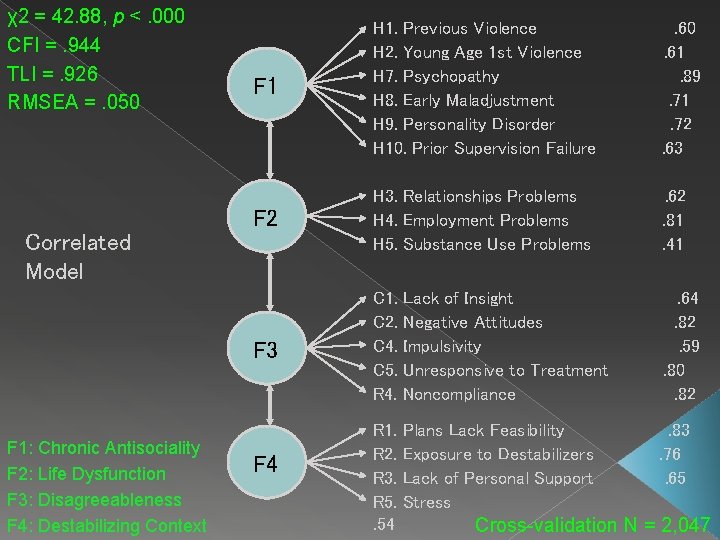
χ2 = 42. 88, p <. 000 CFI =. 944 TLI =. 926 RMSEA =. 050 F 1 H 1. Previous Violence H 2. Young Age 1 st Violence H 7. Psychopathy H 8. Early Maladjustment H 9. Personality Disorder H 10. Prior Supervision Failure . 60. 61. 89. 71. 72. 63 F 2 H 3. Relationships Problems H 4. Employment Problems H 5. Substance Use Problems . 62. 81. 41 F 3 C 1. Lack of Insight C 2. Negative Attitudes C 4. Impulsivity C 5. Unresponsive to Treatment R 4. Noncompliance . 64. 82. 59. 80. 82 R 1. R 2. R 3. R 5. . 54 . 83. 76. 65 Correlated Model F 1: Chronic Antisociality F 2: Life Dysfunction F 3: Disagreeableness F 4: Destabilizing Context F 4 Plans Lack Feasibility Exposure to Destabilizers Lack of Personal Support Stress Cross-validation N = 2, 047
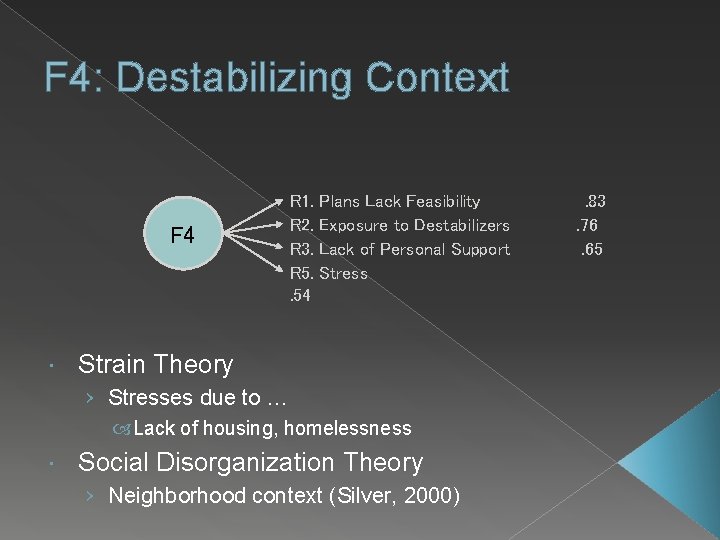
F 4: Destabilizing Context F 4 R 1. R 2. R 3. R 5. . 54 Plans Lack Feasibility Exposure to Destabilizers Lack of Personal Support Stress Strain Theory › Stresses due to … Lack of housing, homelessness Social Disorganization Theory › Neighborhood context (Silver, 2000) . 83. 76. 65
Robustness “The Robust Beauty of Improper Linear Models” -- Dawes (1979) Unit weighting works (Grann & Långström, 2006)
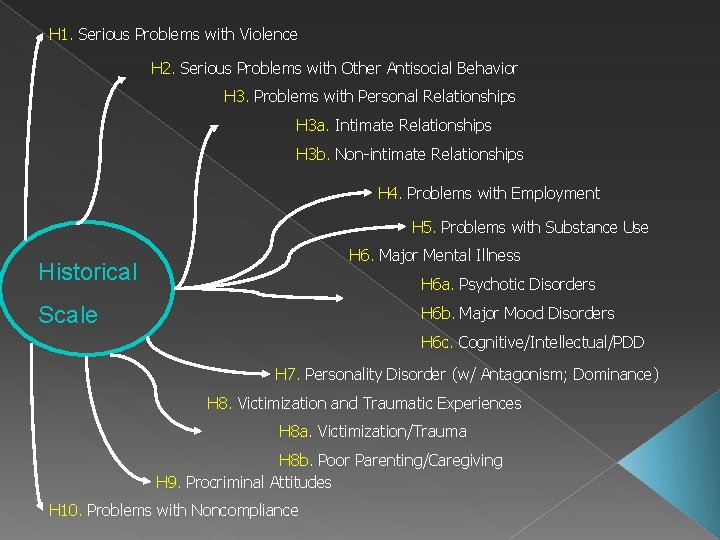
H 1. Serious Problems with Violence H 2. Serious Problems with Other Antisocial Behavior H 3. Problems with Personal Relationships H 3 a. Intimate Relationships H 3 b. Non-intimate Relationships H 4. Problems with Employment H 5. Problems with Substance Use H 6. Major Mental Illness Historical H 6 a. Psychotic Disorders Scale H 6 b. Major Mood Disorders H 6 c. Cognitive/Intellectual/PDD H 7. Personality Disorder (w/ Antagonism; Dominance) H 8. Victimization and Traumatic Experiences H 8 a. Victimization/Trauma H 8 b. Poor Parenting/Caregiving H 9. Procriminal Attitudes H 10. Problems with Noncompliance
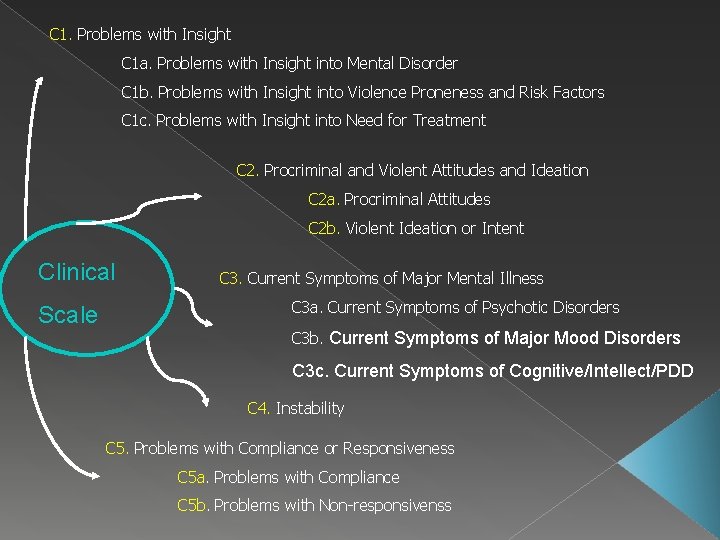
C 1. Problems with Insight C 1 a. Problems with Insight into Mental Disorder C 1 b. Problems with Insight into Violence Proneness and Risk Factors C 1 c. Problems with Insight into Need for Treatment C 2. Procriminal and Violent Attitudes and Ideation C 2 a. Procriminal Attitudes C 2 b. Violent Ideation or Intent Clinical Scale C 3. Current Symptoms of Major Mental Illness C 3 a. Current Symptoms of Psychotic Disorders C 3 b. Current Symptoms of Major Mood Disorders C 3 c. Current Symptoms of Cognitive/Intellect/PDD C 4. Instability C 5. Problems with Compliance or Responsiveness C 5 a. Problems with Compliance C 5 b. Problems with Non-responsivenss
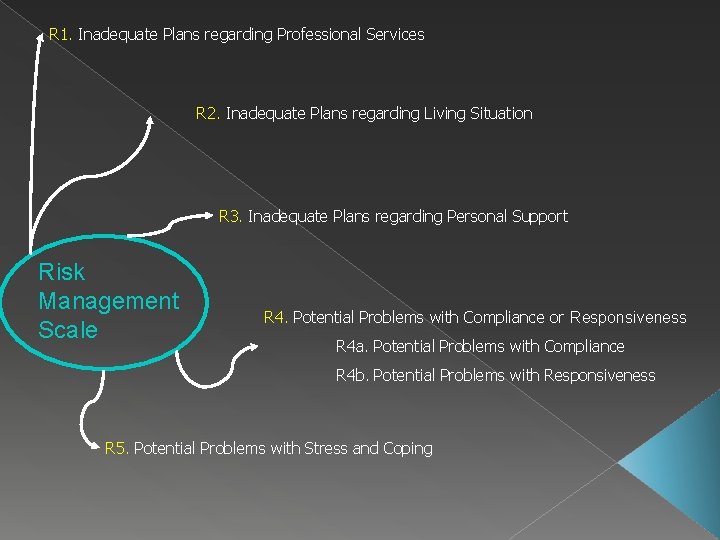
R 1. Inadequate Plans regarding Professional Services R 2. Inadequate Plans regarding Living Situation R 3. Inadequate Plans regarding Personal Support Risk Management Scale R 4. Potential Problems with Compliance or Responsiveness R 4 a. Potential Problems with Compliance R 4 b. Potential Problems with Responsiveness R 5. Potential Problems with Stress and Coping
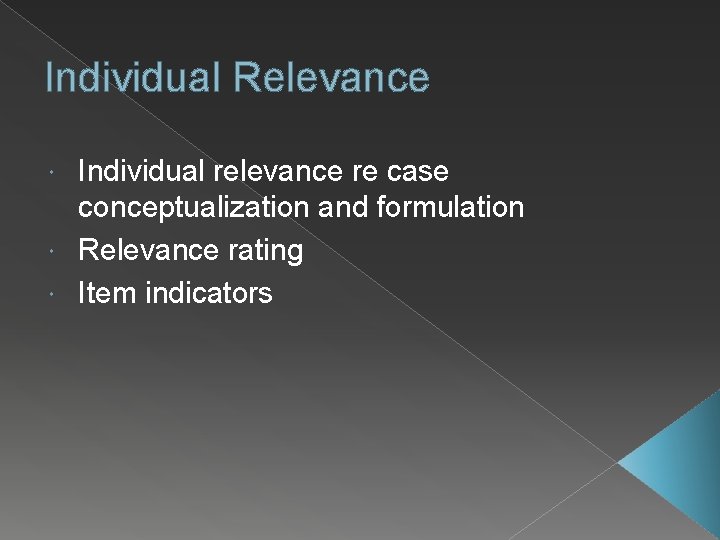
Individual Relevance Individual relevance re case conceptualization and formulation Relevance rating Item indicators
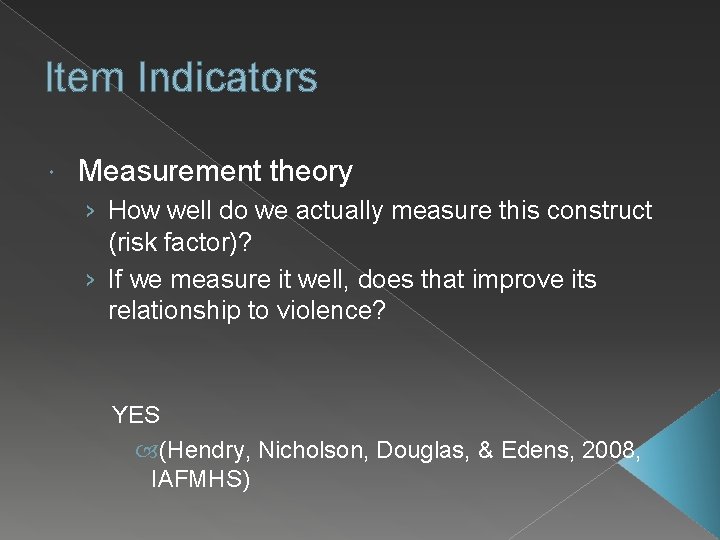
Item Indicators Measurement theory › How well do we actually measure this construct (risk factor)? › If we measure it well, does that improve its relationship to violence? YES (Hendry, Nicholson, Douglas, & Edens, 2008, IAFMHS)
Example: Problems with Noncompliance (H 10) This risk factor reflects serious problems complying with treatment, rehabilitation, or supervision plans designed to improve the person’s psychosocial adjustment and reduce the chances of violence. The problems may include such things as poor motivation, unwillingness, or refusal to attend treatment or supervision.
H 10 Indicators q q q q Failure to establish positive working relationships with professionals Negative (hostile, pessimistic, uncooperative) attitude toward treatment Superficial or insincere participation in treatment or supervision Failure to attend treatment or supervision as directed (e. g. , premature termination) Fails to abide by others’ conditions of treatment or supervision Noncompliance has clearly escalated over time Noncompliance has been evident in the past 12 months
Item Ratings Presence and severity › › 0 – not present 1 – possibly/partially present 2 – definitely present 3 – present, and extreme Relevance › Is the risk factor relevant to this person’s risk for violence? Yes; no; possibly
Grounded in Research The HCR-20 meets definition of “test” › A standardized procedure to make decisions about people Reliability and validity of items (scales) and of summary risk ratings Summary risk ratings… › Is it reliable and valid in the way it is intended to be used? HCR: V 3 will not be released until it is tested
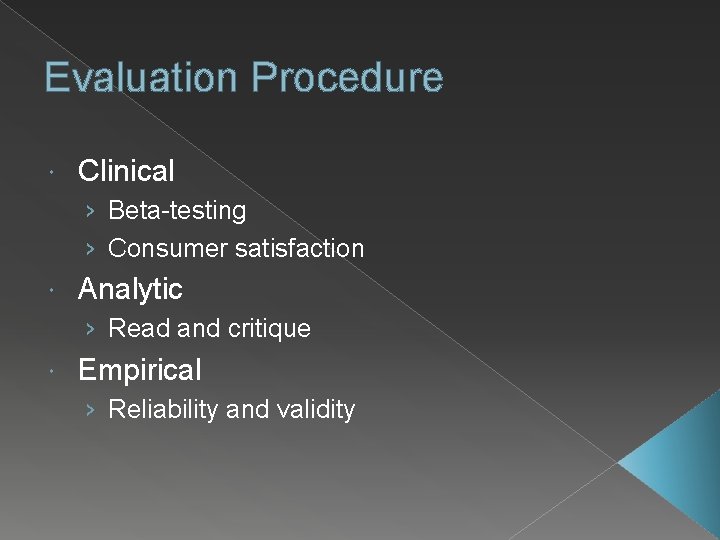
Evaluation Procedure Clinical › Beta-testing › Consumer satisfaction Analytic › Read and critique Empirical › Reliability and validity
Thank You, and Contact Kevin Douglas douglask@sfu. ca http: //kdouglas. wordpress. com/