
Draw an orbital diagram for Al Electrons and
Draw an orbital diagram for Al
Electrons and Ions Which electrons are responsible for chemical properties? Valence electrons Core electrons
• Atoms in the same group. . . 1) have the same outer electron configuration. 2) have the same valence electrons. • The group number = • How many valence e- in Be Al S
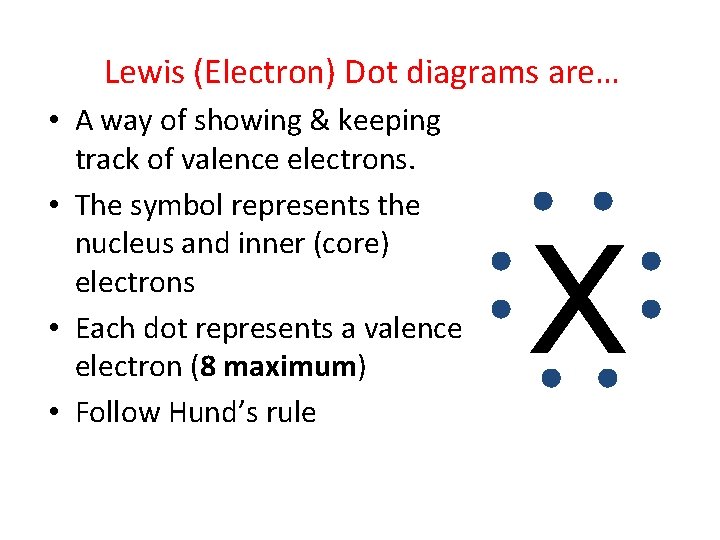
Lewis (Electron) Dot diagrams are… • A way of showing & keeping track of valence electrons. • The symbol represents the nucleus and inner (core) electrons • Each dot represents a valence electron (8 maximum) • Follow Hund’s rule X
The Lewis Dot diagrams
The Octet Rule Noble gases are inert. l Gilbert Lewis (1916) used this fact to explain why atoms form certain kinds of ions and molecules l The Octet Rule: in forming compounds, atoms tend to achieve a noble gas configuration; 8 in the outer level is stable l Every noble gas (except He) has 8 e- in the outer energy level l
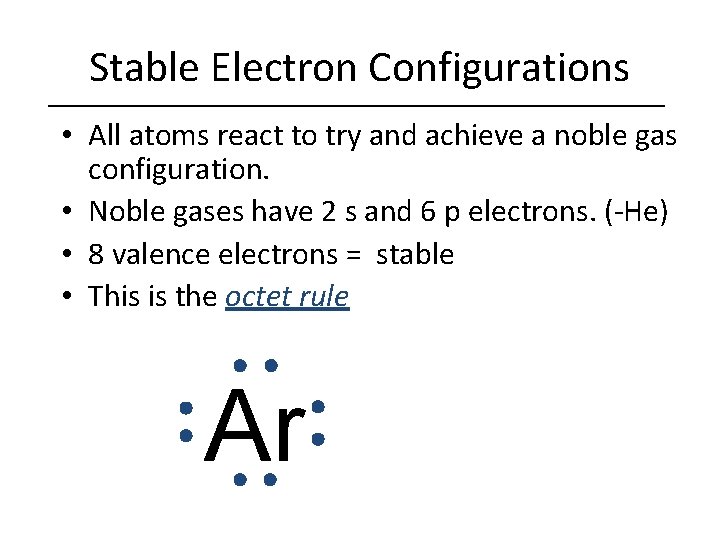
Stable Electron Configurations • All atoms react to try and achieve a noble gas configuration. • Noble gases have 2 s and 6 p electrons. (-He) • 8 valence electrons = stable • This is the octet rule Ar
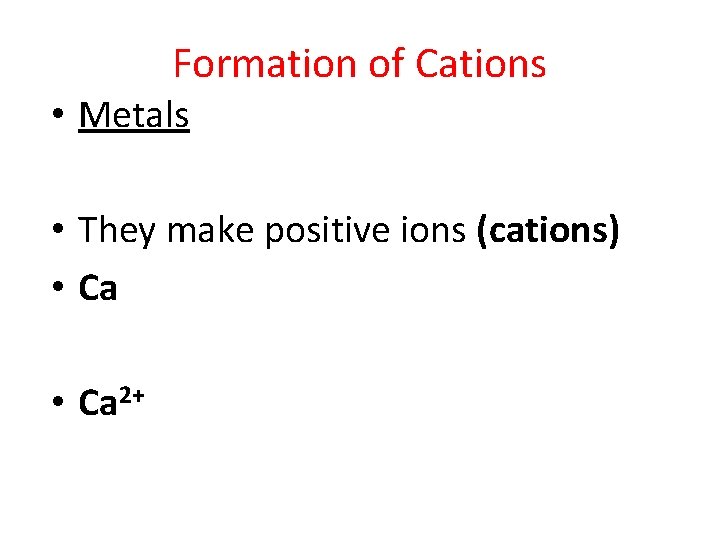
Formation of Cations • Metals • They make positive ions (cations) • Ca 2+
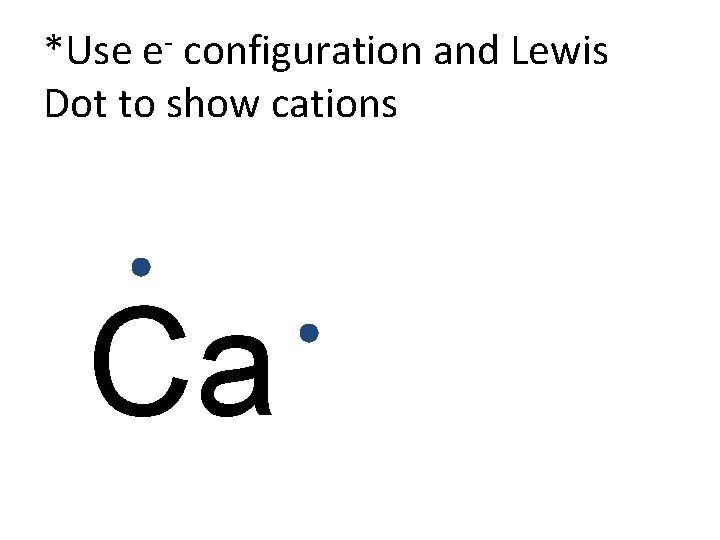
e *Use configuration and Lewis Dot to show cations Ca
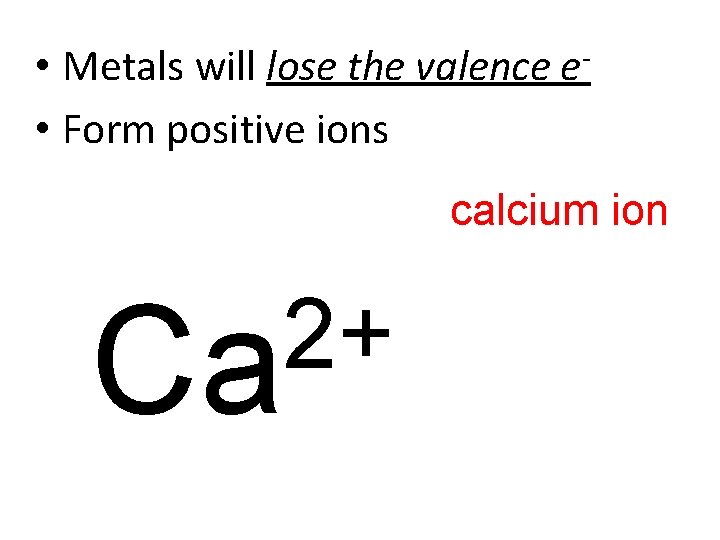
• Metals will lose the valence e • Form positive ions calcium ion 2+ Ca
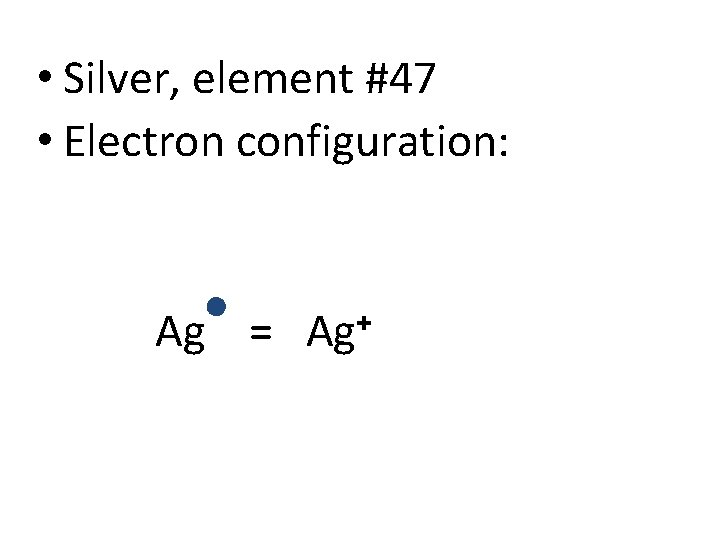
• Silver, element #47 • Electron configuration: Ag = Ag+
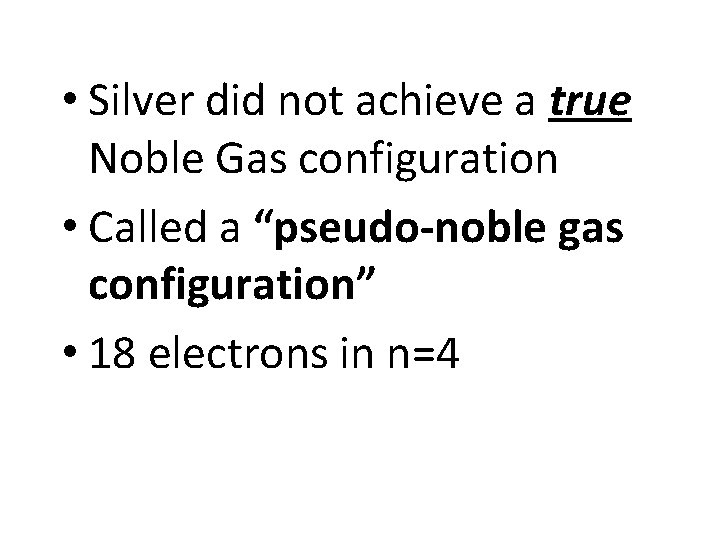
• Silver did not achieve a true Noble Gas configuration • Called a “pseudo-noble gas configuration” • 18 electrons in n=4
Electron Configurations: Anions • Nonmetals gain electrons for a noble gas configuration. • They make negative ions (anions) • O = • O 2 - = • Halide ions -ions from chlorine or other halogens that gain electrons
Name anions properly • Oxygen • Phosphorus • Nitrogen • Bromine • Iodine
7. 2 Ionic Bonding • Anions and cations are held together by opposite charges (+ and -) **Electrostatic forces • Ionic compounds often form salts. • Simplest ratio of elements in an ionic compound is called the formula unit. • The bond is formed through the transfer of electrons (lose/gain) to achieve noble gas configuration.
Ionic Compounds 1. Electrically neutral 2. metal combines with a nonmetal 3. Simplest ratio of elements in an ionic compound is called the formula unit.
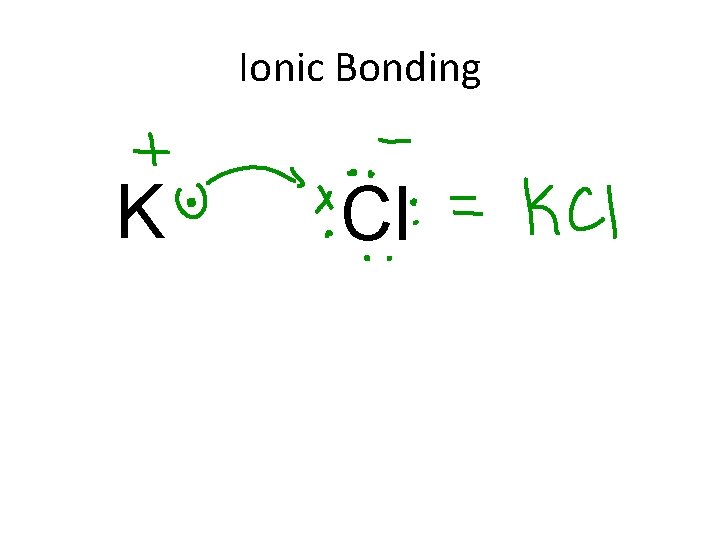
Ionic Bonding K Cl
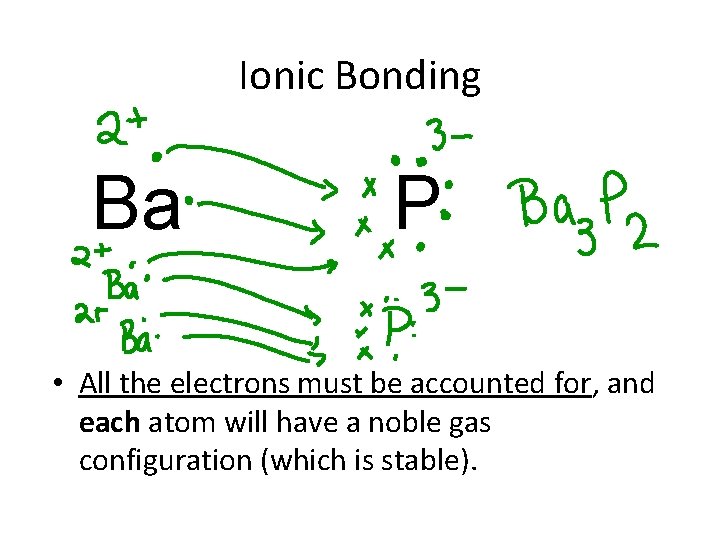
Ionic Bonding Ba P • All the electrons must be accounted for, and each atom will have a noble gas configuration (which is stable).
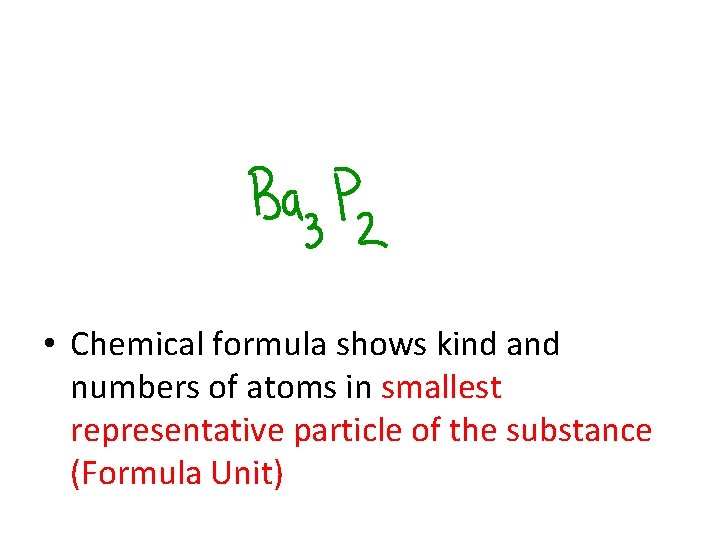
• Chemical formula shows kind and numbers of atoms in smallest representative particle of the substance (Formula Unit)
Properties of Ionic Compounds 1. Crystalline solids - a regular repeating arrangement of ions in the solid: Fig. 7. 9, page 197 – Ions are strongly bonded together. – Structure is rigid. 2. High melting points • Coordination number- number of ions of opposite charge surrounding it
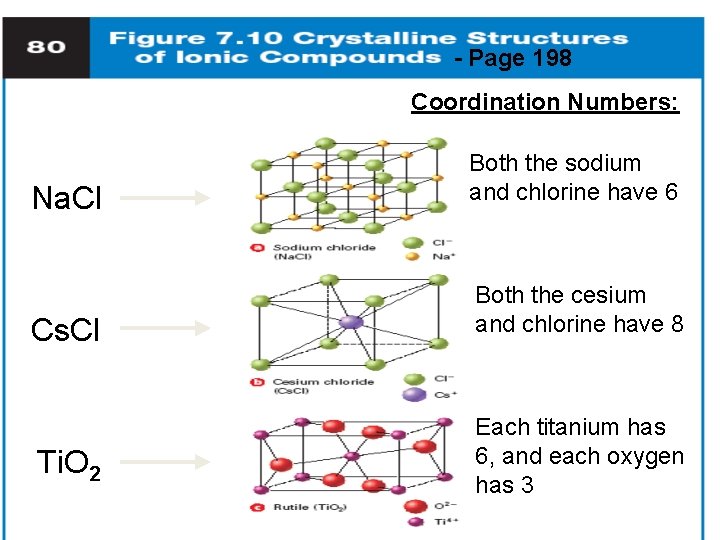
- Page 198 Coordination Numbers: Na. Cl Both the sodium and chlorine have 6 Cs. Cl Both the cesium and chlorine have 8 Ti. O 2 Each titanium has 6, and each oxygen has 3
Do they Conduct? Conducting electricity means allowing charges to move. • In a solid, the ions are locked in place. • Ionic solids are insulators. • When melted, the ions can move around. 3. Melted ionic cmpds are good conductors. • – – Na. Cl: must get to about 800 ºC. Dissolved in water, they also conduct (free to move in aqueous solutions)
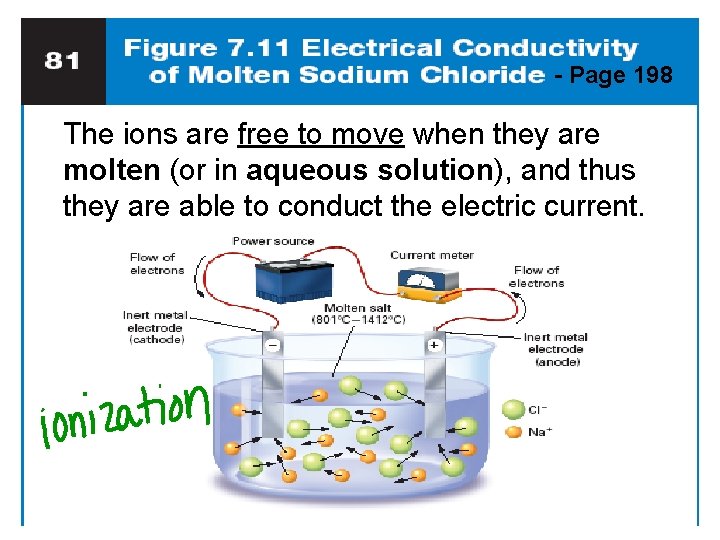
- Page 198 The ions are free to move when they are molten (or in aqueous solution), and thus they are able to conduct the electric current.
Metallic Bonds are… • how metal atoms are held together in the solid. • Metals hold on to their valence electrons very weakly. • Think of them as positive ions (cations) floating in a sea of electrons: Fig. 7. 12, p. 201
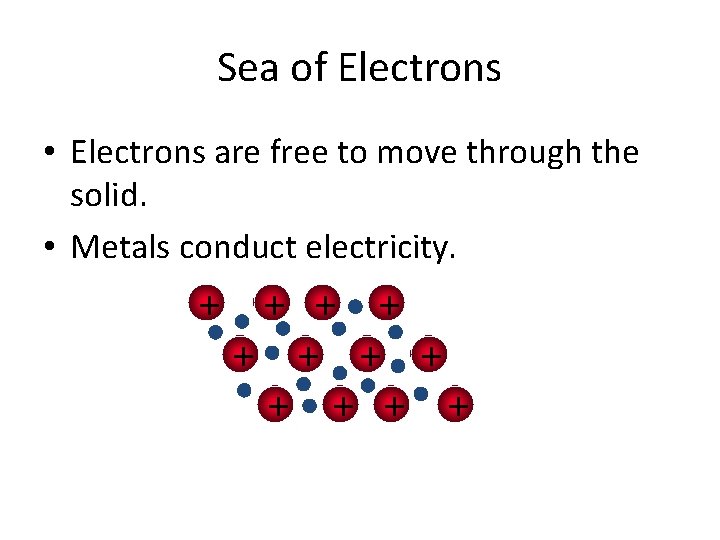
Sea of Electrons • Electrons are free to move through the solid. • Metals conduct electricity. + + +
Metals are Malleable • Hammered into sheets/shapes (bend). • Also ductile - drawn into wires. • Both malleability and ductility explained in terms of the mobility of the valence electrons
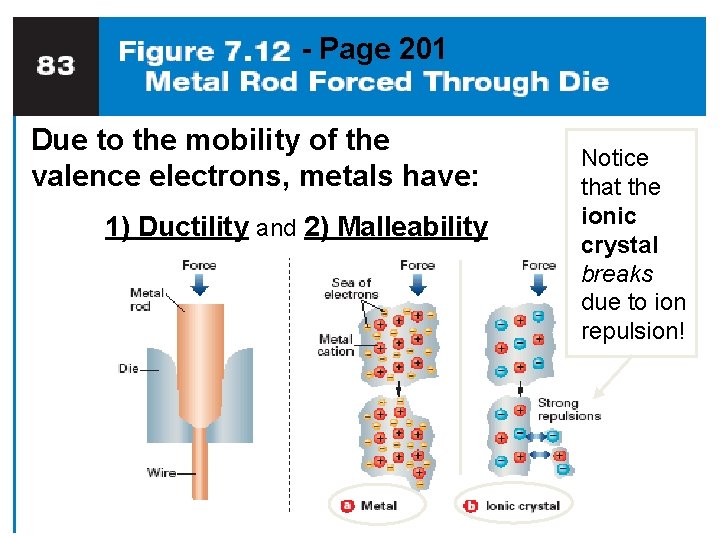
- Page 201 Due to the mobility of the valence electrons, metals have: 1) Ductility and 2) Malleability Notice that the ionic crystal breaks due to ion repulsion!
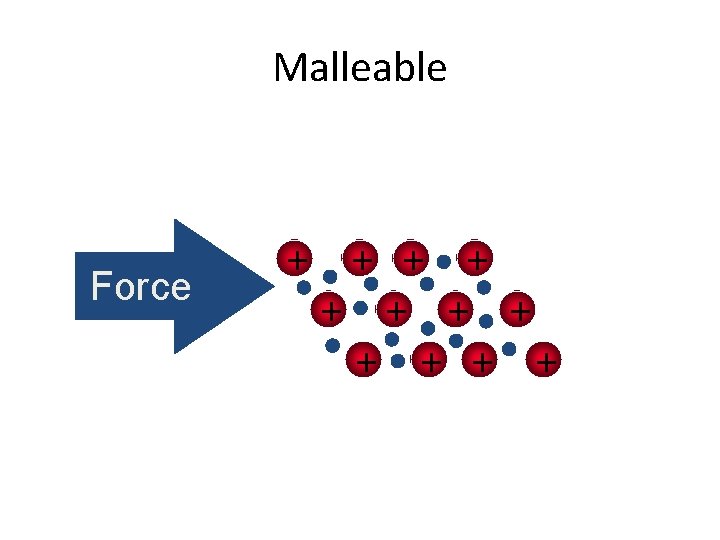
Malleable Force + + +
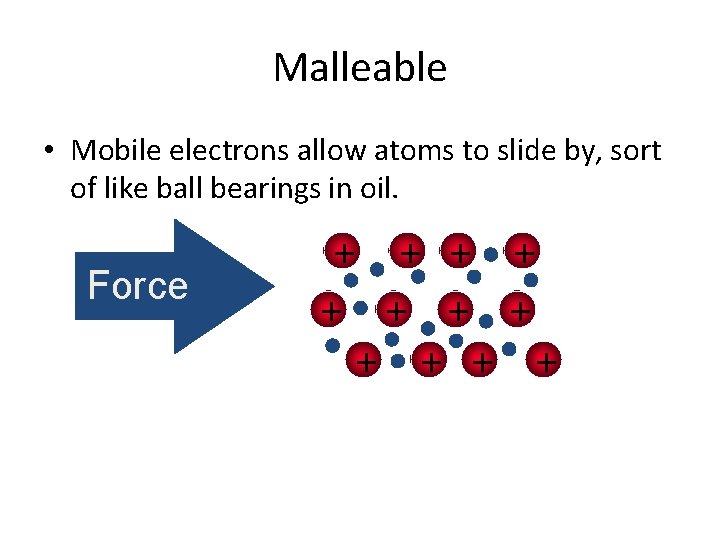
Malleable • Mobile electrons allow atoms to slide by, sort of like ball bearings in oil. Force + + +
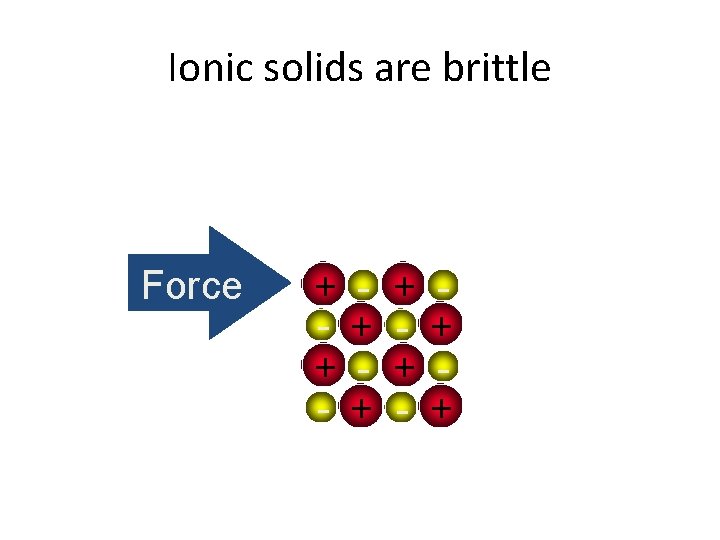
Ionic solids are brittle Force + + - + +
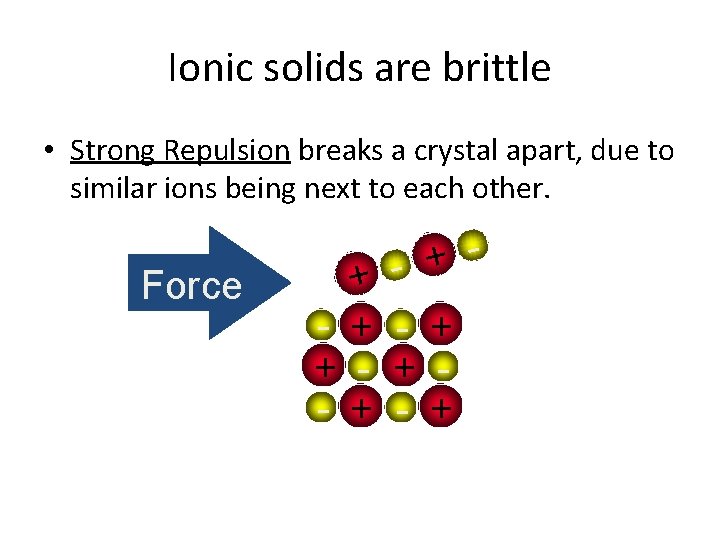
Ionic solids are brittle • Strong Repulsion breaks a crystal apart, due to similar ions being next to each other. Force + + - + - + - +
Crystalline structure of metal • If made of one kind of atom, metals are among the simplest crystals; very compact & orderly • Note Fig. 7. 14, p. 202 for types: 1. Body-centered cubic: –every atom (except those on the surface) has 8 neighbors –Na, K, Fe, Cr, W
Crystalline structure of metal 2. Face-centered cubic: – every atom has 12 neighbors – Cu, Ag, Au, Al, Pb 3. Hexagonal close-packed – every atom also has 12 neighbors – different pattern due to hexagonal – Mg, Zn, Cd
Alloys • We use lots of metals every day, but few are pure metals • Alloys are mixtures of 2 or more elements, at least 1 is a metal • made by melting a mixture of the ingredients, then cooling • Brass: an alloy of Cu and Zn • Bronze: Cu and Sn
Why use alloys? • Properties are often superior to the pure element • Sterling silver (92. 5% Ag, 7. 5% Cu) is harder and more durable than pure Ag, but still soft enough to make jewelry and tableware • Steels are very important alloys – corrosion resistant, ductility, hardness, toughness, cost
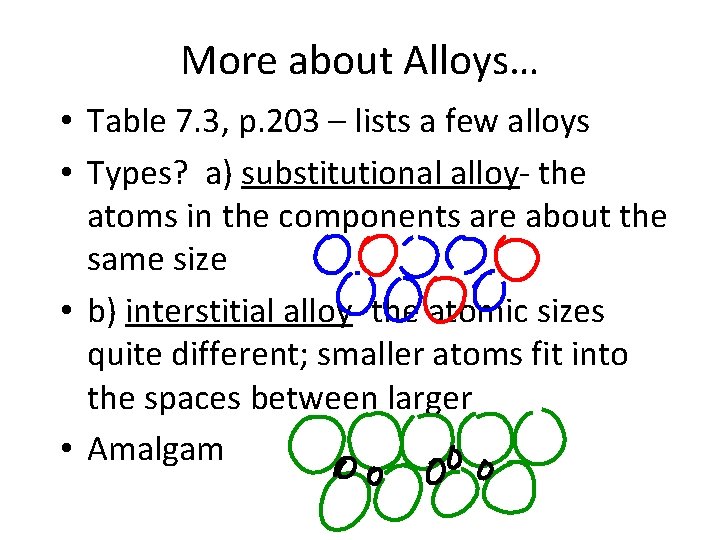
More about Alloys… • Table 7. 3, p. 203 – lists a few alloys • Types? a) substitutional alloy- the atoms in the components are about the same size • b) interstitial alloy- the atomic sizes quite different; smaller atoms fit into the spaces between larger • Amalgam
- Slides: 36