
Dramatic Terms Shakespeare Drama and the Tragic Hero
- Slides: 16
Dramatic Terms Shakespeare, Drama, and the Tragic Hero
Protagonist • Main characters of a play • Drive the action of the play by striving to achieve a goal
Antagonists/Obstacles • Antagonist: a character who interferes with a protagonists reaching his/her goal • Obstacle: a non-human force which interferes with a protagonist reaching his/her goal – Nature – Fate
Dramatic Question • Will the protagonist reach his/her goal? – This creates suspense – Makes a story interesting
Conflict • Conflict occurs when a protagonist runs into an antagonist or an obstacle • Two types – External: – Internal: between two separate forces within one character
Elements of Shakespearean Plot • Exposition – Reveals main characters; sets stage; reveals basic conflict • Complications – – – Plot twists Conflicts arise Rising action Things get more interesting In Shakespeare, something occurs to put the natural order out of balance
Elements of Shakespearean Plot • Turning Point – When the protagonist is irrevocably sent on his or her way to either achieving or failing to achieve his/her goal – Always 3 rd act of Shakespeare’s plays • Climax – When the dramatic question is answered – Always in 5 th act of Shakespeare’s plays • Denoument/Resolution – – – Act 5 Ties up loose ends Natural order reestablished in Shakespeare
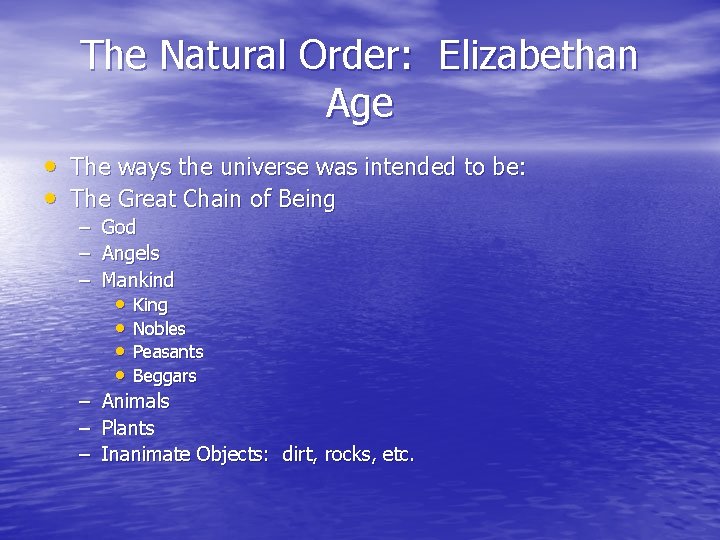
The Natural Order: Elizabethan Age • The ways the universe was intended to be: • The Great Chain of Being – God – Angels – Mankind • • King Nobles Peasants Beggars – Animals – Plants – Inanimate Objects: dirt, rocks, etc.
The Natural Order: Elizabethan Age • A benevolent, wise, king/queen in power • All are loyal to this king/queen • No chaos or anarchy because the Great Chain of Being is adhered to – All people play their designated roles—roles designated by God
The Natural Order: Elizabethan Age • Tragedy occurs when the natural order, the chain, is somehow disrupted – For example: • King is corrupt • A rightful king is overthrown • God is disobeyed • Results of the chain being disrupted – Tremendous social/political upheaval – Suffering, death, destruction – Anarchy, chaos, and loss of stability
The Natural Order: Elizabethan Age • Basic Structure of Shakespearean plays: – Natural order is somehow upset • Comedies: nothing terribly awful happens • Tragedies: lots of very bad things occur – Many complications occur as a result – In the end, the order is always reestablished, at tremendous cost in a tragedy
Other Common Elements in Shakespeare • Foreshadowing – When an event hints at something to come later in the play • Dramatic Irony – Audience and at least one character knows something a different character in the play does not • Situational Irony – When something occurs very different or opposite of what you would expect
The Tragic Hero • Character of great political/social standing – Must fall from a great height to get the desired effect • Neither totally evil or totally good – If too good, we are angered – If too evil, we feel justice
The Tragic Hero • Tragic Flaw – Hero is destroyed due to some tragic character flaw – A personal error or frailty – Not an innocent victim of fate – Hero is responsible for own destruction • Hero suffers greatly as a result of his/her mistakes
The Tragic Hero • Suffering leads to enlightenment – It is not pointless suffering – Character grows and changes • Downfall arouses pity and fear – Pity: we see how far they have fallen and how much they suffer – Fear: if it could happen to someone of great importance, it could happen to us
Purpose of Tragedy • Why watch a play that ends with great sadness and pain? How is this entertainment? • Catharsis: an emotional purging – Allows audience an outlet for negative, toxic emotions that build up – Thus, relief or even satisfaction is often the paradoxical effect of watching a tragedy