
Dramatic Literature prepared by Camille Quamina Functions of
Dramatic Literature prepared by Camille Quamina
Functions of Acts and Scenes • They make up the series of events we call “the plot” of the play. • They bring the issues in a play (conflicts and themes) quickly and sharply into focus for the audience • They identify links and relationships between the segments of action presented on the stage • A scene may set up expectations which another fulfills. • Their use echoes and develop thematic issues throughout the play
Functions continued • Used to affect the pace of the play’s development by slowing down or quickening the pace of the action thus affecting dramatic interest • Used to convey imagery and symbols which can affect the atmosphere of the play • They form part of the plot, which is the larger dramatic structure
Plot • The term plot refers to the order of events, incidents and action within a story that emphasize the development and resolution of the conflict. • Gustav Freytag’s Pyramid (theory of dramatic structure) proposes the following phases for plot analysis: exposition, rising action, climax, falling action, denouement (unraveling of the plot)
Linear and Non-linear Plots • All plays have some sort of storyline that provides unity to the sequence of events depicted • Most plots of traditional plays tend to be “linear” which means that the action develops in a chronological and sequential manner with a clear beginning, middle and end. • Most plots of modern plays tend to be mainly non-linear which means that the action does not develop in a clear sequential manner; the time sequencing of action may be disrupted or delayed for dramatic effect.
Developmental Phases in a Play: Exposition • Refers to section (usually found at the beginning) which provides background information necessary for the audience to make sense of the plot • There are two main ways that a playwright provides information during this section of a play: direct exposition and indirect exposition • Direct: use of prologue or narrator (third person). • Indirect: use of dialogue, action and reportage.
Developmental Phases in a Play: Rising Action • Event or incident and the consequences that takes place or has already taken place before the play’s start. • Incitement for the conflict that will drive the action of the main plot. • Interaction between characters or characters and their social environment becomes more complicated as the central conflict intensifies and may lead to sub-plot (a minor series of action that thematically echo and amplify the concerns of the main plot and may involve different characters and settings) or a double plot. • Connection between sub and main plot becomes apparent just before the climax
Developmental Phases in a Play: Climax • Whether it is a single event or series of minor encounters, the climax, for the audience, must be the point of greatest emotional engagement with the conflict • An important structural element associated with the climax is the “crisis” or “turning point” in the action, where the fortunes of the leading character dramatically change for better or worse
Developmental Phases in a Play: Falling Action & Denouement • It is the crisis or dramatic reversal of fortune for the protagonist that begins the next phase of the play’s development called the falling action. • The action and conflict of the play move towards some kind of culmination with the protagonist being triumphant or defeated depending on the type of play. • In tragic drama it is referred to as “catastrophe”, Greek meaning “down turn” • In non-tragic plays we say “denouement”, French for unraveling or untying of a knot. In reference to a novel we say “resolution”.
What is Conflict? • Conflict provides dramatic tension that keeps the audience emotionally engaged and interested in continuing to watch. • It arises when a character who pursues a goal encounters opposition and obstacles in the form of other characters, physical obstacles, ideas and emotions and even conflicts within him/herself. • There are five types of conflict commonly used in dramatic as well as other literary works.
What is Conflict continued • Where there is a combination of types of conflicts within a play, one type is usually predominant • the playwright will use dialogue and action to help recognise it as the central conflict, thereby investing the strongest emotion and attention into its development • What we recognise as the main conflict is dependent on the strength of the protagonist characterisation, the strength of the antagonist characterisation and the intensity of the protagonist’s drive towards her/his goal(s)
Types of Conflicts • The individual versus nature: pits the protagonist against a force of nature such as a storm, earthquake, hurricane etc. • Individual versus individual: protagonist/hero against antagonist/villain (arch villain and anti hero) • The individual against society: pits character against the laws, traditions, customs, fashions and expectations of their society • The individual against himself: a complex character who is conflicted because of emotional and moral issues • The individual against fate: fate is depicted as an uncontrollable, unknowable force that determines one’s destiny
Character and Characterisation Defined • The term character refers to any figure or type of person who is represented in a dramatic or narrative work and who can be differentiated by some particular quality of speech, acton or disposition • The various ways and techniques that the writer uses to present and develop character that he/she creates are called characterisation • In drama characters reveal themselves to the audiences based on what they say, their manner of saying it, their actions and their manner of doing them
Types of Characters • Flat or caricature: persona developed around a single idea or quality. Lacks complexity and details that distinguish it as person rather than a type of person. It is built around one particular trait. Also referred to as “two dimensional” because they lack complexity • Stereotype: a type of flat character sharing personality features and traits commonly associated with the type of race, gender, occupation, class or background and experience that the character represents
Types of Characters continued • Stock characters: common stereotypical characters that represent traits required in a particular genre or dramatic convention • Chorus, Choral or Choric: comments on and explains the actions of other character and events in the plot providing additional information. They represent voice and values of the community by which the other characters and their actions may be judged.
Types of Characters • Round: has a multi-faceted complexity that we associate with persons in real life. They are referred to as “three dimensional” • Static: does not undergo significant change in personality or outlook during the development of the plot • Dynamic: undergoes change in personality or outlook as a result of the experiences • Doubling: performs two or more roles in a drama. Reduces number of actors for the sake of economy or serves some larger ideological purpose
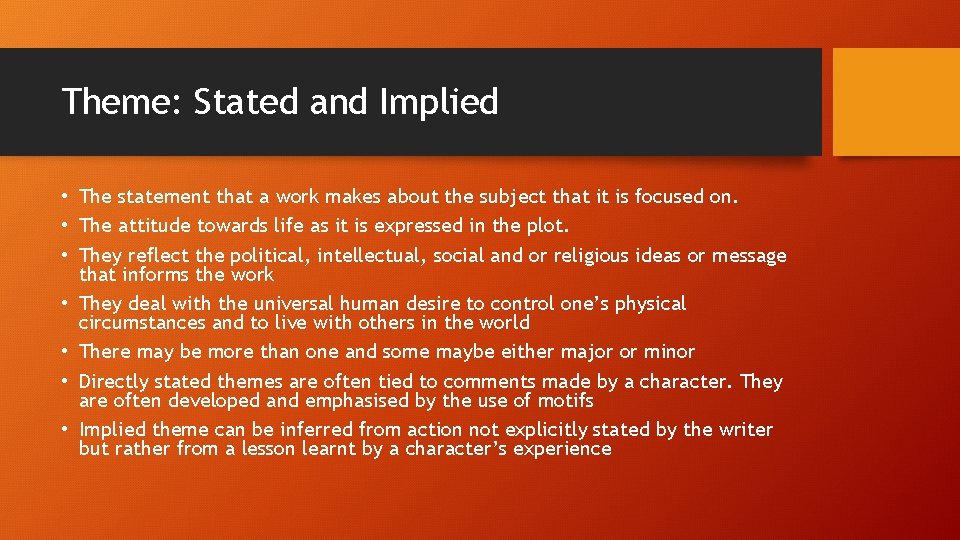
Theme: Stated and Implied • The statement that a work makes about the subject that it is focused on. • The attitude towards life as it is expressed in the plot. • They reflect the political, intellectual, social and or religious ideas or message that informs the work • They deal with the universal human desire to control one’s physical circumstances and to live with others in the world • There may be more than one and some maybe either major or minor • Directly stated themes are often tied to comments made by a character. They are often developed and emphasised by the use of motifs • Implied theme can be inferred from action not explicitly stated by the writer but rather from a lesson learnt by a character’s experience
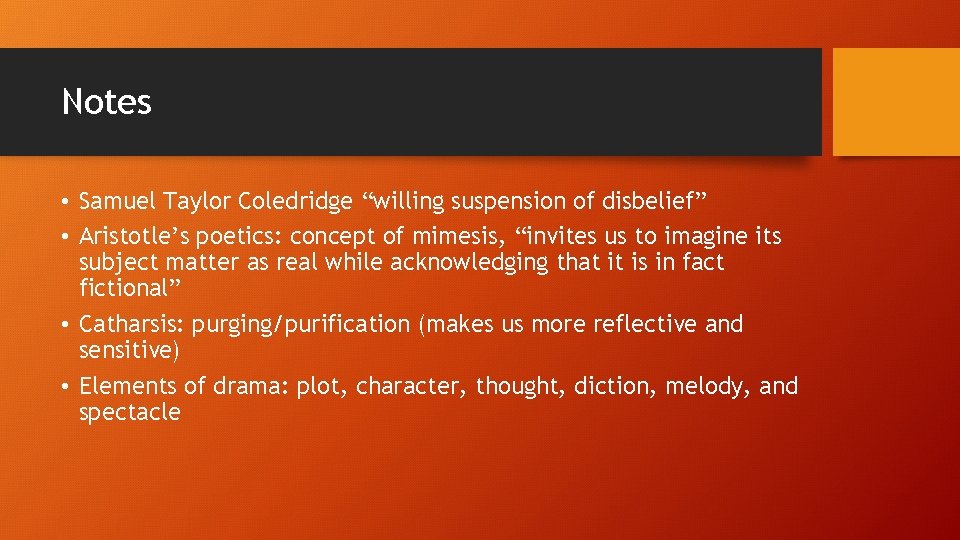
Notes • Samuel Taylor Coledridge “willing suspension of disbelief” • Aristotle’s poetics: concept of mimesis, “invites us to imagine its subject matter as real while acknowledging that it is in fact fictional” • Catharsis: purging/purification (makes us more reflective and sensitive) • Elements of drama: plot, character, thought, diction, melody, and spectacle
Work Cited Mc. Dermott, Harold. CAPE Literatures in English Drama Module. Port of Spain: Caribbean Educational Publishers. 2014. Print.
- Slides: 19