
Dramatic introduction OVERFISHING OF ATLANTIC BLUEFIN TUNA Thunnus
Dramatic introduction!
OVERFISHING OF ATLANTIC BLUEFIN TUNA (Thunnus thynnus) Implications and Conservation Strategies Nick Gezon, Linda Isakson, Laura Pratt, and Alex Lee

GENERAL OVERFISHING • 16. 6% of animal protein consumed • $80 billion/year industry • Employs ~750 million people worldwide • Catch peaked in late 1990 s at 90 million tonnes, now at 77 million tonnes as a result of exploitation • Bottom-trawling, dredges, traps have damaged or altered 95% of marine habitats • 85% of global fish stocks depleted • Illegal, unregulated and unreported (IUU) main culprit
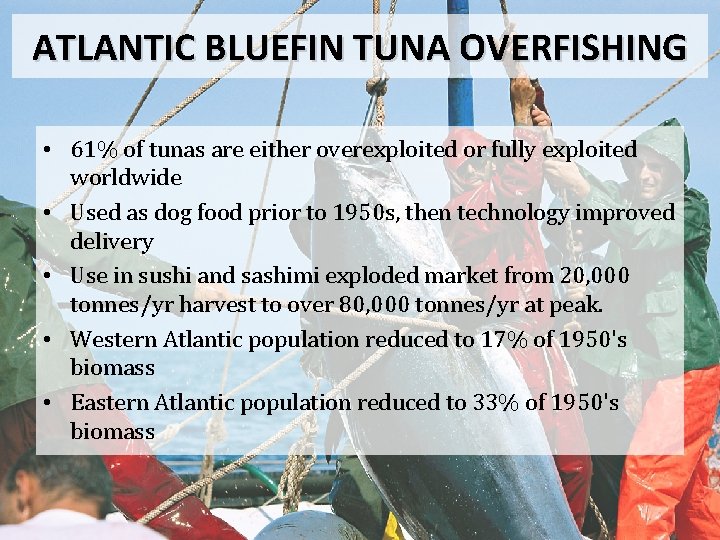
ATLANTIC BLUEFIN TUNA OVERFISHING • 61% of tunas are either overexploited or fully exploited worldwide • Used as dog food prior to 1950 s, then technology improved delivery • Use in sushi and sashimi exploded market from 20, 000 tonnes/yr harvest to over 80, 000 tonnes/yr at peak. • Western Atlantic population reduced to 17% of 1950's biomass • Eastern Atlantic population reduced to 33% of 1950's biomass
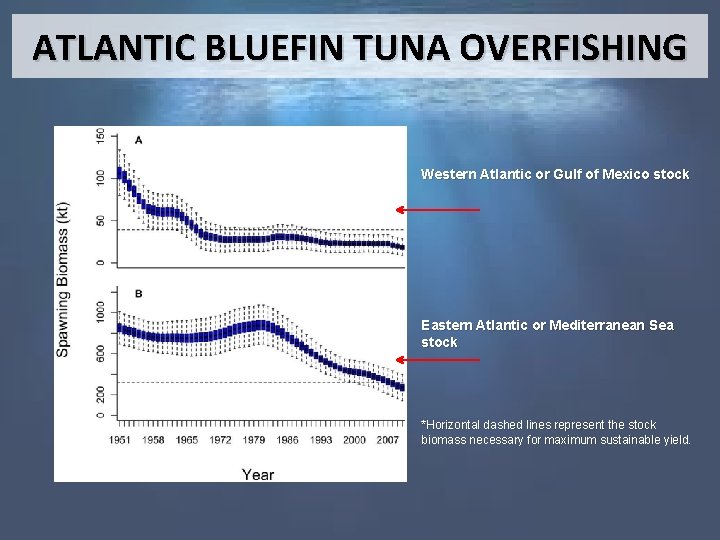
ATLANTIC BLUEFIN TUNA OVERFISHING Western Atlantic or Gulf of Mexico stock Eastern Atlantic or Mediterranean Sea stock *Horizontal dashed lines represent the stock biomass necessary for maximum sustainable yield.
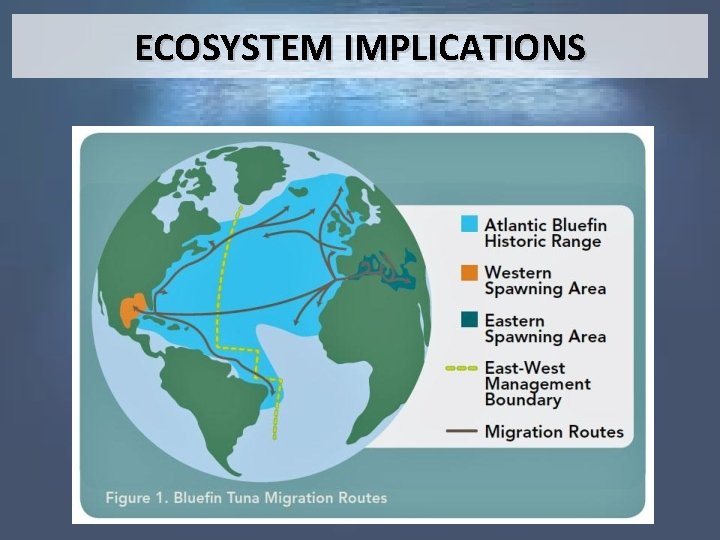
ECOSYSTEM IMPLICATIONS
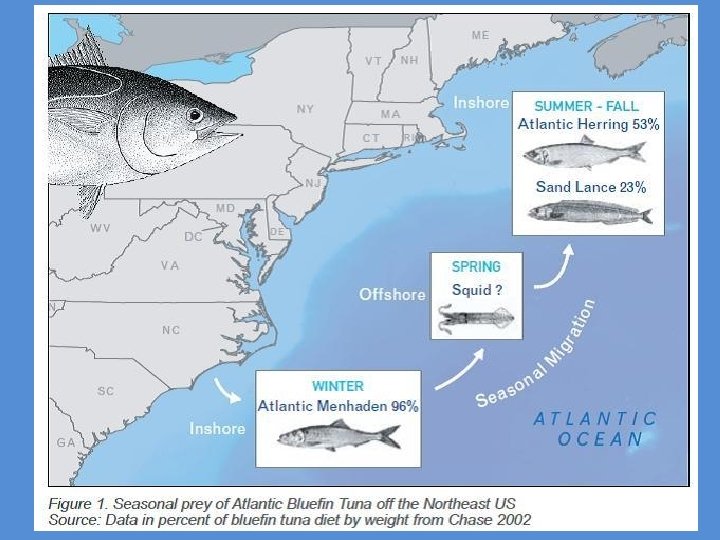
ECOSYSTEM IMPLICATIONS • Bluefin Tuna are apex predators in the Atlantic pelagic • • • ecosystem. They feed on mackerel, squid, herring, and sardines. They have a top-down effect on the food web controlling prey populations. Overfishing of bluefin tuna has caused populations of prey to become unstable (Boom and Bust Cycles) This threatens the health of the whole ecosystem. A study assessing the risks for global fisheries health found that changes in lower trophic level prey fish populations pose the greatest threat to fisheries collapse (Pinsky et al. 2011)
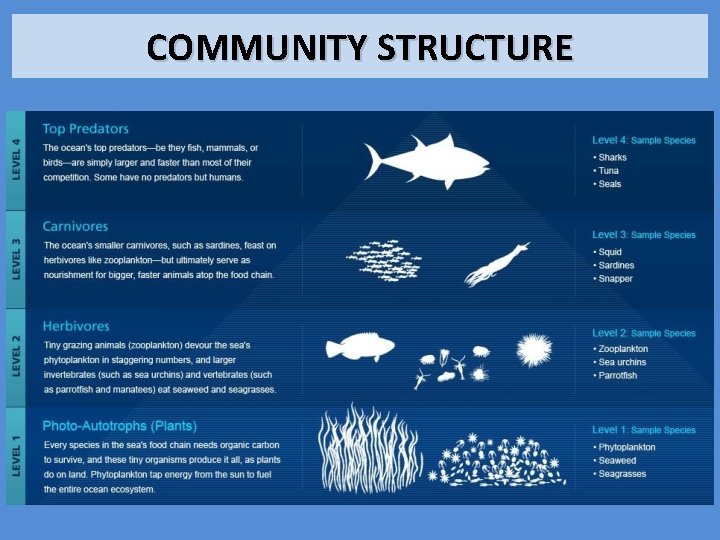
COMMUNITY STRUCTURE
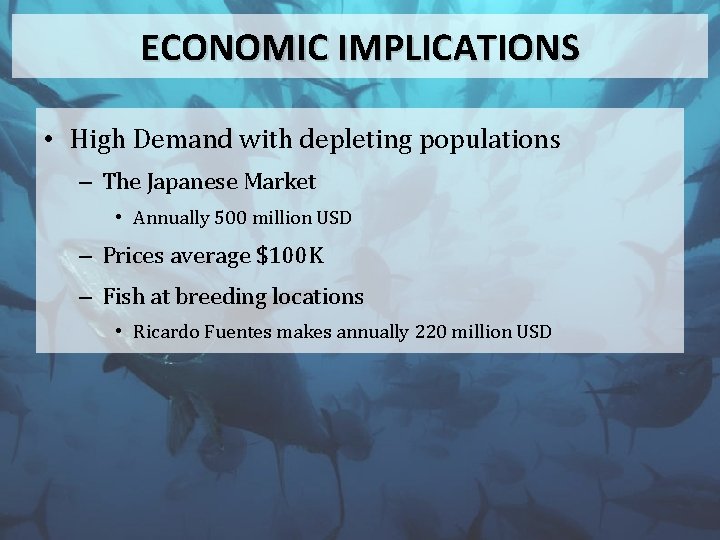
ECONOMIC IMPLICATIONS • High Demand with depleting populations – The Japanese Market • Annually 500 million USD – Prices average $100 K – Fish at breeding locations • Ricardo Fuentes makes annually 220 million USD
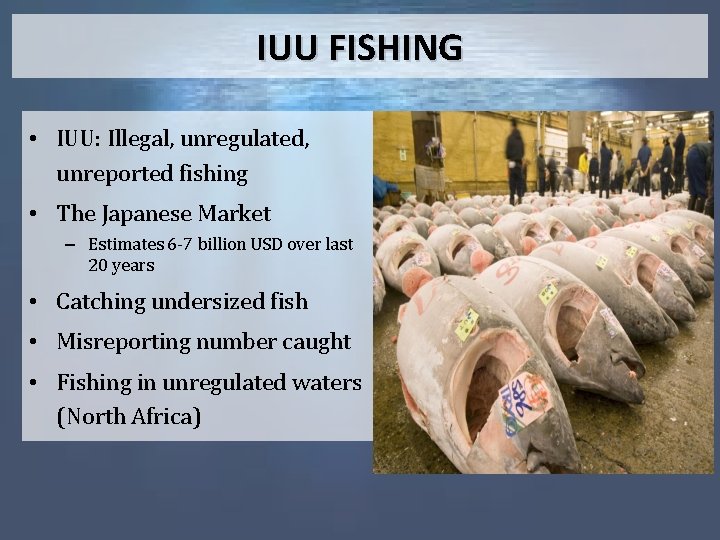
IUU FISHING • IUU: Illegal, unregulated, unreported fishing • The Japanese Market – Estimates 6 -7 billion USD over last 20 years • Catching undersized fish • Misreporting number caught • Fishing in unregulated waters (North Africa)
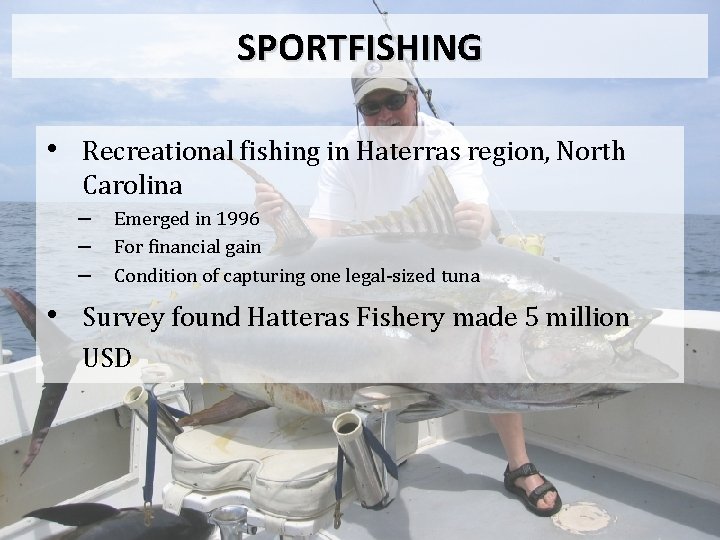
SPORTFISHING • Recreational fishing in Haterras region, North Carolina – Emerged in 1996 – For financial gain – Condition of capturing one legal-sized tuna • Survey found Hatteras Fishery made 5 million USD
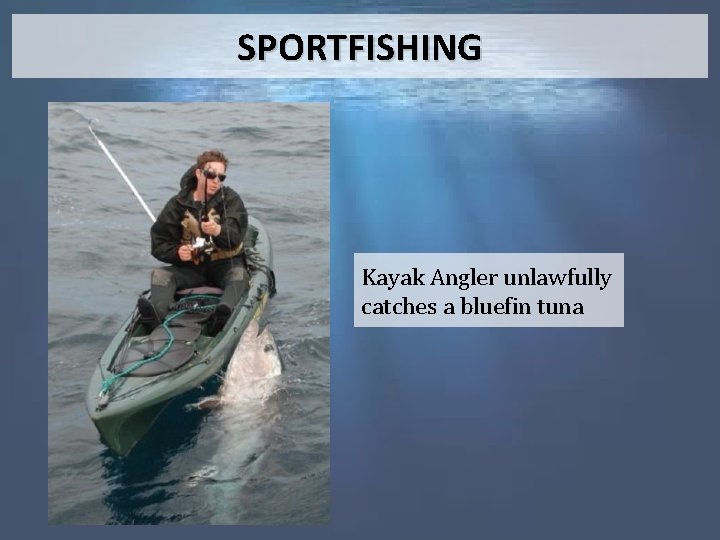
SPORTFISHING Kayak Angler unlawfully catches a bluefin tuna
ATLANTIC BLUEFIN TUNA OVERFISHING • ICCAT created in 1969 to regulate bluefin harvesting • 40 years later, bluefin still in decline • IUU fishing still rampant but more stringent measures are being taken • Proposal to list T. thynnus under CITES rejected • Recently adopted 13, 500 tonnes limit for 2013
CONSERVATION MEASURES • Current: – Aquaculture– the farming of bluefin tuna • Clean. Seas Aquaculture Growout – Spawning Sanctuaries • Protected habitats – Gulf of Mexico
CONSERVATION MEASURES • Problems: – There is a significant amount of IUU (illegal, unreported, unregulated) – Bluefin are not optimal fish to farm – Biomass is so low that it’s hard to bounce back with continued fishing – Little international cooperation • Because of adverse affects on economy and culture
CONSERVATION MEASURES • The future: – Continue placing regulations and bans upon fishing – Encourage international compliance • Trade embargos • Onboard monitors for IUU – Develop new methods of aquaculture
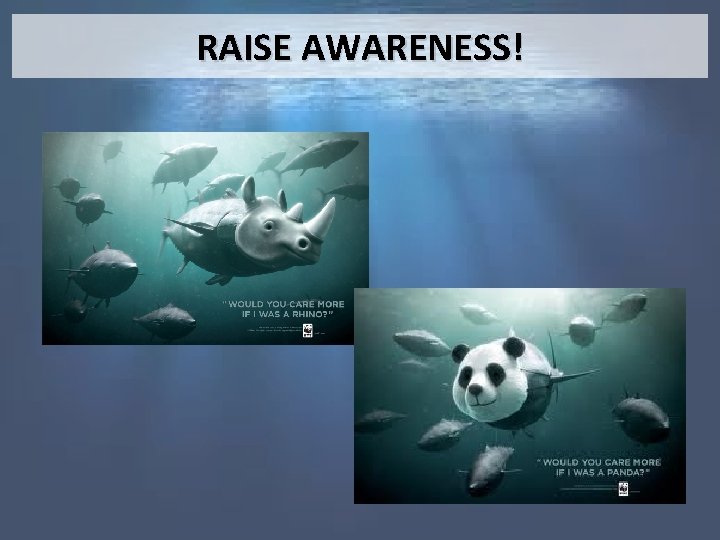
RAISE AWARENESS!
SOURCES • • • Bohnsack, B. L. , Ditton, R. B. , Stoll, J. R. , Chen, R. J. , Novak, R. , Smutko, L. S. 2002. The economic impacts of the recreational bluefin tuna fishery in Hatteras, North Carolina. North American Journal of Fisheries Management. Vol 22, Issue 1, p 165 -176. Center for Public Integrity. 2012. The black market in bluefin tuna. http: //www. publicintegrity. org/2010/11/07/2335/overview-black-market-bluefin Ellis, R. 2008. The bluefin in peril. Scientific American. Vol 298, p 70 -77. Ezzy, E. , Scarborough, H. , Wallis, A. 2012. Recreational value of southern bluefin tuna fishing. Economic Papers: A Journal of applied economics and policy. Vol 31(2), p 150 -159. Fromentin, J. M. , Powers, J. E. 2005. Atlantic bluefin tuna: population dynamics, ecology, fisheries and management. Fish and Fisheries. Vol 6, p 281 -306. International Commission for the Conservation of Atlantic Tunas. Statistical Bulletin 40, 1960 -2009. July 2011. Kato, Dawn, M. 2011. The Battle for Bluefin: The Consumers Role in Preserving the Atlantic Bluefin Tuna. California Western International Law Journal. Vol 42, Issue 1, p 149 -188. Pinsky M. L. , Jensen O. P. , Ricard D. , Palumbi S. R. 2011 Unexpected patterns of fisheries collapse in the world’s oceans. PNAS Ecology Polachek, Tom. 2012. Assessment of IUU fishing for Southern Bluefin Tuna. Marine Policy. Vol 36, p 1150– 1165. United Nations Conference on Sustainable Development. 2012. The Future We Want: Oceans. Rio+20 Factsheet.
- Slides: 19