
Dramatic Conventions Or what makes a play a
![[no narrator] • There is no narrator in most plays. • How does this](https://slidetodoc.com/presentation_image_h2/7f0be87a347dc79edefa303945687e75/image-8.jpg "[no narrator] • There is no narrator in most plays. • How does this")
![[no visuals except for what’s happening on stage] • Again, this is unique to](https://slidetodoc.com/presentation_image_h2/7f0be87a347dc79edefa303945687e75/image-9.jpg "[no visuals except for what’s happening on stage] • Again, this is unique to")
- Slides: 12
Dramatic Conventions! Or, what makes a play, a play?
Dialogue RODERIGO <Tush, > never tell me! IAGO <‘Sblood, > but you’ll not hear me!
Monologue • Spoken by one character. • There IS an audience (one or more characters) on the stage, to whom the speech is being addressed. • Iago, 1. 1. 8 -35 (“Despise me / If I do not. ”) • How many has Iago had so far?
Soliloquy • • • Also spoken by one character. But no one else is being addressed. The character is speaking to him/herself. Often, there’s no one else on stage. Iago will get the first one: 1. 3. 426 -447 (“Thus do I ever make my fool my purse. ”)
Aside • Spoken by one character while others are on the stage. • But no one else is meant to hear– the aside is like a little “secret” being offered to us from the character, an inside joke or bit of info. • Iago will use a bunch of these: 2. 1. 182 (aside “He takes her by the palm…”)
Stage Directions • Very minimally used by playwrights in Shakespeare’s time. • Descriptions of setting, entrances and exits, and occasionally gestures/movements • Lots of room for interpretation of Shakespeare’s plays due to such little use of explicit directions!
Setting & Action indicated through dialogue • “Rouse him” – tells us it’s night because Iago is commanding Roderigo to wake up Brabantio– and then Roderigo does just that • “Do you know my voice? ” – tells us Brabantio can’t actually see Roderigo, since Roderigo has to ask him this question • “Strike on the tinder, ho!” – tells us it’s dark because Brabantio is commanding his servants to light some torches. And then they do.
[no narrator] • There is no narrator in most plays. • How does this make a play feel “different” from other kinds of texts?
[no visuals except for what’s happening on stage] • Again, this is unique to drama. We can only see what is being staged for us (we can’t see other, far-off scenes, that might be included in a text like a novel or poem). • How might this affect the kinds of details a playwright chooses to include in a script?
ACT IT OUT • Your group will create a mini script from 1. 1. • Script should include at least two actors who will speak lines. You can also have nonspeaking actors. • Script should be at least four lines long.
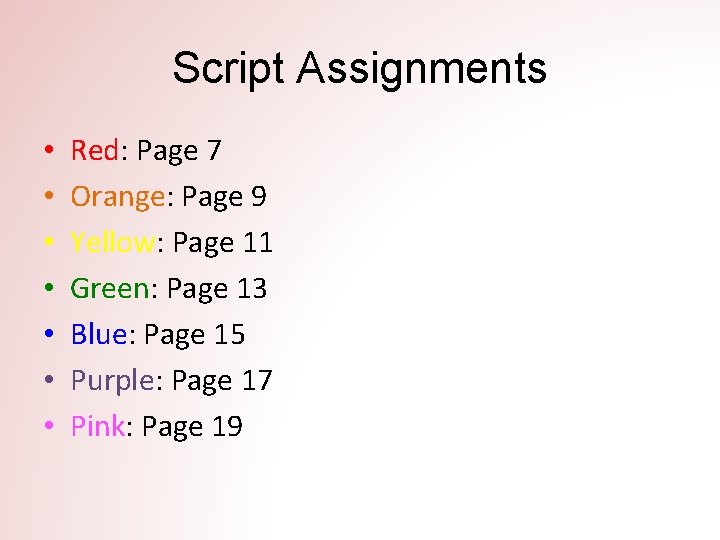
Script Assignments • • Red: Page 7 Orange: Page 9 Yellow: Page 11 Green: Page 13 Blue: Page 15 Purple: Page 17 Pink: Page 19
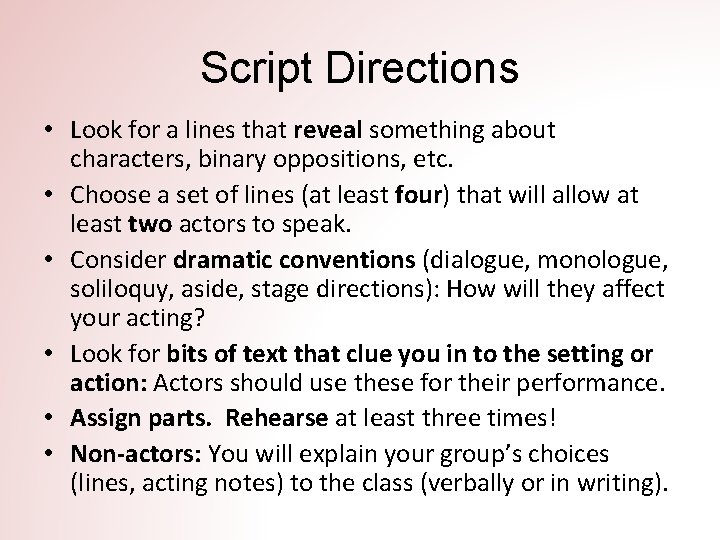
Script Directions • Look for a lines that reveal something about characters, binary oppositions, etc. • Choose a set of lines (at least four) that will allow at least two actors to speak. • Consider dramatic conventions (dialogue, monologue, soliloquy, aside, stage directions): How will they affect your acting? • Look for bits of text that clue you in to the setting or action: Actors should use these for their performance. • Assign parts. Rehearse at least three times! • Non-actors: You will explain your group’s choices (lines, acting notes) to the class (verbally or in writing).