
Drag Forces AP Physics C Here is the

- Slides: 15
Drag Forces AP Physics C
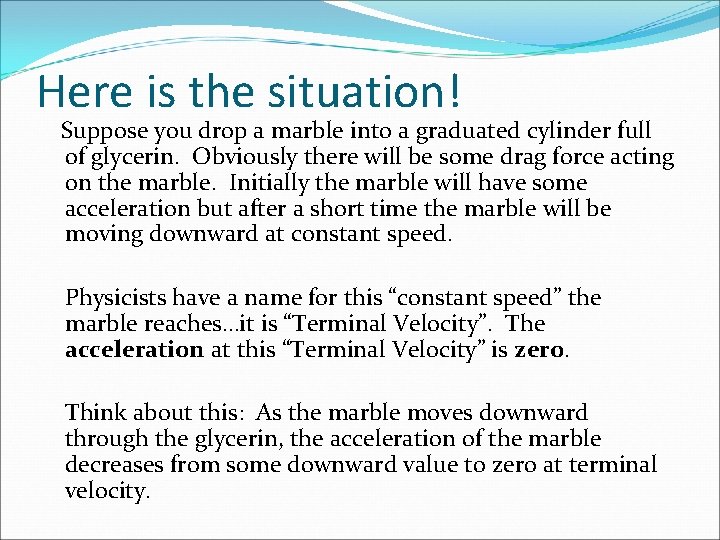
Here is the situation! Suppose you drop a marble into a graduated cylinder full of glycerin. Obviously there will be some drag force acting on the marble. Initially the marble will have some acceleration but after a short time the marble will be moving downward at constant speed. Physicists have a name for this “constant speed” the marble reaches…it is “Terminal Velocity”. The acceleration at this “Terminal Velocity” is zero. Think about this: As the marble moves downward through the glycerin, the acceleration of the marble decreases from some downward value to zero at terminal velocity.
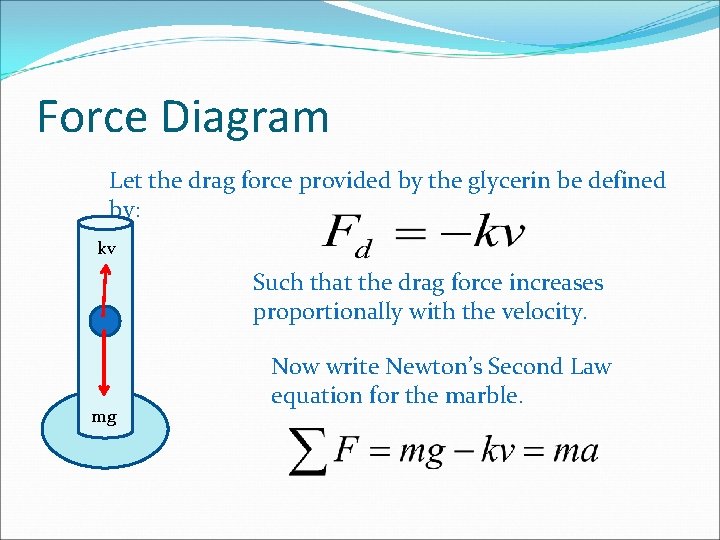
Force Diagram Let the drag force provided by the glycerin be defined by: kv Such that the drag force increases proportionally with the velocity. mg Now write Newton’s Second Law equation for the marble.
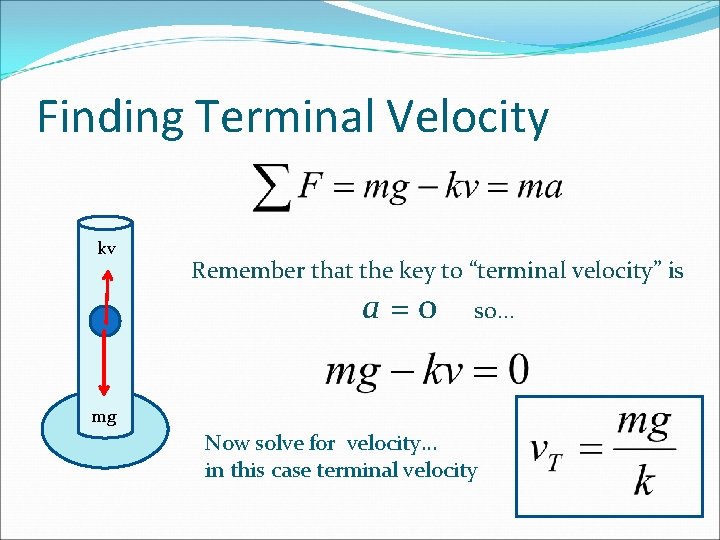
Finding Terminal Velocity kv Remember that the key to “terminal velocity” is a=0 so… mg Now solve for velocity… in this case terminal velocity
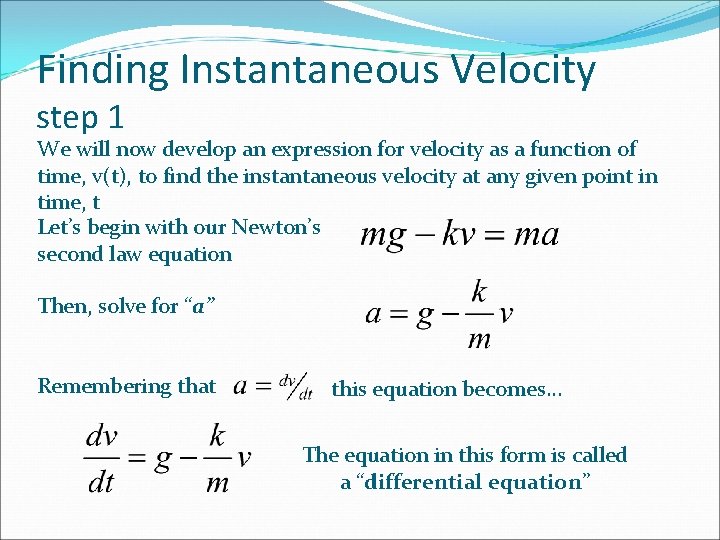
Finding Instantaneous Velocity step 1 We will now develop an expression for velocity as a function of time, v(t), to find the instantaneous velocity at any given point in time, t Let’s begin with our Newton’s second law equation Then, solve for “a” Remembering that this equation becomes… The equation in this form is called a “differential equation”
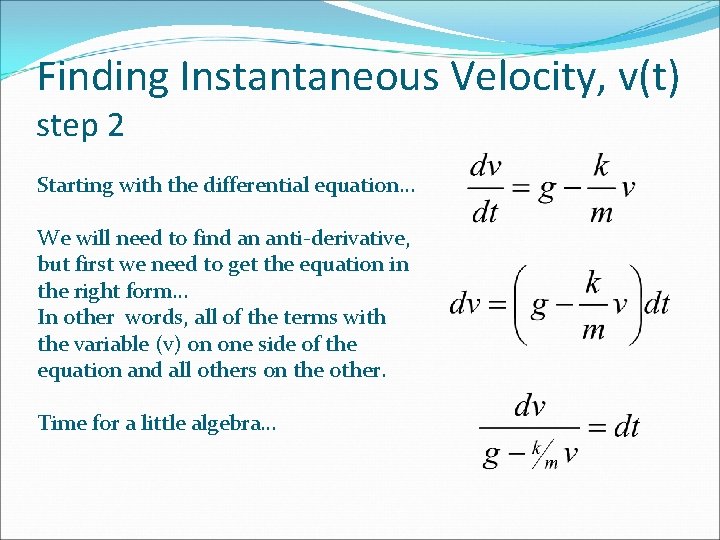
Finding Instantaneous Velocity, v(t) step 2 Starting with the differential equation… We will need to find an anti-derivative, but first we need to get the equation in the right form… In other words, all of the terms with the variable (v) on one side of the equation and all others on the other. Time for a little algebra…
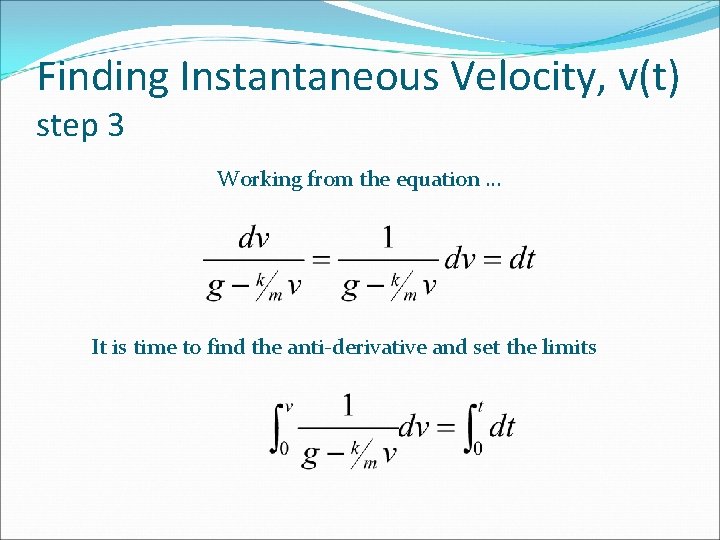
Finding Instantaneous Velocity, v(t) step 3 Working from the equation … It is time to find the anti-derivative and set the limits
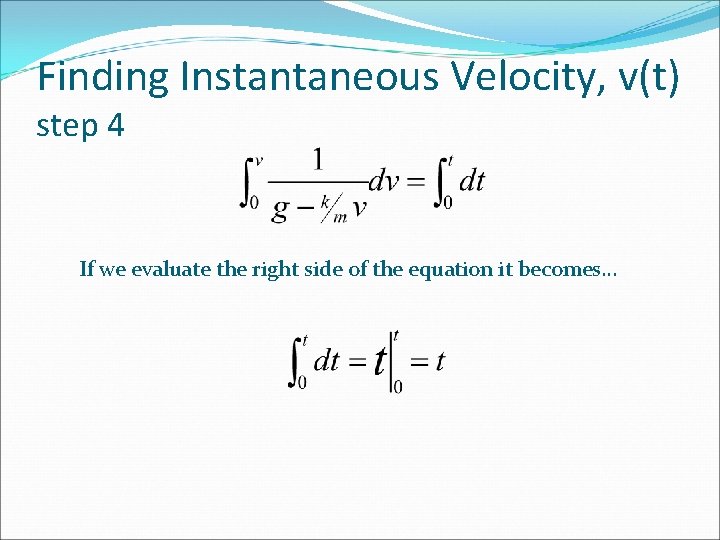
Finding Instantaneous Velocity, v(t) step 4 If we evaluate the right side of the equation it becomes…
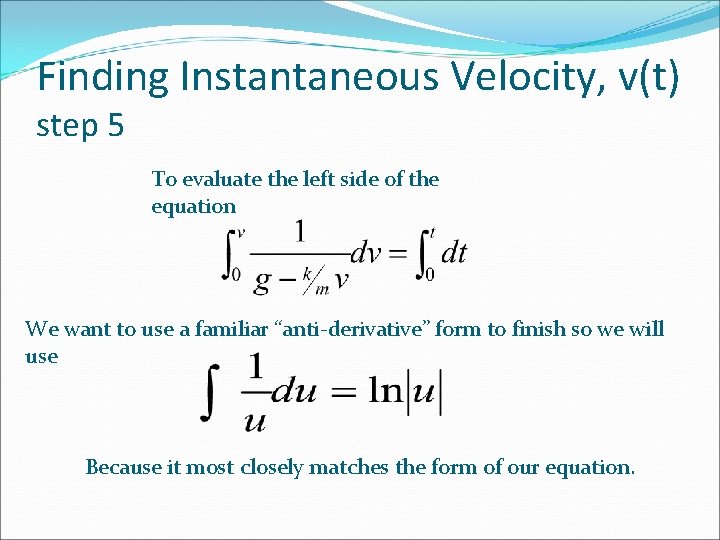
Finding Instantaneous Velocity, v(t) step 5 To evaluate the left side of the equation We want to use a familiar “anti-derivative” form to finish so we will use Because it most closely matches the form of our equation.
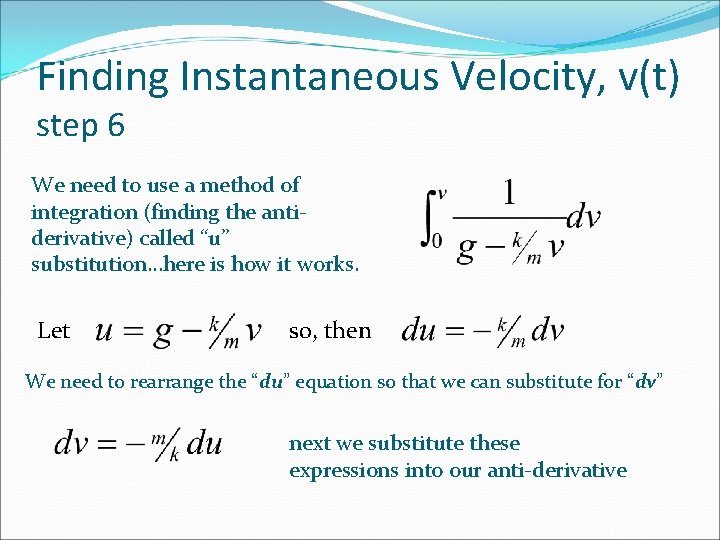
Finding Instantaneous Velocity, v(t) step 6 We need to use a method of integration (finding the antiderivative) called “u” substitution…here is how it works. Let so, then We need to rearrange the “du” equation so that we can substitute for “dv” next we substitute these expressions into our anti-derivative
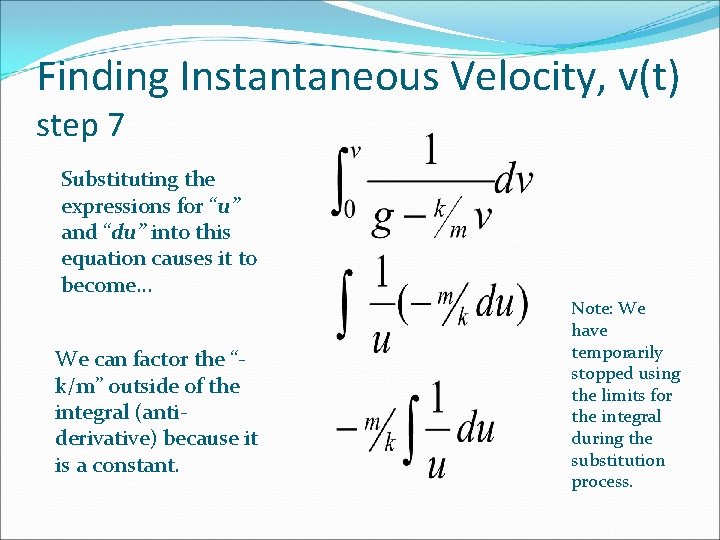
Finding Instantaneous Velocity, v(t) step 7 Substituting the expressions for “u” and “du” into this equation causes it to become… We can factor the “k/m” outside of the integral (antiderivative) because it is a constant. Note: We have temporarily stopped using the limits for the integral during the substitution process.
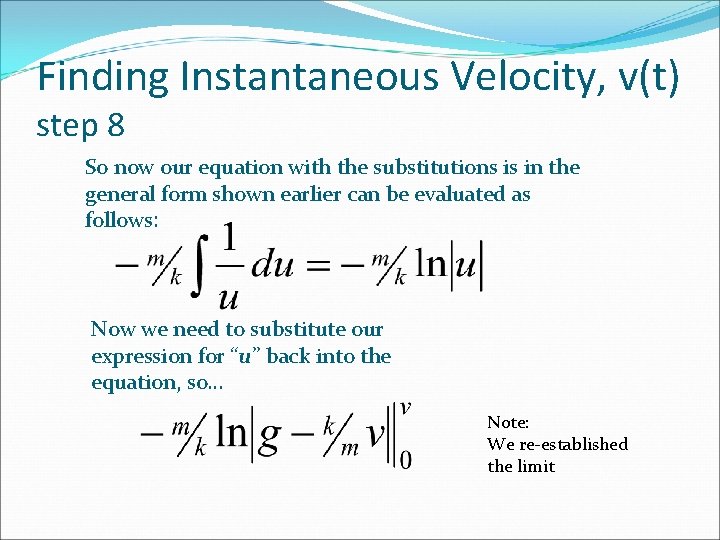
Finding Instantaneous Velocity, v(t) step 8 So now our equation with the substitutions is in the general form shown earlier can be evaluated as follows: Now we need to substitute our expression for “u” back into the equation, so… Note: We re-established the limit
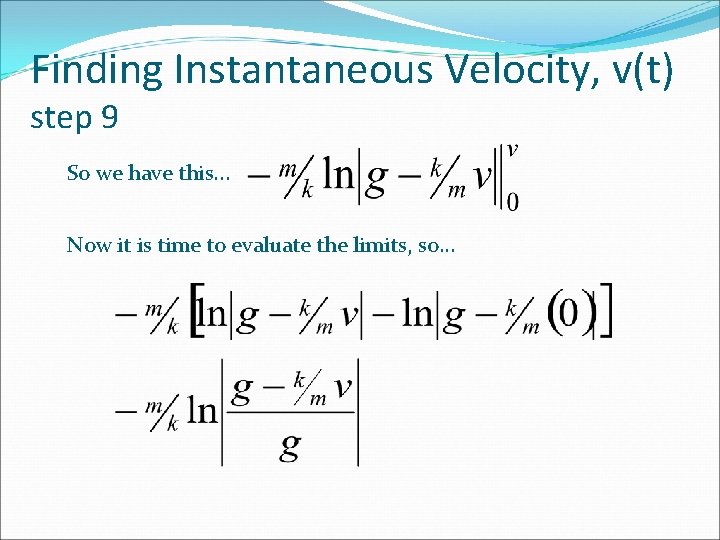
Finding Instantaneous Velocity, v(t) step 9 So we have this. . . Now it is time to evaluate the limits, so…
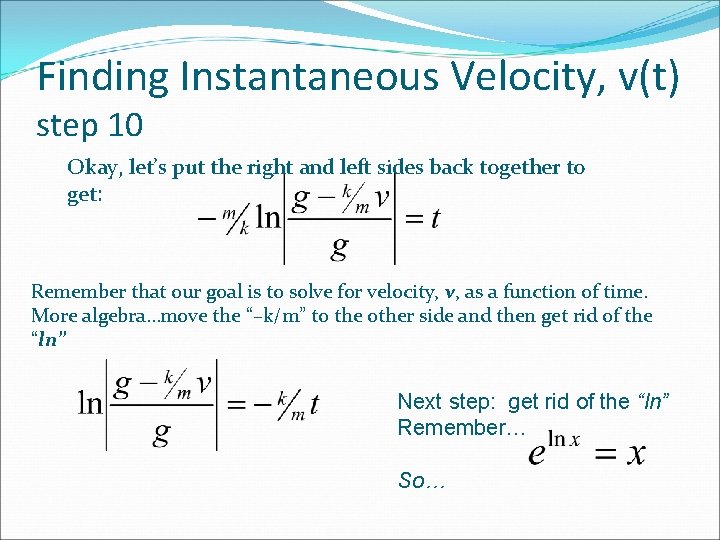
Finding Instantaneous Velocity, v(t) step 10 Okay, let’s put the right and left sides back together to get: Remember that our goal is to solve for velocity, v, as a function of time. More algebra…move the “–k/m” to the other side and then get rid of the “ln” Next step: get rid of the “ln” Remember… So…
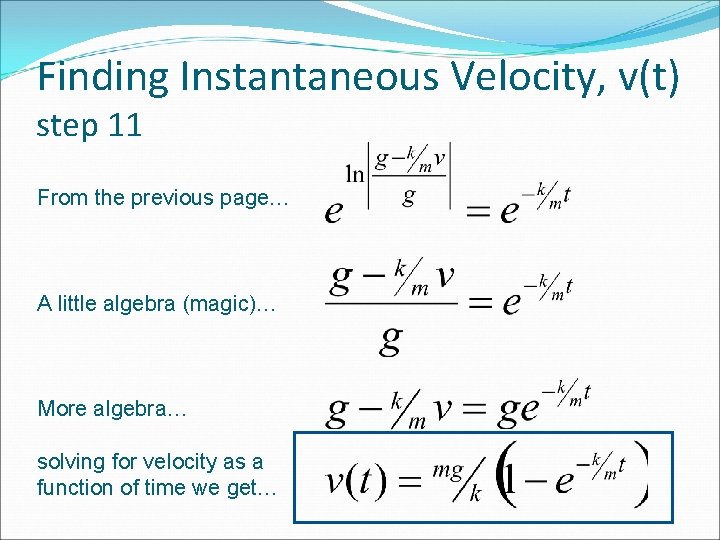
Finding Instantaneous Velocity, v(t) step 11 From the previous page… A little algebra (magic)… More algebra… solving for velocity as a function of time we get…