
Drafting the US Constitution Drafting the Constitution n
- Slides: 10
Drafting the US Constitution
Drafting the Constitution n Between 1781 and 1787 it became clear that the Articles of Confederation were not working – Too many weaknesses – Shays’s Rebellion- Farmers in Western MA rebelled due to high taxation and too much debt on their farms
Drafting the Constitution n May 1787 - Delegates from 12 states (no Rhode Island) meet to “revise” the Articles of Confederation – George Washington elected presiding officer – Other attendees include: Ben Franklin, John Adams, Alexander Hamilton, James Madison, Roger Sherman *Thomas Jefferson does not attend the Constitutional Convention
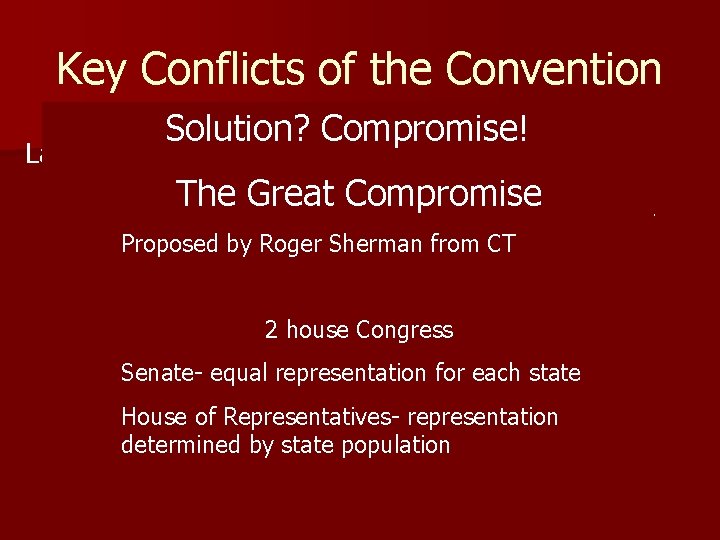
Key Conflicts of the Convention Solution? Compromise! n Small States VS. Large States – Congress should – Congress. The should. Great be Compromise be composed of 1 composed of 2 houses house Proposed by Roger Sherman from CT – votes should be – Each state should assigned according to have 1 vote population of the state 2 house Congress– State governments Senateequal representation for governments each state should be weaker than should remain the federal House of Representatives- representation stronger than the government determined by state population federal government
Key Conflicts at the Convention n North Solution? VS. Compromise! n South – Slaves should not be – Slaves should be The 3/5 Compromise counted when deciding counted when the number of count as 3 “Real determining Every 5 slaves People” for both delegates congressional taxation and representation purposes representation – Slaves should be counted when levying – Slaves should not be taxes counted when levying taxes
Other important aspects of the Constitution n 7 Articles divide the government into 3 branches 1. Legislative- bicameral 2. Executive 3. Judicial n The Constitution stipulates the powers and limitations of each branch of government
Other important aspects of the Constitution n The Constitution establishes a “limited government” – The federal (national government) can do only those things written in the Constitution. Everything else is state authority.
Other important aspects of the Constitution n Separation of Powers invented to keep one branch from becoming too powerful -executive enforces laws -legislative passes laws (statutes) -judicial clarifies and establishes laws
Critical Thinking Questions n In what ways did the new system of government fulfill the nation’s need for a stronger central government and at the same time allay its fear of a government having too much power? n What was the Great Compromise and how did it reconcile the interests of the small states with the interests of the more populous states?
Other important aspects of the Constitution checks and balances n tools used by 1 branch to keep other branches in check 1. Executive branch has veto power 2. Legislative branch- investigation of actions, impeachment, veto override 3. Judicial Branch- judicial review Can declare laws null and void