
DRAFTING THE STANDARD TABLE OF CONTENTS Draft Development
DRAFTING THE STANDARD
TABLE OF CONTENTS § Draft Development Guide – Key Considerations § Patent Information § Copyright Information § Getting Started § IEEE SA Template Instructional Videos § Classification of Standards § Verb Usage § Additional Resources § IEEE SA Staff Support 2
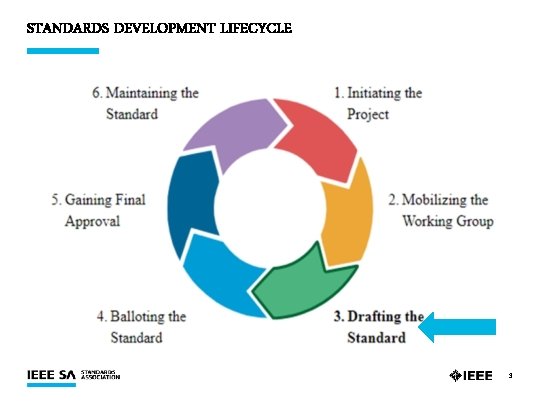
STANDARDS DEVELOPMENT LIFECYCLE 3
DRAFT DEVELOPMENT GUIDE § Keep the Scope and Purpose of the PAR central at all times – this is what the IEEE SA Standards Board will be evaluating the draft against. § Develop an outline of the draft to serve as the structure for the standard. § Assign clause leads amongst working group members. o Subgroups can be created to develop sections of the draft. § Avoid writing the document in the WG meeting. o Use the meeting times to discuss clause leads/assignments, draft goals and milestones, make motions and decisions, provide technical contributions § Consider using a technical editor to gather inputs and ensure technical consistency. § Do not make the draft public. Do not share the draft with people who are not participants of the WG. § Approval must be obtained by the WG to move the draft forward for balloting – and captured in the minutes. § The WG will need to submit the final draft to the Standards Committee for approval to go to Ballot. § Always refer to your WG Policy & Procedures to ensure conformity. 4
PATENT INFORMATION § The WG Chair shall request a Letter of Assurance (LOA) from potential essential patent holders. o Early identification of holders of potential essential patent claims is encouraged. o Please review the IEEE SA Patent Information found here: IEEE SA Patent Information If you have questions, contact the IEEE SA Standards Board Patent Committee Administrator at patcom@ieee. org 5

COPYRIGHT INFORMATION Every draft version has to be labeled with the appropriate copyright notices. § These notices provide copyright protection. The IEEE SA Standards Style Manual explains the proper wording for these notices. § If you're using material from another document, you need to ensure that the copyright owner has granted permission. Even if material is borrowed from an IEEE publication. § Click the following links to learn more about Copyright. o IEEE Standards Association Copyright Policy For Contributions o Copyright FAQs 6

GETTING STARTED § Refer to the IEEE SA Style Manual for document structure. § Utilize the current IEEE SA draft templates available in: o MS WORD o Frame. Maker 7
IEEE SA TEMPLATE INSTRUCTIONAL VIDEOS The following instructional videos were developed to help WGs successfully use the IEEE SA templates for creating a draft standard. § Video #1 Getting Started with the Template § Video #2 Composing Your Draft in the Template § Video #3 Adding Figures & Tables in the Template § Video #4 Adding Annexes, Creating a Bibliography, and Inserting Cross-References in the Microsoft Template 8
CLASSIFICATION OF STANDARDS Standards: documents with mandatory requirements. § Shall indicates mandatory requirements to be strictly followed without deviation in order to conform to the standard. Recommended practices: documents in which procedures and positions preferred by the IEEE are presented. § Should indicates a particular recommendation among several possibilities without mentioning or excluding others; or that a certain course of action is preferred but not necessarily required. Guides: documents in which alternative approaches to good practice are suggested but no clear-cut recommendations are made. § May indicates a course of actions permissible within the limits of a standard. § Can indicates possibility and capability. Trial-Use documents: publications in effect for not more than three years (See subclause 5. 7. of the IEEE SA Standards Board Operations Manual). They can be any of the categories of standards publications listed above. 9
VERB USAGE Deprecated Verbs § The use of must is deprecated for use when stating mandatory requirements and shall only be used for unavoidable situations. § The use of will is deprecated for use when stating mandatory requirements and shall only be used in statements of fact. Although it is permissible to use various verbs within a document, the predominant verb usage shall correspond to the type of document being written. Absolute Verbiage § Avoid making explicit or implicit guarantees if there is a possibility of unforeseen situations or circumstances altering the outcome. § Words to avoid: ensure, guarantee, always. Safety § Avoid the use of the word ‘safe’ in a standard unless the condition or practice referenced by the word safe has been tested under all cases as being, in fact, safe. This is unlikely. 10
ADDITIONAL RESOURCES § Here is an editable IEEE Project Timeline to help the WG plan your draft development. § Please peruse the IEEE GET Program to check out IEEE standards available at no cost for your review of how certain standards are written. o Suggested example is GET 802(R) Standards § e. Tools - IEEE SA offers a variety of tools to assist in the standards development process. For assistance with requesting access to any of the tools, please contact your IEEE SA Program Manager. 11
IEEE SA STAFF SUPPORT Staff support to the WG during draft development includes: § Request supporting standards for WG review § Request for Base standard in Word Template § Provide Copyright permission letters templates § Provide Patent (LOA) material § Access to Standards Dictionary § Answer Standards Development Process questions § Guidance on Draft sharing § Guidance on SA Balloting 12
THANK YOU 13
- Slides: 13