
DRAFTING A CODE FOR WIRELESS COMMUNICATION FACILITIES Disclaimer

- Slides: 22
DRAFTING A CODE FOR WIRELESS COMMUNICATION FACILITIES Disclaimer: This session presents a brief background of the Telecommunications Act; What is the Spectrum Act– Why is it important to drafting an Ordinance and the most recent FCC Ruling. This presentation is presented through the lens of how the City of Pocatello addressed WCF’s – The Objective of this session is to present basic information that will be helpful in drafting a WCF Ordinance.
BACKGROUND FEDERAL COMMUNICATIONS COMMISSION (FCC) 1996 Health & Safety standards were set forth on Radio Radiation Frequency Emissions (RFR) Same time Congress passed the Telecommunications Act of 1996 Act Prohibits State & Local Govts from denying applications based upon environmental effects of RFR if FCC’s guidelines are followed
SPECTRUM ACT Adopted as part of the Middle Class Tax Relief & Job Creation Act of 2012 – specifically contained under Section 6409 47 U. S. C. 1455 Intended to “Advance Wireless Broadband Service” Key Ruling – A State or Local Govt. MAY NOT DENY, & SHALL APPROVE, Any “Eligible Facilities” request for a modification of an existing Wireless Tower or Base Station that does not “Substantially Change the physical dimensions of such Tower or Base Station”
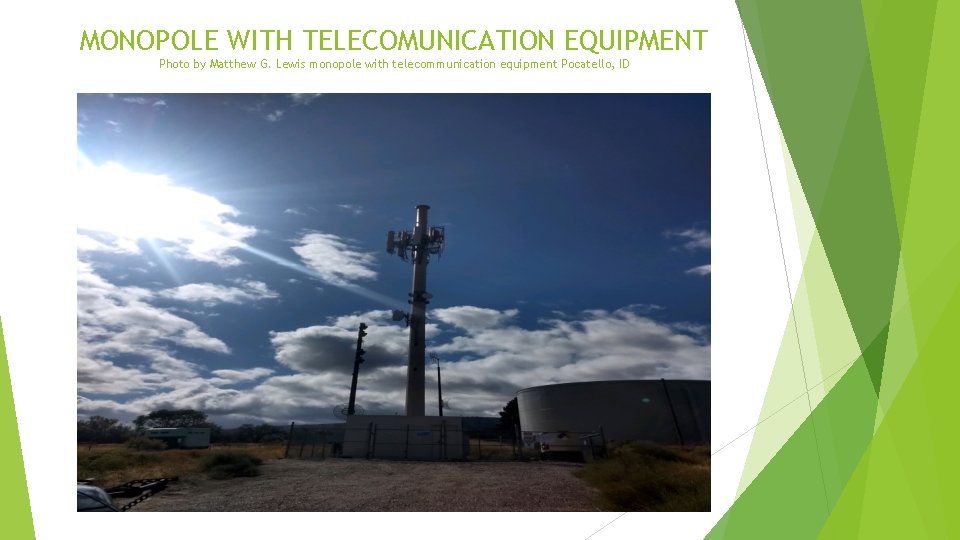
MONOPOLE WITH TELECOMUNICATION EQUIPMENT Photo by Matthew G. Lewis monopole with telecommunication equipment Pocatello, ID
FCC ADOPTED ADDITIONAL RULES Unclear Definitions/Interpretations included - what is “Eligible Facilities” request? What is “Substantial Change” to the Physical Dimensions of a Tower or Base Station? What is an existing “Tower or Base Station”? December 17, 2014 FCC Adopted Regulations Implementing Section 6409(a) taking effect on April 9, 2015 The Rules Defined Terms that were not Defined in the Spectrum Act including “Eligible Support Structure”, “Existing”, “Substantial Change”, & “Wireless Tower”
ELIGIBLE FACILITIES REQUEST Is any request for modification of an existing wireless tower or base station that involves: Collocation of new transmission equipment Removal of transmission equipment Replacement of transmission equipment Based on the Spectrum Act & FCC rules a revised WCF Ordinance was drafted and approved by the City Council November 2016
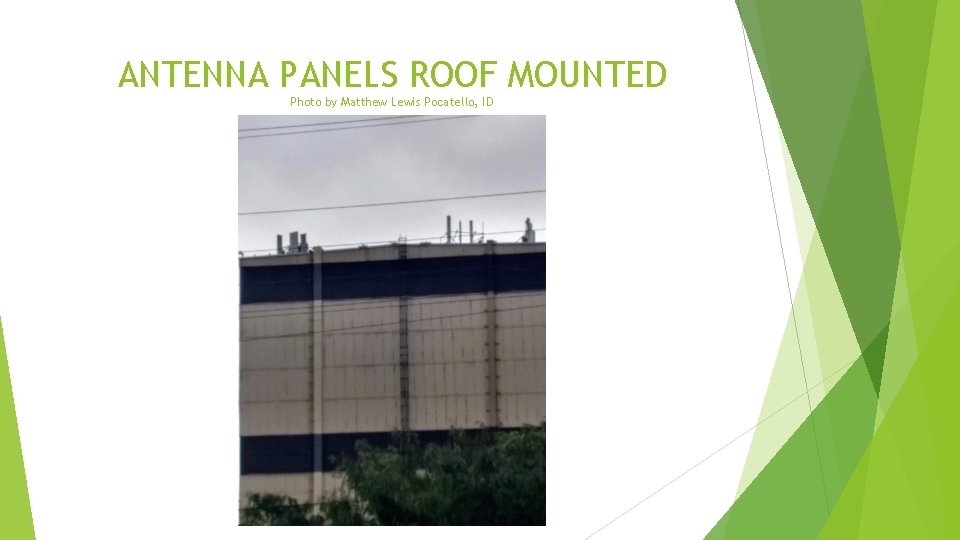
ANTENNA PANELS ROOF MOUNTED Photo by Matthew Lewis Pocatello, ID
RECENT FCC RULES APPROVED September 26, 2018 the FCC approved a new rule: The Streamlining Deployment of Next Generation Wireless Infrastructure Declaratory Ruling & Third Report Order- On 5 G Wireless network deployment that curtails local authority – What did the FCC Decision DO? It limits fees local governments may assess on telecommunications companies for placement, construction or co-location of new wireless facilities
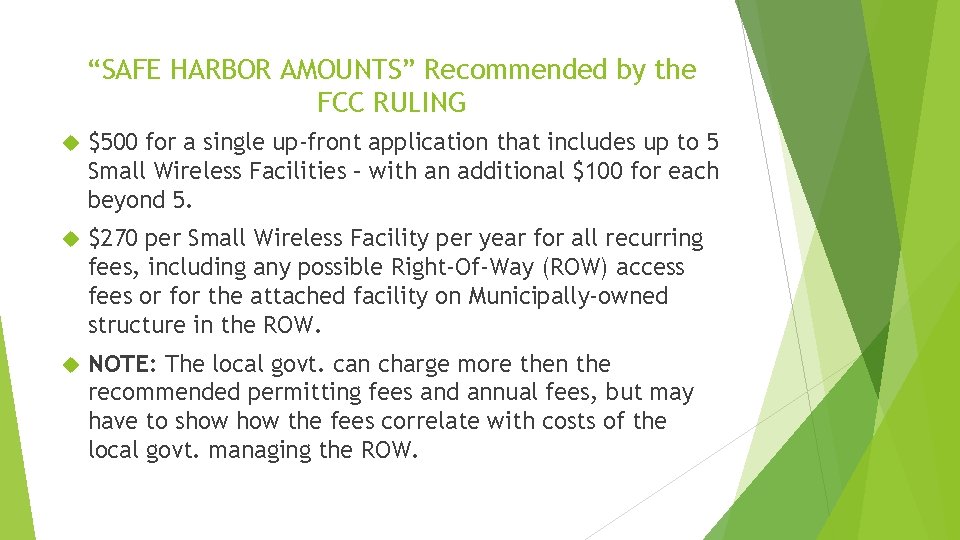
“SAFE HARBOR AMOUNTS” Recommended by the FCC RULING $500 for a single up-front application that includes up to 5 Small Wireless Facilities – with an additional $100 for each beyond 5. $270 per Small Wireless Facility per year for all recurring fees, including any possible Right-Of-Way (ROW) access fees or for the attached facility on Municipally-owned structure in the ROW. NOTE: The local govt. can charge more then the recommended permitting fees and annual fees, but may have to show the fees correlate with costs of the local govt. managing the ROW.
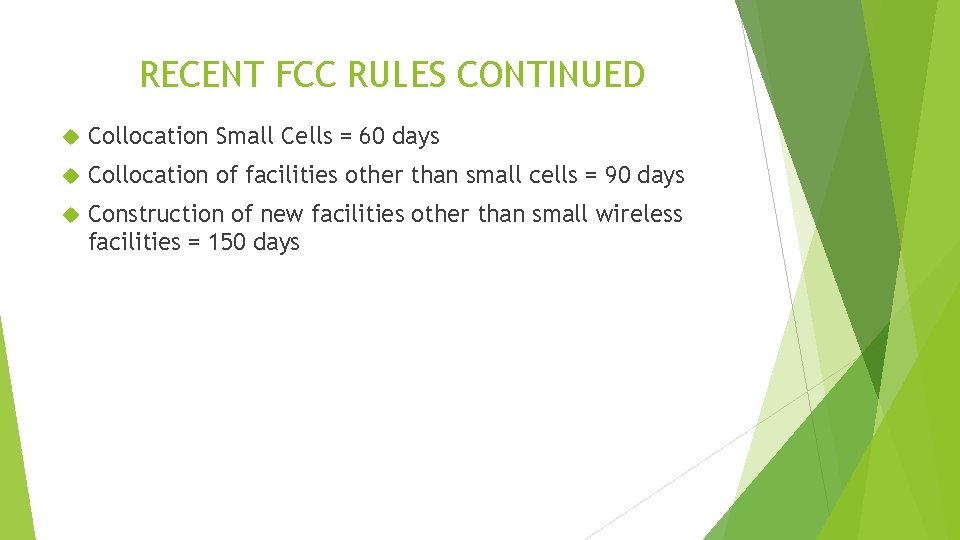
RECENT FCC RULES CONTINUED Collocation Small Cells = 60 days Collocation of facilities other than small cells = 90 days Construction of new facilities other than small wireless facilities = 150 days
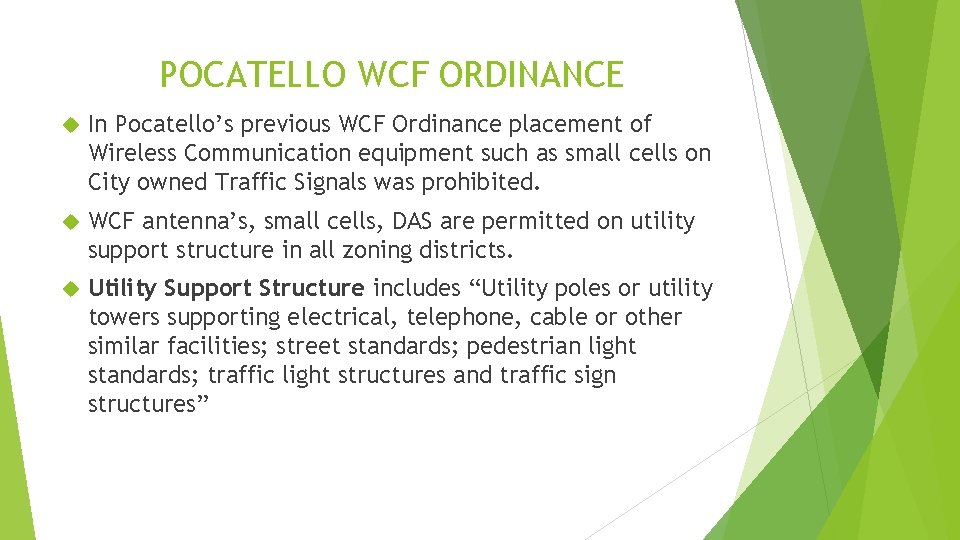
POCATELLO WCF ORDINANCE In Pocatello’s previous WCF Ordinance placement of Wireless Communication equipment such as small cells on City owned Traffic Signals was prohibited. WCF antenna’s, small cells, DAS are permitted on utility support structure in all zoning districts. Utility Support Structure includes “Utility poles or utility towers supporting electrical, telephone, cable or other similar facilities; street standards; pedestrian light standards; traffic light structures and traffic sign structures”
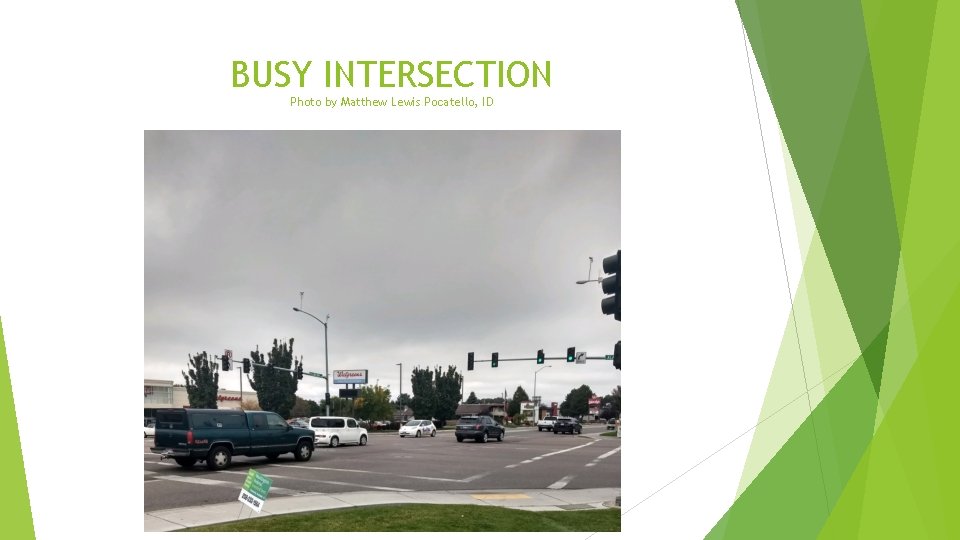
BUSY INTERSECTION Photo by Matthew Lewis Pocatello, ID
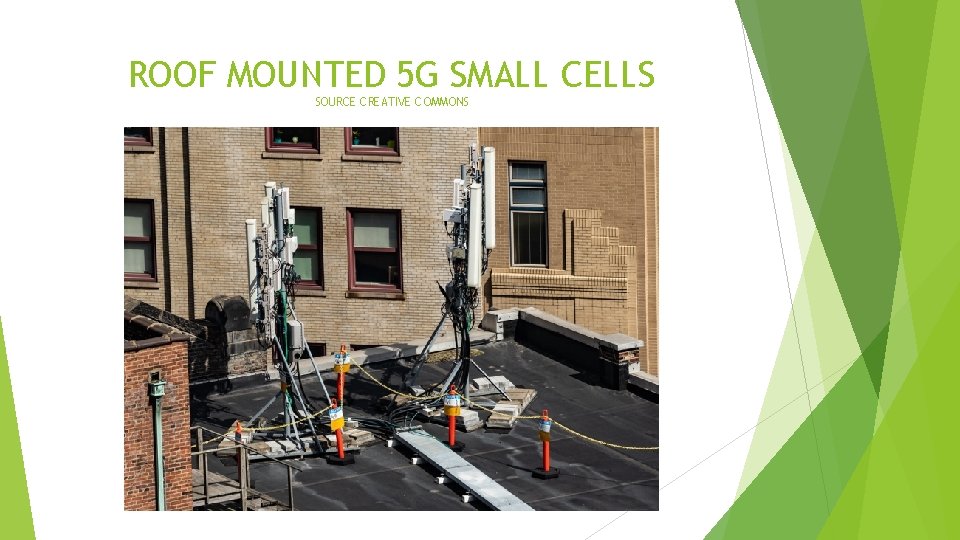
ROOF MOUNTED 5 G SMALL CELLS SOURCE CREATIVE COMMONS
Pocatello WCF Code Section 15. 42. 040 Types of WCF Permits Required A TYPE 1 WCF permit shall be required for an “eligible facilities request” 1. Collocation of new transmission equipment; 2. The removal of transmission equipment; 3. The replacement or modification of transmission equipment; 4. Distributed antenna systems and small cells A TYPE 2 WCF permit includes the following: 1. Any modification of an eligible support structure, including the collocation of new equipment, that substantially changes the physical dimensions of the eligible support structure on which it is mounted; or 2. Any collocation not eligible for a TYPE 1 permit; or 3. Any roof mounted antenna & support system for an antenna not exceeding 10 feet above the highest portion of the roof. Note that TYPE 1 & 2 Applications are approved administratively
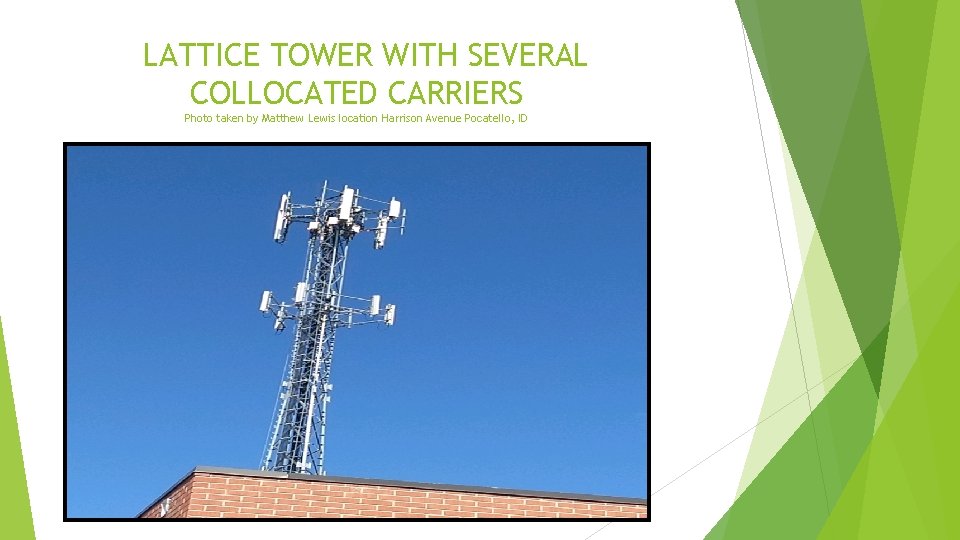
LATTICE TOWER WITH SEVERAL COLLOCATED CARRIERS Photo taken by Matthew Lewis location Harrison Avenue Pocatello, ID
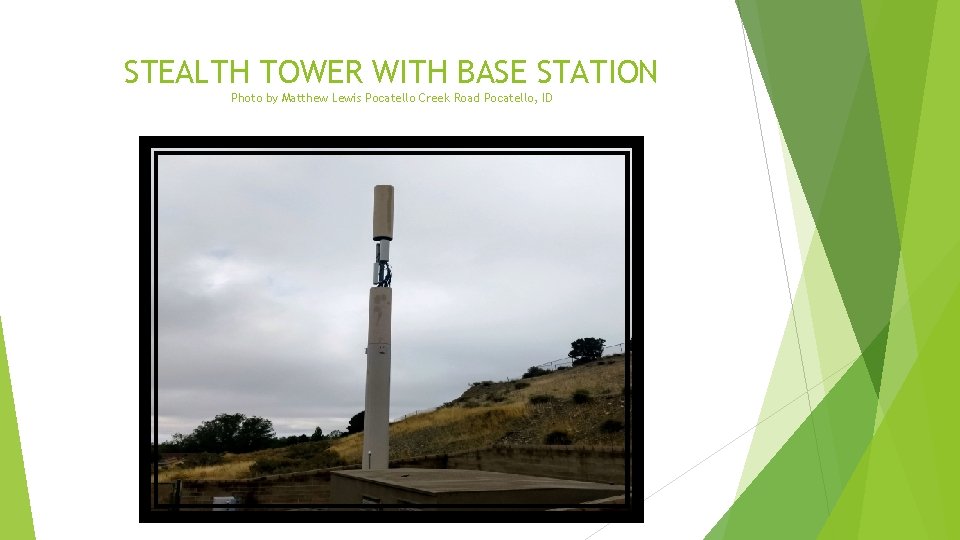
TYPE 3 WCF AND DEFINITIONS A TYPE 3 WCF permit shall be required for siting of any new WCF “tower” that is not a collocation subject to a TYPE 1 or 2 permit. New towers are NOT permitted in public Right-Of-Ways. A “Tower”-“Includes any structure built for the sole or primary purpose of supporting any wireless communication facility”. A new Tower in all Residential & Mixed Use Districts may be conditionally permitted only on City owned property following a public hearing before the City Council. The Tower shall be of stealth design – examples include towers disguised as trees, use of earth tone colors, flagpoles, bell towers, and architecturally screened roof mounted antennas.
STEALTH TOWER WITH BASE STATION Photo by Matthew Lewis Pocatello Creek Road Pocatello, ID
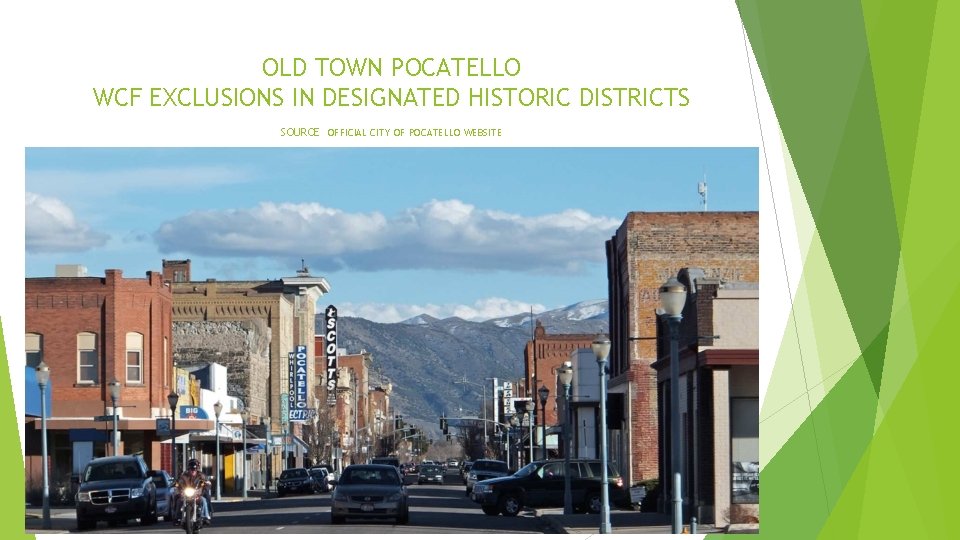
OLD TOWN POCATELLO WCF EXCLUSIONS IN DESIGNATED HISTORIC DISTRICTS SOURCE OFFICIAL CITY OF POCATELLO WEBSITE
WCF & DESIGNATED HISTORIC DISTRICTS Certificate of Appropriateness: Applications submitted for a WCF within the Downtown Historic District or within 250 feet of the boundary, must be reviewed by the Pocatello Historic Preservation Commission accompanied by a Certificate of Appropriateness. There are exclusions: 1. There’s an exclusion from FCC National Historic Preservation Act (NHPA) review for collocations on existing utility structures including utility poles and electric transmission towers only where the deployment meets specified size limitations & involves no new ground disturbance. 2. There is an exclusion for collocations on utility structures where Historic Preservation review is currently required under existing rules solely because the structures are more than 45 years old 3. Collocations on buildings & other non-tower structures allow exclusions permitted with the following conditions: a. There must be an existing antenna on the building or structure b. The new antenna must comply with all zoning conditions & historic preservation conditions applicable to existing antennas in the same vicinity that directly mitigate or prevent adverse visual effects, such as camouflage requirements; and c. The deployment must involve no new ground disturbance
Idaho Statute Sections 54 -1202 & 54 -1227 Question was asked of Idaho Society Professional Land Surveyor Board of Directors – “Do easements and lease areas require monuments? ” In the fall/winter edition of the Board’s News Bulletin No. 56 the Board answered “YES” As such Pocatello’s WCF Ordinance Chapter 15. 42. 080 G. reads, Idaho Statute 55 -2904.
HELPFUL RESOURCES BLOG September 26, 2018 by Arthur Scott, Zach George, FCC curtails local control in 5 G deployment order; Municipal Action Guide -Small Cell Wireless Technology in Cities; National League of Cities; 2018 FCC Ruling Strips Small Cell Local Control Mechanisms, September 27, 2018 Government Technology originally published in Governing; by Mike Maciag, Governing; FCC’s Wireless Facility Rules Implementing Section 6409(A); League of California Cities City Attorney’s Spring, Wednesday, May 6, 2015; Prepared by: Harriet A. Steiner, Partner, Best & Krieger LLP; Joshua Nelson, Associate, Best & Krieger LLP; New 5 G equipment creates conflict in downtowns; Downtown Idea Exchange; Volume 66, No. 7 July 2019. FCC Removes Regulatory Barriers to Deployment of Infrastructure Used in 5 G Wireless Services, October 3, 2018; Mitchell F. Bretcher; Debra Mc. Guire Mercer; Technology, Media & Telecommunications Federal Regulatory & Administrative Law – Washington, D. C.
THANK YOU QUESTIONS