
DRAFT Promotional Copy for NNSDO Cognitive Mental Status


- Slides: 21
DRAFT Promotional Copy for NNSDO Cognitive / Mental Status Assessment of Older Adults 1
Objectives n Identify the importance of mental status assessment in older adults n Define and identify the components of mental status assessment n Assess mental status using validated tool – Folstein Mini-Mental Status Examination (MMSE) n Assess mood using validated tool – Yesavage Geriatric Depression Scale (GDS) and Cornell Depression Scale (CDS) – identifying strengths and limitations 2
Cognitive Impairment Statistics 4 to 5 million older adults experience cognitive impairment n Dementia in the community ¨ 5% of 65 – 75 years old ¨ 25 to 30% of ages 85+ ¨ 60% nursing home residents n 3
Where are they? n 80% of all medical care for dementia occurs in (1) Doctors’ offices; (2) Hospital settings, and (3)Nursing homes n Outpatient settings: ¨ Few patients are screened UNLESS cognitive impairment is apparent ¨ Unrecognized delirium or cognitive deficits in 30 – 40% of emergency department older adults 4
The value of cognitive screening n Detects noncomplaining but impaired older adults n Dementia delirium or cognitive deficits almost always undiagnosed n Patients screened ONLY when cognitive impairment is apparent 5
Mental Status Assessment n Cognitive function decline: dementias, delirium, and impaired thought process n Indicators of general cognitive loss: declining scores on tests of memory n Mental Status Assessment screens for changes in cognition and mood but does not diagnose 6
Cognitive assessment n Identify the presence of and monitor the course of dementia, depression, or delirium n Determines readiness to learn n Evaluates effectiveness of treatment regimen 7
Components of Mental Status Assessment Alertness / Level of Consciousness n Attention n Comprehension n Construction n Emotional Status n Higher Memory Function n 8
Components of Mental Status Assessment n Insight n Intelligence n Judgment n Memory n Orientation to time, place, and person 9
Components of Mental Status Assessment n Perception n Physical appearance n Psychomotor behavior n Speech and language n Thinking 10
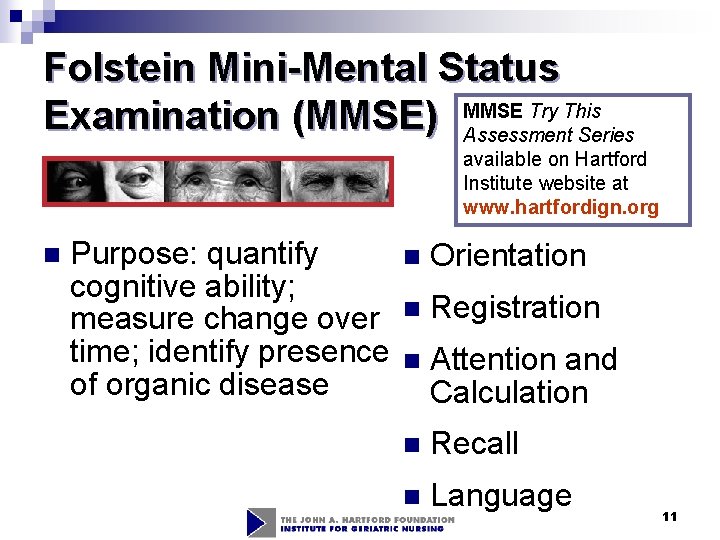
Folstein Mini-Mental Status Try This Examination (MMSE) MMSE Assessment Series available on Hartford Institute website at www. hartfordign. org n Purpose: quantify cognitive ability; measure change over time; identify presence of organic disease n Orientation n Registration n Attention and Calculation n Recall n Language 11
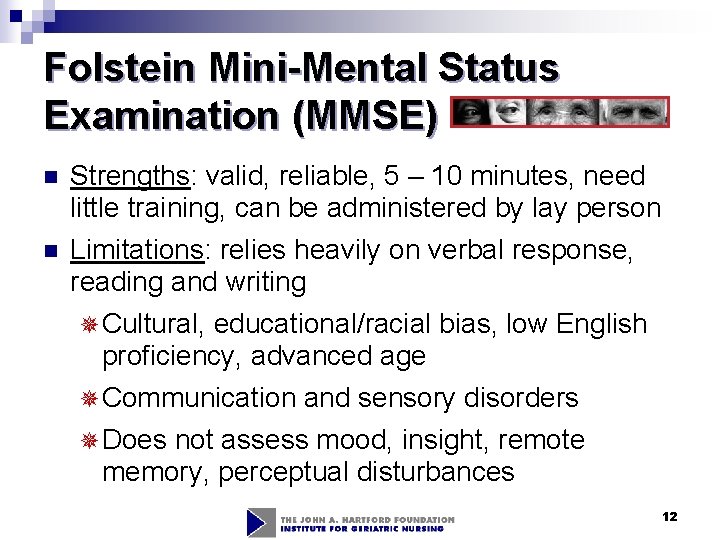
Folstein Mini-Mental Status Examination (MMSE) n Strengths: valid, reliable, 5 – 10 minutes, need little training, can be administered by lay person n Limitations: relies heavily on verbal response, reading and writing ¯ Cultural, educational/racial bias, low English proficiency, advanced age ¯ Communication and sensory disorders ¯ Does not assess mood, insight, remote memory, perceptual disturbances 12
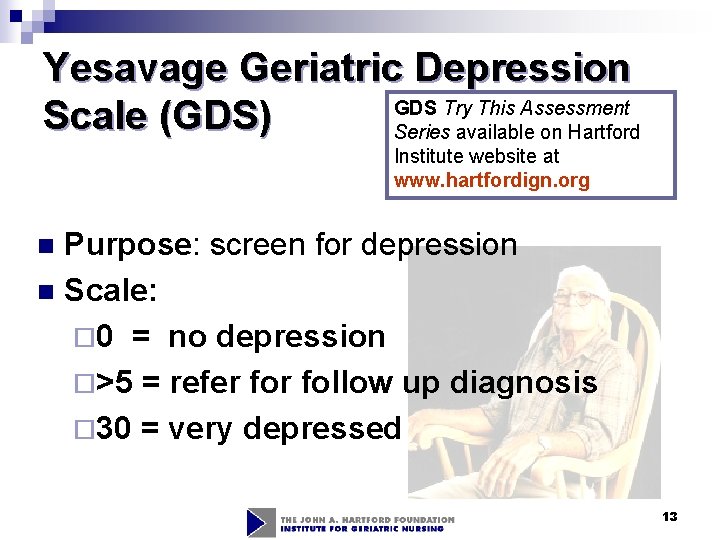
Yesavage Geriatric Depression GDS Try This Assessment Scale (GDS) Series available on Hartford Institute website at www. hartfordign. org Purpose: screen for depression n Scale: ¨ 0 = no depression ¨>5 = refer follow up diagnosis ¨ 30 = very depressed n 13
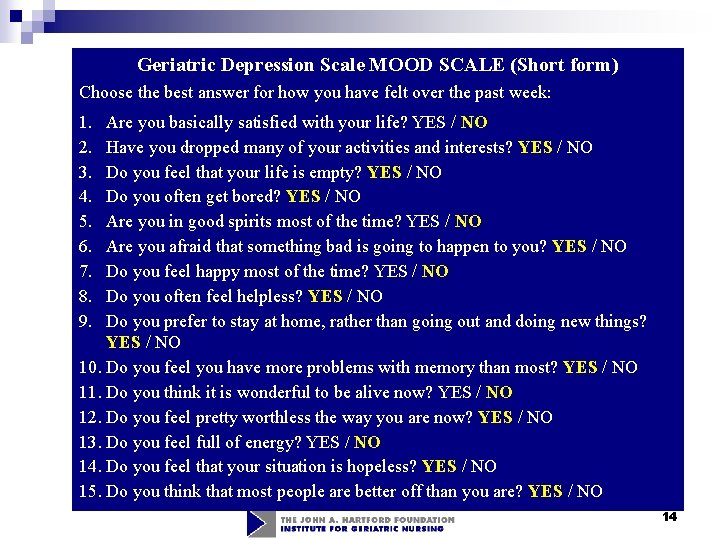
Geriatric Depression Scale MOOD SCALE (Short form) Choose the best answer for how you have felt over the past week: 1. 2. 3. 4. 5. 6. 7. 8. 9. Are you basically satisfied with your life? YES / NO Have you dropped many of your activities and interests? YES / NO Do you feel that your life is empty? YES / NO Do you often get bored? YES / NO Are you in good spirits most of the time? YES / NO Are you afraid that something bad is going to happen to you? YES / NO Do you feel happy most of the time? YES / NO Do you often feel helpless? YES / NO Do you prefer to stay at home, rather than going out and doing new things? YES / NO 10. Do you feel you have more problems with memory than most? YES / NO 11. Do you think it is wonderful to be alive now? YES / NO 12. Do you feel pretty worthless the way you are now? YES / NO 13. Do you feel full of energy? YES / NO 14. Do you feel that your situation is hopeless? YES / NO 15. Do you think that most people are better off than you are? YES / NO 14
Yesavage Geriatric Depression Scale (GDS) Strengths ¨Self-rated, yes/no ¨No training required ¨Effective screen for MINOR depression ¨Used for physically healthy and physically ill, and cognitively impaired with MMSE >15. 15
Yesavage Geriatric Depression Scale (GDS) Limitations ¨Cannot be used if client cannot selfreport such as those with severe depression and / or psychosis ¨Questionable reliability with MMSE <15 ¨Cannot discriminate between clinical diagnostic categories and changes over time 16
Cornell Scale for Depression in Dementia (CSDD) Purpose: screen for depression in older adults with dementia n Scoring n 0 = no depression n 2 = probable depression n 19 = severe depression n Those patients with a score of 12 or above should be referred for followup diagnosis. n 17
Cornell Scale for Depression in Dementia (CSDD) (Tool available for viewing online at http: //www. aafp. org/afp/20020915/1001. html) Strength n Able to assess for depression in clients with Advanced dementia Limitations n Requires clinician n Not self-administered n Takes longer 18
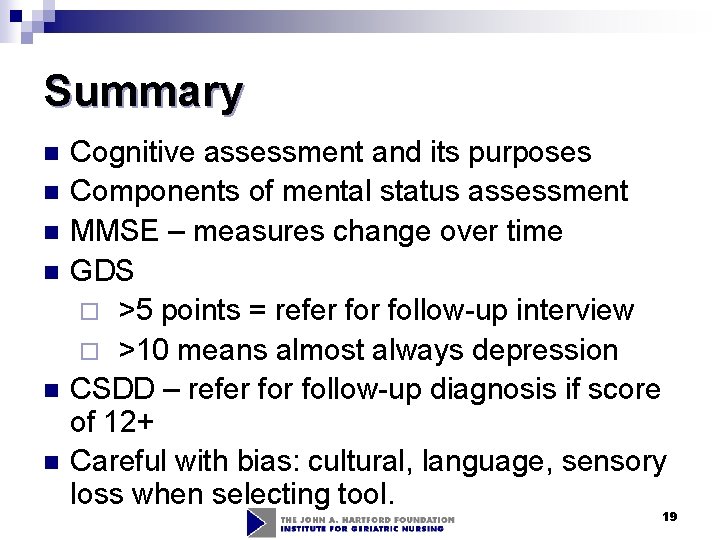
Summary n n n Cognitive assessment and its purposes Components of mental status assessment MMSE – measures change over time GDS ¨ >5 points = refer follow-up interview ¨ >10 means almost always depression CSDD – refer follow-up diagnosis if score of 12+ Careful with bias: cultural, language, sensory loss when selecting tool. 19
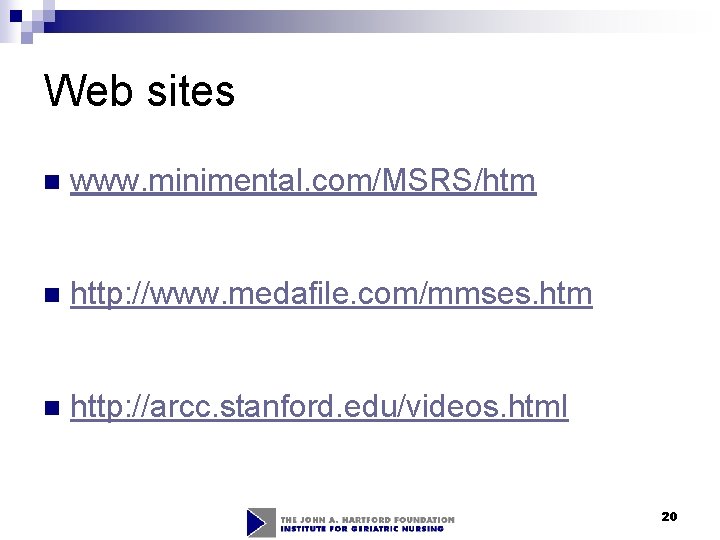
Web sites n www. minimental. com/MSRS/htm n http: //www. medafile. com/mmses. htm n http: //arcc. stanford. edu/videos. html 20
QUESTIONS? 21