
DRAFT Enrons PRC Determination of Success and Suitability
DRAFT Enron’s PRC Determination of Success and Suitability of Enron’s Performance Review process June 11, 2001 Confidential and Proprietary Data here is used for illustrative purposes NOT Actual Data
Table of Contents • Executive Summary • Adoption of PRC within Enron -Effects of Enron’s PRC • Upward Executive Mobility • Churn / Career Movement • Separations • Contribution Loss • Incentive Pay and Earnings Correlation • Income Contribution from PRC units • External Benchmarking • Why Companies Use Forced Rankings • How Enron’s Process Compares • Advantages of a 360 degree / Ranking process vs. a Vertical Process • Risk Mitigation • Supplemental Data Confidential and Proprietary ATTORNEY-CLIENT PRIVILEDGE 2
Points for illustrative purposes only NOT based on Actual Data yet Executive Summary • Upward Executive Mobility • For VPs and MDs, average time between promotions in PRC participating units is lower at one year than non-participating units at two-plus years. Employees advance quicker to the Executive Level in these units, suggesting that PRC enables the identification of top talent and provides immediate rewards. • More VPs and MDs are promoted from within PRC participating units than non-participating units. Those executives have been, on average, more successful than direct hires into executive positions suggested by the continued advancement, number of top leadership positions, and retention. • The gross margin contribution is greatest among those identified as top talent from PRC, suggesting that PRC directly links performance feedback with shareholder return. Gross Margin contributions continue to increase xx % each year, indicating that PRC raises the bar and allows Enron to identify those who contribute the most to earnings. • Churn / Career Movement • In all units, separation rates were equal indicating that PRC units do not create more voluntary terminations. These units compared to industry comparisons show xxx. PRC allows the enterprise to track how separations impact the company through a new metric, Contribution Loss. • In PRC participating units, overall, employees advance quicker ie. average time between promotions is one year versus three-plus years in non-participating units, suggesting that PRC may enable the identification of top talent more successfully and quicker. • Internal churn is highest among the PRC units, suggesting a more agile culture than their counterpart. These business units tend to move into new markets quicker and profit sooner i. e. first mover advantage. Confidential and Proprietary ATTORNEY-CLIENT PRIVILEDGE 3
Points for illustrative purposes only NOT based on Actual Data yet Executive Summary • Churn / Career Movement (continued) • In February 2000, fifty top performers were identified and moved to a new business unit, EBS, in one week, allowing the organization to be agile and quick to fill new business units with proven top talent. • Incentive Pay and Earnings Correlation • Profitability both for employees and business unit is greatest among PRC units, suggesting that PRC enables a successful incentive pay strategy. • Greatest success in new business growth evident in PRC units, suggesting that these environments promote and reward entrepreneurs. • Over 75% of incomes from new businesses that did not exist ten years ago, originating from PRC units. • 90% of these new businesses are led by top talent identified by a PRC process. • E-Pulse Survey • Annual employee feedback surveys did not show lower ratings for PRC units compared to their counterparts. • External Benchmarking. • Enron’s process and intent varies somewhat with those traditional termed “ rank and yank”. Confidential and Proprietary ATTORNEY-CLIENT PRIVILEDGE 4
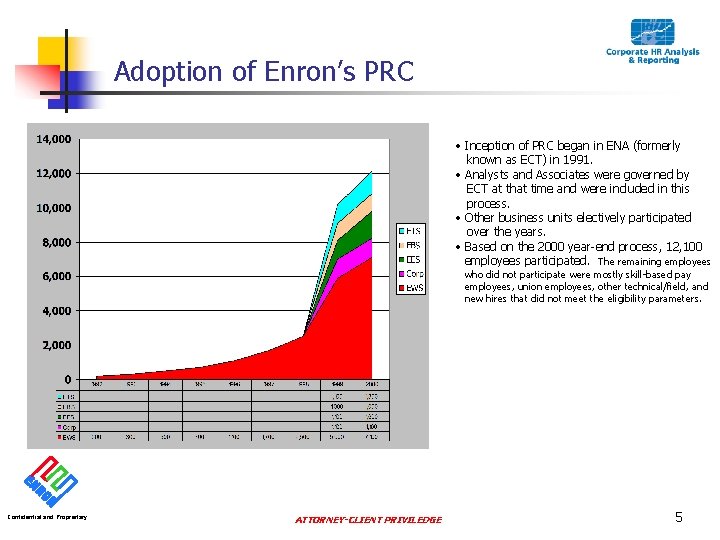
Adoption of Enron’s PRC • Inception of PRC began in ENA (formerly known as ECT) in 1991. • Analysts and Associates were governed by ECT at that time and were included in this process. • Other business units electively participated over the years. • Based on the 2000 year-end process, 12, 100 employees participated. The remaining employees who did not participate were mostly skill-based pay employees, union employees, other technical/field, and new hires that did not meet the eligibility parameters. Confidential and Proprietary ATTORNEY-CLIENT PRIVILEDGE 5
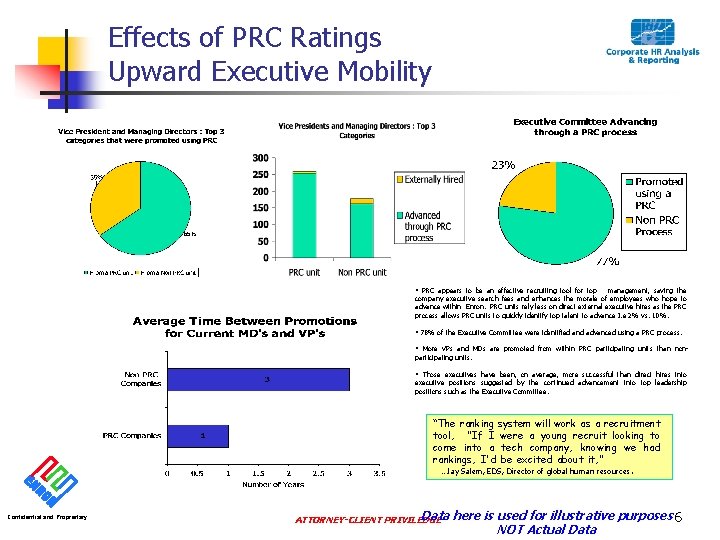
Effects of PRC Ratings Upward Executive Mobility • PRC appears to be an effective recruiting tool for top management, saving the company executive search fees and enhances the morale of employees who hope to advance within Enron. PRC units rely less on direct external executive hires as the PRC process allows PRC units to quickly identify top talent to advance I. e 2% vs. 10%. • 78% of the Executive Committee were identified and advanced using a PRC process. • More VPs and MDs are promoted from within PRC participating units than nonparticipating units. • Those executives have been, on average, more successful than direct hires into executive positions suggested by the continued advancement into top leadership positions such as the Executive Committee. “The ranking system will work as a recruitment tool, "If I were a young recruit looking to come into a tech company, knowing we had rankings, I'd be excited about it, " …Jay Salem, EDS, Director of global human resources. Confidential and Proprietary Data ATTORNEY-CLIENT PRIVILEDGE here is used for illustrative purposes 6 NOT Actual Data
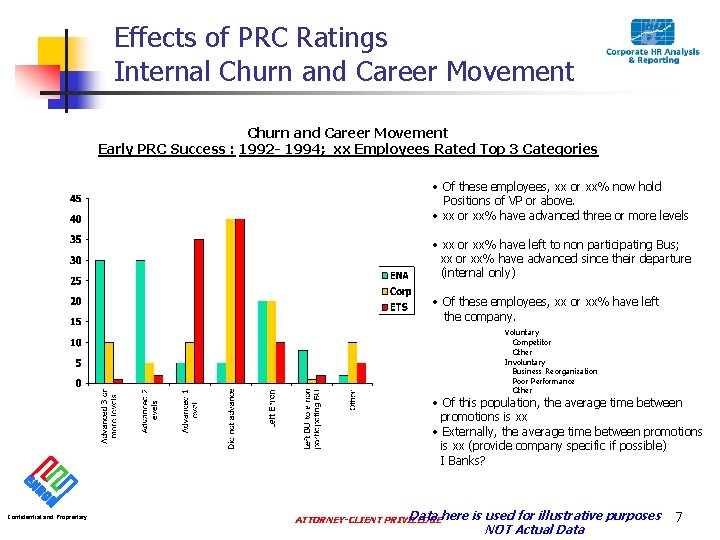
Effects of PRC Ratings Internal Churn and Career Movement Early PRC Success : 1992 - 1994; xx Employees Rated Top 3 Categories • Of these employees, xx or xx% now hold Positions of VP or above. • xx or xx% have advanced three or more levels • xx or xx% have left to non participating Bus; xx or xx% have advanced since their departure (internal only) • Of these employees, xx or xx% have left the company. Voluntary Competitor Other Involuntary Business Reorganization Poor Performance Other • Of this population, the average time between promotions is xx • Externally, the average time between promotions is xx (provide company specific if possible) I Banks? Confidential and Proprietary Data here ATTORNEY-CLIENT PRIVILEDGE is used for illustrative purposes NOT Actual Data 7
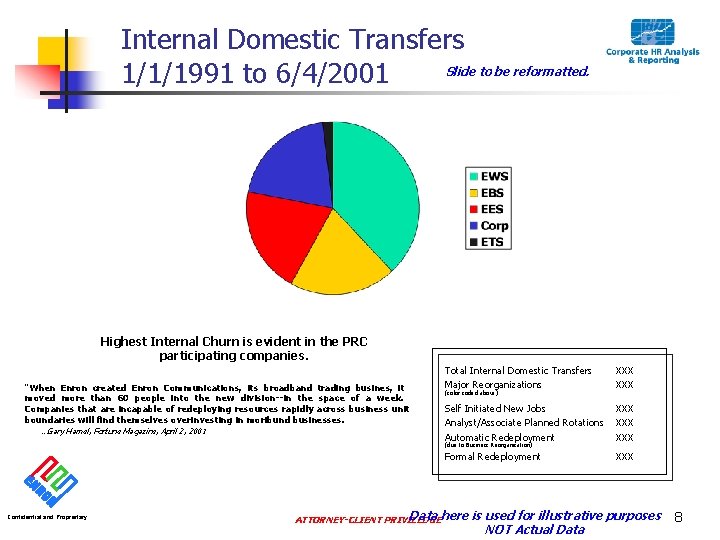
Internal Domestic Transfers Slide to be reformatted. 1/1/1991 to 6/4/2001 Highest Internal Churn is evident in the PRC participating companies. “When Enron created Enron Communications, its broadband trading busines, it moved more than 60 people into the new division--in the space of a week. Companies that are incapable of redeploying resources rapidly across business unit boundaries will find themselves overinvesting in moribund businesses. …Gary Hamel, Fortune Magazine, April 2, 2001 Total Internal Domestic Transfers Major Reorganizations XXX Self Initiated New Jobs Analyst/Associate Planned Rotations Automatic Redeployment XXX XXX Formal Redeployment XXX (color coded above) (due to Business Reorganization) Confidential and Proprietary Data here ATTORNEY-CLIENT PRIVILEDGE is used for illustrative purposes NOT Actual Data 8
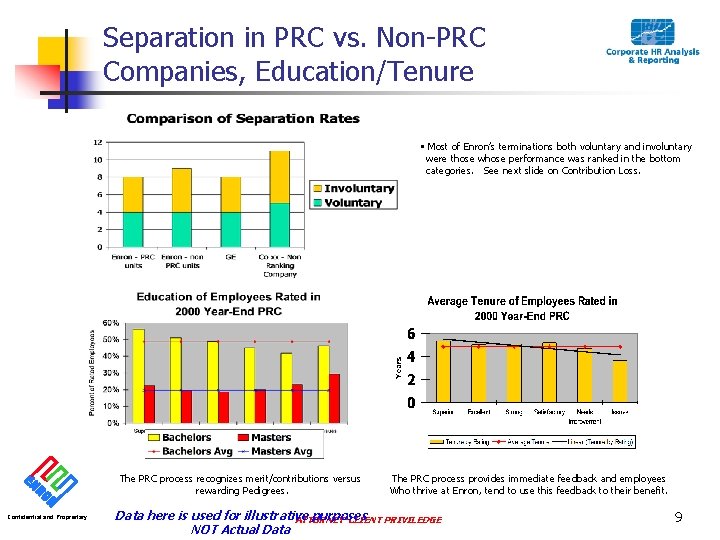
Separation in PRC vs. Non-PRC Companies, Education/Tenure • Most of Enron’s terminations both voluntary and involuntary were those whose performance was ranked in the bottom categories. See next slide on Contribution Loss. The PRC process recognizes merit/contributions versus rewarding Pedigrees. Confidential and Proprietary The PRC process provides immediate feedback and employees Who thrive at Enron, tend to use this feedback to their benefit. Data here is used for illustrative purposes PRIVILEDGE ATTORNEY-CLIENT NOT Actual Data 9
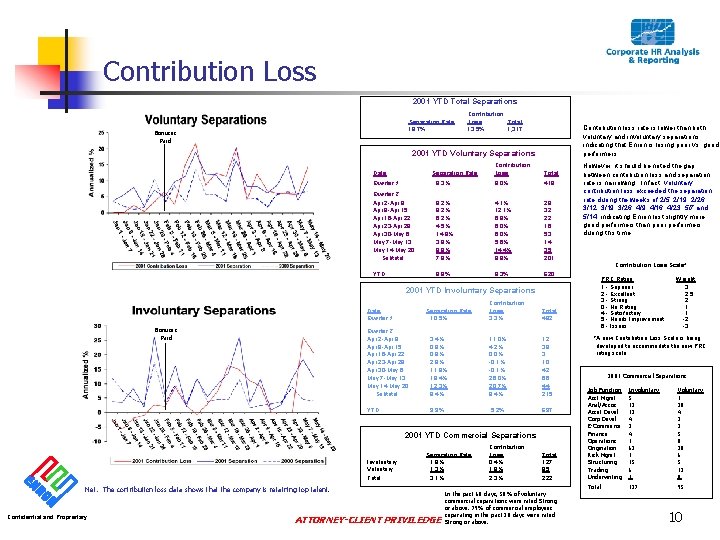
Contribution Loss 2001 YTD Total Separations Separation Rate 18. 7% Bonuses Paid Contribution Loss Total 13. 5% 1, 317 Contribution loss rate is lower than both voluntary and involuntary separations, indicating that Enron is losing poor vs. good performers. 2001 YTD Voluntary Separations Contribution Loss Total 9. 3% 8. 0% 419 Apr 2 -Apr 8 Apr 9 -Apr 15 Apr 16 -Apr 22 Apr 23 -Apr 29 Apr 30 -May 6 May 7 -May 13 May 14 -May 20 Subtotal 8. 2% 6. 2% 4. 5% 14. 8% 3. 9% 9. 8% 7. 8% 4. 1% 12. 1% 6. 9% 6. 0% 5. 6% 14. 4% 8. 9% 29 32 22 16 53 14 35 201 YTD 8. 8% 8. 3% 620 Date Separation Rate Quarter 1 Quarter 2 However, it should be noted the gap between contribution loss and separation rate is narrowing. In fact, voluntary contribution loss exceeded the separation rate during the weeks of 2/5, 2/19, 2/26, 3/12, 3/19, 3/26, 4/9, 4/16, 4/23, 5/7 and 5/14, indicating Enron lost slightly more good performers than poor performers during this time. Contribution Loss Scale* 2001 YTD Involuntary Separations Date Quarter 1 Bonuses Paid Separation Rate 10. 5% Contribution Loss 3. 3% Total 482 Quarter 2 Apr 2 -Apr 8 Apr 9 -Apr 15 Apr 16 -Apr 22 Apr 23 -Apr 29 Apr 30 -May 6 May 7 -May 13 May 14 -May 20 Subtotal 3. 4% 0. 8% 2. 8% 11. 8% 18. 4% 12. 3% 8. 4% 11. 0% 4. 2% 0. 0% -0. 1% 26. 0% 20. 7% 9. 4% 12 38 3 10 42 66 44 215 YTD 9. 9% 5. 2% 697 2001 YTD Commercial Separations Involuntary Voluntary Total Separation Rate 1. 8% 1. 3% 3. 1% Net: The contribution loss data shows that the company is retaining top talent. Confidential and Proprietary ATTORNEY-CLIENT PRIVILEDGE Contribution Loss 0. 4% 1. 9% 2. 3% Total 127 95 222 In the past 60 days, 58% of voluntary commercial separations were rated Strong or above. 79% of commercial employees separating in the past 30 days were rated Strong or above. PRC Rating 1 - Superior 2 - Excellent 3 - Strong 0 - No Rating 4 - Satisfactory 5 - Needs Improvement 6 - Issues Weight 3 2. 5 2 1 1 -2 -3 *A new Contribution Loss Scale is being developed to accommodate the new PRC rating scale. 2001 Commercial Separations Job Function Acct Mgmt Anal/Assoc Asset Devel Corp Devel E-Commerce Finance Operations Origination Risk Mgmt Structuring Trading Underwriting Involuntary 5 12 13 4 1 62 1 15 6 1 Voluntary 1 30 4 2 2 5 0 28 6 5 12 0 Total 127 95 10
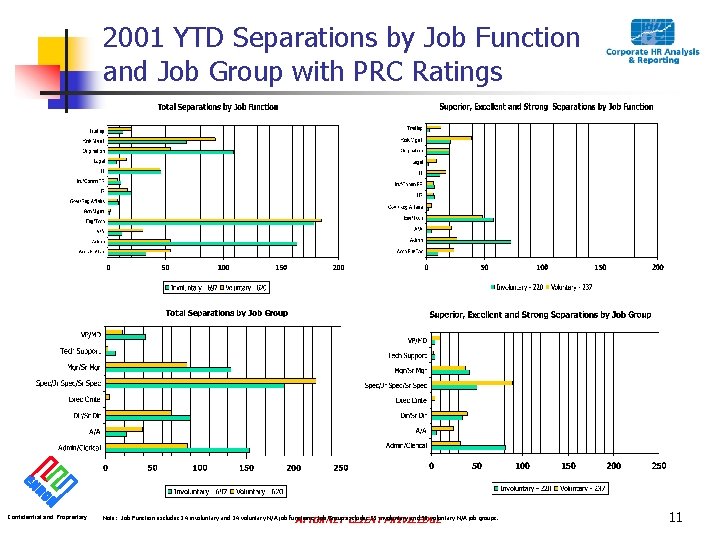
2001 YTD Separations by Job Function and Job Group with PRC Ratings Confidential and Proprietary Note: Job Function excludes 24 involuntary and 34 voluntary N/A job functions; Job Group excludes 55 involuntary and 90 voluntary N/A job groups. ATTORNEY-CLIENT PRIVILEDGE 11
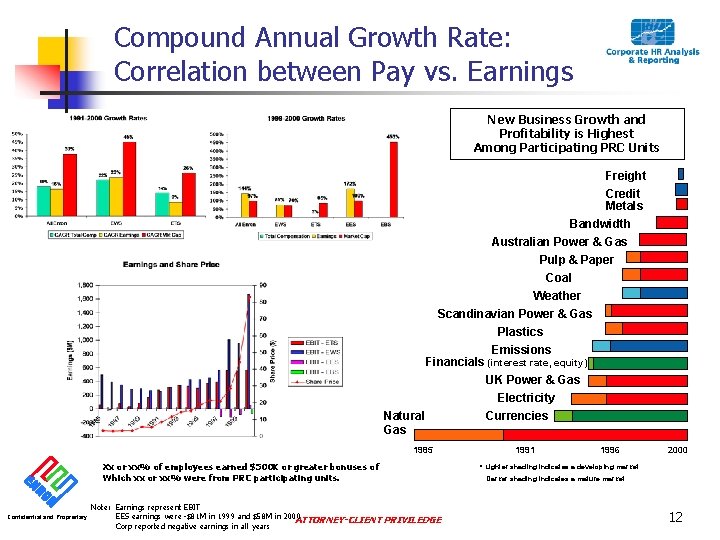
Compound Annual Growth Rate: Correlation between Pay vs. Earnings New Business Growth and Profitability is Highest Among Participating PRC Units Freight Credit Metals Bandwidth Australian Power & Gas Pulp & Paper Coal Weather Scandinavian Power & Gas Plastics Emissions Financials (interest rate, equity) UK Power & Gas Electricity Natural Currencies Gas 1985 Xx or xx% of employees earned $500 K or greater bonuses of Which xx or xx% were from PRC participating units. Confidential and Proprietary Note: Earnings represent EBIT EES earnings were -$81 M in 1999 and $58 M in 2000 ATTORNEY-CLIENT PRIVILEDGE Corp reported negative earnings in all years 1991 1996 2000 * Lighter shading indicates a developing market Darker shading indicates a mature market 12
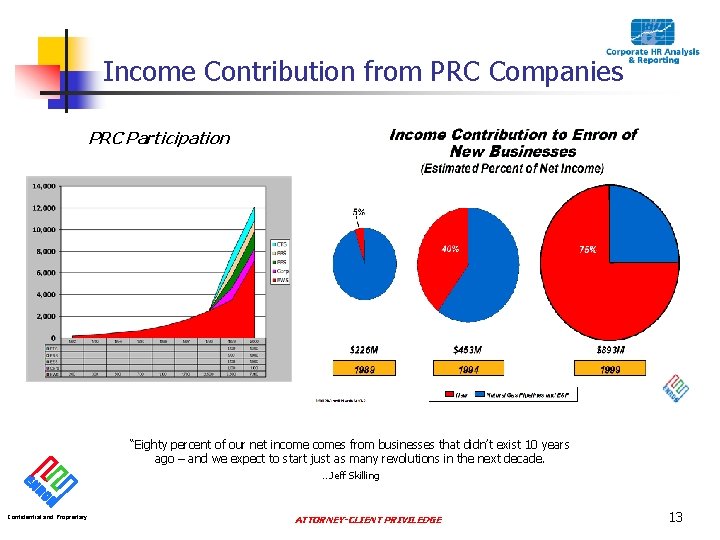
Income Contribution from PRC Companies PRC Participation “Eighty percent of our net incomes from businesses that didn’t exist 10 years ago – and we expect to start just as many revolutions in the next decade. …Jeff Skilling Confidential and Proprietary ATTORNEY-CLIENT PRIVILEDGE 13
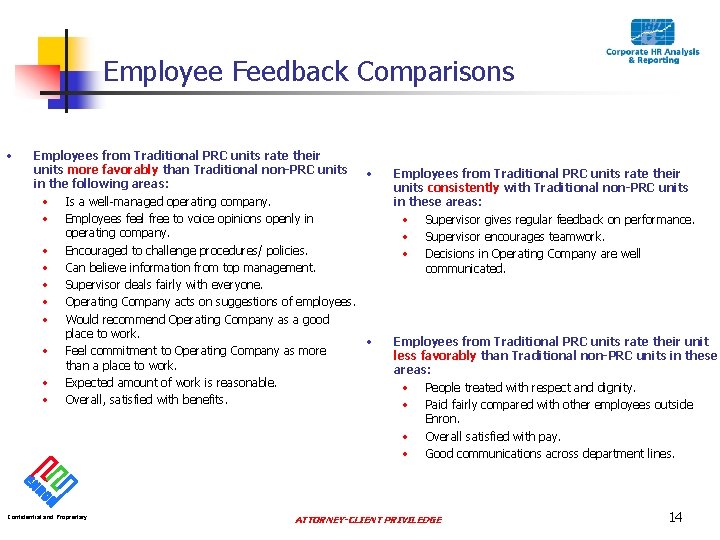
Employee Feedback Comparisons • Employees from Traditional PRC units rate their units more favorably than Traditional non-PRC units • in the following areas: • Is a well-managed operating company. • Employees feel free to voice opinions openly in operating company. • Encouraged to challenge procedures/ policies. • Can believe information from top management. • Supervisor deals fairly with everyone. • Operating Company acts on suggestions of employees. • Would recommend Operating Company as a good place to work. • • Feel commitment to Operating Company as more than a place to work. • Expected amount of work is reasonable. • Overall, satisfied with benefits. Confidential and Proprietary Employees from Traditional PRC units rate their units consistently with Traditional non-PRC units in these areas: • Supervisor gives regular feedback on performance. • Supervisor encourages teamwork. • Decisions in Operating Company are well communicated. Employees from Traditional PRC units rate their unit less favorably than Traditional non-PRC units in these areas: • People treated with respect and dignity. • Paid fairly compared with other employees outside Enron. • Overall satisfied with pay. • Good communications across department lines. ATTORNEY-CLIENT PRIVILEDGE 14
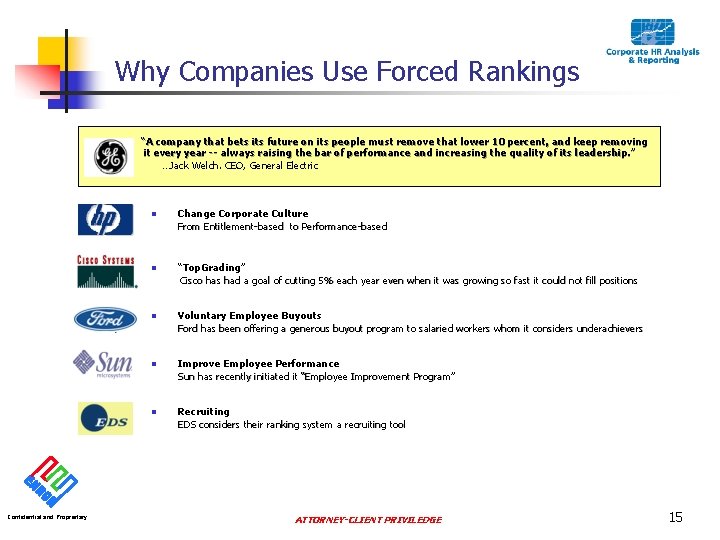
Why Companies Use Forced Rankings “A company that bets its future on its people must remove that lower 10 percent, and keep removing it every year -- always raising the bar of performance and increasing the quality of its leadership. ” …Jack Welch. CEO, General Electric n n n Confidential and Proprietary Change Corporate Culture From Entitlement-based to Performance-based “Top. Grading” Cisco has had a goal of cutting 5% each year even when it was growing so fast it could not fill positions Voluntary Employee Buyouts Ford has been offering a generous buyout program to salaried workers whom it considers underachievers Improve Employee Performance Sun has recently initiated it “Employee Improvement Program” Recruiting EDS considers their ranking system a recruiting tool ATTORNEY-CLIENT PRIVILEDGE 15
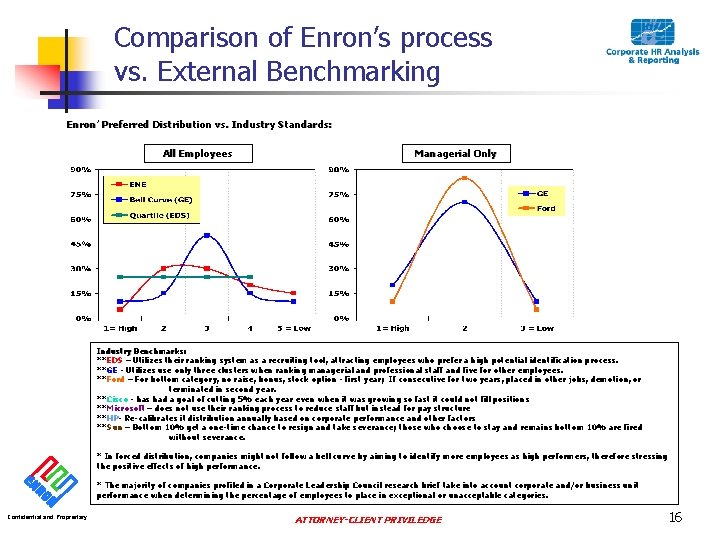
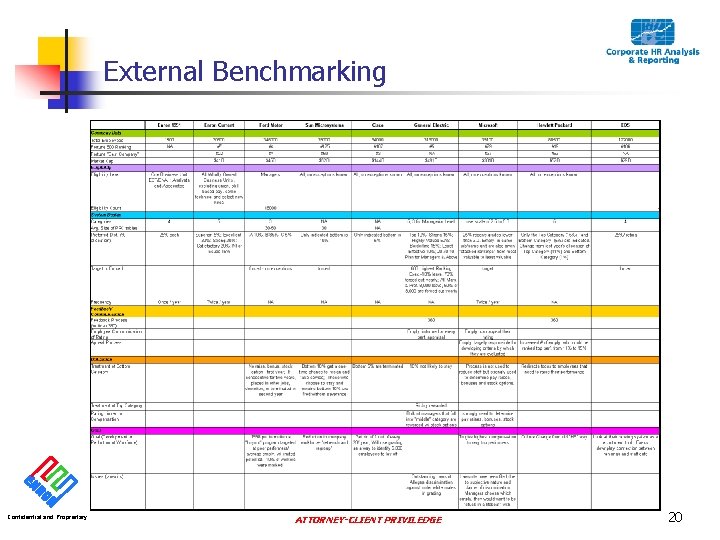
Comparison of Enron’s process vs. External Benchmarking Enron’ Preferred Distribution vs. Industry Standards: All Employees Managerial Only Industry Benchmarks: **EDS – Utilizes their ranking system as a recruiting tool, attracting employees who prefer a high potential identification process. **GE - Utilizes use only three clusters when ranking managerial and professional staff and five for other employees. **Ford – For bottom category, no raise, bonus, stock option - first year; If consecutive for two years, placed in other jobs, demotion, or terminated in second year. **Cisco - has had a goal of cutting 5% each year even when it was growing so fast it could not fill positions **Microsoft – does not use their ranking process to reduce staff but instead for pay structure **HP- Re-calibrates it distribution annually based on corporate performance and other factors **Sun – Bottom 10% get a one-time chance to resign and take severance; those who choose to stay and remains bottom 10% are fired without severance. * In forced distribution, companies might not follow a bell curve by aiming to identify more employees as high performers, therefore stressing the positive effects of high performance. * The majority of companies profiled in a Corporate Leadership Council research brief take into account corporate and/or business unit performance when determining the percentage of employees to place in exceptional or unacceptable categories. Confidential and Proprietary ATTORNEY-CLIENT PRIVILEDGE 16
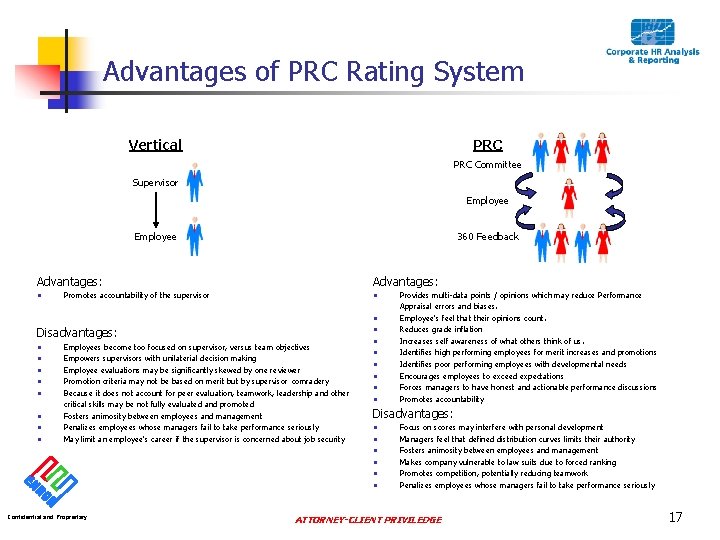
Advantages of PRC Rating System Vertical PRC Committee Supervisor Employee 360 Feedback Advantages: n Advantages: Promotes accountability of the supervisor n n Disadvantages: n n n n n Employees become too focused on supervisor, versus team objectives Empowers supervisors with unilaterial decision making Employee evaluations may be significantly skewed by one reviewer Promotion criteria may not be based on merit but by supervisor comradery Because it does not account for peer evaluation, teamwork, leadership and other critical skills may be not fully evaluated and promoted Fosters animosity between employees and management Penalizes employees whose managers fail to take performance seriously May limit an employee’s career if the supervisor is concerned about job security n n n Disadvantages: n n n Confidential and Proprietary Provides multi-data points / opinions which may reduce Performance Appraisal errors and biases. Employee’s feel that their opinions count. Reduces grade inflation Increases self awareness of what others think of us. Identifies high performing employees for merit increases and promotions Identifies poor performing employees with developmental needs Encourages employees to exceed expectations Forces managers to have honest and actionable performance discussions Promotes accountability Focus on scores may interfere with personal development Managers feel that defined distribution curves limits their authority Fosters animosity between employees and management Makes company vulnerable to law suits due to forced ranking Promotes competition, potentially reducing teamwork Penalizes employees whose managers fail to take performance seriously ATTORNEY-CLIENT PRIVILEDGE 17
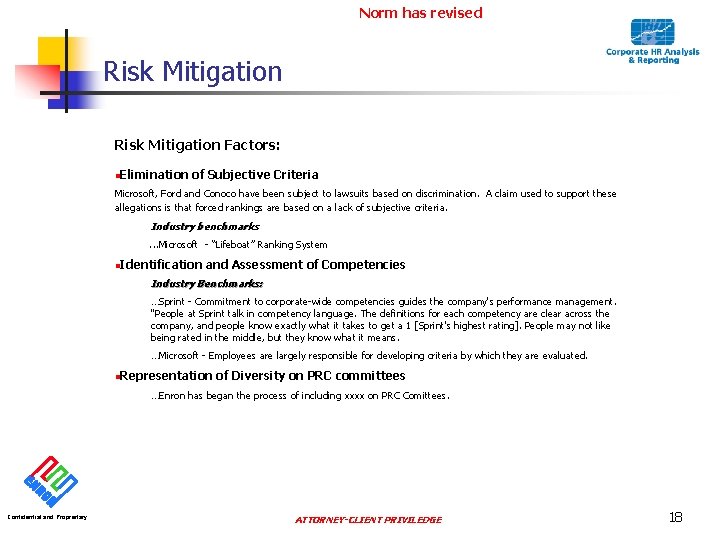
Norm has revised Risk Mitigation Factors: Elimination of Subjective Criteria n Microsoft, Ford and Conoco have been subject to lawsuits based on discrimination. A claim used to support these allegations is that forced rankings are based on a lack of subjective criteria. Industry benchmarks. . . Microsoft - “Lifeboat” Ranking System Identification and Assessment of Competencies n Industry Benchmarks: …Sprint - Commitment to corporate-wide competencies guides the company's performance management. "People at Sprint talk in competency language. The definitions for each competency are clear across the company, and people know exactly what it takes to get a 1 [Sprint's highest rating]. People may not like being rated in the middle, but they know what it means. …Microsoft - Employees are largely responsible for developing criteria by which they are evaluated. Representation of Diversity on PRC committees n …Enron has began the process of including xxxx on PRC Comittees. Confidential and Proprietary ATTORNEY-CLIENT PRIVILEDGE 18
Supplemental Data Human Capital Analysis 19
External Benchmarking Confidential and Proprietary ATTORNEY-CLIENT PRIVILEDGE 20
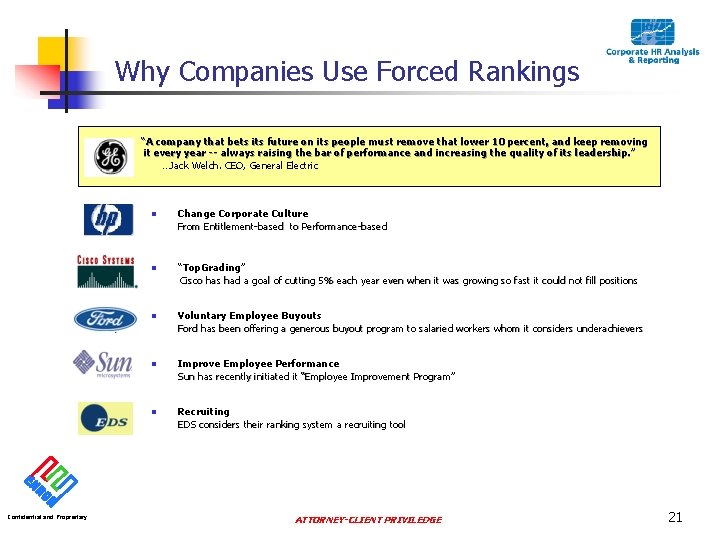
Why Companies Use Forced Rankings “A company that bets its future on its people must remove that lower 10 percent, and keep removing it every year -- always raising the bar of performance and increasing the quality of its leadership. ” …Jack Welch. CEO, General Electric n n n Confidential and Proprietary Change Corporate Culture From Entitlement-based to Performance-based “Top. Grading” Cisco has had a goal of cutting 5% each year even when it was growing so fast it could not fill positions Voluntary Employee Buyouts Ford has been offering a generous buyout program to salaried workers whom it considers underachievers Improve Employee Performance Sun has recently initiated it “Employee Improvement Program” Recruiting EDS considers their ranking system a recruiting tool ATTORNEY-CLIENT PRIVILEDGE 21
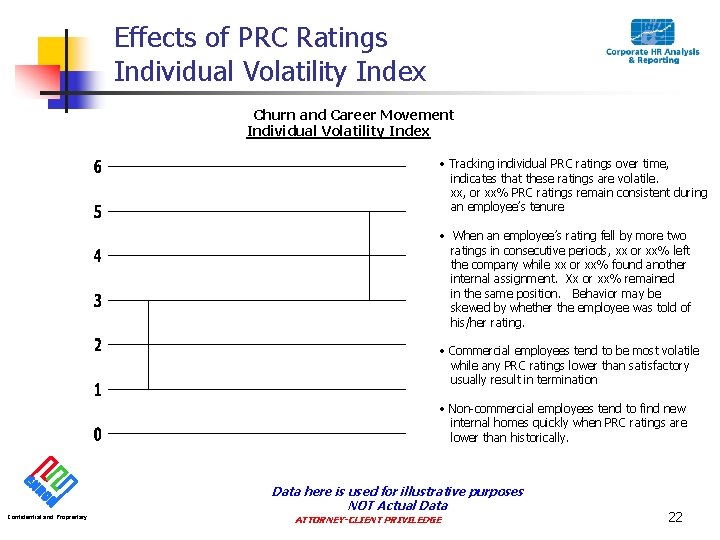
Effects of PRC Ratings Individual Volatility Index Churn and Career Movement Individual Volatility Index • Tracking individual PRC ratings over time, indicates that these ratings are volatile. xx, or xx% PRC ratings remain consistent during an employee’s tenure • When an employee’s rating fell by more two ratings in consecutive periods, xx or xx% left the company while xx or xx% found another internal assignment. Xx or xx% remained in the same position. Behavior may be skewed by whether the employee was told of his/her rating. • Commercial employees tend to be most volatile while any PRC ratings lower than satisfactory usually result in termination • Non-commercial employees tend to find new internal homes quickly when PRC ratings are lower than historically. Data here is used for illustrative purposes NOT Actual Data Confidential and Proprietary ATTORNEY-CLIENT PRIVILEDGE 22
Effects of PRC Ratings Culture and Participant Demographics Culture • Culture defined by PRC participating units • Culture defined by non-PRC participating units • External Culture Benchmarking Participant Demographics • Median Age; Gender; Ethnicity over the history of PRC • Felecia Acevedo can provide for 2000 year-end PRC process only; historical data will need to be obtained from Kathy Schultea’s team. Confidential and Proprietary In or out ATTORNEY-CLIENT PRIVILEDGE 23
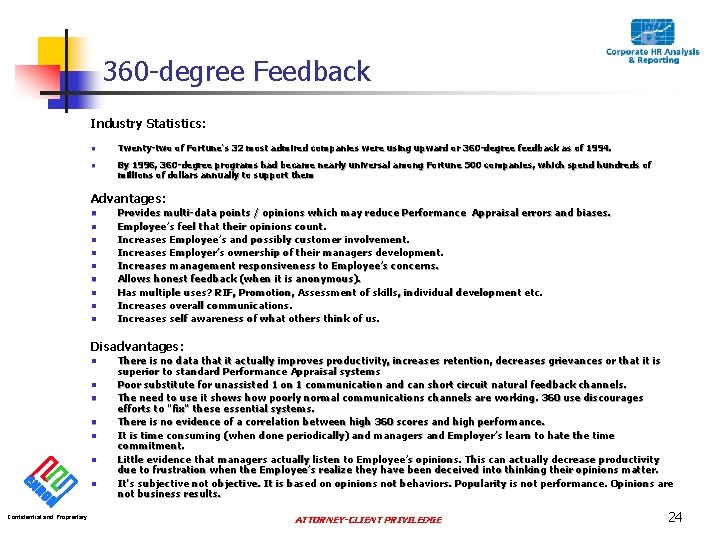
360 -degree Feedback Industry Statistics: n n Twenty-two of Fortune's 32 most admired companies were using upward or 360 -degree feedback as of 1994. By 1996, 360 -degree programs had became nearly universal among Fortune 500 companies, which spend hundreds of millions of dollars annually to support them Advantages: n n n n n Provides multi-data points / opinions which may reduce Performance Appraisal errors and biases. Employee’s feel that their opinions count. Increases Employee’s and possibly customer involvement. Increases Employer’s ownership of their managers development. Increases management responsiveness to Employee’s concerns. Allows honest feedback (when it is anonymous). Has multiple uses? RIF, Promotion, Assessment of skills, individual development etc. Increases overall communications. Increases self awareness of what others think of us. Disadvantages: n n n n Confidential and Proprietary There is no data that it actually improves productivity, increases retention, decreases grievances or that it is superior to standard Performance Appraisal systems Poor substitute for unassisted 1 on 1 communication and can short circuit natural feedback channels. The need to use it shows how poorly normal communications channels are working. 360 use discourages efforts to "fix" these essential systems. There is no evidence of a correlation between high 360 scores and high performance. It is time consuming (when done periodically) and managers and Employer’s learn to hate the time commitment. Little evidence that managers actually listen to Employee’s opinions. This can actually decrease productivity due to frustration when the Employee’s realize they have been deceived into thinking their opinions matter. It's subjective not objective. It is based on opinions not behaviors. Popularity is not performance. Opinions are not business results. ATTORNEY-CLIENT PRIVILEDGE 24

Consult with Michelle Impact to Wrongful Termination Costs Wrongful Termination Correlated to PRC Confidential and Proprietary ATTORNEY-CLIENT PRIVILEDGE 25
- Slides: 25