
Draft eCommerce Policy Framework of Pakistan Presentation by
Draft e-Commerce Policy Framework of Pakistan Presentation by Ministry of Commerce & Textile Commerce Division
Definition of e-Commerce For the purpose of e-Commerce Policy Framework; e-Commerce is defined as buying and selling of goods or services including digital products, through electronic transactions conducted via the internet or other computermediated (online communication) networks.


e-Commerce in Pakistan* • e-Commerce sales in 2017 = Rs. 20. 7 billion • Grew by 93. 7% in 2018 = Rs. 40. 1 billion • 60% e-Commerce transactions by value are post-paid cash-ondelivery (Co. D) transactions *SBP’s Annual Report on the State of Economy 2017 -18
Objectives of e-Commerce Policy Framework • Key driver of Pakistan’s economy • Single window hub and National e-Commerce Council for review and implementation of Policy • Facilitation through regulatory framework • Enhancing exports through e-Commerce platforms • Youth empowerment and employment opportunities through digital connectivity • Efficient payment infrastructure • Streamlining legal systems, taxation structures and digital infrastructure • e-Commerce ecosystem, responsive to consumers’ interests, including dispute resolution • Transparency and accountability in digital industry • Implementation of Sustainable Development Goal-8 (Growth & Decent Work), Goal-9 (Infrastructure and Innovation) and Goal-12 (Sustainable Consumption and Production)

Evolution of e-Commerce Policy Framework • Public and private sector was consulted through Policy Unit and Advisory Council • 50 consultative sessions held • 300 stakeholders consulted • 5 working group reports from public and private sector • Draft publicized on Commerce Division website

e-Commerce Policy Framework Key Areas SME & Youth Consumer Protection Data Protection and Investment ICT & Telecom Financial Inclusion & Digitization Global Connectivity Facilitation & Regulation Logistics Taxation

e-Commerce regulation and facilitation I - Key Features: a. Facilitation § Establishment of National e-Commerce Council § Re-export of faulty goods § Implementation of National Single Window § Review and following of International best practices in taxation § Allocation of the subject of e-Commerce to the Commerce Division § Introduction of e-Procurement model

e-Commerce regulation and facilitation b. Regulation § Compulsory registration with SECP of all e-businesses, having sales of more than 1 million PKR per annum § All online businesses to maintain a physical address in Pakistan § Code of Conduct introduced for e-Commerce platforms to ensure consumer protection
Financial inclusion and digitization through payment infrastructure development II - Key Features: a. Facilitation § Guidelines for merchants’ digital on boarding , by SBP § Access to international payment gateways b. Regulation § Mechanism introduced for gradual shifting on digital payments c. Promotion § Regulation of free lancers by Mo. C (Pak at 4 th no in the world in free lancing services) § Retention of export earnings in foreign currency accounts
Empowering Youth and SMEs through Business Support Programs and Trade Development III - Key Features: a. Facilitation § Association of Freelances, being registered with Mo. C § Creation of an e-Commerce business facilitation hub, by TDAP § Exports enhancing e-Commerce trainings & talent development programs for SMEs § Digital marketing for SMEs § Synergies with other Government initiatives, like Kamyab Jawan program b. Promotion § Initiation of Pak e-SME program § E-Commerce aggregator § Access to finance for SMEs through venture capital and seed funding

CONSUMER PROTECTION IV - Key Features: a. Regulation § Amendments in existing Federal & Provincial Consumer Protection Laws to address e-disputes as well § Mandatory setting up of customer support system and dispute resolution mechanism by all e-commerce platforms § Establishment of Consumer Courts in all districts of each province b. Facilitation § Establishment of Independent Alternate dispute resolution mechanism at Federal & Provincial level § Inclusion of e-commerce disputes in draft Trade Dispute Resolution Act (TDRA) § Creation of e-Courts for quick processing of consumer cases
Taxation V - Key Features: a. Facilitation § Harmonization of GST collection system at provincial level, to avoid double taxation § Introduction of a simplified, one paged sales tax return form b. Promotion § Encouragement and promotion of e-businesses through reduced GST on services , by the Provincial Revenue Authorities
ICT Infrastructure and Telecom Services in Pakistan VI - Key Features: § Total tele-density of ICT sector= 76. 56%. (PTA’s data of 2017 -18) § 161 million cellular subscribers, 70 million 3 G/4 G subscribers and 72 million broadband subscribers (PTA’s data of 2019) a. Facilitation § Collaboration of Mo. C & Mo. ITT to further strengthen Pak’s ICT infrastructure and Telecom sector § Expedited work on complimentary policies such as accession to Information Technology Agreement, WTO.
Logistics VII - Key Features: a. Facilitation § Introduction of Express Mail Service (EMS Plus) by Pakpost for speedy export processing to Saudi Arabia, U. A. E. , Japan, U. K. , Thailand Australia. § Automation in Logistics, to be adopted by e-Commerce platforms § Mechanism for timely payments to e-Commerce sellers § Logistics Infrastructure identification, to complement e-businesses b. Regulation § National Logistics Policy by Ministry of Communications, to develop a chapter on e-Commerce facilitation
Data Protection and Investment VIII - Key Features: a. Regulation § Pakistan’s first Cloud Policy, being developed by Mo. ITT § Early enactment of Data Protection Act. b. Facilitation § Encouragement of investment in complete chain of e-Commerce including logistics, payment gateways and market places
Global Connectivity and Participation in Multilateral Negotiations IX - Key Features: a. Regulation § Continuous engagement at Multilateral forums § Negotiations b. Facilitation § Access to foreign markets c. Promotion § Transformation of TDAP into a digitally savvy and service oriented organization with capabilities for digital marketing and e. Commerce promotion
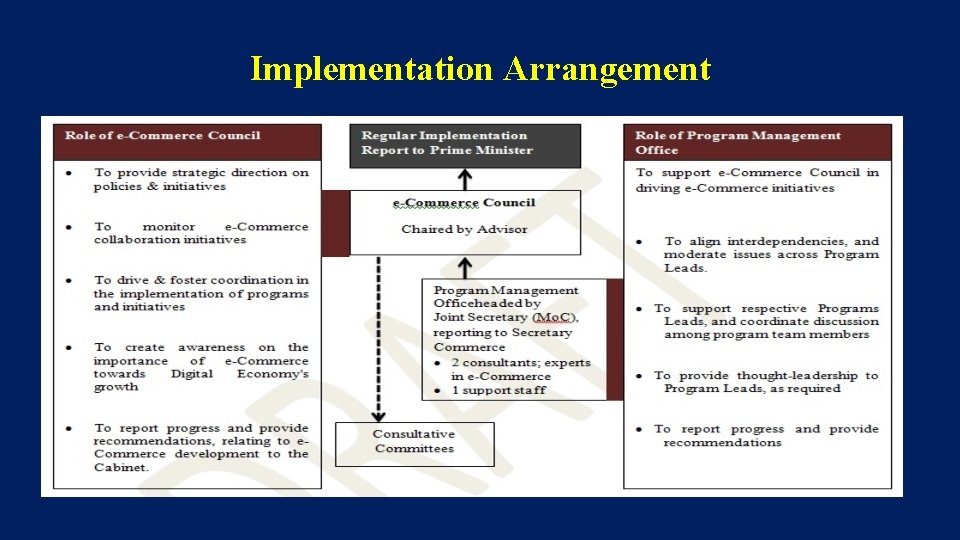
Implementation Arrangement
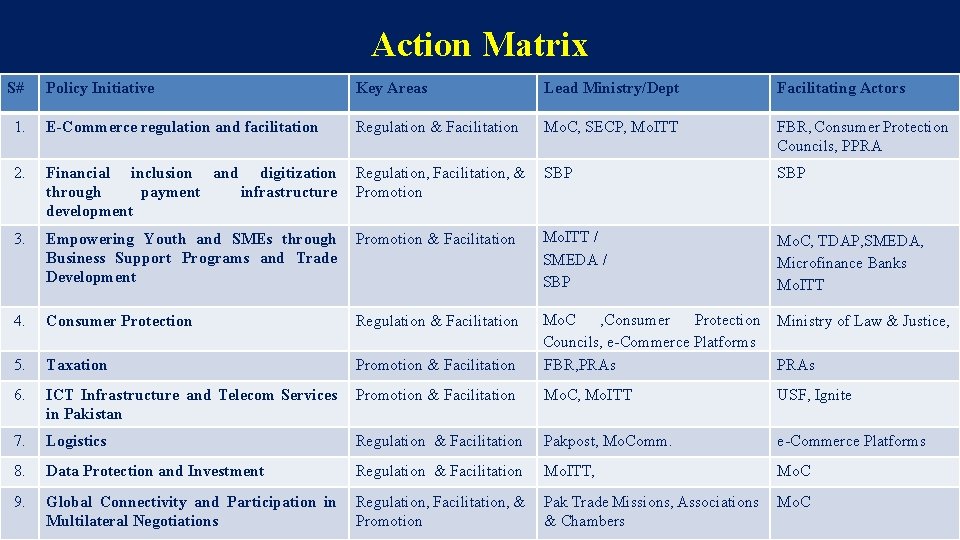
Action Matrix S# Policy Initiative Key Areas Lead Ministry/Dept Facilitating Actors 1. E-Commerce regulation and facilitation Regulation & Facilitation Mo. C, SECP, Mo. ITT FBR, Consumer Protection Councils, PPRA 2. Financial inclusion and digitization through payment infrastructure development Regulation, Facilitation, & Promotion SBP 3. Empowering Youth and SMEs through Business Support Programs and Trade Development Promotion & Facilitation Mo. ITT / SMEDA / SBP Mo. C, TDAP, SMEDA, Microfinance Banks Mo. ITT 4. Consumer Protection Regulation & Facilitation Ministry of Law & Justice, 5. Taxation Promotion & Facilitation Mo. C , Consumer Protection Councils, e-Commerce Platforms FBR, PRAs 6. ICT Infrastructure and Telecom Services in Pakistan Promotion & Facilitation Mo. C, Mo. ITT USF, Ignite 7. Logistics Regulation & Facilitation Pakpost, Mo. Comm. e-Commerce Platforms 8. Data Protection and Investment Regulation & Facilitation Mo. ITT, Mo. C 9. Global Connectivity and Participation in Multilateral Negotiations Regulation, Facilitation, & Promotion Pak Trade Missions, Associations & Chambers Mo. C PRAs
Additions in the New draft • Foreword has been included for ownership of the document at the highest level. • Policy Framework’s goals have been aligned with the SDGs, for better implementation of the Policy Framework in line with Digital Pakistan Policy. • Only one definition of e-Commerce has been incorporated to any avoid ambiguity.
Additions in the New draft (proposals) • Establishment of e-Commerce Council , to supervise implementation of the Policy Framework. • The companies having sales of more than one million PKR per annum, to be register with SECP. The purpose is to facilitate small businesses & startups. • The subject of e-Commerce, to be allocated to Commerce Division under the Rules of Business, 1973, for its better coordination and facilitation. • e-Procurement model, to be adopted by public and private sector, to encourage and promote digitization of procurement procedures in Pakistan.
Additions in the New draft • Gradual shift of Cash-on-Delivery (Co. D) payment method to digital payments, with a time line of Sept, 2022 for payments beyond 10, 000/= PKR. Furthermore, efforts shall be made to convert all Co. D payments into digital payments preferably within 10 years (2029). • It is recommended that M/o. IT&T in collaboration with SBP will approach Pay. Pal and other payment gateways to ensure availability of several international payment gateways in Pakistan
Additions in the New draft • A dedicated chapter on Empowering Youth and SMEs through business support programs and recognition of free lancers as an important segment for enhancing exports has been further developed. Four special initiatives, as mentioned below, have been introduced in this regard Creation of an e-Commerce business facilitation hub. Empower youth and SMEs for e-Commerce, through Pak e-SME program. Access to finance for SMEs to promote digitization in Pakistan. Skill development Program.
Additions in the New draft • Establishment of e-Courts has been proposed • Data Protection, Localization and Sovereignty will be covered in Cloud Policy and Data protection Act being drafted by M/o IT&T • A new chapter on global connectivity and participation in multilateral negotiations has been added • A proposal has been incorporated regarding transformation of the Trade Development Authority of Pakistan into a digitally savvy and service oriented organization
Additions in the New draft • A dedicated chapter on ICT infrastructure and Telecom services in Pakistan has been included wherein it has been proposed that, Commerce and IT Ministries will continue expedited work on complementary policies such as accession to Information Technology Agreement of WTO. • In consultation with the M/o Communications it has been proposed that Ministry of Communications shall include a dedicated chapter on facilitating e-Commerce, including timely payments to sellers by the logistics companies, in its draft National Freight and Logistics Policy.

THANK YOU
- Slides: 26