
DRAFT DHET SECTOR SKILLS PLAN FRAMEWORK AND REQUIREMENTS

- Slides: 19
DRAFT DHET SECTOR SKILLS PLAN FRAMEWORK AND REQUIREMENTS 2011 - 2016 1 Q
CONTENTS v v v v Introduction Purpose of the SSP Framework Target readership of SSP Guiding principles Structure and layout of SSP What should chapter 1 to Chapter 5 of the SSP contain? Conclusion 2
INTRODUCTION v One of the core responsibilities of SETAs is to develop Sector Skills Plans and this framework aims to provide guidance to this v The framework outlines the following: Flexibility in approaches, methods and format that are available to meet the set criteria for compilation of SSP A Sector Skills Plan (SSP) and its purpose The SSP planning cycle and sets out annual time-frames The criteria for evaluation of SSPs 3
PURPOSE AND AIM OF THE SSP FRAMEWORK v To provide guidance to SETAs in preparation and compilation of SSPs in accordance with the provisions of the Skills Development Act of 1998 and the SSP evaluation requirements v The main aim is to provide uniformity in the structure and content of an SSP 4
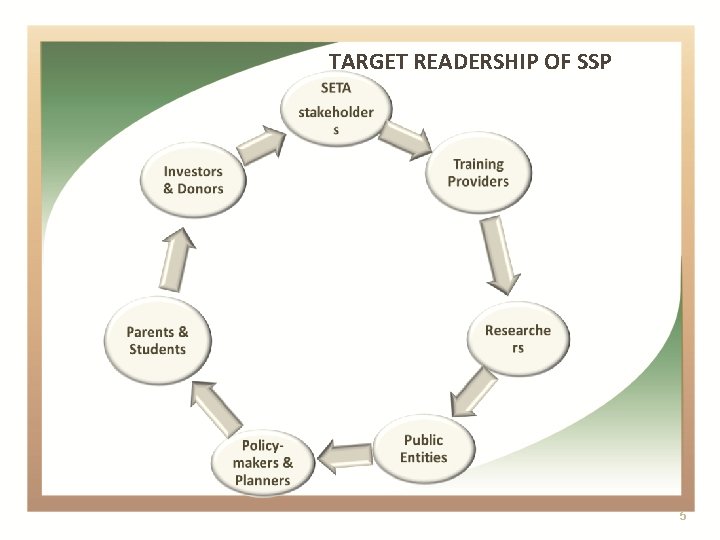
TARGET READERSHIP OF SSP 5
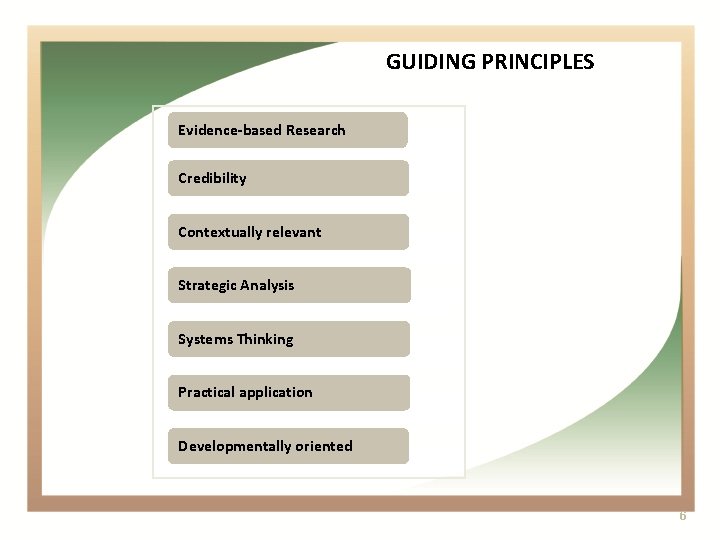
GUIDING PRINCIPLES Evidence-based Research Credibility Contextually relevant Strategic Analysis Systems Thinking Practical application Developmentally oriented 6
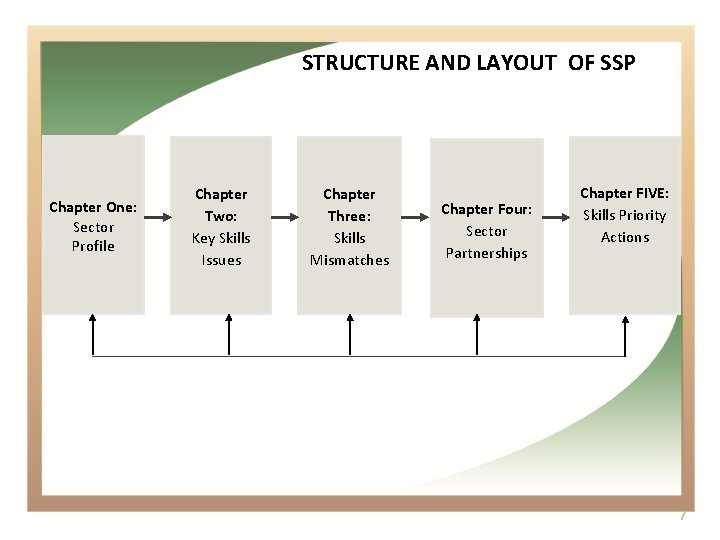
STRUCTURE AND LAYOUT OF SSP Chapter One: Sector Profile Chapter Two: Key Skills Issues Chapter Three: Skills Mismatches Chapter Four: Sector Partnerships Chapter FIVE: Skills Priority Actions 7
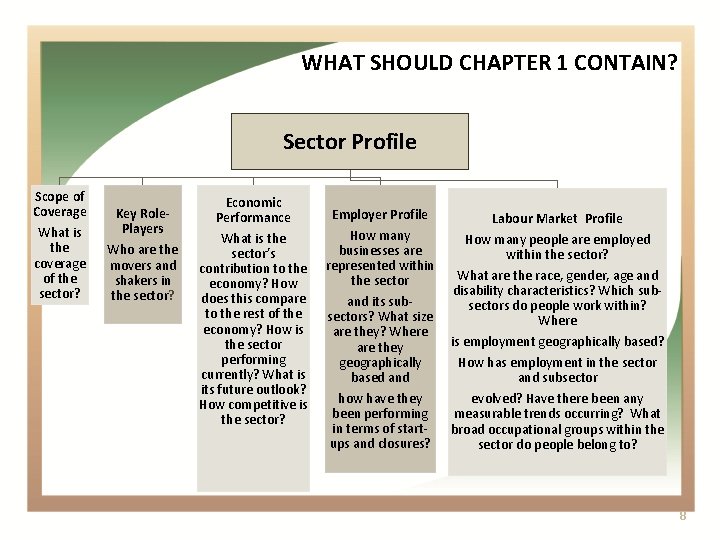
WHAT SHOULD CHAPTER 1 CONTAIN? Sector Profile Scope of Coverage What is the coverage of the sector? Key Role. Players Who are the movers and shakers in the sector? Economic Performance What is the sector’s contribution to the economy? How does this compare to the rest of the economy? How is the sector performing currently? What is its future outlook? How competitive is the sector? Employer Profile Labour Market Profile How many people are employed businesses are within the sector? represented within What are the race, gender, age and the sector disability characteristics? Which suband its subsectors do people work within? sectors? What size Where are they? Where is employment geographically based? are they geographically How has employment in the sector based and subsector how have they evolved? Have there been any been performing measurable trends occurring? What in terms of startbroad occupational groups within the ups and closures? sector do people belong to? 8
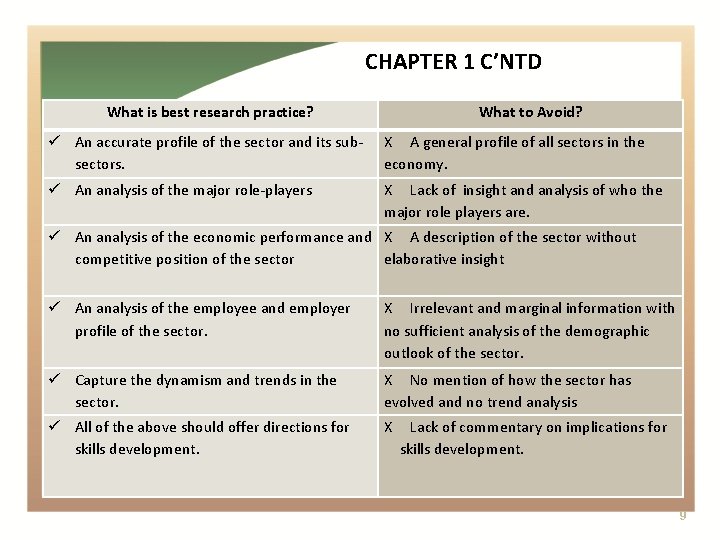
CHAPTER 1 C’NTD What is best research practice? What to Avoid? An accurate profile of the sector and its subsectors. X A general profile of all sectors in the economy. An analysis of the major role-players X Lack of insight and analysis of who the major role players are. An analysis of the economic performance and X A description of the sector without competitive position of the sector elaborative insight An analysis of the employee and employer profile of the sector. X Irrelevant and marginal information with no sufficient analysis of the demographic outlook of the sector. Capture the dynamism and trends in the sector. X No mention of how the sector has evolved and no trend analysis All of the above should offer directions for skills development. X Lack of commentary on implications for skills development. 9
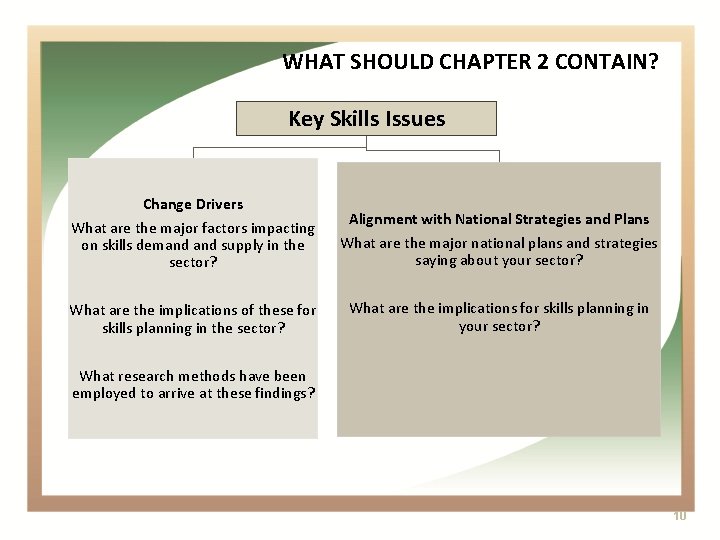
WHAT SHOULD CHAPTER 2 CONTAIN? Key Skills Issues Change Drivers What are the major factors impacting on skills demand supply in the sector? What are the major national plans and strategies saying about your sector? What are the implications of these for skills planning in the sector? What are the implications for skills planning in your sector? Alignment with National Strategies and Plans What research methods have been employed to arrive at these findings? 10
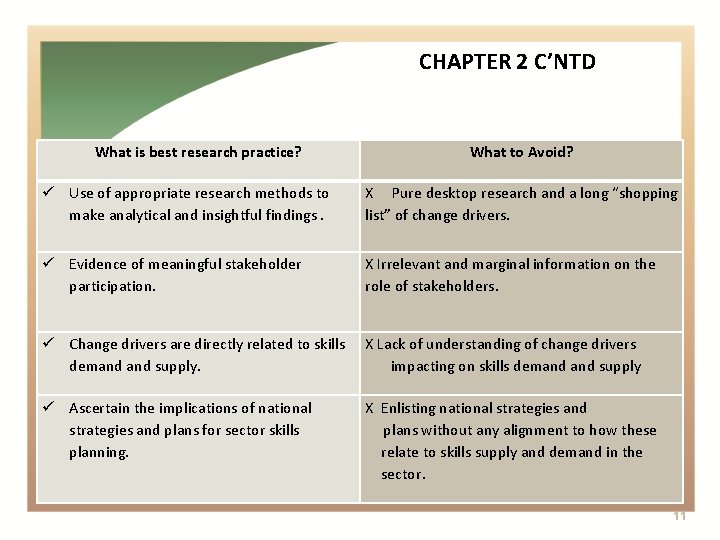
CHAPTER 2 C’NTD What is best research practice? What to Avoid? Use of appropriate research methods to make analytical and insightful findings. X Pure desktop research and a long “shopping list” of change drivers. Evidence of meaningful stakeholder participation. X Irrelevant and marginal information on the role of stakeholders. Change drivers are directly related to skills demand supply. X Lack of understanding of change drivers impacting on skills demand supply Ascertain the implications of national strategies and plans for sector skills planning. X Enlisting national strategies and plans without any alignment to how these relate to skills supply and demand in the sector. 11
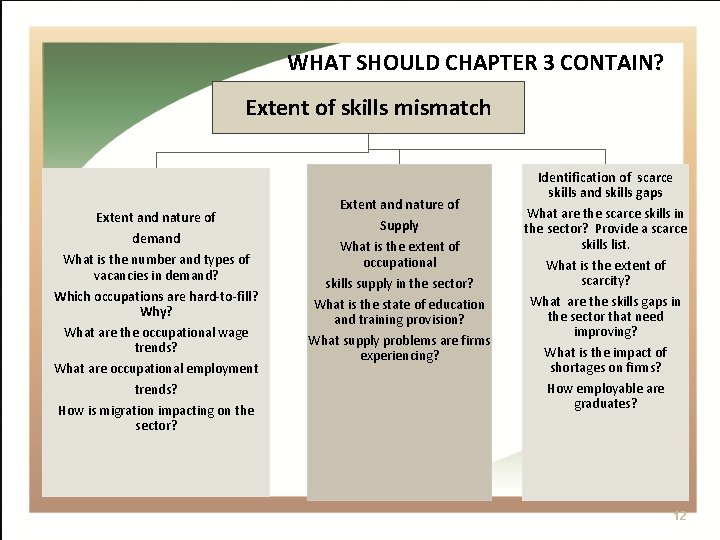
WHAT SHOULD CHAPTER 3 CONTAIN? Extent of skills mismatch Extent and nature of demand What is the number and types of vacancies in demand? Which occupations are hard-to-fill? Why? What are the occupational wage trends? What are occupational employment trends? How is migration impacting on the sector? Extent and nature of Supply What is the extent of occupational skills supply in the sector? What is the state of education and training provision? What supply problems are firms experiencing? Identification of scarce skills and skills gaps What are the scarce skills in the sector? Provide a scarce skills list. What is the extent of scarcity? What are the skills gaps in the sector that need improving? What is the impact of shortages on firms? How employable are graduates? 12
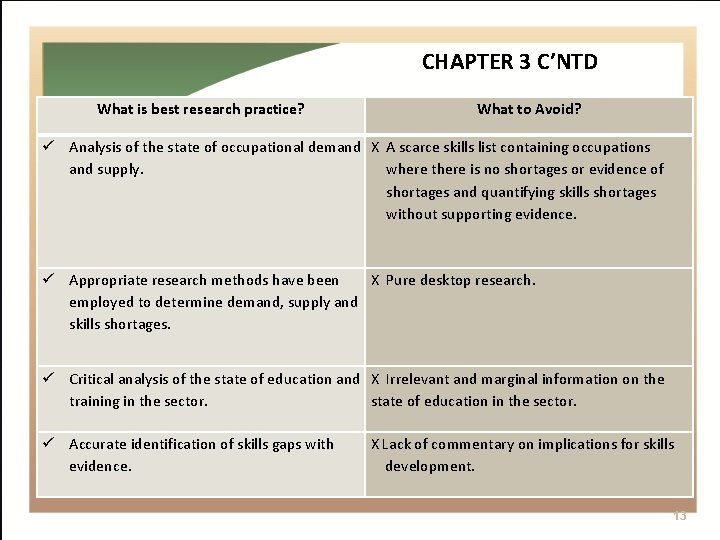
CHAPTER 3 C’NTD What is best research practice? What to Avoid? Analysis of the state of occupational demand X A scarce skills list containing occupations and supply. where there is no shortages or evidence of shortages and quantifying skills shortages without supporting evidence. Appropriate research methods have been X Pure desktop research. employed to determine demand, supply and skills shortages. Critical analysis of the state of education and X Irrelevant and marginal information on the training in the sector. state of education in the sector. Accurate identification of skills gaps with evidence. X Lack of commentary on implications for skills development. 13
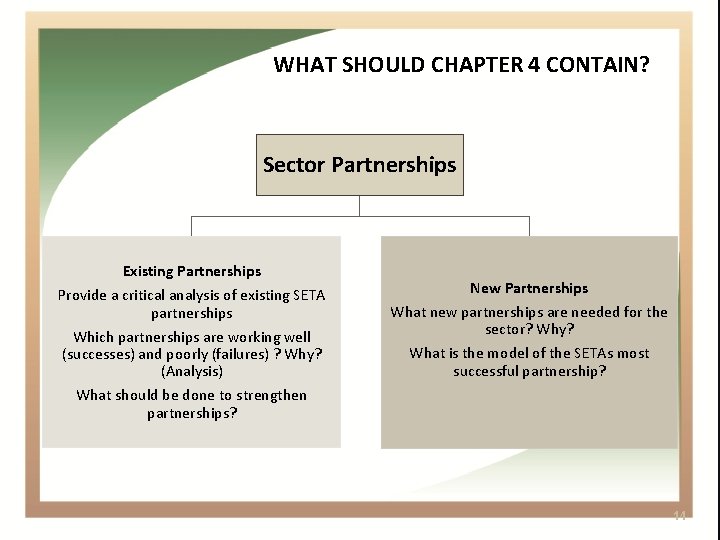
WHAT SHOULD CHAPTER 4 CONTAIN? Sector Partnerships Existing Partnerships Provide a critical analysis of existing SETA partnerships Which partnerships are working well (successes) and poorly (failures) ? Why? (Analysis) What should be done to strengthen partnerships? New Partnerships What new partnerships are needed for the sector? Why? What is the model of the SETAs most successful partnership? 14
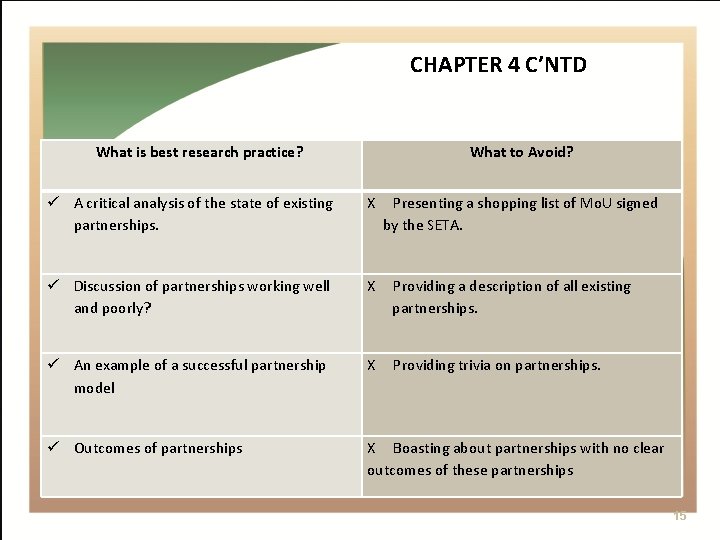
CHAPTER 4 C’NTD What is best research practice? What to Avoid? A critical analysis of the state of existing partnerships. X Presenting a shopping list of Mo. U signed by the SETA. Discussion of partnerships working well and poorly? X Providing a description of all existing partnerships. An example of a successful partnership model X Providing trivia on partnerships. Outcomes of partnerships X Boasting about partnerships with no clear outcomes of these partnerships 15
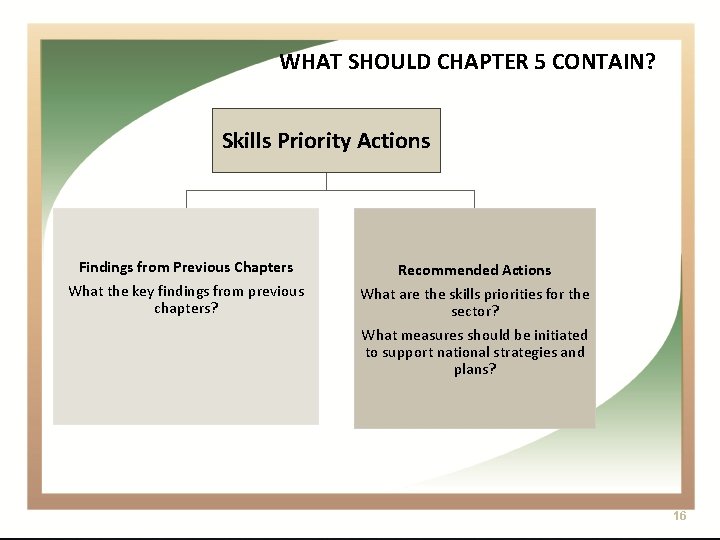
WHAT SHOULD CHAPTER 5 CONTAIN? Skills Priority Actions Findings from Previous Chapters What the key findings from previous chapters? Recommended Actions What are the skills priorities for the sector? What measures should be initiated to support national strategies and plans? 16
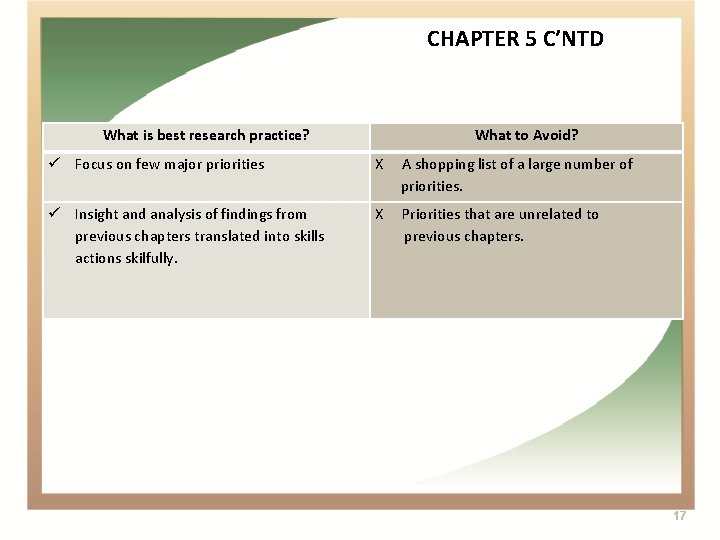
CHAPTER 5 C’NTD What is best research practice? What to Avoid? Focus on few major priorities X A shopping list of a large number of priorities. Insight and analysis of findings from previous chapters translated into skills actions skilfully. X Priorities that are unrelated to previous chapters. 17
CONCLUSION v. Need to work in support of each other to ensure effective implementation of the SSP framework v Shared goal: An SSP that presents credible and quality data that can be used to inform skills development policies 18
Thank you! 19