
DR Waqar Al Kubaisy 26122021 1 Chi Square

DR. Waqar Al – Kubaisy 26/12/2021 1

Chi Square 26/12/2021 2 (χ ) test 2
SPECIFIC LEARNING OUTCOMES On completion of this lecture, you should be able to: 1. Explain the basis for the use of Chi square tests on qualitative data 2. Explain the limitations of the Chi square tests 3. Carry out the Chi square tests 4. Interpret the findings from the Chi square tests of significance 5. Interpret degrees of freedom and critical values of Chi square statistics from Chi square table CONTENTS 1. Explanation of the basis for the use of Chi square tests on qualitative data 2. Explanation of the limitations of the Chi square tests 3. Calculation of Chi square 4. Chi square table 5. Interpretation of the findings from the Chi square tests of significance An important thing is the type of the variable concerned. 3 26/12/2021
Data Discrete Variable Chi Square (χ2 test Continuous Variable one cont. var. at the time Two Groups with one C. V. axb 2 x 2 Two cont. var. at same time More than Two Groups with one C. V. t test Correlation Regression F test ANOVA Sample and Two independent population Dependent samples An important thing is the type of the variable concerned. 26/12/2021 4
number of students who were succeeded Baghdad Mu’tah Syria Ui. TM succeeded 180 170 175 200 An important thing is the type of the variable concerned. 5 26/12/2021
Baghdad Total 210 succeeded % 180 85. 7 Mu’tah 182 170 Baghdad Mu’tah Syria 26/12/2021 Total 210 182 200 93. 4 succeeded % 180 85. 7 170 175 93. 4 87. 5 Not succeeded 30 12 25 6
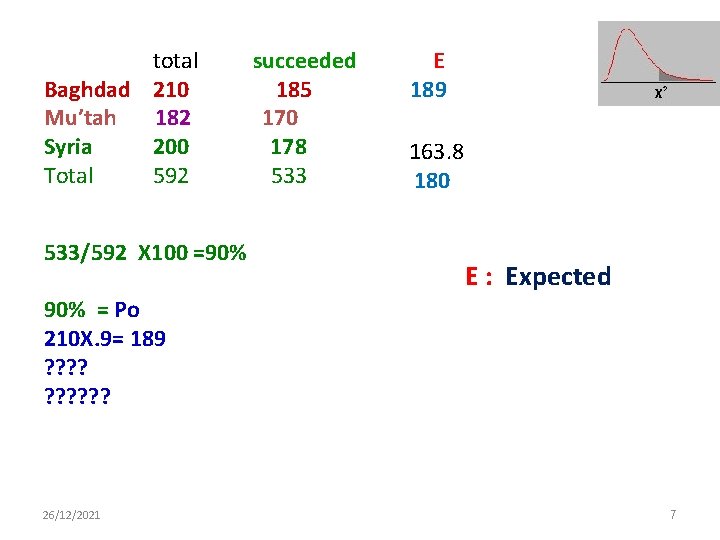
total Baghdad 210 Mu’tah 182 Syria 200 Total 592 533/592 X 100 =90% succeeded 185 170 178 533 E 189 163. 8 180 E : Expected 90% = Po 210 X. 9= 189 ? ? ? ? ? 26/12/2021 7
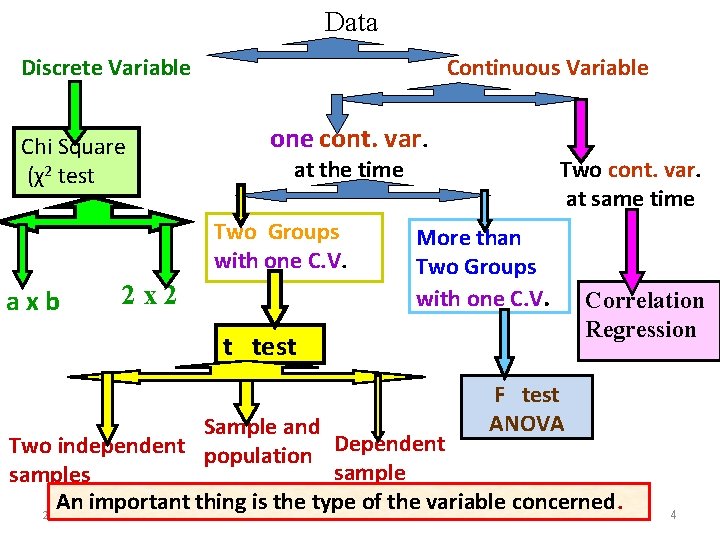
t test have been applied to test significance difference between two means when the data measurement is continuous. When data measurement is discrete, here the measurement is just counting the No. of individual the techniques used to test significance difference is chi square (χ2). The data we have here is only enumerative data or counting data. Counting No. of individuals falling in one category, class, group or another. <20 30+ Sex occupation 20 – 24 Age 25 – 29 groups The data consist of counting No. in each sample or group. ? ? An important thing is the type of the variable concerned. 26/12/2021 8
The data consist of counting No. in each sample or group. The data consist of proportion of individuals in each group or sample, So statistical inference are made in term of proportions. While statistical inference in continuous data are made in term of means The techniques for testing hypothesis concerning enumerative data is known as chi square (χ2) test. Chi square is used in testing difference in proportions, while t test is used in testing difference in means. Comparing calculated χ2 with tabulated χ2 in relation to critical region. The steps of inference in χ2 just as that of t test, only the computing methodology is different. An important thing is the type of the variable concerned. 26/12/2021 9
In t test the statistics technique is based on measurement of continuous variable for single population parameters was μ which was estimated by sample mean. When measurement is merely the presence or absence of certain condition, the population parameter is "P" : the proportion of condition in population which is estimated by p ; the proportion of condition in the sample. So testing hypothesis about population proportion "P" based on sample proportion P is similar to testing hypothesis about μ. If the true population proportion of condition is Po and sample size is N, So Po N = total No. of condition that expected (E) in population. 80% proportion of success. 600 No. of student. 600 x 0. 8 = 480 Expected No. (E). An important thing is the type of the variable concerned. 26/12/2021 10
We classify persons into categories such as • male female • smoker not smoker • Succeeded and not succeeded…. etc then Øcount the number of observation fall in each category The result is frequency data r enumerative data because we enumerate the No. of person in each category Categorical data , because we count the No. of person in each category, 26/12/2021 11 When measurement
When measurement is merely the presence or absence of certain condition, Х Absolute No ü Proportion the population parameter is P: : the proportion of condition in population which is estimated by P: the proportion of condition in the sample So testing hypothesis about population proportion "P" based on sample proportion P is similar to testing hypothesis about μ. An important thing is the type of the variable concerned. 26/12/2021 12
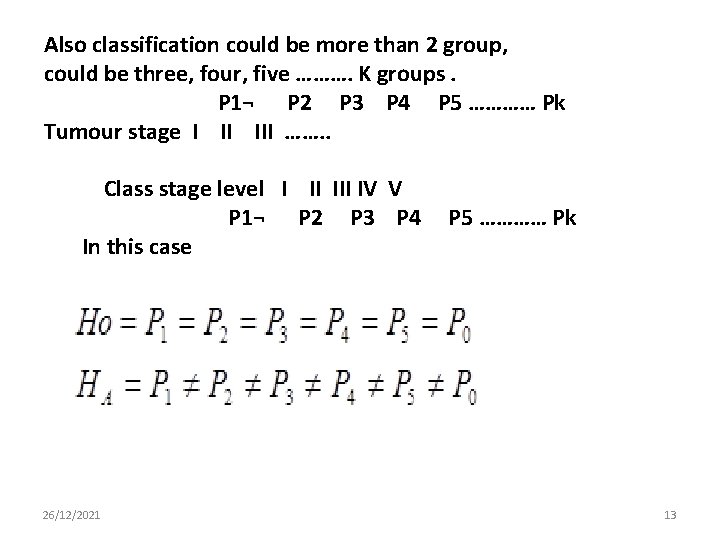
Also classification could be more than 2 group, could be three, four, five ………. K groups. P 1¬ P 2 P 3 P 4 P 5 ………… Pk Tumour stage I II III ……. . Class stage level I II IV V P 1¬ P 2 P 3 P 4 In this case 26/12/2021 P 5 ………… Pk 13
The data consist of counting No. in each sample or group The data consist of proportion of individuals in each group or sample, So statistical inference are made in term of proportions While statistical inference in continuous data are made in term of mean. The technique for testing hypothesis concerning enumerative , Discrete, Categorical , Qualitative data is known as counting data chi square (χ2) test. 26/12/2021 14
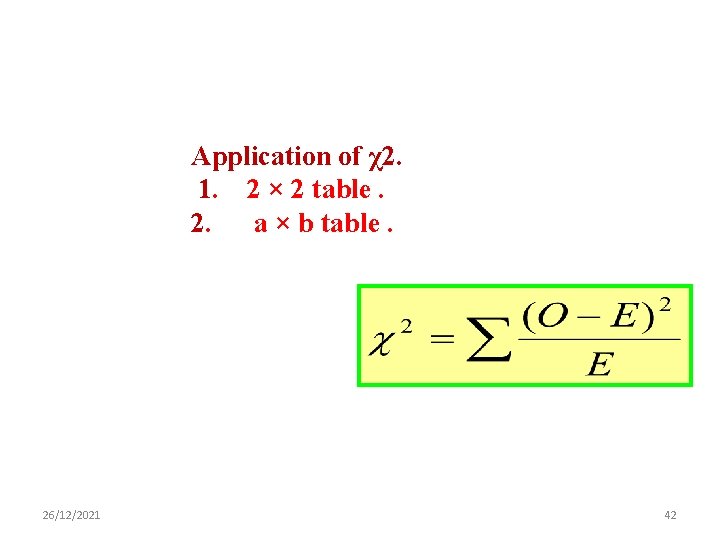
Chi square (χ2) It is the sum of the squared difference between the observed(O) frequency and expected(E) frequency, divided by the expected frequency. An important thing is the type of the variable concerned. 26/12/2021 15
So if the actual No. of subject with condition observed No. ( O ) is close to the expected No. (E) then the Ho will be not rejected ( ). This mean that P=Po. Usually summation So To overcome this result, we have to square O-E make it as (O-E)² then divided by E for each cell. Then we have to do the summation Therefore, χ2 is always UPPER ONE SIDED TEST An important thing is the type of the variable concerned. 26/12/2021 16
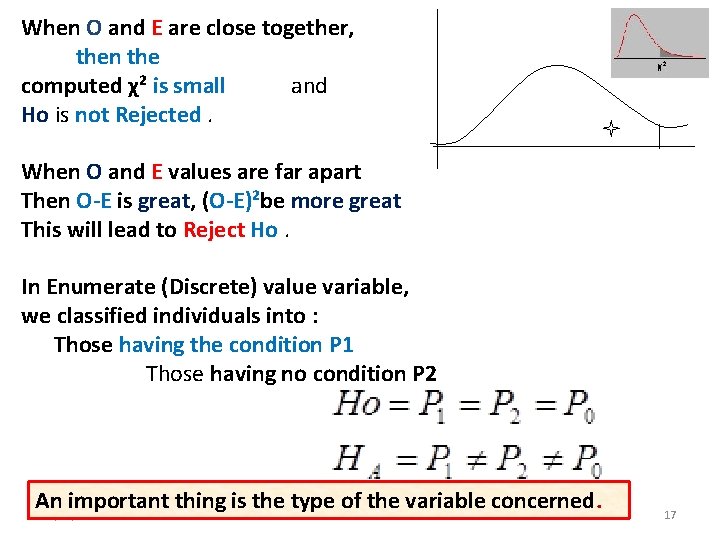
When O and E are close together, then the computed χ² is small and Ho is not Rejected. When O and E values are far apart Then O-E is great, (O-E)²be more great This will lead to Reject Ho. In Enumerate (Discrete) value variable, we classified individuals into : Those having the condition P 1 Those having no condition P 2 An important thing is the type of the variable concerned. 26/12/2021 17
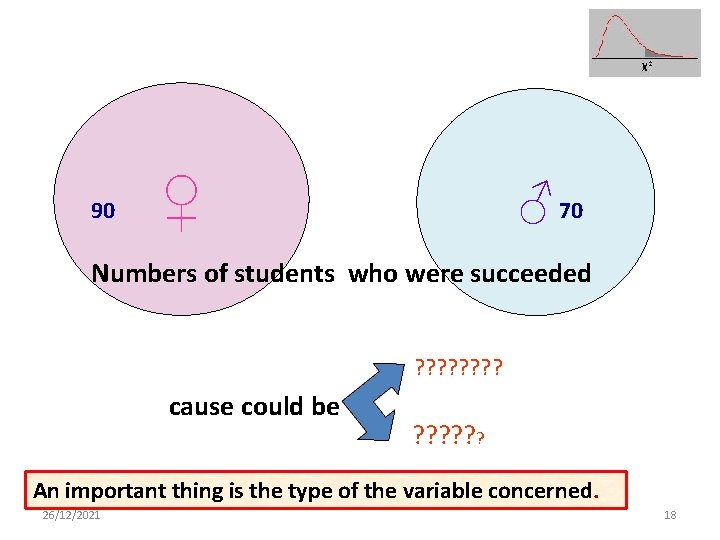
90 ♀ ♂ 70 Numbers of students who were succeeded ? ? ? ? cause could be ? ? ? An important thing is the type of the variable concerned. 26/12/2021 18
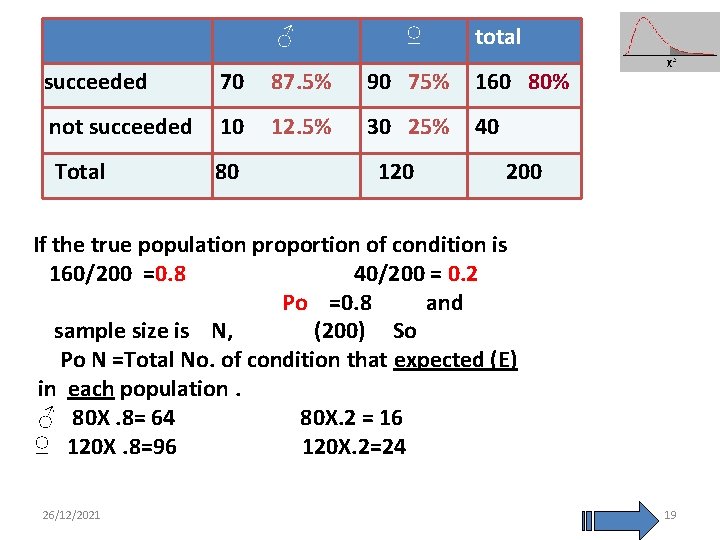
♂ ♀ total succeeded 70 87. 5% 90 75% 160 80% not succeeded 10 12. 5% 30 25% 40 Total 80 120 200 If the true population proportion of condition is 160/200 =0. 8 40/200 = 0. 2 Po =0. 8 and sample size is N, (200) So Po N =Total No. of condition that expected (E) in each population. ♂ 80 X. 8= 64 80 X. 2 = 16 ♀ 120 X. 8=96 120 X. 2=24 26/12/2021 19
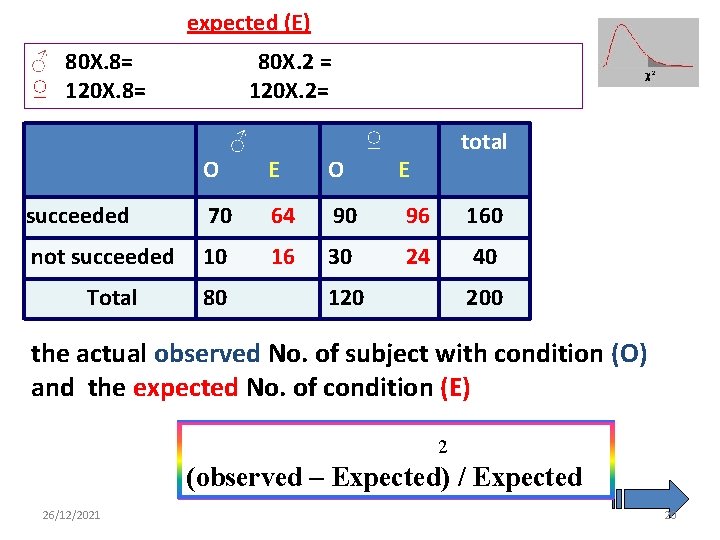
expected (E) ♂ 80 X. 8= ♀ 120 X. 8= 80 X. 2 = 120 X. 2= ♂ total ♀ O E O succeeded 70 64 90 96 160 not succeeded 10 16 30 24 40 Total 80 E 120 200 the actual observed No. of subject with condition (O) and the expected No. of condition (E) 2 (observed – Expected) / Expected 26/12/2021 20
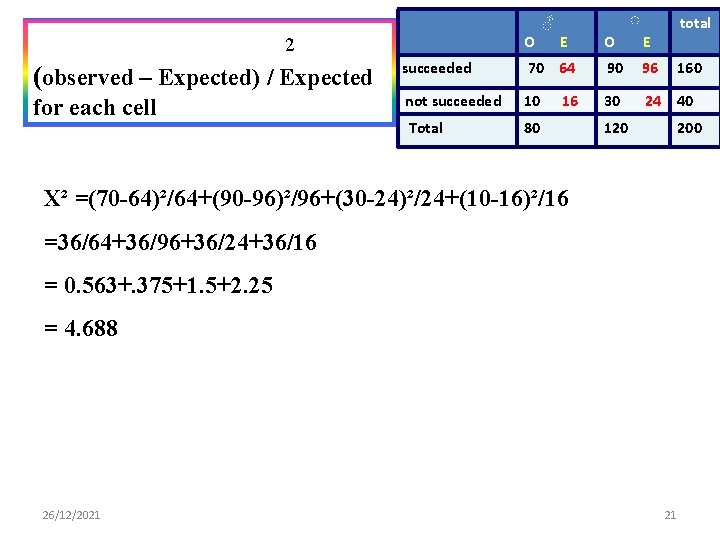
♂ O 2 total ♀ E O E (observed – Expected) / Expected succeeded 70 64 90 96 for each cell not succeeded 10 30 24 40 Total 80 16 160 120 200 X² =(70 -64)²/64+(90 -96)²/96+(30 -24)²/24+(10 -16)²/16 =36/64+36/96+36/24+36/16 = 0. 563+. 375+1. 5+2. 25 = 4. 688 26/12/2021 21
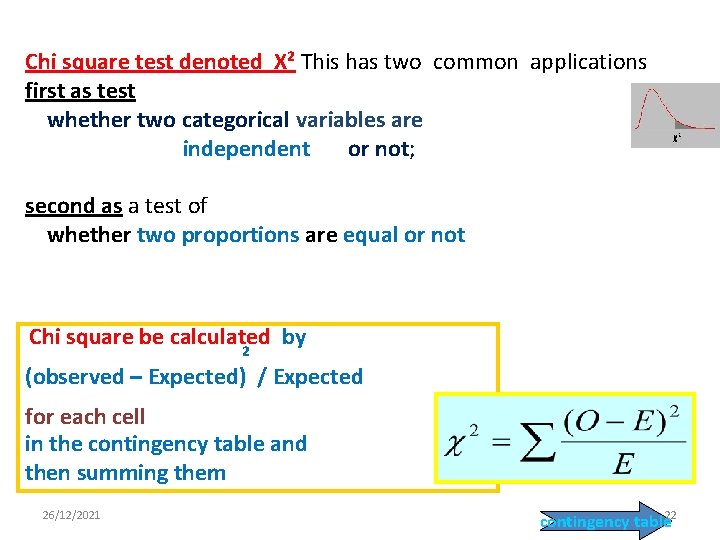
Chi square test denoted X² This has two common applications: first as test vwhether two categorical variables are independent or not; second as a test of vwhether two proportions are equal or not Chi square be calculated by ² (observed – Expected) / Expected for each cell in the contingency table and then summing them 26/12/2021 contingency table 22
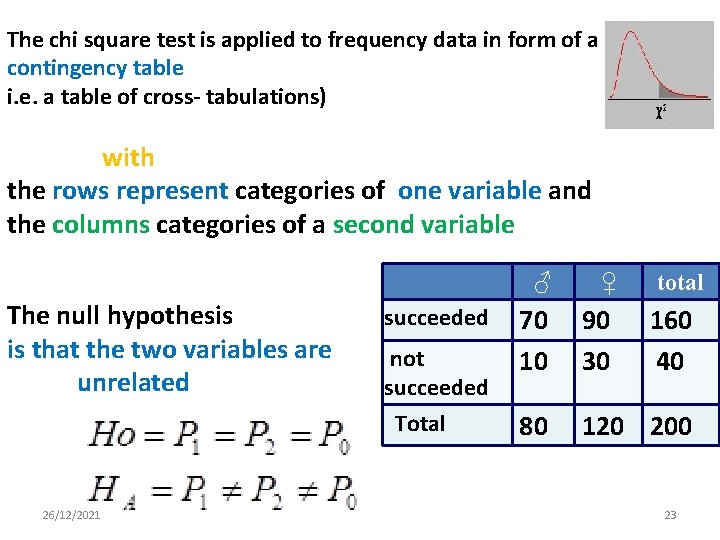
The chi square test is applied to frequency data in form of a contingency table i. e. a table of cross- tabulations) with the rows represent categories of one variable and the columns categories of a second variable. ♂ The null hypothesis is that the two variables are unrelated succeeded not succeeded Total 26/12/2021 ♀ total 70 10 90 30 160 40 80 120 200 23
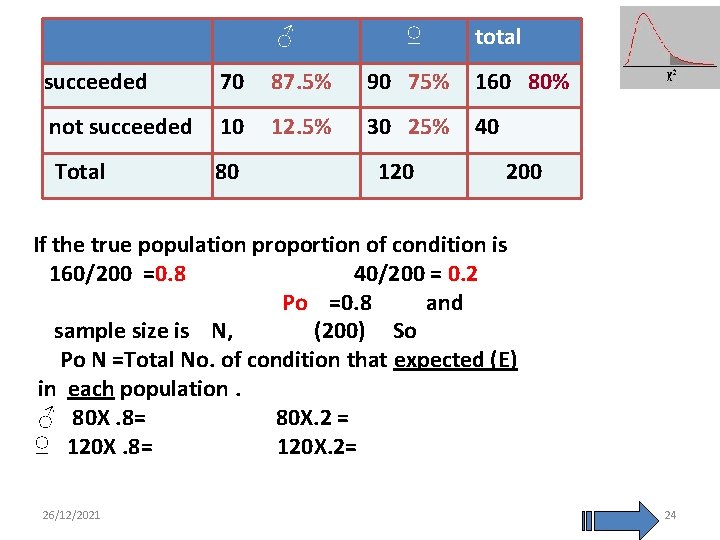
♂ ♀ total succeeded 70 87. 5% 90 75% 160 80% not succeeded 10 12. 5% 30 25% 40 Total 80 120 200 If the true population proportion of condition is 160/200 =0. 8 40/200 = 0. 2 Po =0. 8 and sample size is N, (200) So Po N =Total No. of condition that expected (E) in each population. ♂ 80 X. 8= 80 X. 2 = ♀ 120 X. 8= 120 X. 2= 26/12/2021 24
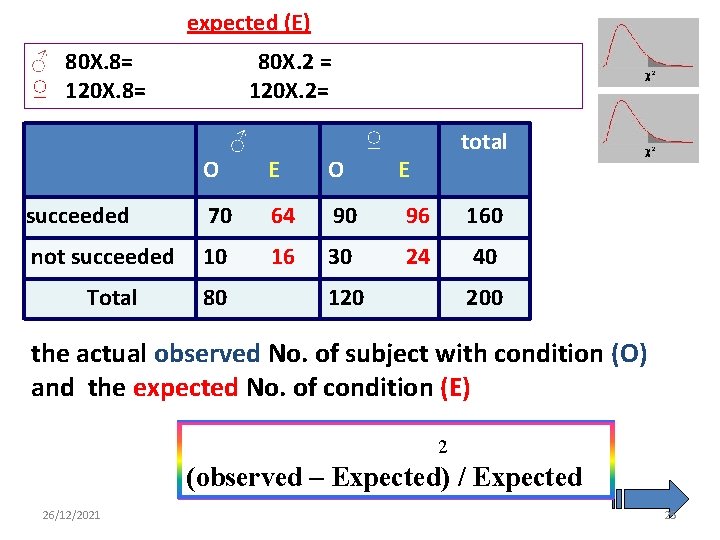
expected (E) ♂ 80 X. 8= ♀ 120 X. 8= 80 X. 2 = 120 X. 2= ♂ total ♀ O E O succeeded 70 64 90 96 160 not succeeded 10 16 30 24 40 Total 80 E 120 200 the actual observed No. of subject with condition (O) and the expected No. of condition (E) 2 (observed – Expected) / Expected 26/12/2021 25
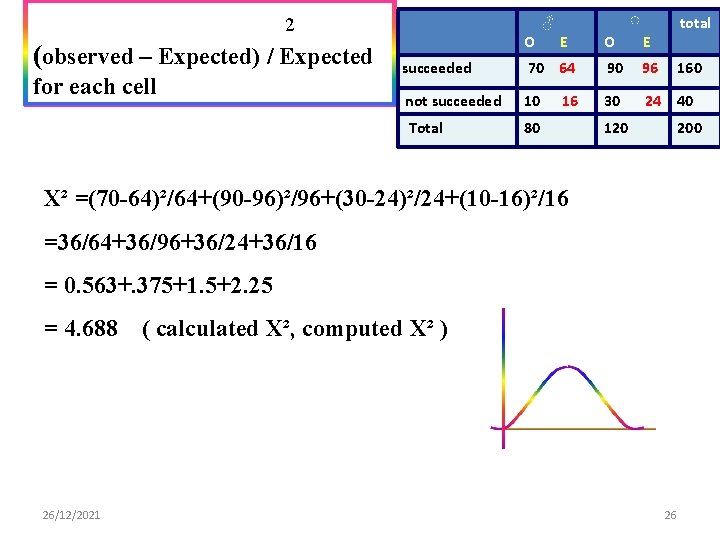
2 (observed – Expected) / Expected for each cell ♂ O total ♀ E O E succeeded 70 64 90 96 not succeeded 10 30 24 40 Total 80 16 160 120 200 X² =(70 -64)²/64+(90 -96)²/96+(30 -24)²/24+(10 -16)²/16 =36/64+36/96+36/24+36/16 = 0. 563+. 375+1. 5+2. 25 = 4. 688 26/12/2021 ( calculated X², computed X² ) 26
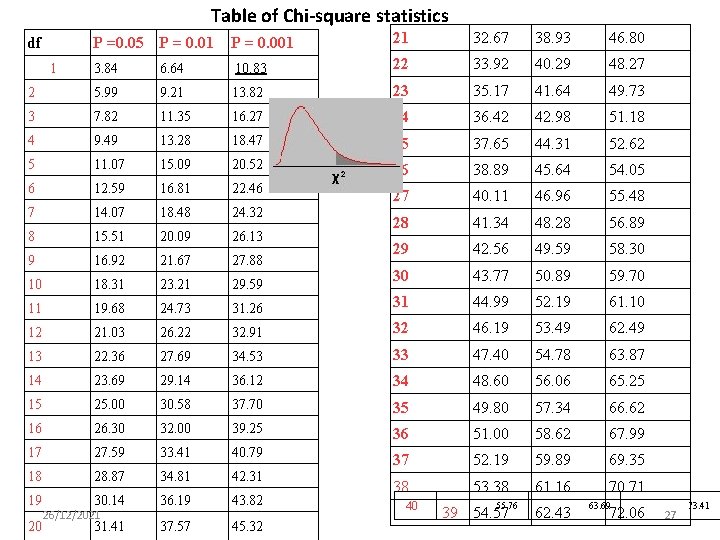
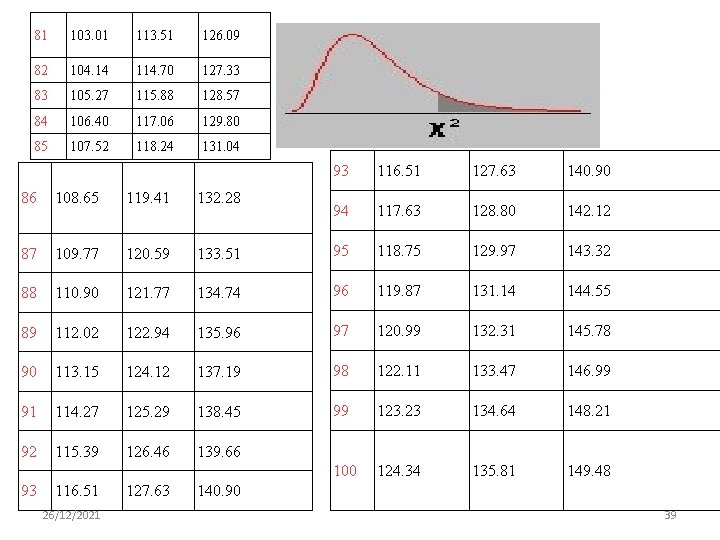
Table of Chi-square statistics P =0. 05 P = 0. 01 P = 0. 001 21 32. 67 38. 93 46. 80 3. 84 6. 64 10. 83 22 33. 92 40. 29 48. 27 2 5. 99 9. 21 13. 82 23 35. 17 41. 64 49. 73 3 7. 82 11. 35 16. 27 24 36. 42 42. 98 51. 18 4 9. 49 13. 28 18. 47 25 37. 65 44. 31 52. 62 5 11. 07 15. 09 20. 52 26 38. 89 45. 64 54. 05 6 12. 59 16. 81 22. 46 7 14. 07 18. 48 24. 32 27 40. 11 46. 96 55. 48 8 15. 51 20. 09 26. 13 28 41. 34 48. 28 56. 89 9 16. 92 21. 67 27. 88 29 42. 56 49. 59 58. 30 10 18. 31 23. 21 29. 59 30 43. 77 50. 89 59. 70 11 19. 68 24. 73 31. 26 31 44. 99 52. 19 61. 10 12 21. 03 26. 22 32. 91 32 46. 19 53. 49 62. 49 13 22. 36 27. 69 34. 53 33 47. 40 54. 78 63. 87 14 23. 69 29. 14 36. 12 34 48. 60 56. 06 65. 25 15 25. 00 30. 58 37. 70 35 49. 80 57. 34 66. 62 16 26. 30 32. 00 39. 25 36 51. 00 58. 62 67. 99 17 27. 59 33. 41 40. 79 18 28. 87 34. 81 42. 31 37 52. 19 59. 89 69. 35 30. 14 36. 19 43. 82 38 53. 38 61. 16 70. 71 31. 41 37. 57 45. 32 df 1 19 20 26/12/2021 40 55. 76 39 54. 57 62. 43 63. 69 72. 06 27 73. 41
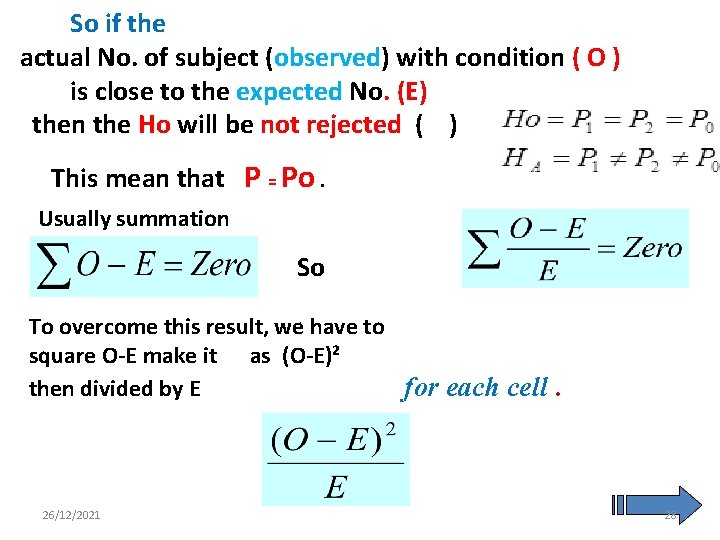
So if the actual No. of subject (observed) with condition ( O ) is close to the expected No. (E) then the Ho will be not rejected ( ) This mean that P = Po. Usually summation So To overcome this result, we. have to square O-E make it as (O-E)² then divided by E for each cell. 26/12/2021 28
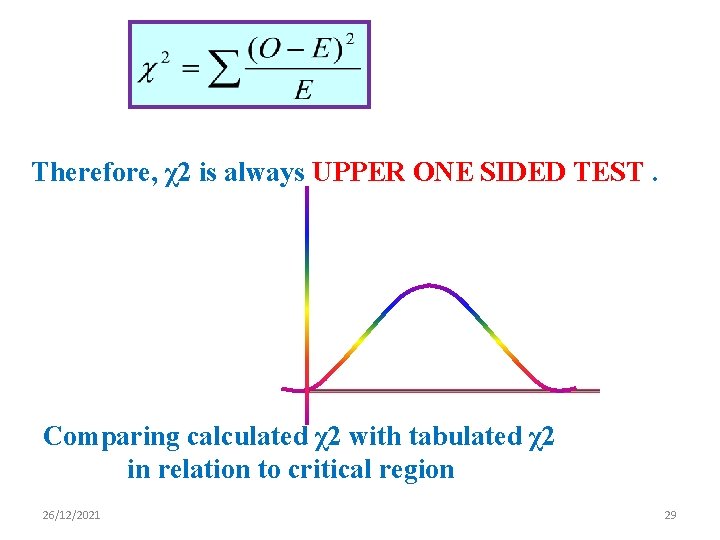
Therefore, χ2 is always UPPER ONE SIDED TEST. Comparing calculated χ2 with tabulated χ2 in relation to critical region 26/12/2021 29
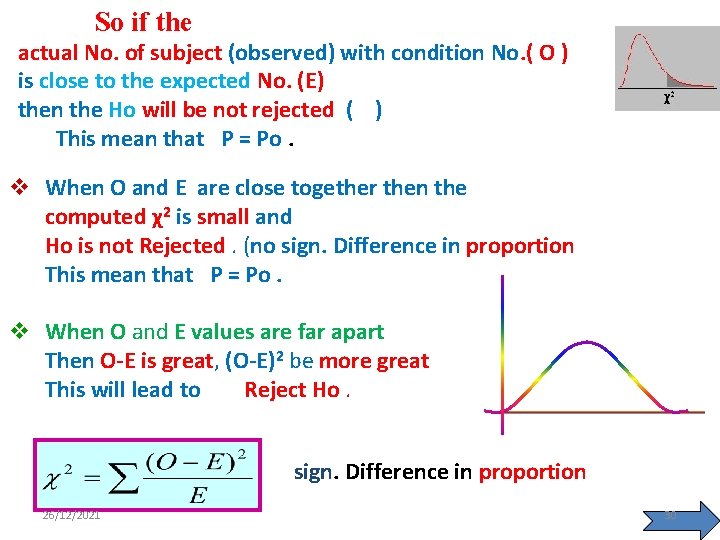
So if the actual No. of subject (observed) with condition No. ( O ) is close to the expected No. (E) then the Ho will be not rejected ( ) This mean that P = Po. v When O and E are close together then the computed χ2 is small and Ho is not Rejected. (no sign. Difference in proportion This mean that P = Po. v When O and E values are far apart Then O-E is great, (O-E)2 be more great This will lead to Reject Ho. sign. Difference in proportion 26/12/2021 30
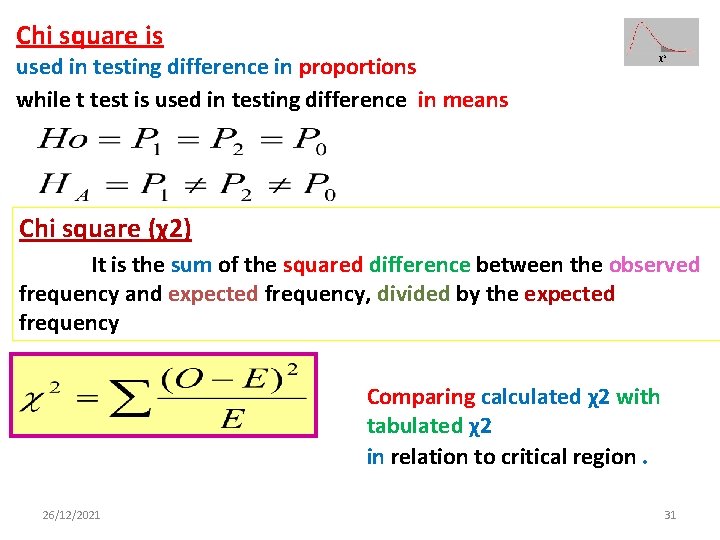
Chi square is used in testing difference in proportions while t test is used in testing difference in means. Chi square (χ2) It is the sum of the squared difference between the observed frequency and expected frequency, divided by the expected frequency. Comparing calculated χ2 with tabulated χ2 in relation to critical region. 26/12/2021 31
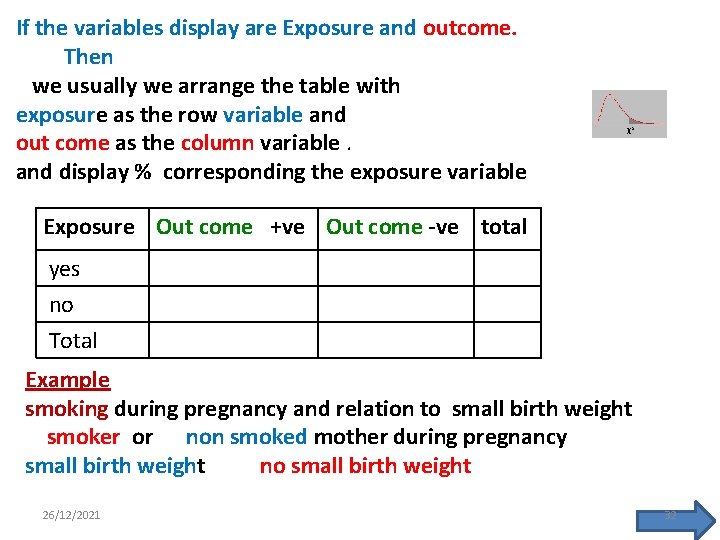
If the variables display are Exposure and outcome. Then we usually we arrange the table with exposure as the row variable and out come as the column variable. and display % corresponding the exposure variable Exposure Out come +ve Out come -ve total yes no Total Example smoking during pregnancy and relation to small birth weight smoker or non smoked mother during pregnancy small birth weight no small birth weight 26/12/2021 32
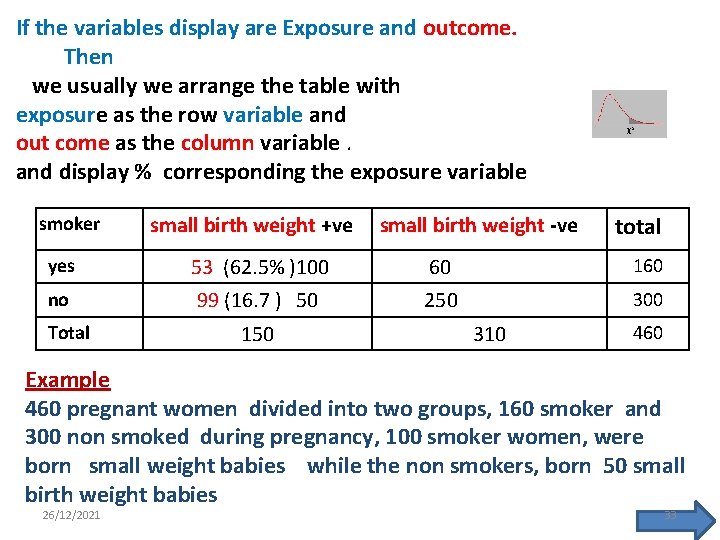
If the variables display are Exposure and outcome. Then we usually we arrange the table with exposure as the row variable and out come as the column variable. and display % corresponding the exposure variable smoker small birth weight +ve small birth weight -ve total yes 53 (62. 5% )100 60 160 no 99 (16. 7 ) 50 250 300 Total 150 310 460 Example 460 pregnant women divided into two groups, 160 smoker and 300 non smoked during pregnancy, 100 smoker women, were born small weight babies while the non smokers, born 50 small birth weight babies 26/12/2021 33
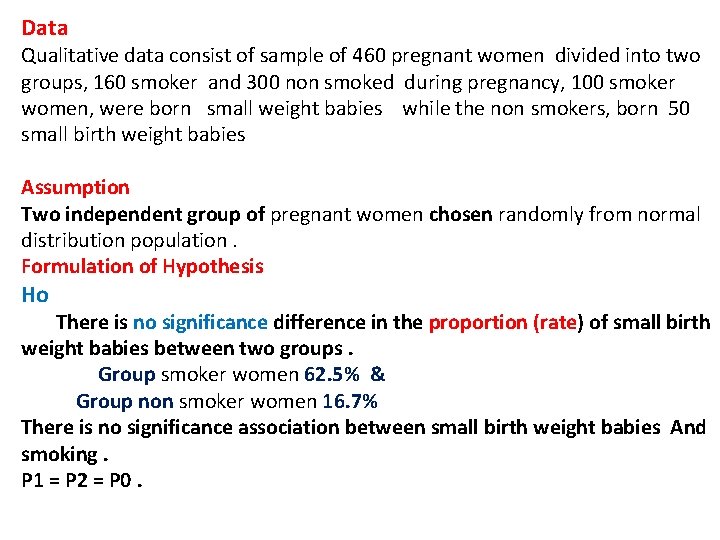
Data Qualitative data consist of sample of 460 pregnant women divided into two groups, 160 smoker and 300 non smoked during pregnancy, 100 smoker women, were born small weight babies while the non smokers, born 50 small birth weight babies Assumption Two independent group of pregnant women chosen randomly from normal distribution population. Formulation of Hypothesis Ho There is no significance difference in the proportion (rate) of small birth weight babies between two groups. Group smoker women 62. 5% & Group non smoker women 16. 7% There is no significance association between small birth weight babies And smoking. P 1 = P 2 = P 0.
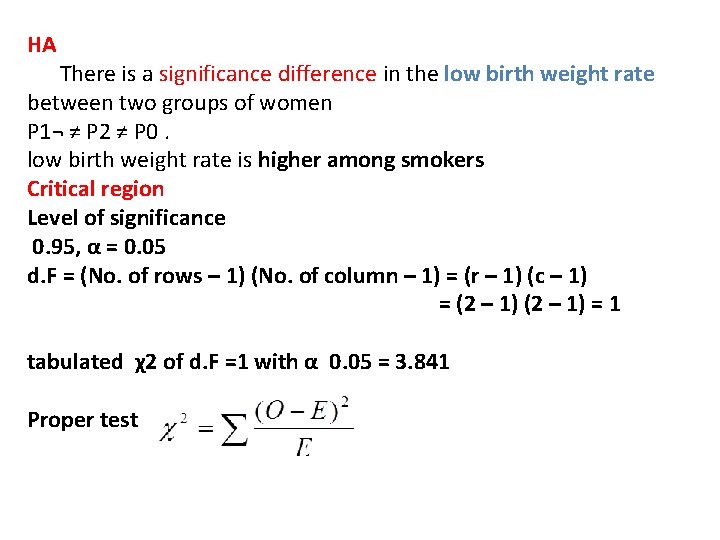
HA There is a significance difference in the low birth weight rate between two groups of women P 1¬ ≠ P 2 ≠ P 0. low birth weight rate is higher among smokers Critical region Level of significance 0. 95, α = 0. 05 d. F = (No. of rows – 1) (No. of column – 1) = (r – 1) (c – 1) = (2 – 1) = 1 tabulated χ2 of d. F =1 with α 0. 05 = 3. 841 Proper test
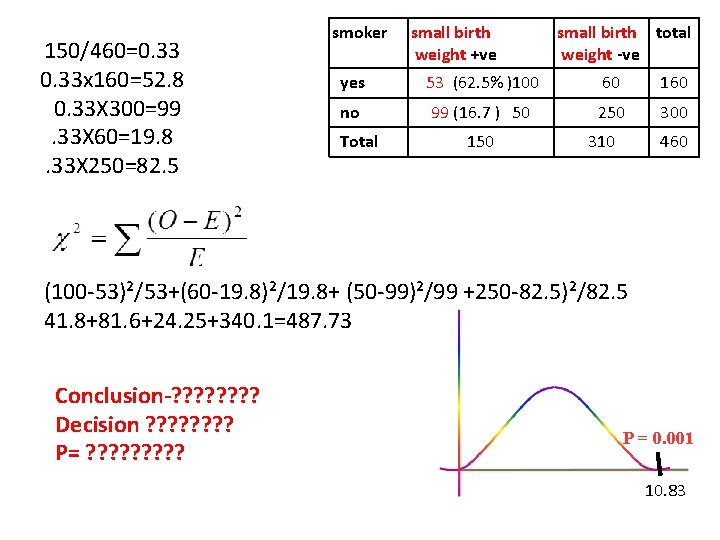
150/460=0. 33 x 160=52. 8 0. 33 X 300=99. 33 X 60=19. 8. 33 X 250=82. 5 smoker small birth weight +ve small birth total weight -ve yes 53 (62. 5% )100 60 160 no 99 (16. 7 ) 50 250 300 Total 150 310 460 (100 -53)²/53+(60 -19. 8)²/19. 8+ (50 -99)²/99 +250 -82. 5)²/82. 5 41. 8+81. 6+24. 25+340. 1=487. 73 Conclusion-? ? ? ? Decision ? ? ? ? P= ? ? ? ? ? P = 0. 001 10. 83
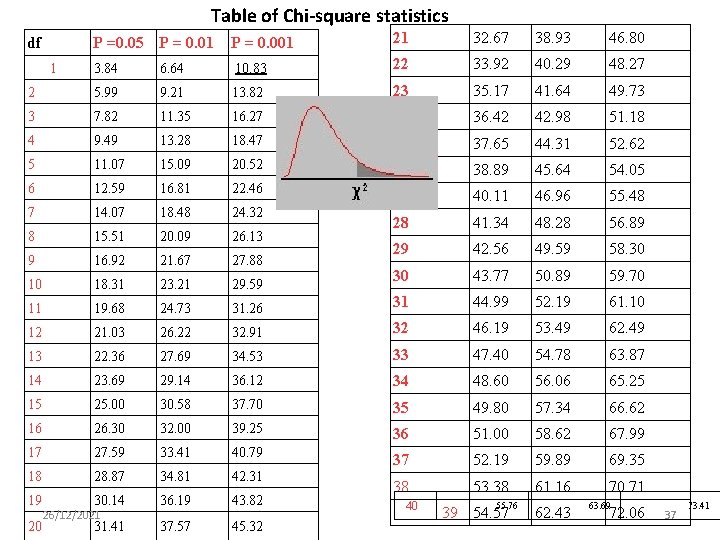
Table of Chi-square statistics P =0. 05 P = 0. 01 P = 0. 001 21 32. 67 38. 93 46. 80 3. 84 6. 64 10. 83 22 33. 92 40. 29 48. 27 2 5. 99 9. 21 13. 82 23 35. 17 41. 64 49. 73 3 7. 82 11. 35 16. 27 24 36. 42 42. 98 51. 18 4 9. 49 13. 28 18. 47 25 37. 65 44. 31 52. 62 5 11. 07 15. 09 20. 52 26 38. 89 45. 64 54. 05 6 12. 59 16. 81 22. 46 7 14. 07 18. 48 24. 32 27 40. 11 46. 96 55. 48 8 15. 51 20. 09 26. 13 28 41. 34 48. 28 56. 89 9 16. 92 21. 67 27. 88 29 42. 56 49. 59 58. 30 10 18. 31 23. 21 29. 59 30 43. 77 50. 89 59. 70 11 19. 68 24. 73 31. 26 31 44. 99 52. 19 61. 10 12 21. 03 26. 22 32. 91 32 46. 19 53. 49 62. 49 13 22. 36 27. 69 34. 53 33 47. 40 54. 78 63. 87 14 23. 69 29. 14 36. 12 34 48. 60 56. 06 65. 25 15 25. 00 30. 58 37. 70 35 49. 80 57. 34 66. 62 16 26. 30 32. 00 39. 25 36 51. 00 58. 62 67. 99 17 27. 59 33. 41 40. 79 18 28. 87 34. 81 42. 31 37 52. 19 59. 89 69. 35 30. 14 36. 19 43. 82 38 53. 38 61. 16 70. 71 31. 41 37. 57 45. 32 df 1 19 20 26/12/2021 40 55. 76 39 54. 57 62. 43 63. 69 72. 06 37 73. 41
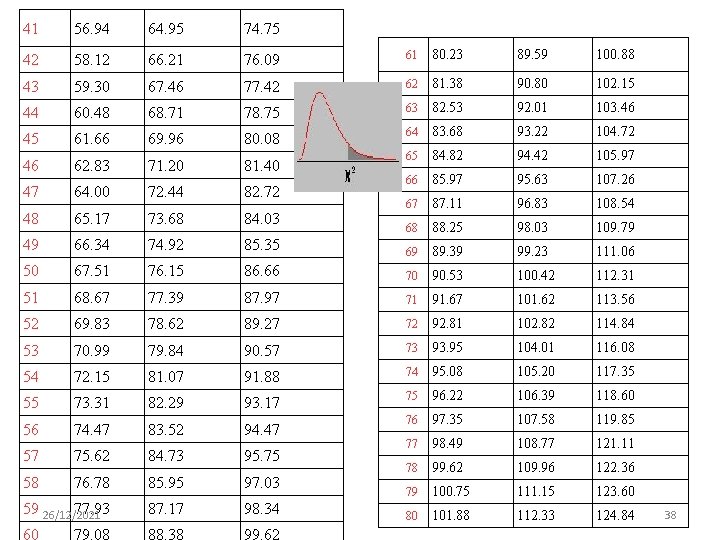
41 56. 94 64. 95 74. 75 42 58. 12 66. 21 76. 09 61 80. 23 89. 59 100. 88 43 59. 30 67. 46 77. 42 62 81. 38 90. 80 102. 15 44 60. 48 68. 71 78. 75 63 82. 53 92. 01 103. 46 45 61. 66 69. 96 80. 08 64 83. 68 93. 22 104. 72 46 62. 83 71. 20 81. 40 65 84. 82 94. 42 105. 97 47 64. 00 72. 44 82. 72 66 85. 97 95. 63 107. 26 48 65. 17 73. 68 84. 03 67 87. 11 96. 83 108. 54 68 88. 25 98. 03 109. 79 49 66. 34 74. 92 85. 35 69 89. 39 99. 23 111. 06 50 67. 51 76. 15 86. 66 70 90. 53 100. 42 112. 31 51 68. 67 77. 39 87. 97 71 91. 67 101. 62 113. 56 52 69. 83 78. 62 89. 27 72 92. 81 102. 82 114. 84 53 70. 99 79. 84 90. 57 73 93. 95 104. 01 116. 08 54 72. 15 81. 07 91. 88 74 95. 08 105. 20 117. 35 55 73. 31 82. 29 93. 17 75 96. 22 106. 39 118. 60 56 74. 47 83. 52 94. 47 76 97. 35 107. 58 119. 85 57 75. 62 84. 73 95. 75 77 98. 49 108. 77 121. 11 58 76. 78 85. 95 97. 03 78 99. 62 109. 96 122. 36 79 100. 75 111. 15 123. 60 59 26/12/2021 77. 93 87. 17 98. 34 80 101. 88 112. 33 124. 84 38
81 103. 01 113. 51 126. 09 82 104. 14 114. 70 127. 33 83 105. 27 115. 88 128. 57 84 106. 40 117. 06 129. 80 85 107. 52 118. 24 131. 04 93 116. 51 127. 63 140. 90 94 117. 63 128. 80 142. 12 86 108. 65 119. 41 132. 28 87 109. 77 120. 59 133. 51 95 118. 75 129. 97 143. 32 88 110. 90 121. 77 134. 74 96 119. 87 131. 14 144. 55 89 112. 02 122. 94 135. 96 97 120. 99 132. 31 145. 78 90 113. 15 124. 12 137. 19 98 122. 11 133. 47 146. 99 91 114. 27 125. 29 138. 45 99 123. 23 134. 64 148. 21 92 115. 39 126. 46 139. 66 100 124. 34 135. 81 149. 48 93 116. 51 26/12/2021 127. 63 140. 90 39
Example A sample of 460 adult was chosen , 240 were given influenza vaccine while the remaining given placebo. Overall 100 persons contracted influenza of whom 20 were in vaccine group. we would like to assess the strength of evidence that vaccination affect the probability of contracting disease is there any evidence that vaccine have an effect on contracting the disease ? ? Total 460 100 persons contracted influenza 240 vaccinated 20 contracted influenza 26/12/2021 40

41 26/12/2021 41
Application of χ2. 1. 2 × 2 table. 2. a × b table. 26/12/2021 42
- Slides: 42