
Dr Steve Martin Cavendish Laboratory Y 9 practical
Dr Steve Martin Cavendish Laboratory
Y 9 practical activity • The task which follows is an adaptation of an activity which we do with our Y 9 visitors when they participate in the Cambridge Physics Experience • It can be done by individuals or teams, at home or in school, as a competition or just for fun, as your teachers and your school’s circumstances require. Cavendish Laboratory
The scenario • Engineers need to design structures which are strong enough for their intended purpose • Those structures need to be sufficiently stiff (who wants to be on a bus crossing a bridge which is too bouncy? ) • Also, economical use of material is important to avoid waste and excessive use of energy during construction. • So, we propose the construction of a model bridge, using some simple but important mechanical ideas. Cavendish Laboratory
What you will need • A good quantity of newspaper or other scrap paper • Sellotape • A gap to be spanned by your bridge (the gap between two chairs will do nicely) • Something to act as a load for your bridge, around half a kilogram. . . masses and hanger is fine in school; or maybe a small bag of sugar if you are doing this at home (but do use something which will be safe and non -messy if dropped on the floor. . . no glass jars of sticky jam, please!) Cavendish Laboratory
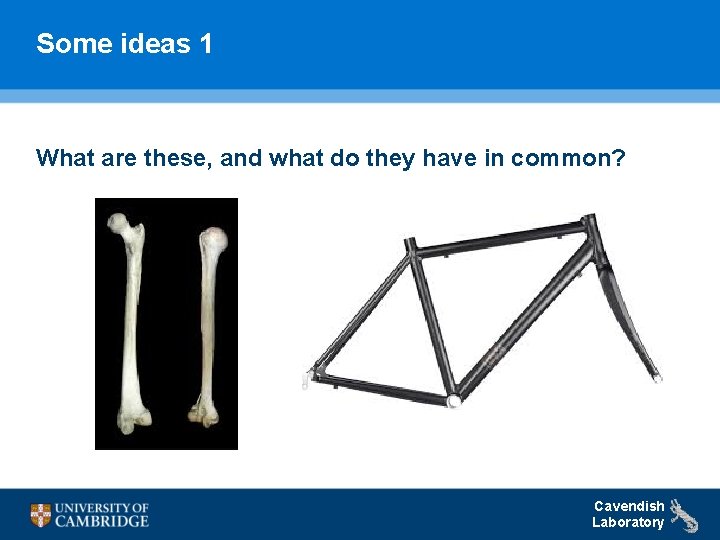
Some ideas 1 What are these, and what do they have in common? Cavendish Laboratory
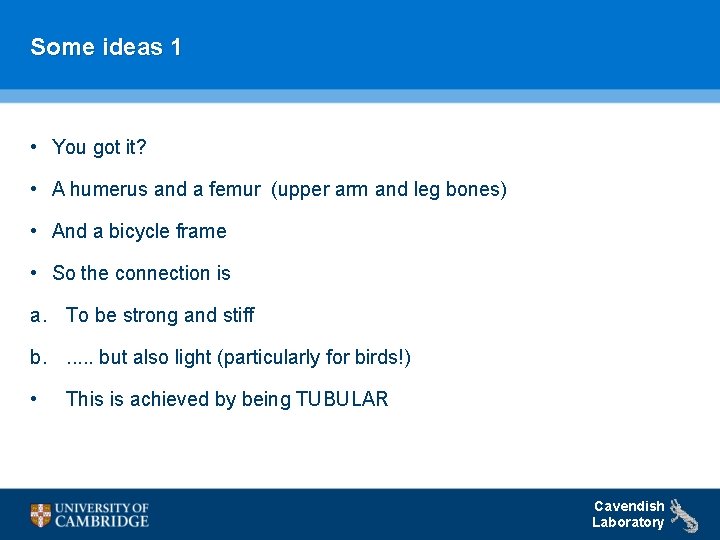
Some ideas 1 • You got it? • A humerus and a femur (upper arm and leg bones) • And a bicycle frame • So the connection is a. To be strong and stiff b. . . but also light (particularly for birds!) • This is achieved by being TUBULAR Cavendish Laboratory
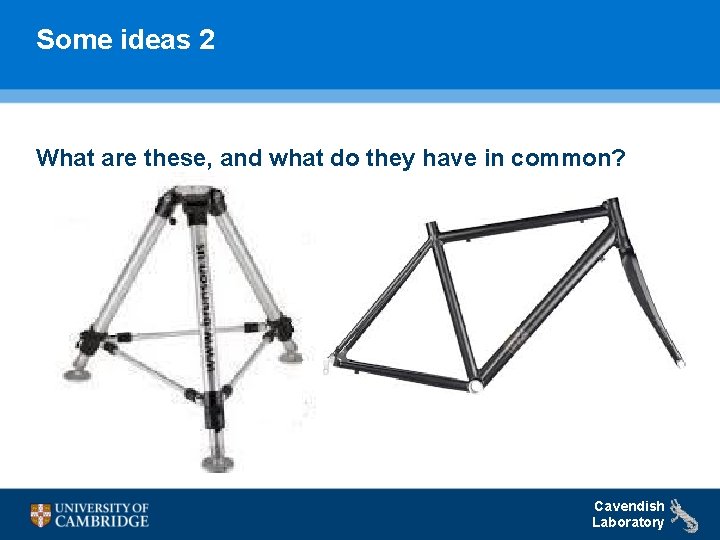
Some ideas 2 What are these, and what do they have in common? Cavendish Laboratory
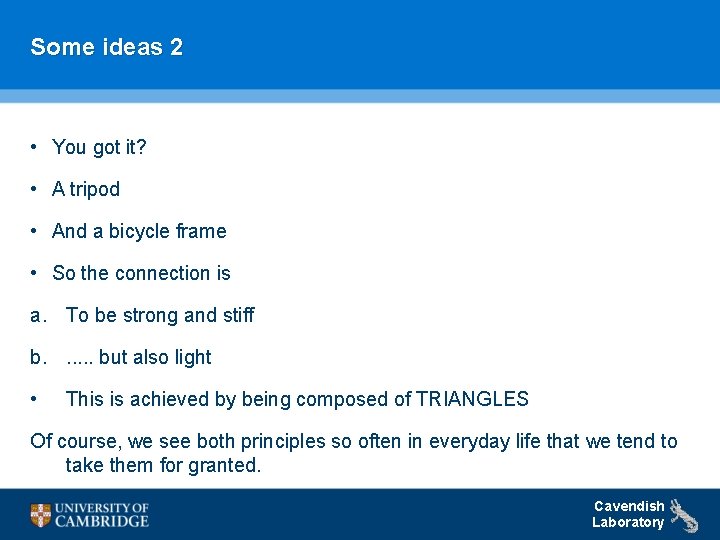
Some ideas 2 • You got it? • A tripod • And a bicycle frame • So the connection is a. To be strong and stiff b. . . but also light • This is achieved by being composed of TRIANGLES Of course, we see both principles so often in everyday life that we tend to take them for granted. Cavendish Laboratory
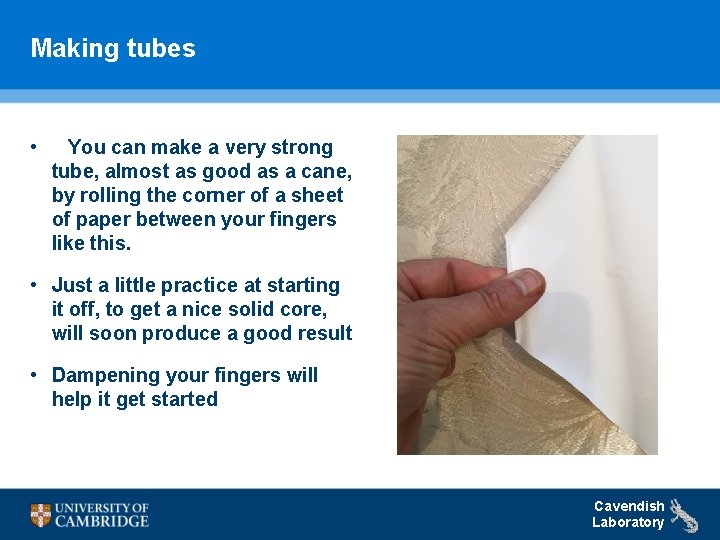
Making tubes • You can make a very strong tube, almost as good as a cane, by rolling the corner of a sheet of paper between your fingers like this. • Just a little practice at starting it off, to get a nice solid core, will soon produce a good result • Dampening your fingers will help it get started Cavendish Laboratory
Your task (individual or team effort) • Design a bridge to span the gap between your two supports, using the two principles explained above and any other ideas of your own. Maybe, do a bit of research on bridge structures. • In designing your bridge, your aim is to bridge the largest possible gap while safely supporting your load, attached at the centre (you will probably be surprised just how strong this kind of construction can be) • If you are doing this as a competition, a good measure of the efficiency of your structure might be: (the span)/ (number of sheets of paper used) • But you or your teachers can devise any kind of competition you like. • Enjoy! Cavendish Laboratory
- Slides: 10