
Dr S Balachandra Rao Hon Director Gandhi centre
Dr. S. Balachandra Rao Hon Director, Gandhi centre for science & human values, Bharatiya Vidya Bhavan, Bangalore BHASKARACHARYA-II ( on the occasion of 900 th Birth Anniversary )
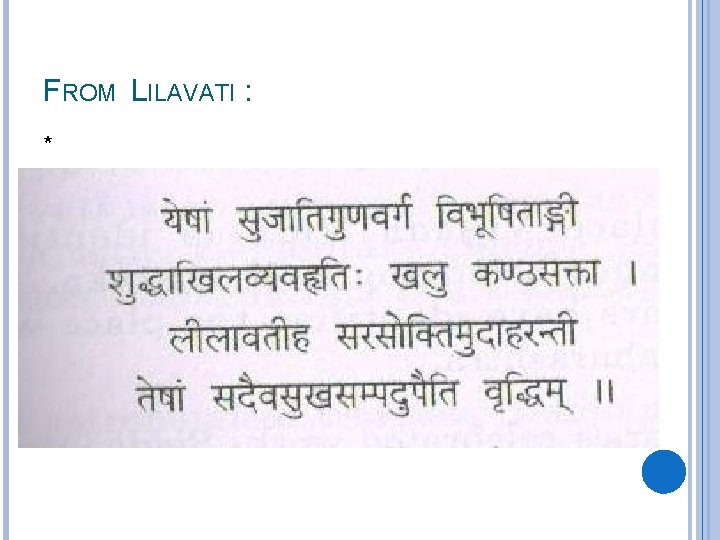
FROM LILAVATI : *
BHASKARA’S TIME According to his own statement “ he belonged to Vijjada vida( Bijjada bida) near the line of Sahyadri mountains”. The place Vijjada vida is identified as present Bijapura of Karnataka, but some scholars have identified the place with a other place in Maharashtra. Born in 1114 CE (This year 900 th Birth Anniversary) Bhaskara’s father was Maheshwara, a scholarly person belonging to the Shandilya gotra.
BHASKARA’S WORKS Siddantha Siromani ( Grahaganitam and Goladhyaya) This text was composed by Bhaskara , when he was 36 years old( in 1150 CE) Lilavati Bijaganitam Karana kutuhalam Vasana Bhasya This text was composed by Bhaskara , when he was 69 years old ( in 1183 CE )
ABOUT HIS WORKS According to some sources Siddantha Siromani consists of four parts namely , Lilavati, Bijaganitam, Grahaganitam and Goladhyaya. The first two are independent texts deal exclusively with Mathematics and the last two with Astronomy. This text was composed by Bhaskara , when he was 36 years old Lilavati is an extremely popular text dealing arithmetic , elementary algebra, permutations of digits, progressions, geometry and mensuration, etc. Bijaganitam is a treatise on advanced algebra. Grahaganitam and Goladhyaya are completely devoted to computations of planetary motions , eclipses and rationales of spherical astronomy. Karana kutuhalam is another smaller astronomical karana text with ready-to-use tables. Vasana Bhasya is a detailed commentary on his works with very interesting and illustrative examples.
BHASKARA’S CONTRIBUTION TO ASTRONOMY Bhaskara’s Siddantha siromani merits as the best and exhaustive text for understanding Indian Astronomy. He gets the credit of being the first among Hindu astronomers in introducing the moon’s equation which is now called “evection’’ into siddhantic text. It is remarkable discovery by Bhaskara which preceded even the western countries by four centuries. The chapter on spherical astronomy, Goladhyaya, is very important from the point of theoretical astronomy. Rationale for the formulae used are provided. Large number of astronomical instruments are given in “yantradhyaya”. He has improved the formulae and methods adopted by earlier Indian Astronomers.
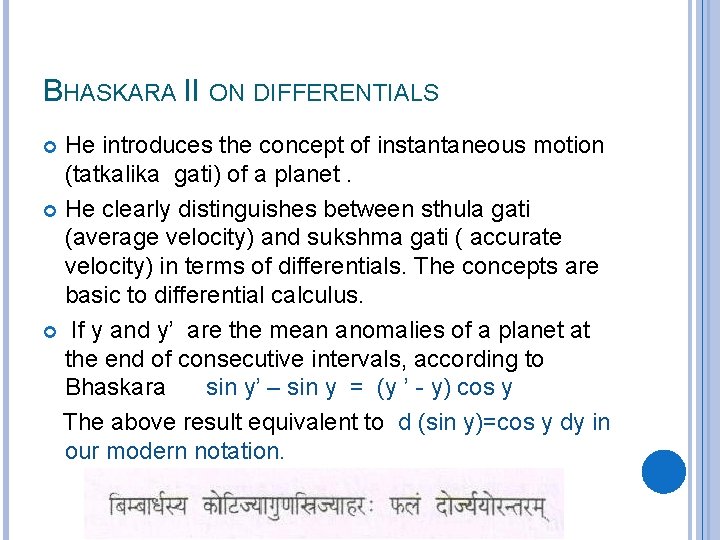
BHASKARA II ON DIFFERENTIALS He introduces the concept of instantaneous motion (tatkalika gati) of a planet. He clearly distinguishes between sthula gati (average velocity) and sukshma gati ( accurate velocity) in terms of differentials. The concepts are basic to differential calculus. If y and y’ are the mean anomalies of a planet at the end of consecutive intervals, according to Bhaskara sin y’ – sin y = (y ’ - y) cos y The above result equivalent to d (sin y)=cos y dy in our modern notation.
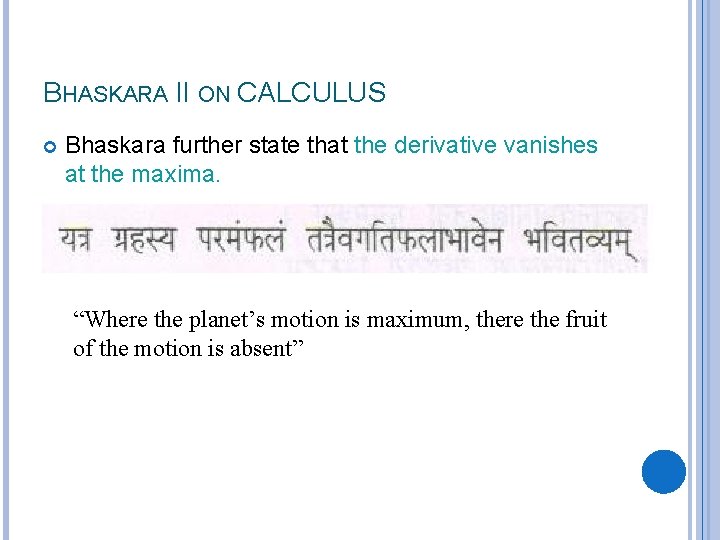
BHASKARA II ON CALCULUS Bhaskara further state that the derivative vanishes at the maxima. “Where the planet’s motion is maximum, there the fruit of the motion is absent”
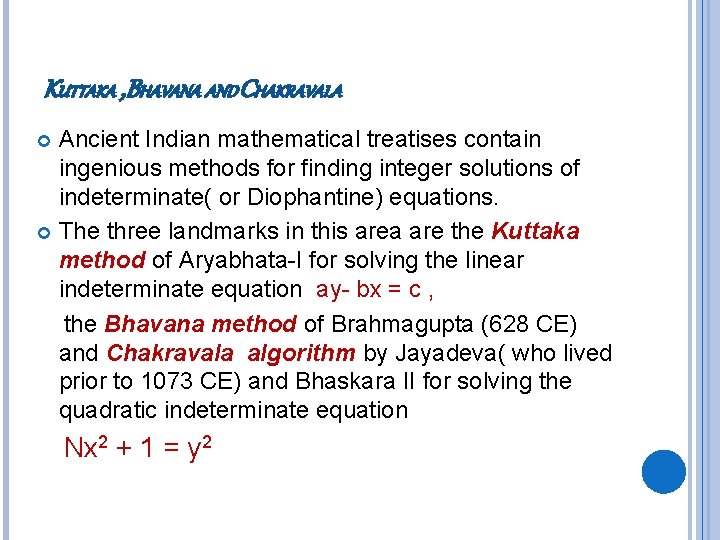
KUTTAKA , BHAVANA AND CHAKRAVALA Ancient Indian mathematical treatises contain ingenious methods for finding integer solutions of indeterminate( or Diophantine) equations. The three landmarks in this area are the Kuttaka method of Aryabhata-I for solving the linear indeterminate equation ay- bx = c , the Bhavana method of Brahmagupta (628 CE) and Chakravala algorithm by Jayadeva( who lived prior to 1073 CE) and Bhaskara II for solving the quadratic indeterminate equation Nx 2 + 1 = y 2
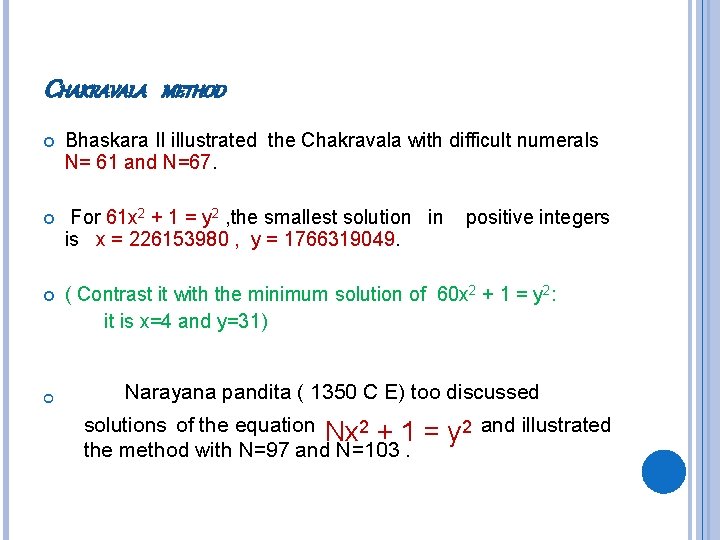
CHAKRAVALA METHOD Bhaskara II illustrated the Chakravala with difficult numerals N= 61 and N=67. For 61 x 2 + 1 = y 2 , the smallest solution in is x = 226153980 , y = 1766319049. ( Contrast it with the minimum solution of 60 x 2 + 1 = y 2: it is x=4 and y=31) positive integers Narayana pandita ( 1350 C E) too discussed solutions of the equation Nx 2 + 1 the method with N=97 and N=103. = y 2 and illustrated
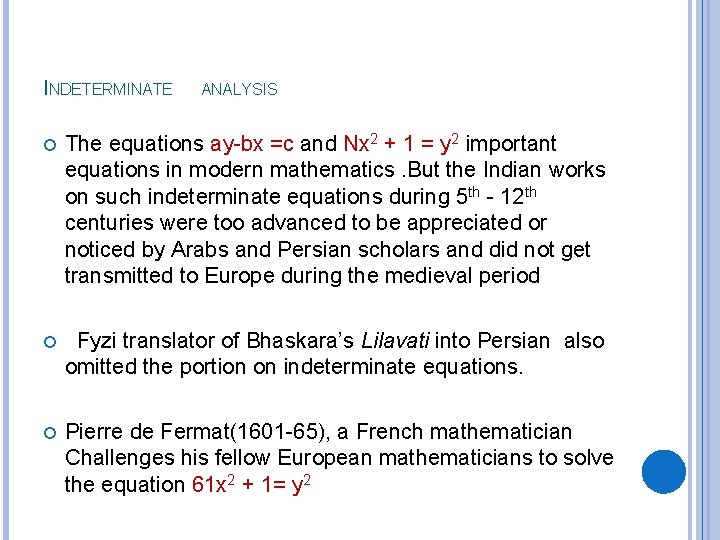
INDETERMINATE ANALYSIS The equations ay-bx =c and Nx 2 + 1 = y 2 important equations in modern mathematics. But the Indian works on such indeterminate equations during 5 th - 12 th centuries were too advanced to be appreciated or noticed by Arabs and Persian scholars and did not get transmitted to Europe during the medieval period Fyzi translator of Bhaskara’s Lilavati into Persian also omitted the portion on indeterminate equations. Pierre de Fermat(1601 -65), a French mathematician Challenges his fellow European mathematicians to solve the equation 61 x 2 + 1= y 2
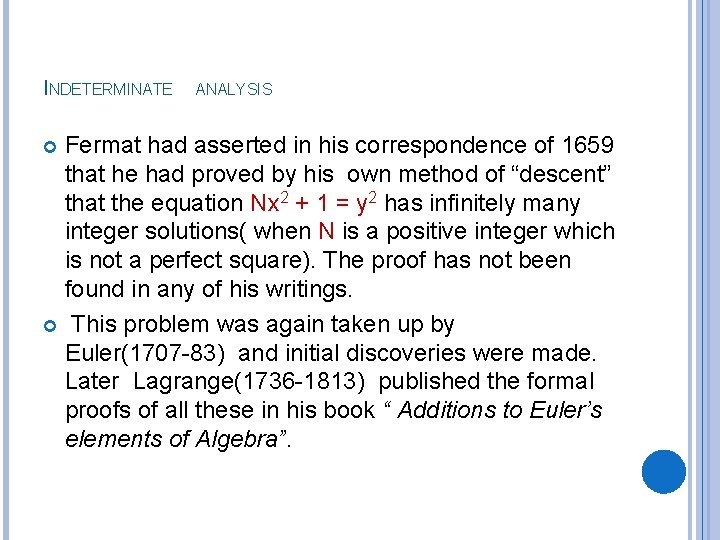
INDETERMINATE ANALYSIS Fermat had asserted in his correspondence of 1659 that he had proved by his own method of “descent” that the equation Nx 2 + 1 = y 2 has infinitely many integer solutions( when N is a positive integer which is not a perfect square). The proof has not been found in any of his writings. This problem was again taken up by Euler(1707 -83) and initial discoveries were made. Later Lagrange(1736 -1813) published the formal proofs of all these in his book “ Additions to Euler’s elements of Algebra”.
THE LABEL PELL’S EQUATION The equation Nx 2 + 1 = y 2 was attributed to the English mathematician John Pell(1611 -85) by Euler although there is no evidence that Pell had investigated the equation. Because of Euler’s mistaken attribution it remained as Pell’s equation, even though it is historically wrong. As suggested by R. Sridharan the equation should be called “Brahmagupta’s equation” as attribute to the genius who contributed the equation thousands of years before the time Fermat and Pell.
COMPLIMENTS AND REMARKS “Bhaskara's Chakravala method is beyond all praise : It is certainly the finest thing achieved in theory of numbers before Lagrange” - Hankel, the famous German mathematician. Regarding Fermat’s challenge, Andre Weil remarks “What would have been Fermat’s astonishment if some missionary , just back from India had told him that his problem had been successfully tackled there by native mathematicians almost five centuries earlier”
CYCLIC QUADRILATERALS WITH RATIONAL SIDES Ø Ø Ø The credit of Constructing a Cyclic Quadrilateral with rational sides goes to Brahmagupta (628 CE) The only cyclic -quadrilateral that was known to western countries till 18 th century was with sides 39, 52, 60, 25 and it was referred to as Brahmagupta’s quadrilateral. The German Mathematician, Kummer (1810 -1893) in one of his papers shows that Brahmagupta’s simple method enables us to construct any number of such quadrilaterals and expresses his great admiration for Brahmagupta.
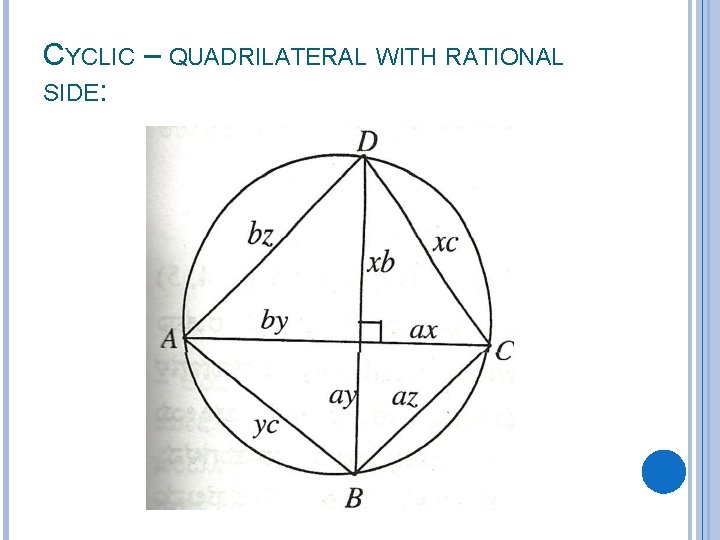
CYCLIC – QUADRILATERAL WITH RATIONAL SIDE:
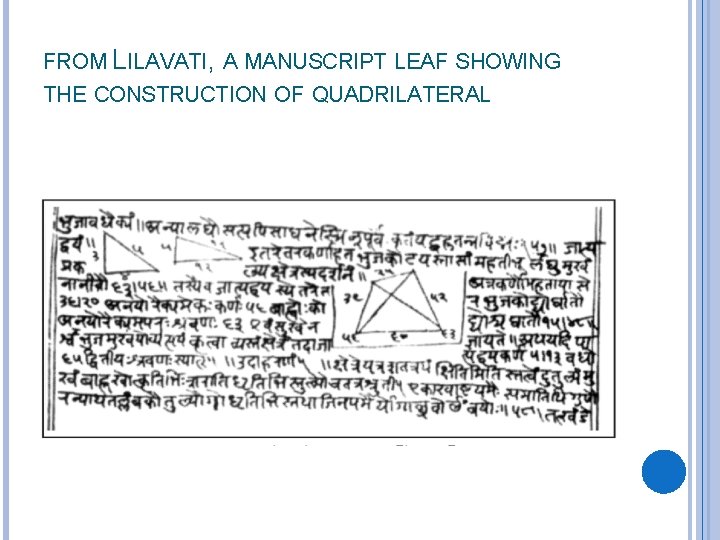
FROM LILAVATI, A MANUSCRIPT LEAF SHOWING THE CONSTRUCTION OF QUADRILATERAL
BHASKARA’S WORK ON CYCLICQUADRILATERAL WITH INTEGER SIDES Bhaskara had explained a construction of cyclic – quadrilateral by considering two right angled triangle with integer sides ( the palm leaf of the manuscript is shown). In the above manuscript the two triangles are of the sides (3, 4, 5 ) and (5, 12, 13) resulting in a cyclic quadrilateral with sides 52, 39, 25 and 60. same as Brahmagupta’s quadrilateral ! !
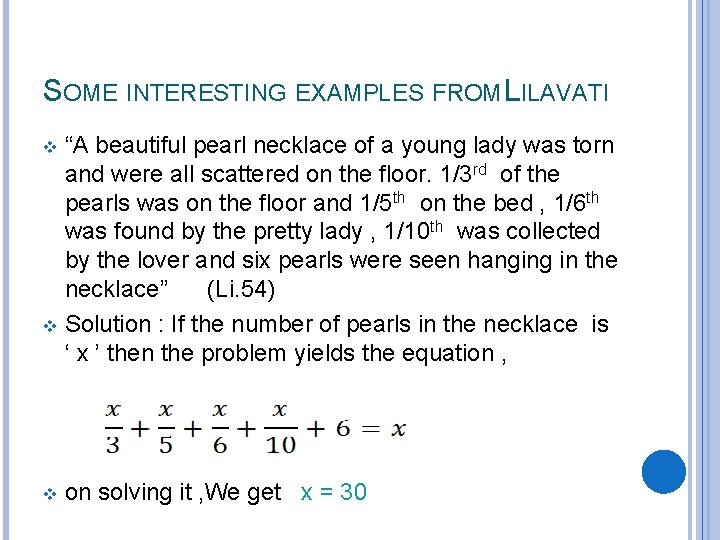
SOME INTERESTING EXAMPLES FROM LILAVATI “A beautiful pearl necklace of a young lady was torn and were all scattered on the floor. 1/3 rd of the pearls was on the floor and 1/5 th on the bed , 1/6 th was found by the pretty lady , 1/10 th was collected by the lover and six pearls were seen hanging in the necklace” (Li. 54) v Solution : If the number of pearls in the necklace is ‘ x ’ then the problem yields the equation , v v on solving it , We get x = 30
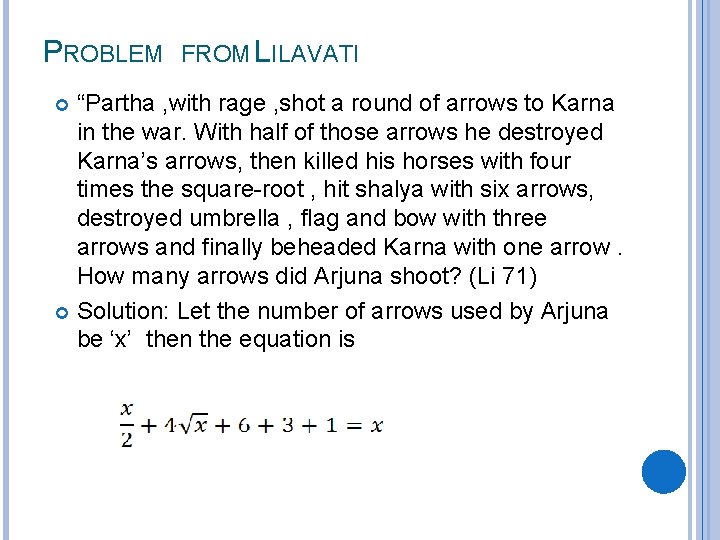
PROBLEM FROM LILAVATI “Partha , with rage , shot a round of arrows to Karna in the war. With half of those arrows he destroyed Karna’s arrows, then killed his horses with four times the square-root , hit shalya with six arrows, destroyed umbrella , flag and bow with three arrows and finally beheaded Karna with one arrow. How many arrows did Arjuna shoot? (Li 71) Solution: Let the number of arrows used by Arjuna be ‘x’ then the equation is
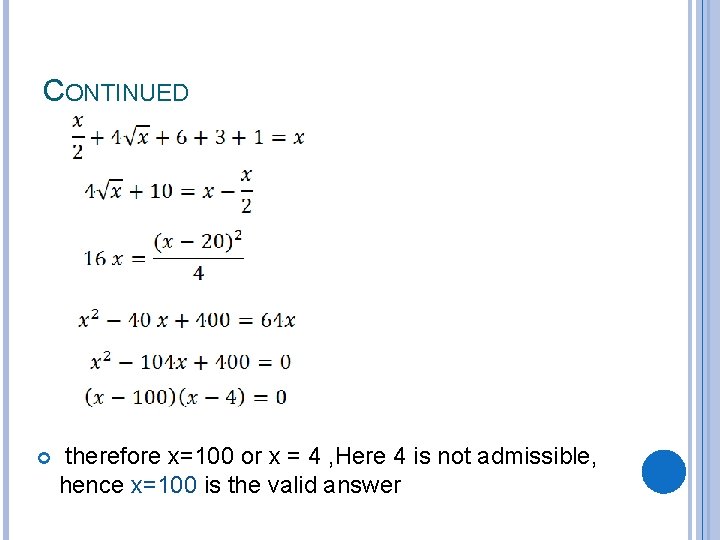
CONTINUED therefore x=100 or x = 4 , Here 4 is not admissible, hence x=100 is the valid answer
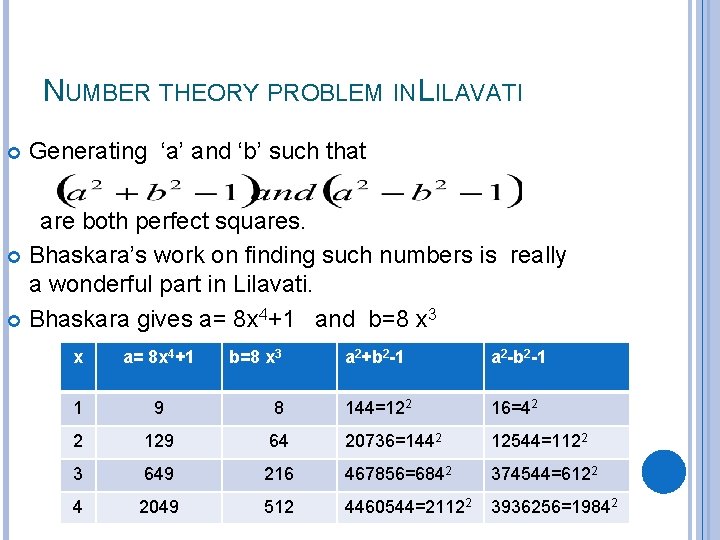
NUMBER THEORY PROBLEM IN LILAVATI Generating ‘a’ and ‘b’ such that are both perfect squares. Bhaskara’s work on finding such numbers is really a wonderful part in Lilavati. Bhaskara gives a= 8 x 4+1 and b=8 x 3 x a= 8 x 4+1 1 9 2 b=8 x 3 a 2+b 2 -1 a 2 -b 2 -1 8 144=122 16=42 129 64 20736=1442 12544=1122 3 649 216 467856=6842 374544=6122 4 2049 512 4460544=21122 3936256=19842
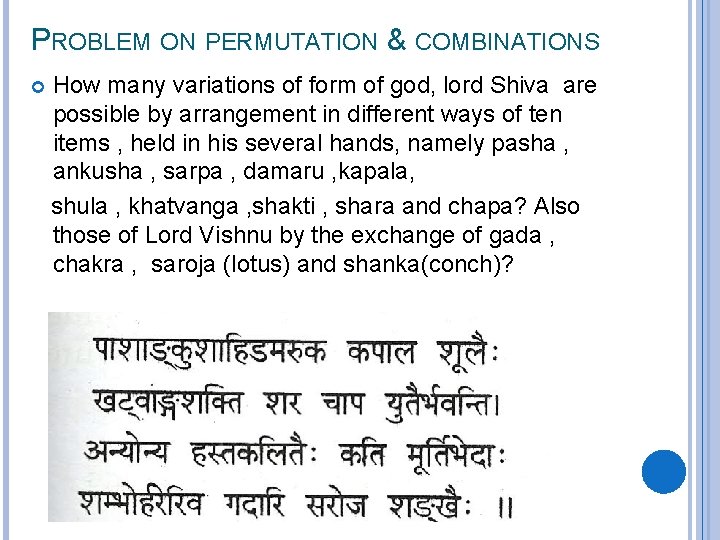
PROBLEM ON PERMUTATION & COMBINATIONS How many variations of form of god, lord Shiva are possible by arrangement in different ways of ten items , held in his several hands, namely pasha , ankusha , sarpa , damaru , kapala, shula , khatvanga , shakti , shara and chapa? Also those of Lord Vishnu by the exchange of gada , chakra , saroja (lotus) and shanka(conch)?
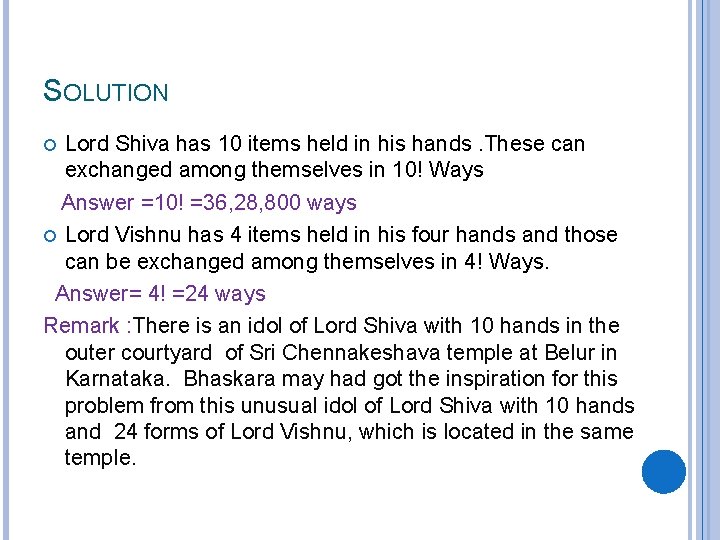
SOLUTION Lord Shiva has 10 items held in his hands. These can exchanged among themselves in 10! Ways Answer =10! =36, 28, 800 ways Lord Vishnu has 4 items held in his four hands and those can be exchanged among themselves in 4! Ways. Answer= 4! =24 ways Remark : There is an idol of Lord Shiva with 10 hands in the outer courtyard of Sri Chennakeshava temple at Belur in Karnataka. Bhaskara may had got the inspiration for this problem from this unusual idol of Lord Shiva with 10 hands and 24 forms of Lord Vishnu, which is located in the same temple.
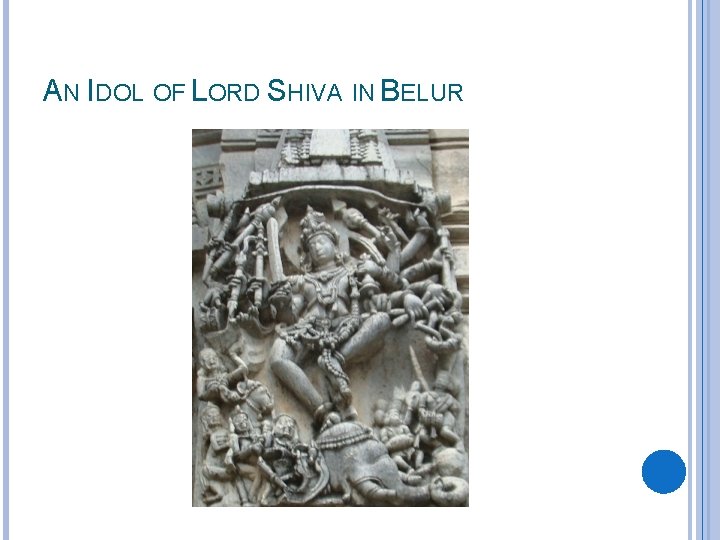
AN IDOL OF LORD SHIVA IN BELUR
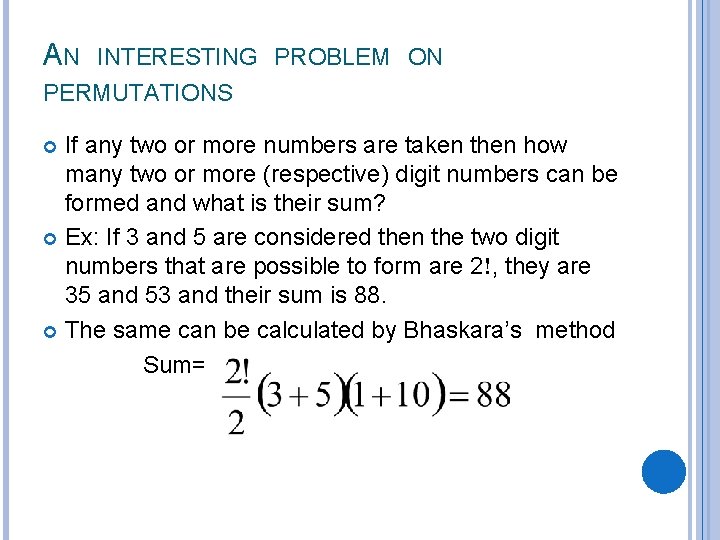
AN INTERESTING PROBLEM ON PERMUTATIONS If any two or more numbers are taken then how many two or more (respective) digit numbers can be formed and what is their sum? Ex: If 3 and 5 are considered then the two digit numbers that are possible to form are 2 , they are 35 and 53 and their sum is 88. The same can be calculated by Bhaskara’s method Sum=
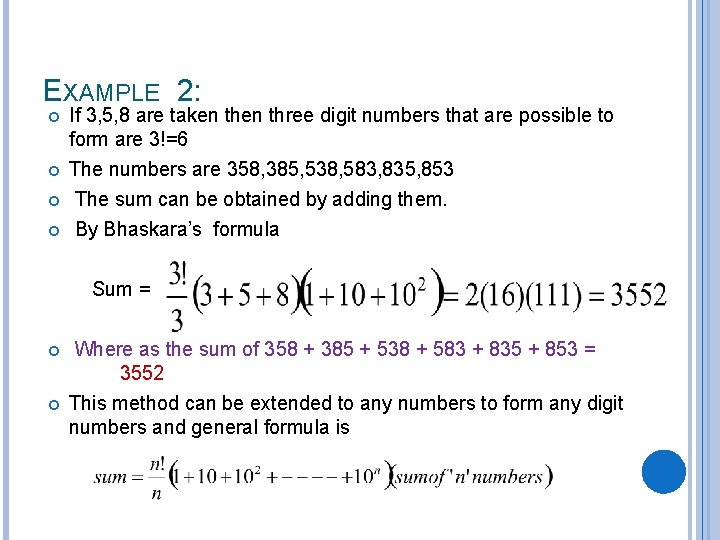
EXAMPLE 2: If 3, 5, 8 are taken three digit numbers that are possible to form are 3!=6 The numbers are 358, 385, 538, 583, 835, 853 The sum can be obtained by adding them. By Bhaskara’s formula Sum = Where as the sum of 358 + 385 + 538 + 583 + 835 + 853 = 3552 This method can be extended to any numbers to form any digit numbers and general formula is
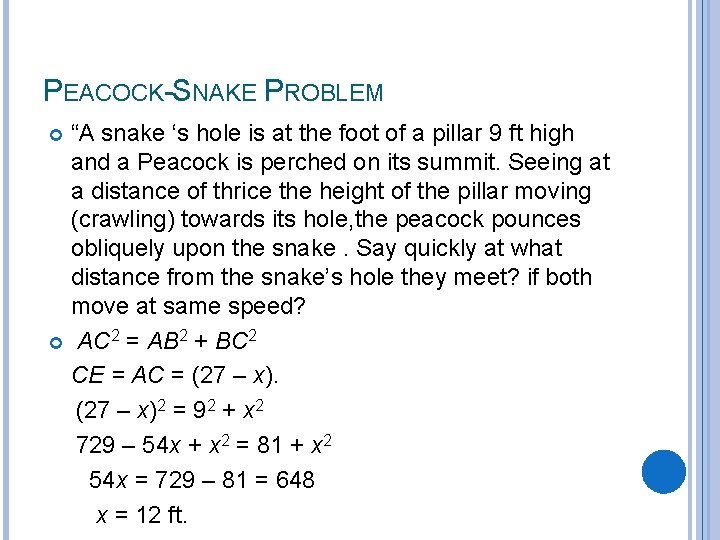
PEACOCK-SNAKE PROBLEM “A snake ‘s hole is at the foot of a pillar 9 ft high and a Peacock is perched on its summit. Seeing at a distance of thrice the height of the pillar moving (crawling) towards its hole, the peacock pounces obliquely upon the snake. Say quickly at what distance from the snake’s hole they meet? if both move at same speed? AC 2 = AB 2 + BC 2 CE = AC = (27 – x)2 = 92 + x 2 729 – 54 x + x 2 = 81 + x 2 54 x = 729 – 81 = 648 x = 12 ft.
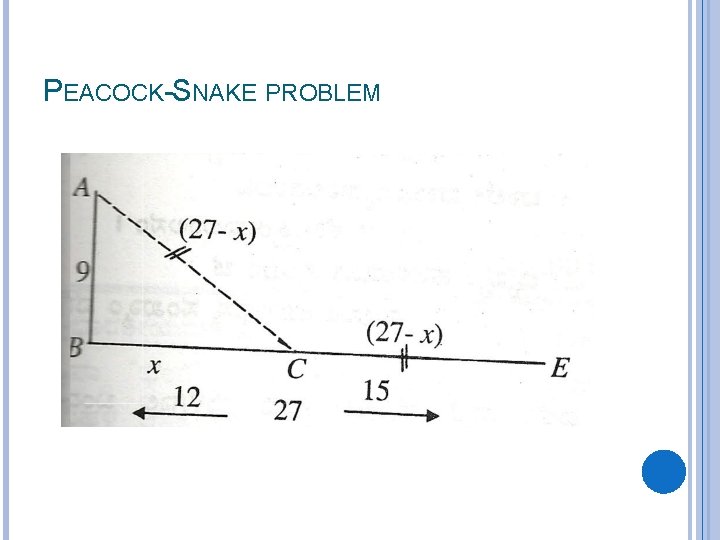
PEACOCK-SNAKE PROBLEM
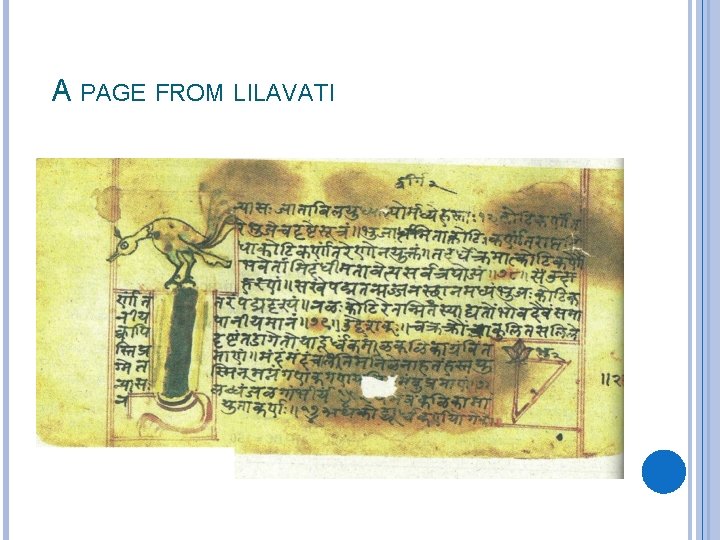
A PAGE FROM LILAVATI
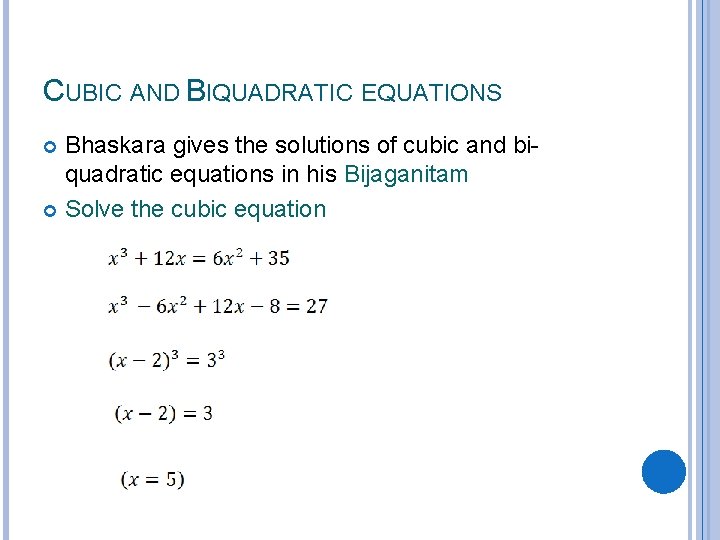
CUBIC AND BIQUADRATIC EQUATIONS Bhaskara gives the solutions of cubic and biquadratic equations in his Bijaganitam Solve the cubic equation
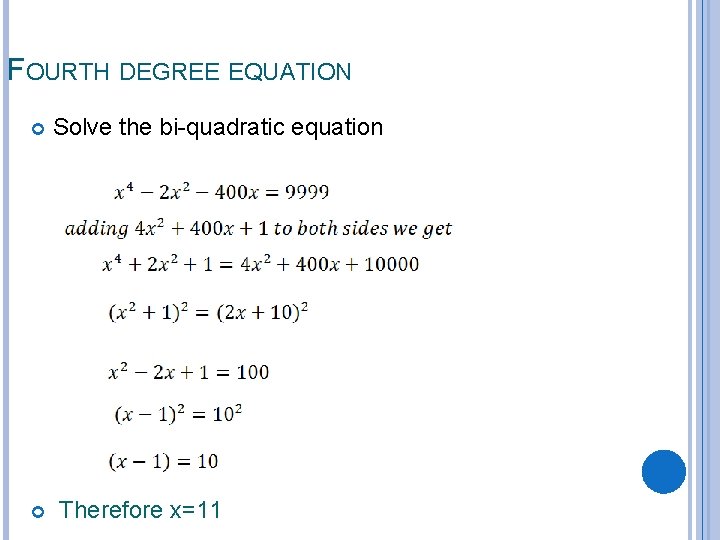
FOURTH DEGREE EQUATION Solve the bi-quadratic equation Therefore x=11
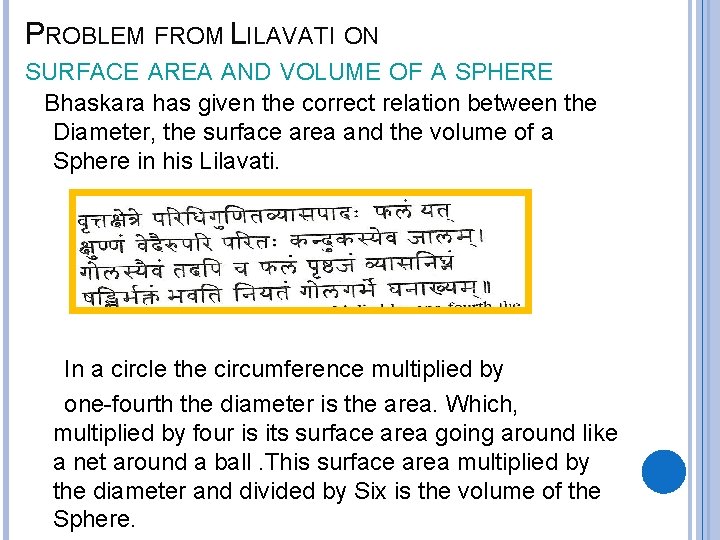
PROBLEM FROM LILAVATI ON SURFACE AREA AND VOLUME OF A SPHERE Bhaskara has given the correct relation between the Diameter, the surface area and the volume of a Sphere in his Lilavati. In a circle the circumference multiplied by one-fourth the diameter is the area. Which, multiplied by four is its surface area going around like a net around a ball. This surface area multiplied by the diameter and divided by Six is the volume of the Sphere.
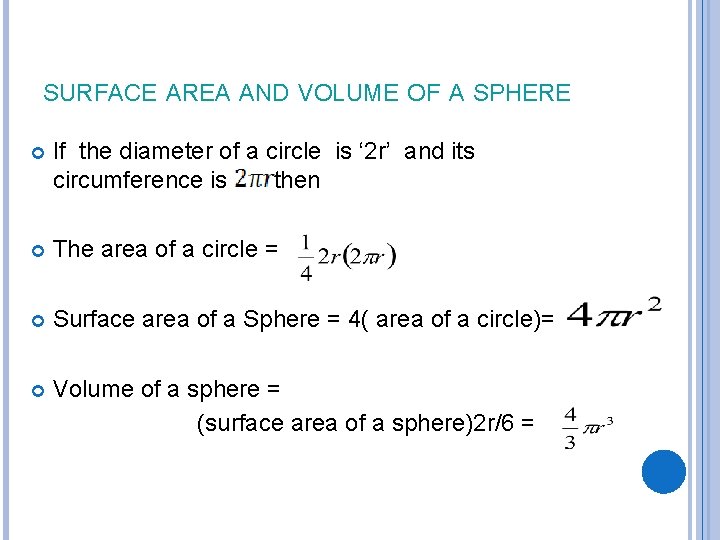
SURFACE AREA AND VOLUME OF A SPHERE If the diameter of a circle is ‘ 2 r’ and its circumference is then The area of a circle = Surface area of a Sphere = 4( area of a circle)= Volume of a sphere = (surface area of a sphere)2 r/6 =
COMMENTARIES ON BHASKARA’S WORKS o o o Krishna Daivajna( c. 16 th century) is known for his commentary on the Bijaganitam of Bhaskara II, known as Bija pallavam. Ganesha Daivajna (c. 16 th century)has written the commentary on Lilavati called Buddi vilasini. Suryadasa(early 16 th century) has written commentary on both Bijaganitam and Lilavati. Sumati Harsha (c. 1621) has written commentary on Karanakutuhalam called Ganaka kumuda kaumudi.
BIBLIOGRAPHY Indian Mathematics and Astronomy some Landmarks , Dr. S. Balachandra Rao, revised 3 rd edition , Bhavan’s Gandhi centre, Bangalore. Mathematics in India, Culture and History of mathematics 7, Kim Plofker , Hindustan Book Agency , New Delhi. Studies in the History of Indian Mathematics, Culture and History of mathematics-5 , C. S. Seshadri , Hindustan Book Agency , New Delhi. Lilavati of Bhaskaracarya with Kriya- kramakari , K. V. Sarma , VVBIS, panjab University. Lilavati , 2 vols, V. G. Apte , Anandashrama Press , Pune. Sisya –dhi- Vrddidha-tantra of Lalla, 2 vols, Dr. Bina Chatterjee, Indian National Science Academy, New Delhi. Sri Bhaskaracharya virachita “Lilavati” in Kannada, K S Nagarajan, SSVM, Bangalore. Lilavti-108 selected Problems in Kannada,

Thank you
- Slides: 37