
Dr Robert Siegler EDCI 6304 Jeff Blackman Who

Dr. Robert Siegler EDCI 6304 Jeff Blackman
Who is he? �Teresa Heinz Professor of Cognitive Psychology at Carnegie Mellon University �Researches children’s thinking �Over 200 articles �Five books �National Academy of Education (2010) �Headed the Fractions Practice Guide Panel for the U. S. Department of Education (2009 – 2010) �American Psychological Association's Distinguished Scientific Contribution Award (2005)
Background �Born in Chicago (1949) �Original interests: History and Economics �University of Illinois �Grad School and Ph. D at SUNY Stonybrook � 1974 – Carnegie Mellon University (Assistant Professor)
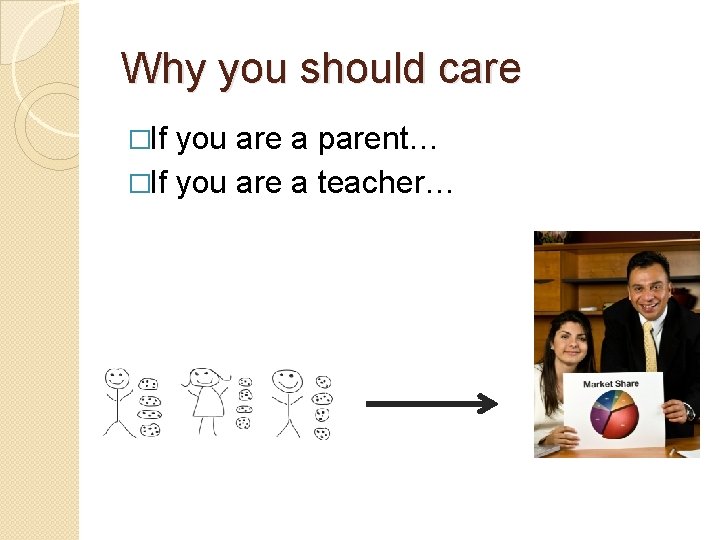
Why you should care �If you are a parent… �If you are a teacher…

Siegler vs. Piaget

Overlapping Waves Model
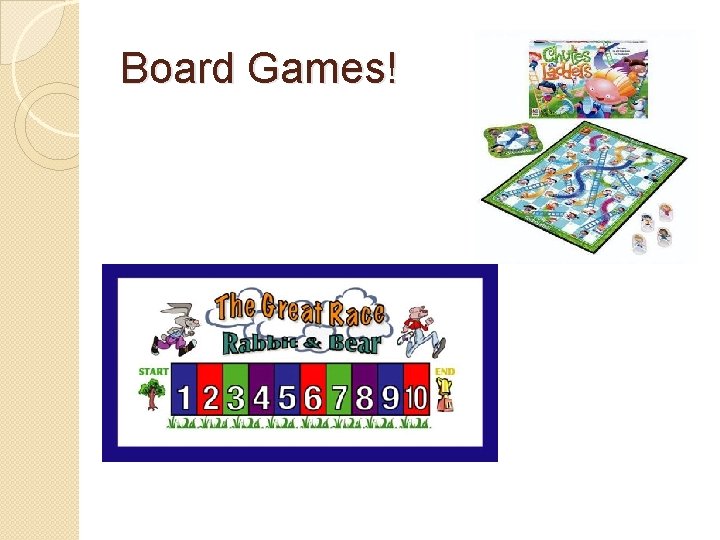
Board Games!
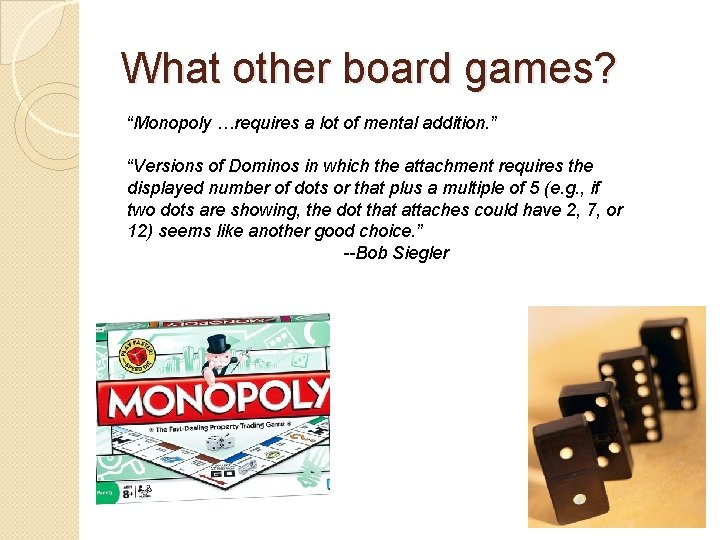
What other board games? “Monopoly …requires a lot of mental addition. ” “Versions of Dominos in which the attachment requires the displayed number of dots or that plus a multiple of 5 (e. g. , if two dots are showing, the dot that attaches could have 2, 7, or 12) seems like another good choice. ” --Bob Siegler
Questions?
Photo Credits Slide 1: Picture of Robert Siegler. From the Robert Siegler home page at http: //www. psy. cmu. edu/~siegler/index. html Slide 4: Picture 1 from Developing effective fractions instruction for kindergarten through 8 th grade: A practice guide - Retrieved from whatworks. ed. gov/publications/practiceguides Slide 4: Picture 2 – Microsoft Office Clipart Slide 5: Piaget - from http: //www. tumblr. com/tagged/jean-piaget Slide 5: Siegler – from http: //www. psy. cmu. edu/~siegler/Am. Psych. Bio. pdf Slide 6: Overlapping Waves Model - from http: //www. psy. cmu. edu/~siegler/Amer. Psy 05. pdf Slide 7: Number game - from http: //www. psy. cmu. edu/~siegler/sieg-cdper 09. pdf Slide 7: Dominoes – from Microsoft Clipart Slide 8: Monopoly – from http: //www. hasbro. com/monopoly/en_US/shop/details. cfm? R=8 EE 05 CCF-6 D 40 -10148 BF 0 -9 EFBF 894 F 9 D 4: en_US Slide 8: Chutes and Ladders – from http: //www. hasbro. com/shop/details. cfm? R=8 EC 0 A 8 E 0 -6 D 40 -1014 -8 BF 09 EFBF 894 F 9 D 4: en_US
References � Carnegie Mellon University (nd). Robert S. Siegler. Retrieved July 16, 2012, from http: //www. psy. cmu. edu/~siegler/ � Carnegie Mellon University, & Siegler, R. S. (2012, June 7). Early Knowledge of Fractions and Long Division Predicts Long-Term Math Success [Video file]. Retrieved from http: //www. youtube. com/watch? v=7 YSj 0 mmjw. BM&feature=player_embedded � Siegler, R. S. (2005). Autobiographical Sketch. American Psychologist, 60(8), 767 -769. � Siegler, R. , Carpenter, T. , Fennell, F. , Geary, D. , Lewis, J. , Okamoto, Y. , Thompson, L. , & Wray, J. (2010). Developing effective fractions instruction for kindergarten through 8 th grade: A practice guide (NCEE #2010 -4039). Washington, DC: National Center for Education Evaluation and Regional Assistance, Institute of Education Sciences, U. S. Department of Education. Retrieved from whatworks. ed. gov/ publications/practiceguides. � Siegler, R. S. (2005). Children's Learning. American Psychologist, 60, 769 -778. � Watson, Malcolm. "Theories of Human Development. " The Great Courses. Chantilly, VA. 2002. MP 3 � Siegler, R. S. (2009). Improving the numerical understanding of children from low-income families. Child Development Perspectives, 3, 118 -124. � Siegler, Robert S. "Modern Learning Theories and Mathematics. " STEM Summit. Irvine, CA. Feb. 2010. Web. 19 July 2012. <http: //www. slideshare. net/stemsummit/modern-learning-theories-and-mathematics -education-robert-siegler>.
- Slides: 11