
Dr Rob Hasker SE 3800 NOTE 8 OTHER
Dr. Rob Hasker SE 3800 NOTE 8 OTHER WAYS TO GET THERE
Where in the world is se 3800? � What were the main points up to now? � What do you know of software process beyond Scrum?
Should every project use Scrum? � Types of projects �Internal development: unit as customer �External client, software as loss leader �External client, time & materials contract �External client, fixed bid contract �Vertical market: small customer base, high need �Shrinkwrapped software: off the shelf, general public � These are generally in order by increasing risk exposure, profitability
Should every project use Scrum? � When might Scrum not be an appropriate model? � What are some of its limitations? �Hard to get the big picture �Early choices may have to be undone �What if we need to design the hardware that will run the system? �How would a fixed-price project work? �What if tasks can’t be planned out for just 2 weeks? ○ What to do about critical production issues? �How to handle fixed deadlines?
What do we really need? � � What must a process provide? Minimal requirements (Pressman): � communication: communication/collaboration with customers & other stakeholders: goal is to figure out what system is to do � planning: establishing plan for technical work, identifying risks, scheduling � modeling: creation of models to clarify requirements and outline the design � construction: code generation (possibly automatic), testing to identify errors in the construction � deployment: delivering the product including customer evaluation
Why have a process? � � What must a process provide? Minimal requirements (Pressman): � communication: communication/collaboration with customers & other stakeholders: goal is to figure out what system is to do � planning: establishing plan for technical work, identifying risks, scheduling � modeling: creation of models to clarify requirements and outline the design � construction: code generation (possibly automatic), testing to identify errors in the construction � deployment: delivering the product including customer evaluation � “Compile more code” - (Kasmir Siekierzynski, 2007)
Process framework � How Scrum satisfies this list: � communication: communication/collaboration with customers & other stakeholders ○ ? � planning: establishing plan for technical work, identifying risks, scheduling ○ ? � modeling: creation of models to clarify requirements and outline the design ○ ? � construction: code generation (possibly automatic), testing to identify errors in the construction ○ ? � deployment: delivering the product including customer evaluation ○ ?
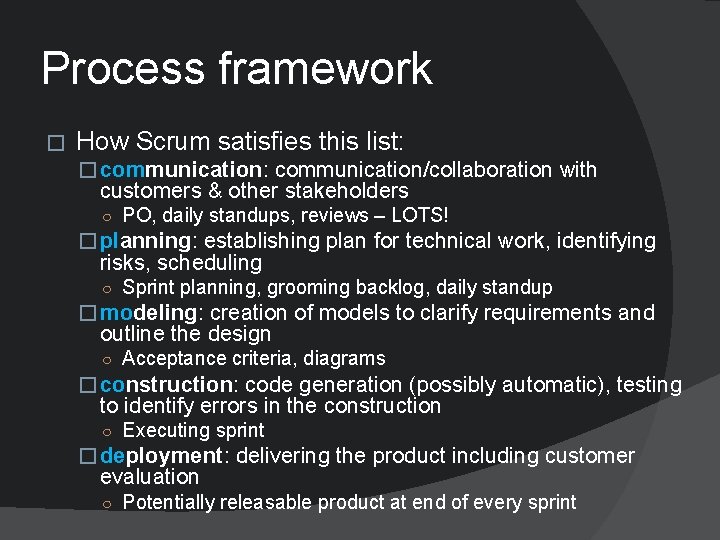
Process framework � How Scrum satisfies this list: � communication: communication/collaboration with customers & other stakeholders ○ PO, daily standups, reviews – LOTS! � planning: establishing plan for technical work, identifying risks, scheduling ○ Sprint planning, grooming backlog, daily standup � modeling: creation of models to clarify requirements and outline the design ○ Acceptance criteria, diagrams � construction: code generation (possibly automatic), testing to identify errors in the construction ○ Executing sprint � deployment: delivering the product including customer evaluation ○ Potentially releasable product at end of every sprint
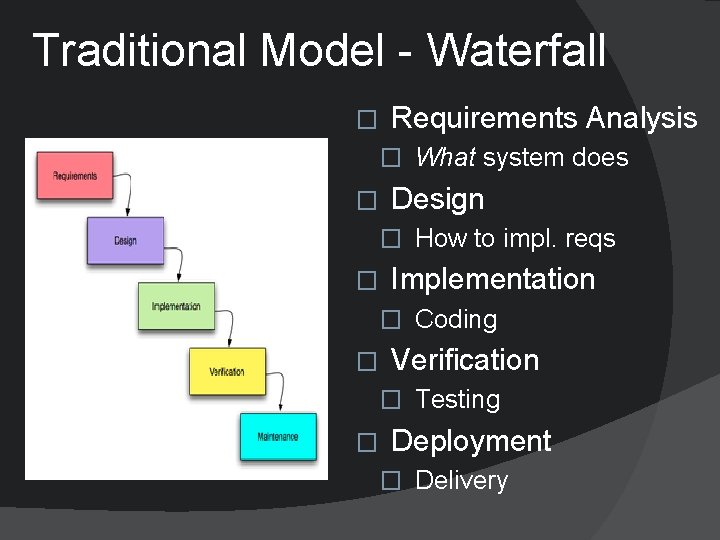
Traditional Model - Waterfall � Requirements Analysis � What system does � Design � How to impl. reqs � Implementation � Coding � Verification � Testing � Deployment � Delivery
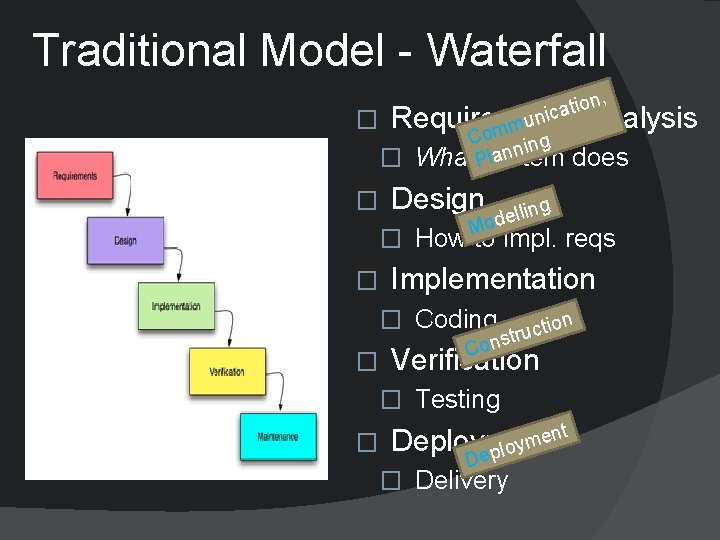
Traditional Model - Waterfall n, o i t a nic u � Requirements Analysis m Com ing n � What system does Plan � Design ng elli d o M � How to impl. reqs � Implementation � Coding � n tio c u r t o ns C Verification � Testing � nt e m Deployment y eplo D � Delivery
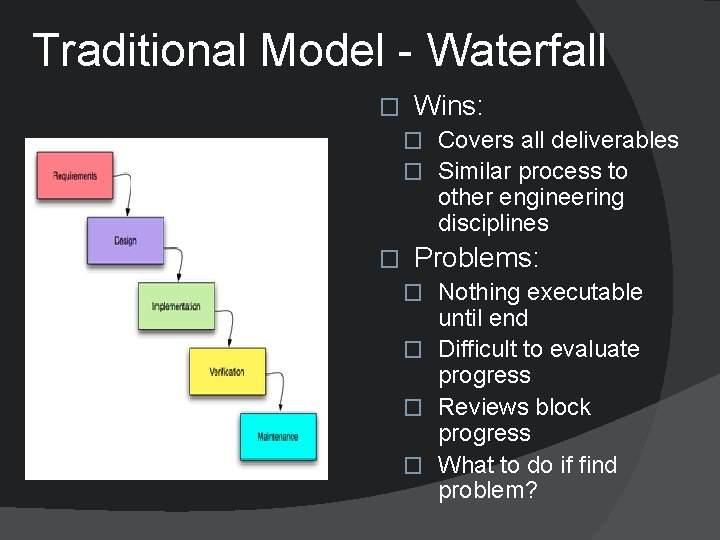
Traditional Model - Waterfall � Wins: � Covers all deliverables � Similar process to other engineering disciplines � Problems: � Nothing executable until end � Difficult to evaluate progress � Reviews block progress � What to do if find problem?
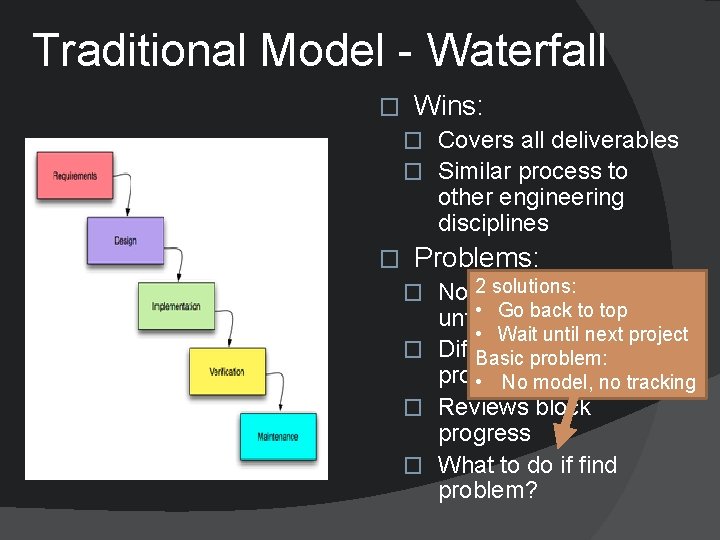
Traditional Model - Waterfall � Wins: � Covers all deliverables � Similar process to other engineering disciplines � Problems: 2 solutions: � Nothing executable • Go back to top until end • Wait until next project � Difficult to evaluate Basic problem: progress • No model, no tracking � Reviews block progress � What to do if find problem?
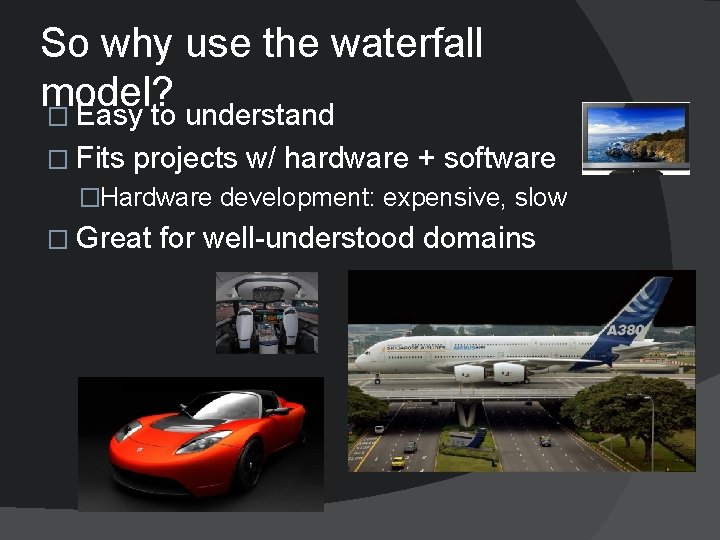
So why use the waterfall model? � Easy to understand � Fits projects w/ hardware + software �Hardware development: expensive, slow � Great for well-understood domains
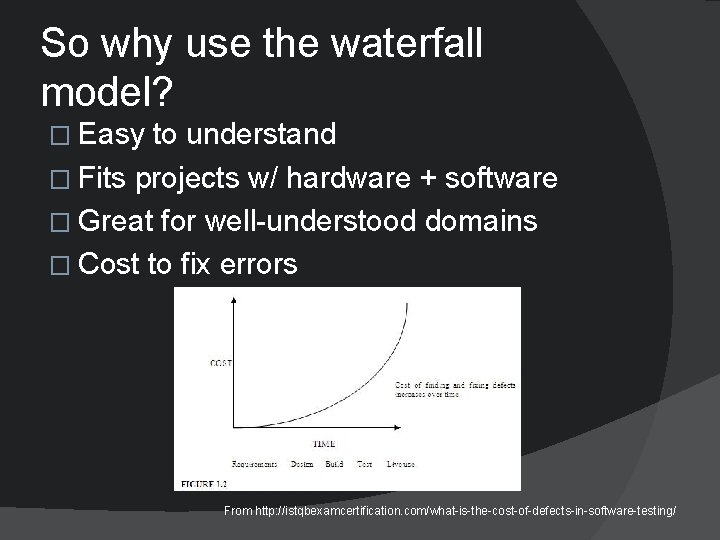
So why use the waterfall model? � Easy to understand � Fits projects w/ hardware + software � Great for well-understood domains � Cost to fix errors From http: //istqbexamcertification. com/what-is-the-cost-of-defects-in-software-testing/
So why use the waterfall model? � Easy to understand � Fits projects w/ hardware + software � Great for well-understood domains � Cost to fix errors But rarely used!
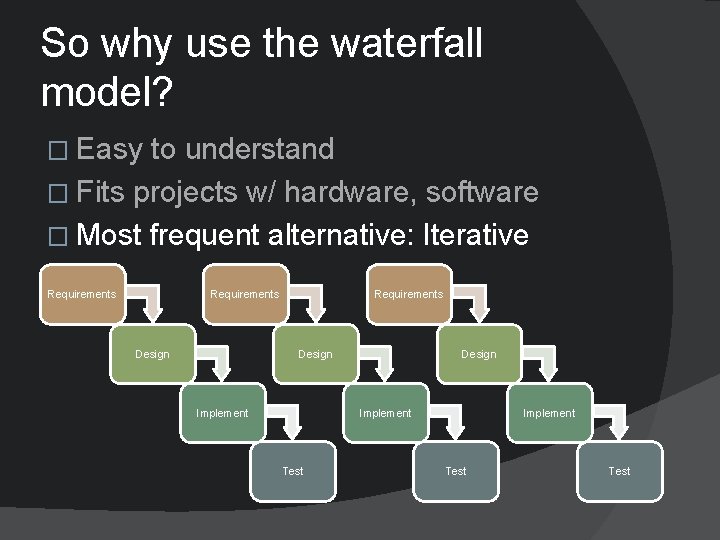
So why use the waterfall model? � Easy to understand � Fits projects w/ hardware, software � Most frequent alternative: Iterative Requirements Design Implement Test
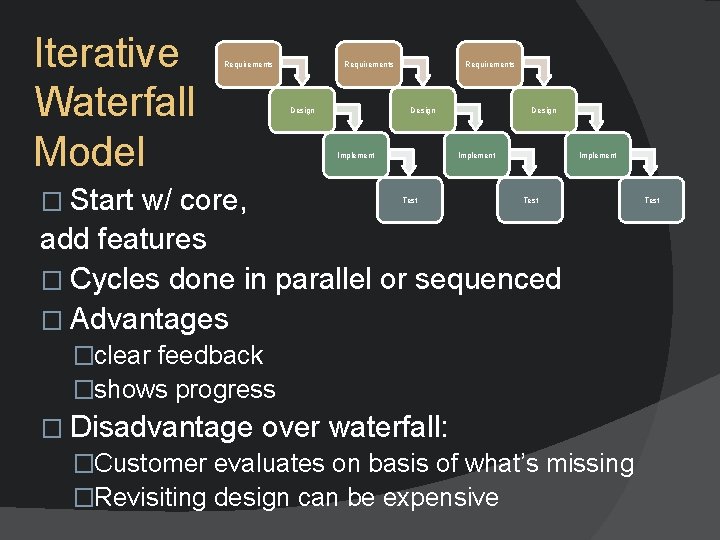
Iterative Waterfall Model Requirements � Start w/ core, Requirements Design Implement Test add features � Cycles done in parallel or sequenced � Advantages �clear feedback �shows progress � Disadvantage over waterfall: �Customer evaluates on basis of what’s missing �Revisiting design can be expensive Test
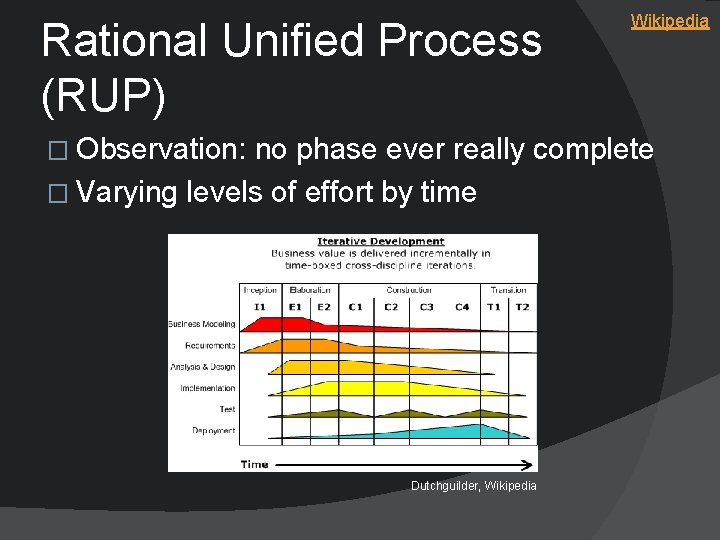
Rational Unified Process (RUP) Wikipedia � Observation: no phase ever really complete � Varying levels of effort by time Dutchguilder, Wikipedia
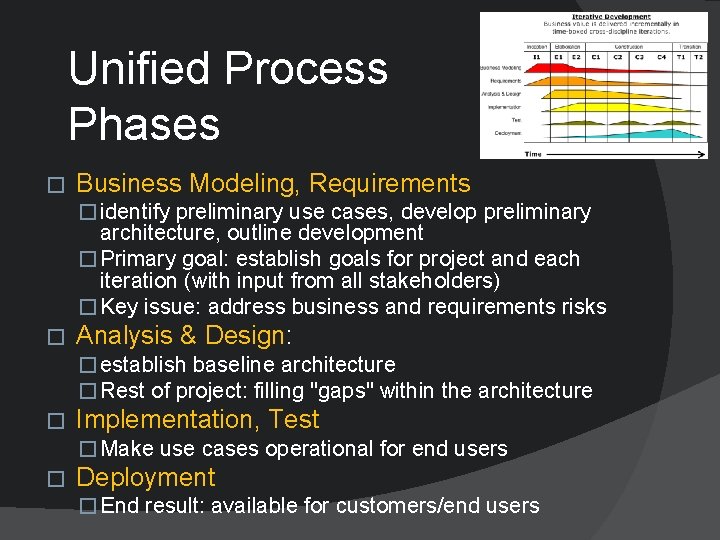
Unified Process Phases � Business Modeling, Requirements � identify preliminary use cases, develop preliminary architecture, outline development � Primary goal: establish goals for project and each iteration (with input from all stakeholders) � Key issue: address business and requirements risks � Analysis & Design: � establish baseline architecture � Rest of project: filling "gaps" within the architecture � Implementation, Test � Make use cases operational for end users � Deployment � End result: available for customers/end users
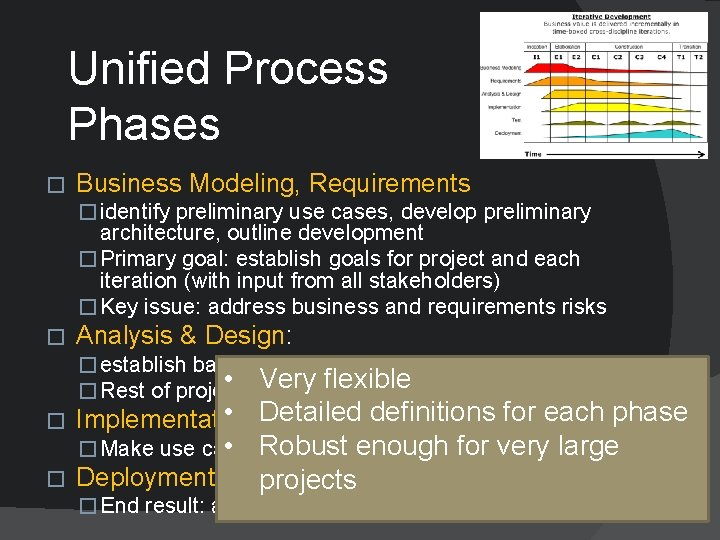
Unified Process Phases � Business Modeling, Requirements � identify preliminary use cases, develop preliminary architecture, outline development � Primary goal: establish goals for project and each iteration (with input from all stakeholders) � Key issue: address business and requirements risks � Analysis & Design: � establish baseline architecture • Very flexible � Rest of project: filling "gaps" within the architecture � • Detailed definitions for each phase Implementation, Test � Deployment • Robust enough for very large � Make use cases operational for end users projects � End result: available for customers/end users
Alternative process models � Waterfall, iterative, RUP: plan-based � Agile alternatives: �Scrum �XP: Extreme Programming �FDD: Feature-driven Development �Kanban
Extreme Programming � Kent Beck, late 90 s �Scrum dates from the early 90 s! � Planning: set of stories �User decides to add Math 264. User selects the Math program, scrolls to first open section not conflicting with previously chosen classes. User adds that section to schedule.
Extreme Programming, cont. � Stories then used to organize project �Customer assigns a "value" to each ○ Priority of each with respect to overall business need �Developer assigns a cost: ○ number of development weeks to implement story ○ split any story that costs more than 3 weeks �Customer & developer: group stories into releases ○ High value, high risk stories typically in first releases ○ Keep releases small, frequent
XP Design � � � Keep it simple Light documentation of design Don't design more than necessary to support stories �…keeping design open to future plans �Avoid detailed designs for features that might not be implemented Also: spike solutions - implement prototype when necessary to test element of design � Long term: refactor as needed to revise designs � �Design is flexible and "owned by all”! The Rules of Extreme Programming
Even more XP � Implementation: pair programming �when possible, have pairs of people work together �XP rule: anyone working alone is subject to being drafted �Also: ensure code always meets standards � Testing �Test-driven development (TDD): write tests before writing code, implement until tests pass
Scrum vs. XP � Exercise: �Differences? �Similarities? �When might XP be preferable?
Feature-Driven Development Wikipedia � Weakness of Scrum: no up-front design �Also a strength! Why? � FDD: an agile process with up-front design �Feature: small, client-valued function �expressed in the form: <action> <result> <object> �Example: “calculate the total of a sale” �Typically: 3 -5 days to develop
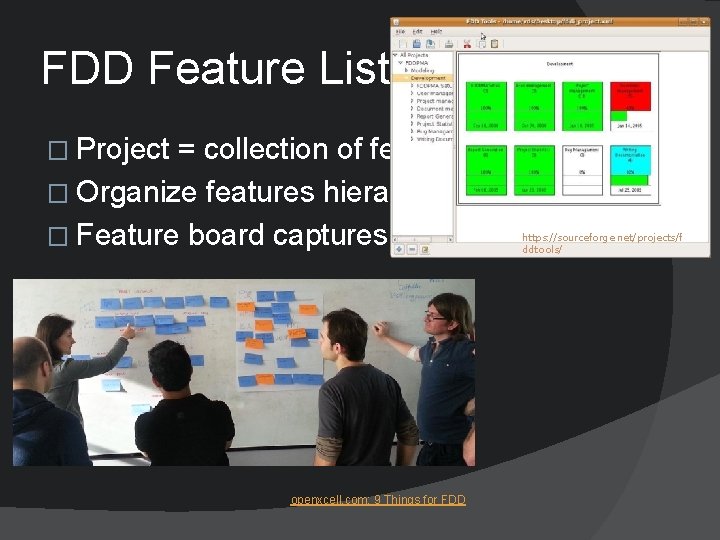
FDD Feature List � Project = collection of features � Organize features hierarchically � Feature board captures this openxcell. com: 9 Things for FDD https: //sourceforge. net/projects/f ddtools/
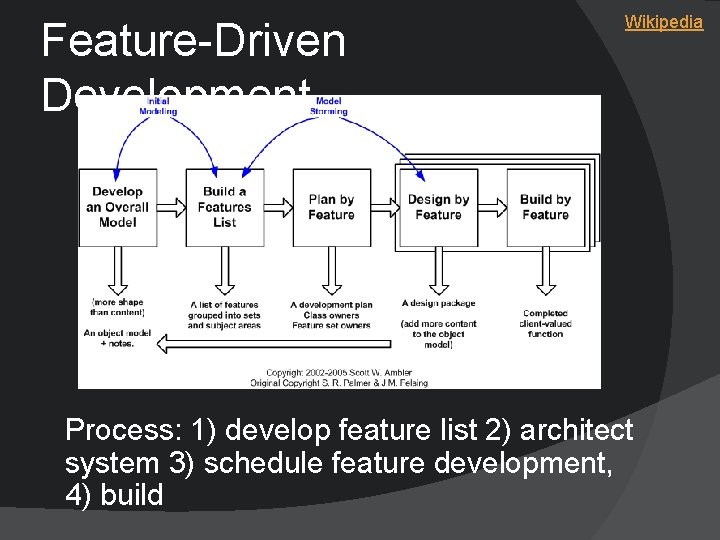
Feature-Driven Development Wikipedia Process: 1) develop feature list 2) architect system 3) schedule feature development, 4) build
Feature-Driven Development � Wins: up front design, planning � Issues: all the problems of up-front design �Possible wasted effort �Developers become attached to their designs � Can become a whack-a-mole development model �Take feature, design, implement, repeat
Kanban )看板( � ‘Signboard’ or ‘billboard’ in Japanese � First developed by Toyota for manufacturing � Motivation: supermarket �people take just what they need when they need it �people can assume constant supply, no need to stock up �store obtains just what it needs to stay stocked Wikipedia leankit. com
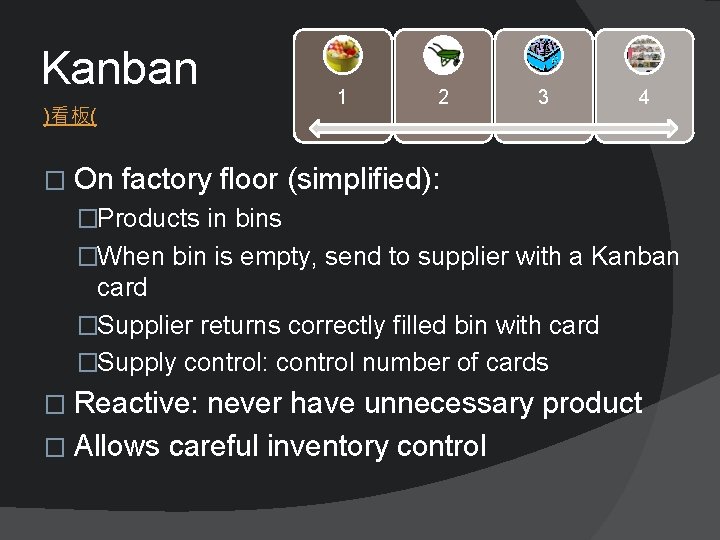
Kanban )看板( 1 2 3 4 � On factory floor (simplified): �Products in bins �When bin is empty, send to supplier with a Kanban card �Supplier returns correctly filled bin with card �Supply control: control number of cards � Reactive: never have unnecessary product � Allows careful inventory control
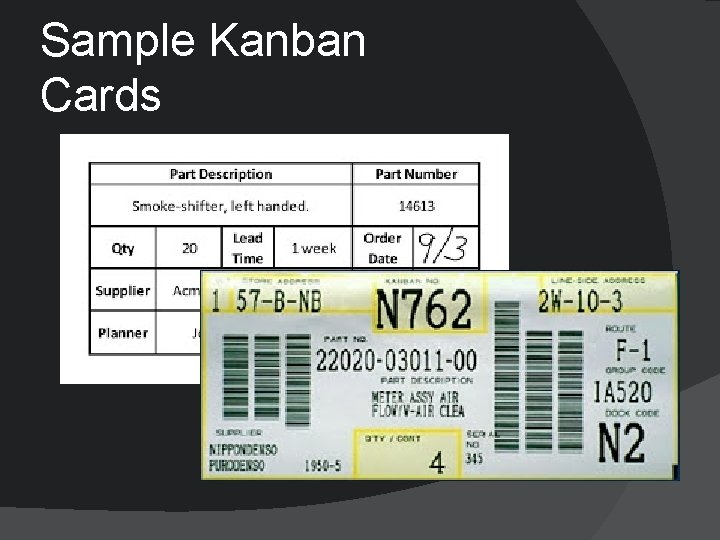
Sample Kanban Cards
Kanban in Software Maintain to-do list in order of importance � When team needs work, take top item � Team applies process to complete item � Key metric: cycle time � �Total time in process: removed from to-do list to done �Consistency allows predicting delivery of future work � Limit work in progress (WIP) �Keeps team focused, ensures efficiency Weekly: retrospective reviewing metrics, process � Can use with almost any other process �
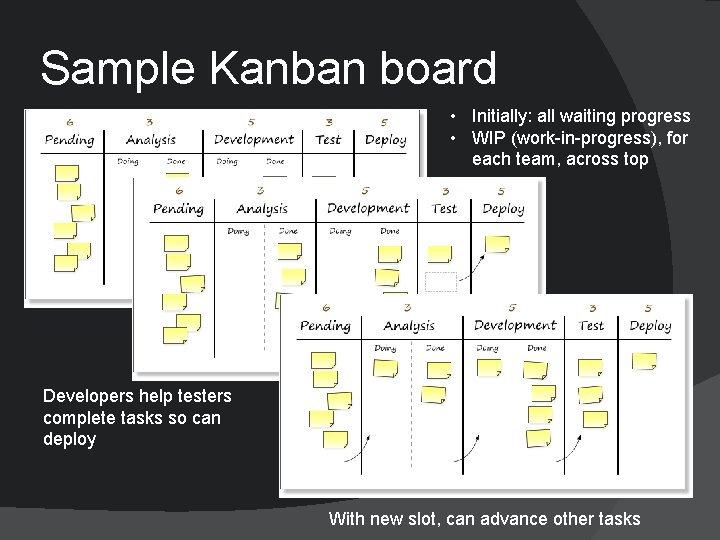
Sample Kanban board • Initially: all waiting progress • WIP (work-in-progress), for each team, across top Developers help testers complete tasks so can deploy With new slot, can advance other tasks
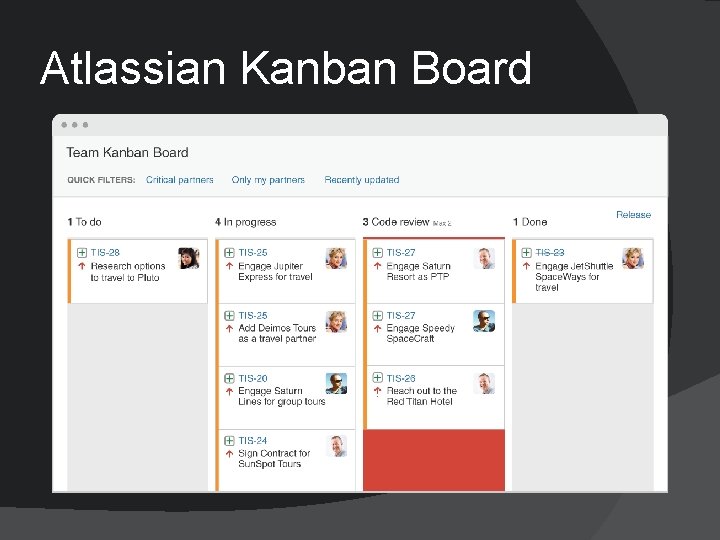
Atlassian Kanban Board
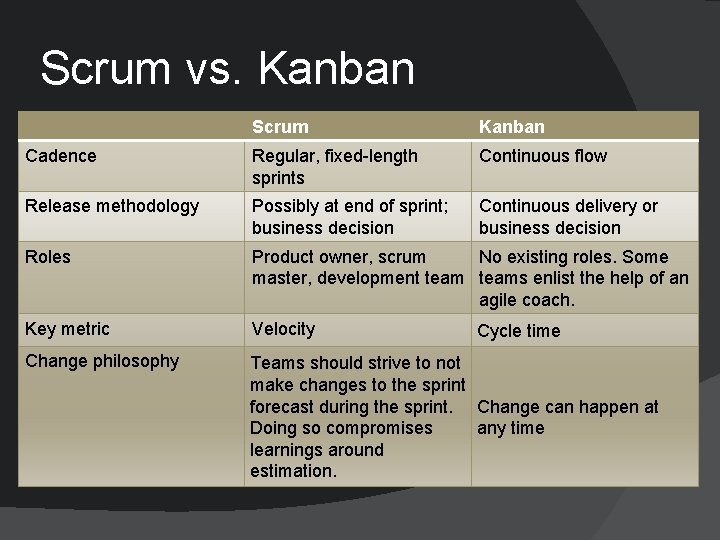
Scrum vs. Kanban Scrum Kanban Cadence Regular, fixed-length sprints Continuous flow Release methodology Possibly at end of sprint; business decision Continuous delivery or business decision Roles Product owner, scrum No existing roles. Some master, development teams enlist the help of an agile coach. Key metric Velocity Change philosophy Teams should strive to not make changes to the sprint forecast during the sprint. Change can happen at Doing so compromises any time learnings around estimation. Cycle time
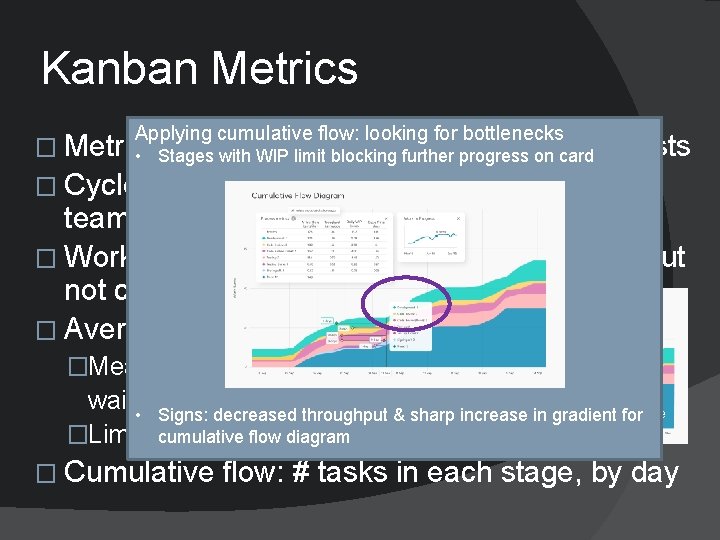
Kanban Metrics Applying cumulative flow: looking for bottlenecks � Metrics: necessary, or Kanban is just to-do lists • Stages with WIP limit blocking further progress on card � Cycle time: done time – time started by 1 st team � Work in progress: work to which committed but not completed � Average time in queues �Measure how long items wait for attention • Signs: decreased throughput & sharp increase in gradient for done cumulative flow diagram �Limit total time in queues � Cumulative flow: # tasks in each stage, by day
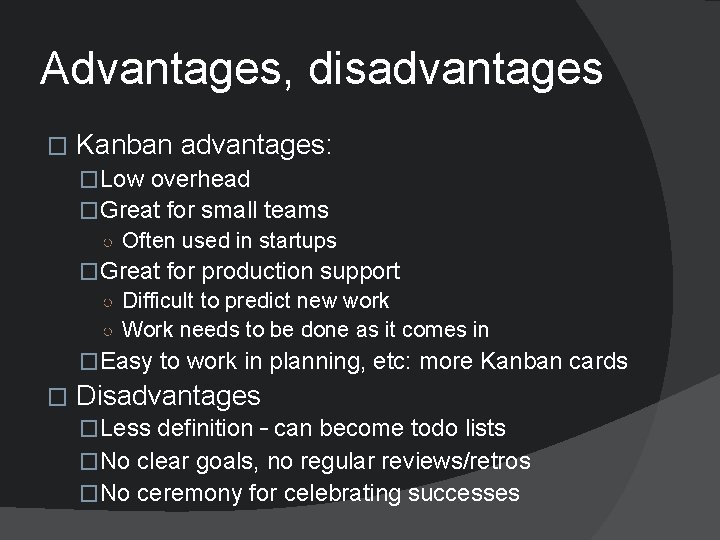
Advantages, disadvantages � Kanban advantages: �Low overhead �Great for small teams ○ Often used in startups �Great for production support ○ Difficult to predict new work ○ Work needs to be done as it comes in �Easy to work in planning, etc: more Kanban cards � Disadvantages �Less definition – can become todo lists �No clear goals, no regular reviews/retros �No ceremony for celebrating successes
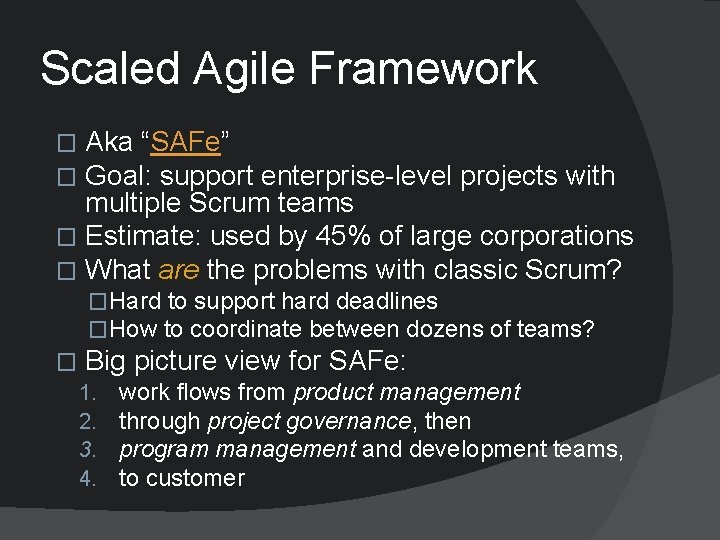
Scaled Agile Framework Aka “SAFe” Goal: support enterprise-level projects with multiple Scrum teams � Estimate: used by 45% of large corporations � What are the problems with classic Scrum? � � �Hard to support hard deadlines �How to coordinate between dozens of teams? � Big picture view for SAFe: 1. 2. 3. 4. work flows from product management through project governance, then program management and development teams, to customer
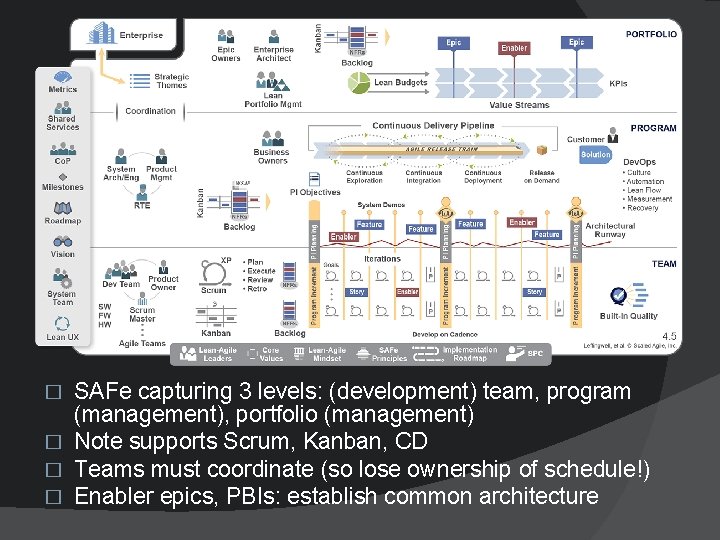
SAFe capturing 3 levels: (development) team, program (management), portfolio (management) � Note supports Scrum, Kanban, CD � Teams must coordinate (so lose ownership of schedule!) � Enabler epics, PBIs: establish common architecture �
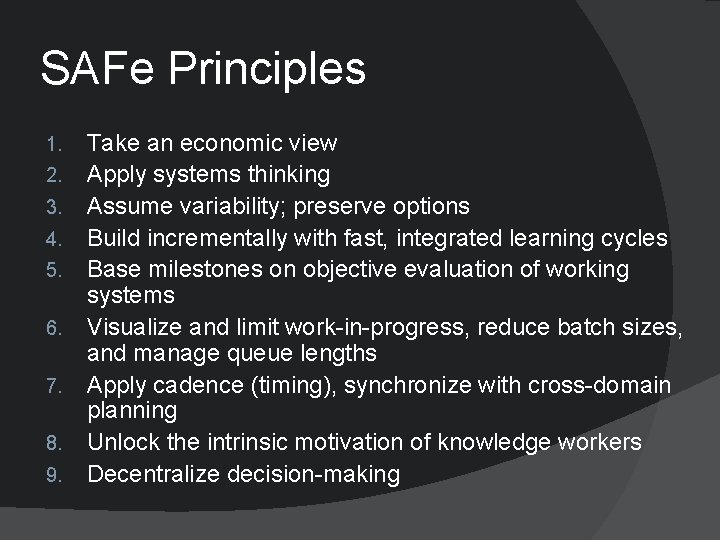
SAFe Principles 1. 2. 3. 4. 5. 6. 7. 8. 9. Take an economic view Apply systems thinking Assume variability; preserve options Build incrementally with fast, integrated learning cycles Base milestones on objective evaluation of working systems Visualize and limit work-in-progress, reduce batch sizes, and manage queue lengths Apply cadence (timing), synchronize with cross-domain planning Unlock the intrinsic motivation of knowledge workers Decentralize decision-making
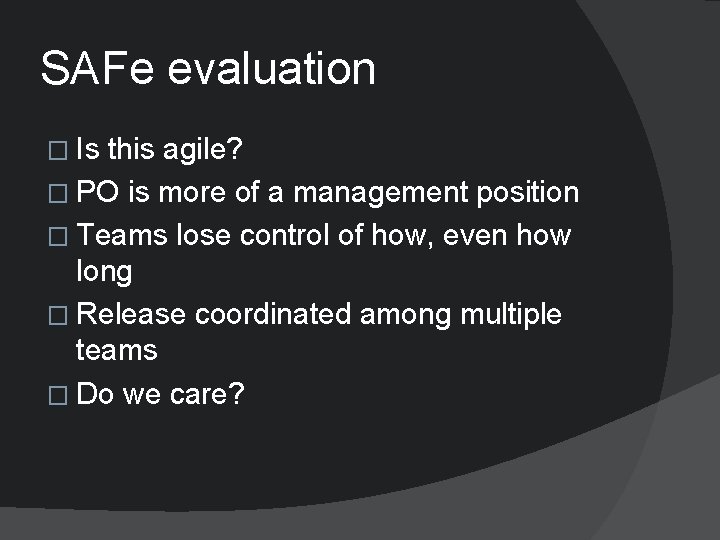
SAFe evaluation � Is this agile? � PO is more of a management position � Teams lose control of how, even how long � Release coordinated among multiple teams � Do we care?
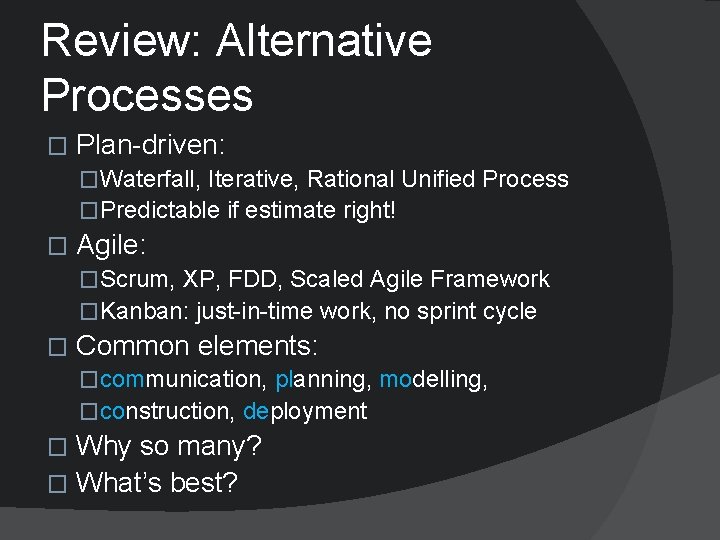
Review: Alternative Processes � Plan-driven: �Waterfall, Iterative, Rational Unified Process �Predictable if estimate right! � Agile: �Scrum, XP, FDD, Scaled Agile Framework �Kanban: just-in-time work, no sprint cycle � Common elements: �communication, planning, modelling, �construction, deployment Why so many? � What’s best? �
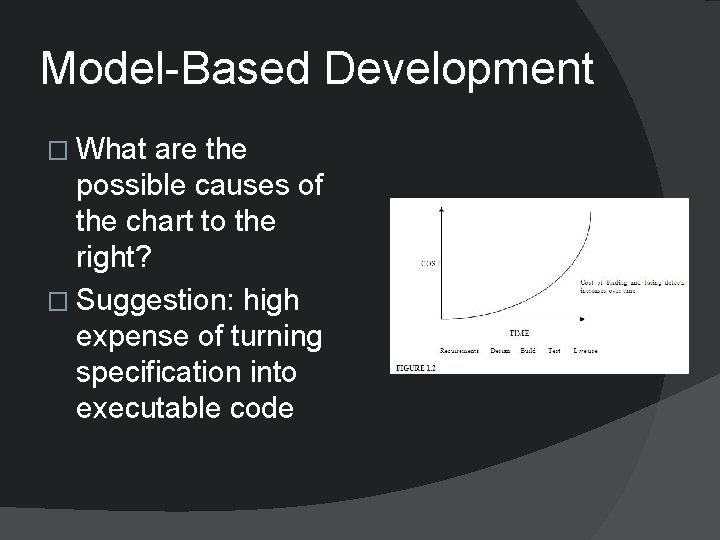
Model-Based Development � What are the possible causes of the chart to the right? � Suggestion: high expense of turning specification into executable code
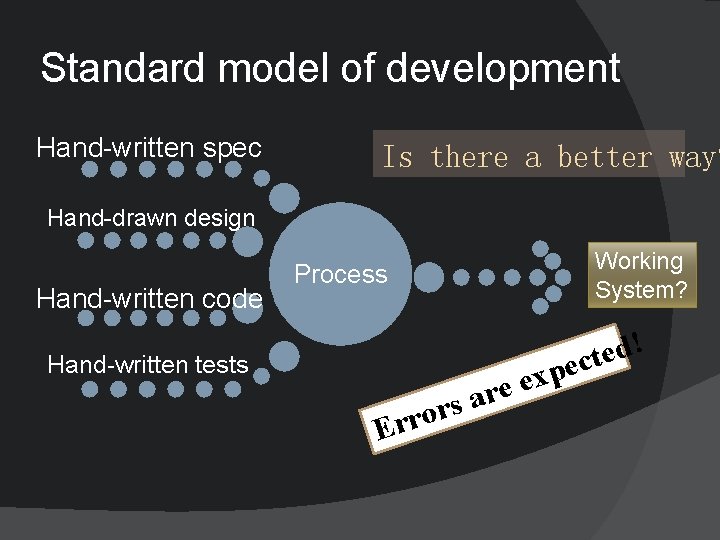
Standard model of development Hand-written spec Is there a better way? Hand-drawn design Hand-written code Working System? Process Hand-written tests r o r r E e e r sa ! d e t xpec
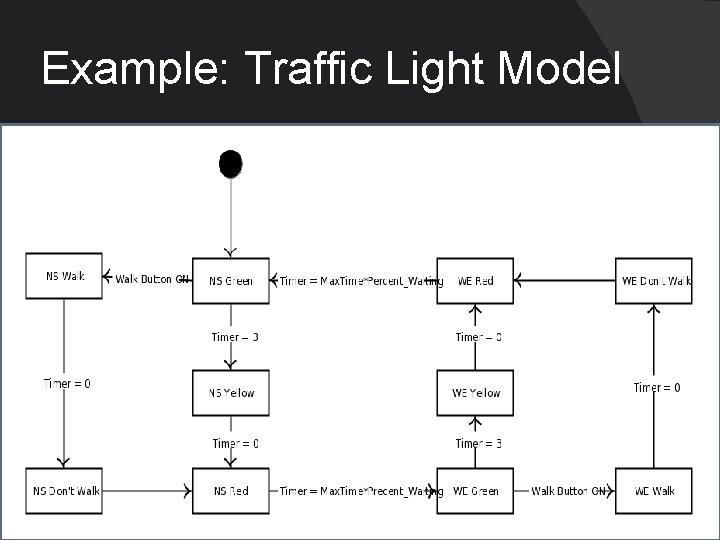
Example: Traffic Light Model
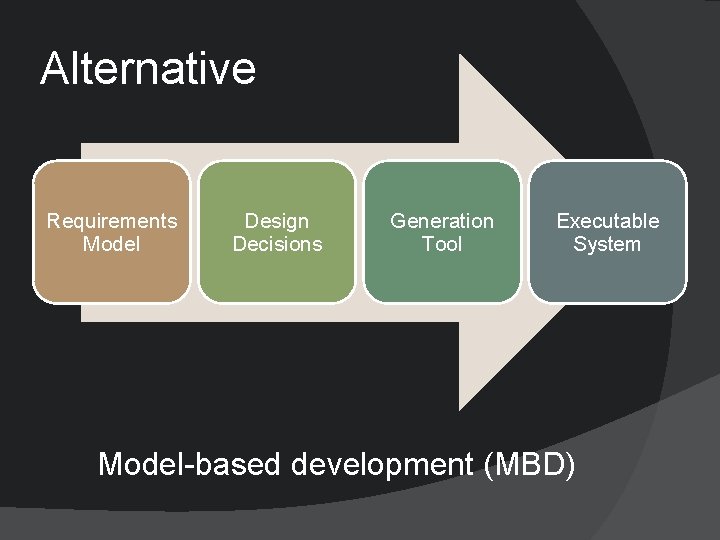
Alternative Requirements Model Design Decisions Generation Tool Executable System Model-based development (MBD)
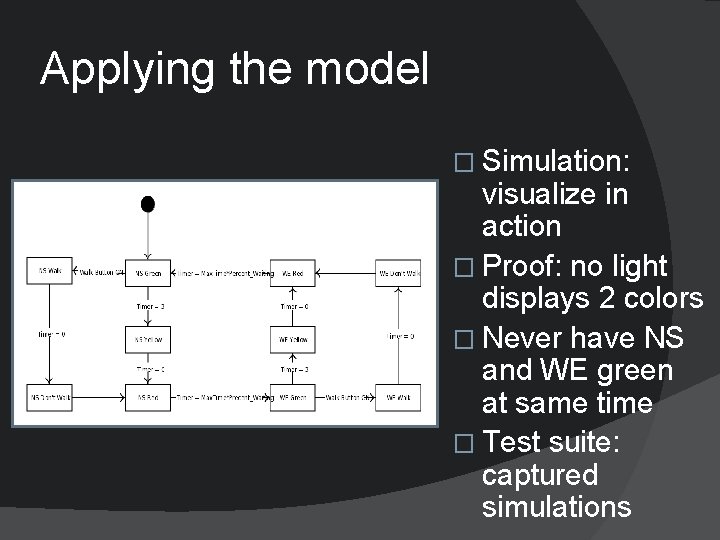
Applying the model � Simulation: visualize in action � Proof: no light displays 2 colors � Never have NS and WE green at same time � Test suite: captured simulations
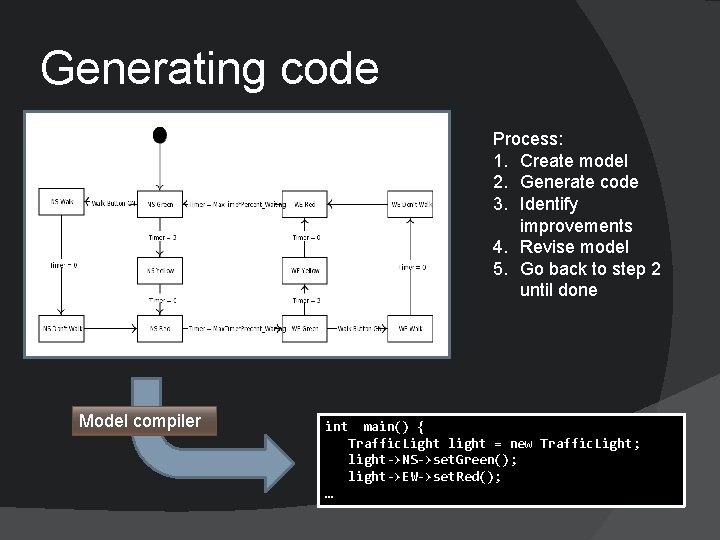
Generating code Process: 1. Create model 2. Generate code 3. Identify improvements 4. Revise model 5. Go back to step 2 until done Model compiler int main() { Traffic. Light light = new Traffic. Light; light->NS->set. Green(); light->EW->set. Red(); …
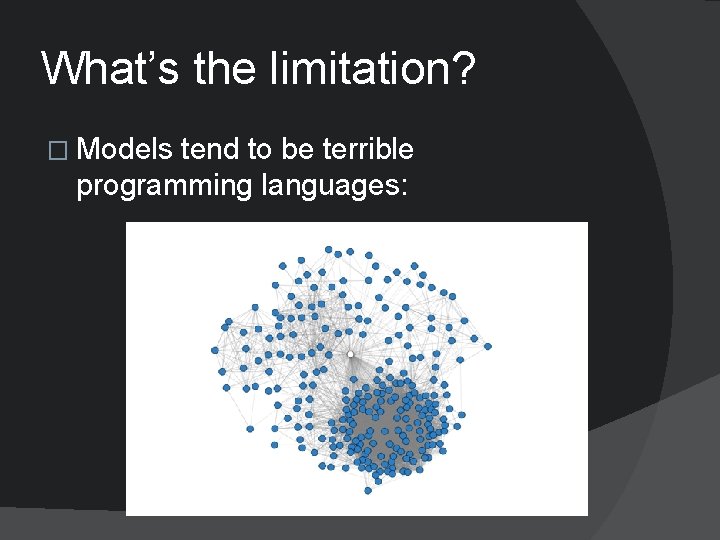
What’s the limitation? � Models tend to be terrible programming languages:
Analysis � Advantages of MBD: �Maintain the model, not the code �Reusable models �Easier to see details ○ Models aren’t requirements! �Fewer opportunities to inject mistakes � Problems with MBD: �Building models can be expensive ○ Some code still needs to be written by hand! ○ If client not maintaining model, unlikely to have savings ○ Iteration can be especially hard to model �Need validated tools to convert to code �Reduced testing, but still need testing!!
- Slides: 52