
Dr Rida Shabbir DPT KMU DAILY INTAKE OUTPUT

Dr. Rida Shabbir DPT KMU

DAILY INTAKE & OUTPUT OF WATER (ML/DAY) Normal Intake: o Fluids ingested (Drinking/in food) o From metabolism 2100 200 Prolonged, heavy exercise ? 200 Total intake 2300 ml/d Output: o Insensible – skin o Insensible – lungs o Sweat o Feces o Urine 350 100 1400 350 650 5000 100 500 Total output 2300 6600 In steady state, water intake = water loss ?
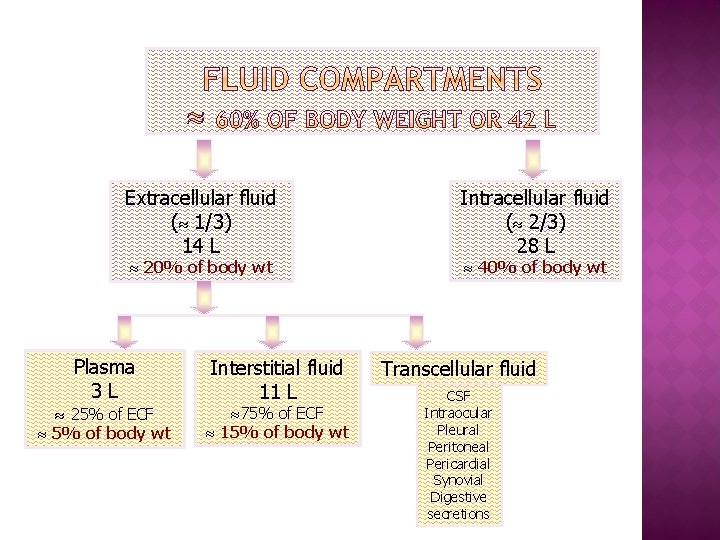
Extracellular fluid ( 1/3) 14 L 20% of body wt Plasma 3 L 25% of ECF 5% of body wt Interstitial fluid 11 L 75% of ECF 15% of body wt Intracellular fluid ( 2/3) 28 L 40% of body wt Transcellular fluid CSF Intraocular Pleural Peritoneal Pericardial Synovial Digestive secretions
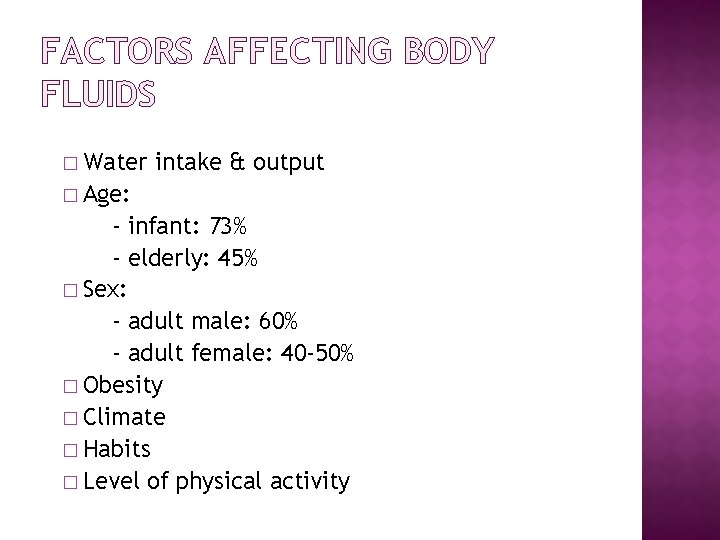
FACTORS AFFECTING BODY FLUIDS � Water intake & output � Age: - infant: 73% - elderly: 45% � Sex: - adult male: 60% - adult female: 40 -50% � Obesity � Climate � Habits � Level of physical activity
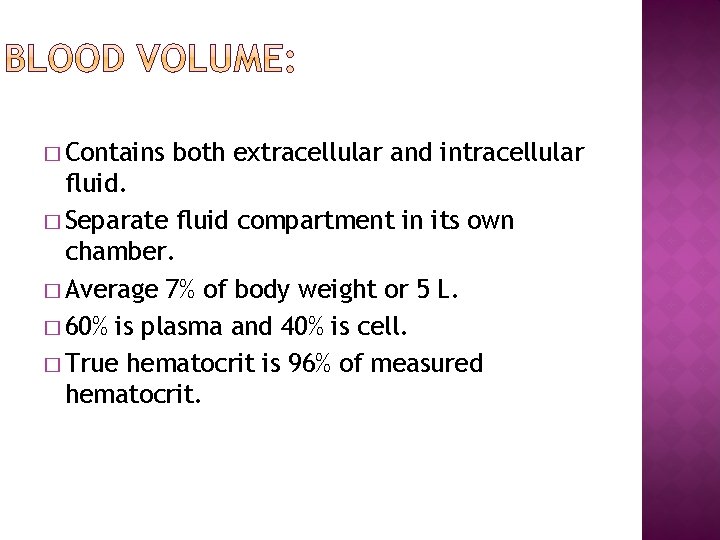
� Contains both extracellular and intracellular fluid. � Separate fluid compartment in its own chamber. � Average 7% of body weight or 5 L. � 60% is plasma and 40% is cell. � True hematocrit is 96% of measured hematocrit.
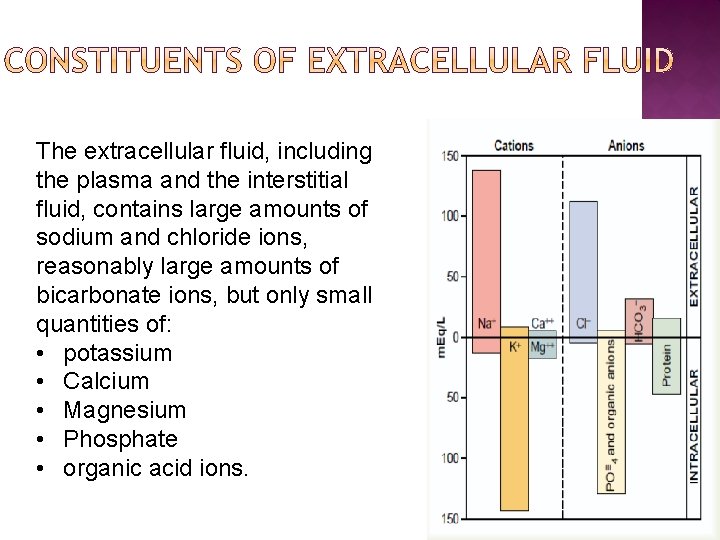
The extracellular fluid, including the plasma and the interstitial fluid, contains large amounts of sodium and chloride ions, reasonably large amounts of bicarbonate ions, but only small quantities of: • potassium • Calcium • Magnesium • Phosphate • organic acid ions.
� Because the plasma and interstitial fluid are separated only by highly permeable capillary membranes, their ionic composition is similar. � Higher concentration of protein in the plasma. � Small amounts of proteins are leaked into the interstitial spaces in most tissues
� Because of the Donnan effect, the concentration of positively charged ions (cations) is slightly greater (about 2 per cent) in the plasma than in the interstitial fluid. � The plasma proteins have a net negative charge and, therefore, tend to bind cations, such as sodium and potassium ions, thus holding extra amounts of these cations in the plasma along with the plasma proteins. � Conversely, negatively charged ions (anions) tend to have a slightly higher concentration in the interstitial fluid compared with the plasma, because the negative charges of the plasma proteins repel the negatively charged anions.
� Intracellular fluid separated from extra cellular fluid by cell membrane. � Highly permeable to water but not to most of the electrolytes. � Small quantities of sodium and chloride. No calcium ions. � Large amount of potassium and phosphate ions. � Moderate quantities of magnesium and sulphate ions. � Large amount of proteins. 4 times that of plasma.
� Evenly dispersed indicator substance and accessing dilution. � Based on conservation of mass principle. � Total mass of a substance after dispersion in fluid compartment is same as total mass injected in the compartment. � Total mass of the substance in the compartment (vol B x conc B) = total mass of the substance injected (vol A x conc A) � Vol B= vol A x conc A/ conc B
� Measurement of total body water: �Tritium and deuterium can be used to measure total body water. �Dilution principle can be used to measure total body water. �Antipyrine (lipid soluble). � Measurement �Substances of extracellular fluid volume: that disperse in plasma and interstitial fluid but do not readily permeate the cell membrane. �Radioactive sodium, chloride, iothalamate, thiosulphate ions and inulin. �Injected in blood and disperses in 30 -60 mints.
� Calculation of intracellular volume: �Intracellular vol= total body water – extracellular vol. � Measurement of plasma vol: �Substances that do not cross capillary membrane. �Serum albumin with radioactive iodine. � Calculation �Interstitial of interstitial fluid vol: fluid vol= extracellular fluid vol – plasma vol. � Measurement �Total of blood vol: blood vol= plasma vol/ 1 - hematocrit.

- Slides: 13