
Dr Rdiger Paschotta RP Photonics Consulting Gmb H
Dr. Rüdiger Paschotta RP Photonics Consulting Gmb. H Competence Area: Fiber Devices
Topics in this Area l Fiber lasers, including “exotic” types l Fiber amplifiers, including telecom-type devices and high power devices l Q switching of fiber lasers l Mode locking of fiber lasers l Pulse propagation in fibers l Noise in fiber devices Note: for more details (with references to publications) on the scientific achievements of R. Paschotta, see http: //www. rp-photonics. com/Science_Paschotta. ppt
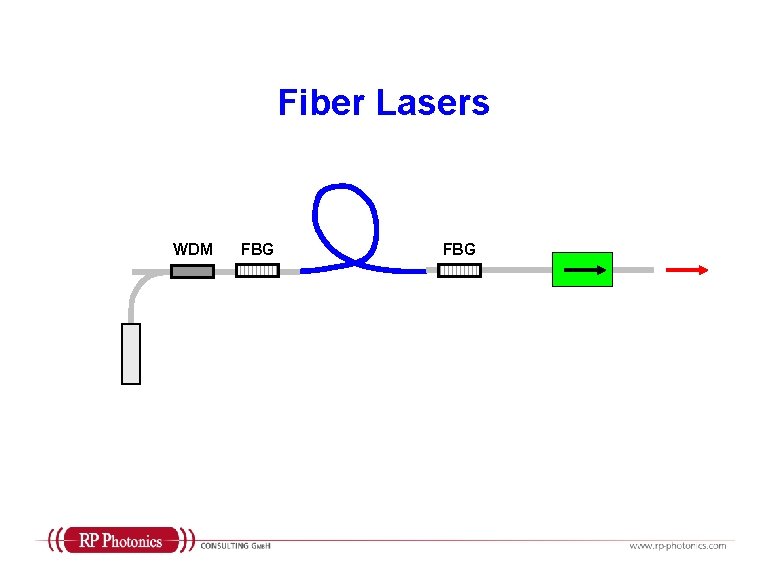
Fiber Lasers WDM FBG
Fiber Lasers l Fiber lasers occur in a great variety of forms, serving very different applications, e. g. : l Lasers generating outputs at special wavelengths, e. g. in the visible or in the infrared spectral region (tracking lasers, displays, pumping of solid-state lasers) l Lasers for very high output power (many watts or even kilowatts) with good beam quality (material processing, various industrial processes, military applications) l Q-switched and mode-locked lasers for short or ultrashort pulses (distance measurements, time & frequency metrology, material processing) l Fiber technology creates a huge amount of attractive technical options, but also comes with a bunch of technical difficulties
Fiber Lasers Examples for previous activities of R. Paschotta: l Developed numerical computer models for optimizing various kinds of fiber lasers, e. g. blue upconversion lasers with three-step excitation; this lead to the powerful commercial software package RP Fiber Power. l Discovered unexpected quenching effects in Yb-doped fibers l Worked out design guidelines for various devices l Contributions to the invention of ring-doped fiber designs l Identification and demonstration of a strange situation where spatial hole burning serves to stabilize single-frequency operation
Fiber Lasers Examples for possible consulting activities: l Develop a numerical model to calculate and optimize the performance of a certain type of fiber laser l Identify performance limitations in terms of output power, wavelength tuning range, linewidth, etc. l Develop fiber laser designs (with optimized fiber parameters, pump source, mirror reflectivities, etc. ) l Analyse and optimize Q-switched or mode-locked fiber lasers l Compare fiber laser technology with competing technologies
The RP Fiber Power Software The commercially available software RP Fiber Power (http: //www. rpphotonics. com/fiberpower. html), developed by Dr. Paschotta, has the following key features: l The integrated mode solver can calculate all guides modes of a fiber from a given refractive index profile. One obtains intensity profiles, propagation constants, group velocities and chromatic dispersion, fraction of power propagating within the fiber core, etc. l One can also numerically simulate beam propagation in fiber devices – not only in simple fibers, but also in multi-core fibers, fiber couplers, etc. A lot of example cases on our website demonstrate the great versatility of the software.
The RP Fiber Power Software l The software can calculate the distribution of optical powers and excitation densities in fiber lasers, amplifiers and ASE sources, taking into account l longitudinal and transverse spatial dependencies l arbitrarily complicated level schemes l influences from spontaneous and stimulated transitions, ASE, excited-state absorption, energy transfers leading to upconversion, etc. l Besides calculating steady-state powers, the software can do dynamic simulations, e. g. for Q switching and pulse amplification. l Ultrashort pulse propagation (for example, in pulse amplifiers and in mode-locked fiber lasers) can also be simulated.
The RP Fiber Power Software l The software has an extremely flexible user interface, with control via simple forms and/or via a powerful script language. Careful documentation and helpful support is also available. For a comprehensive description of RP Fiber Power, see the page http: //www. rp-photonics. com/fiberpower. html, and download our brochure http: //www. rp-photonics. com/RP_Fiber_Power. pdf.
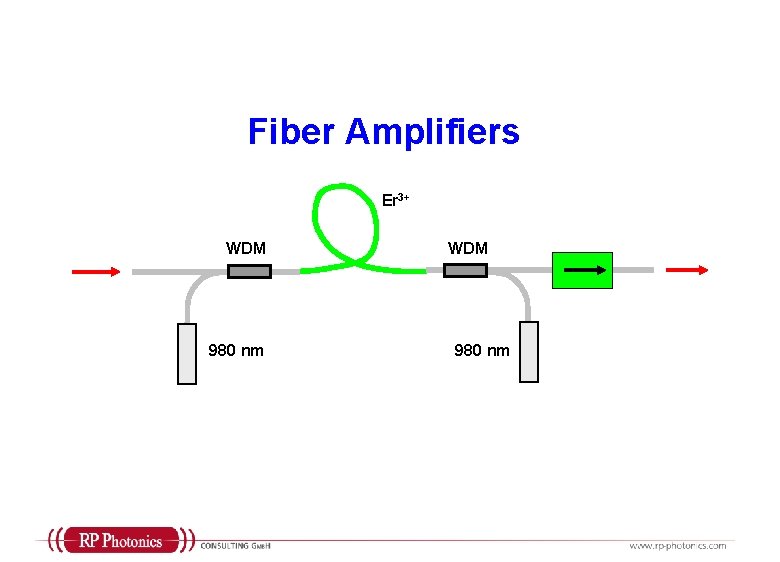
Fiber Amplifiers Er 3+ WDM 980 nm
Fiber Amplifiers l Fiber amplifiers are used for very different applications, e. g. : l Data transmission (compensating losses in telecom fibers, providing power for nonlinear data processing devices, etc. ) l Generation of high output powers (continuous-wave or pulse amplification for material processing, driving nonlinear devices, etc. ) l Generation of optical noise (microscopy, device characterization) l Fiber technology offers large gain and broad amplification bandwidth, but also comes with a bunch of technical difficulties
Fiber Amplifiers Examples for previous activities of R. Paschotta: l Developed numerical computer models for various kinds of fiber amplifiers, e. g. with Yb- or Er-doped fibers; this expertise was used for the software RP Fiber Power. l Worked out design guidelines for various devices l Contributions to the invention of ring-doped fiber designs l Demonstration of high-performance superfluorescence source
Fiber Amplifiers Examples for possible consulting activities: l Develop a numerical model to calculate and optimize the performance of a certain type of fiber amplifier l Identify performance limitations in terms of output power, nonlinear distortions, etc. l Develop fiber amplifier designs (with optimized fiber parameters, pump source, etc. ) l Analyze and optimize noise properties (noise figure, nonlinear distortions)
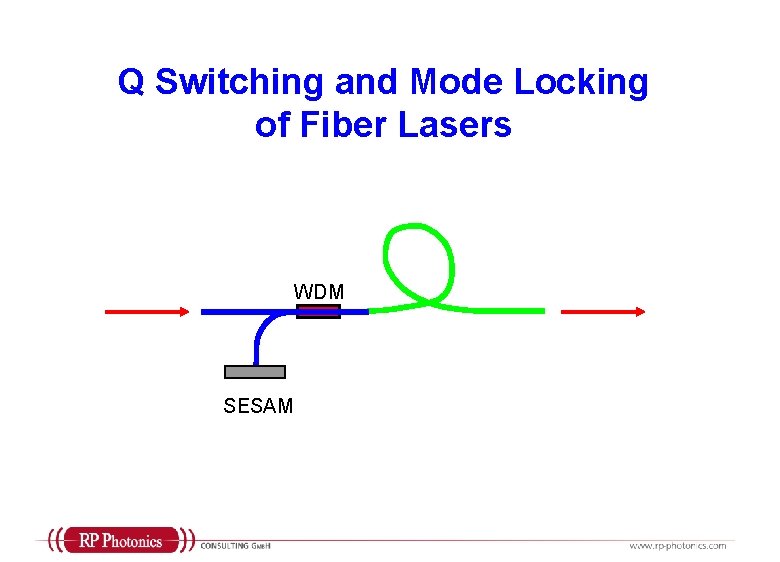
Q Switching and Mode Locking of Fiber Lasers WDM SESAM
Q Switching and Mode Locking l Fiber lasers can be used for pulse generation: l Q switching for generation of nanosecond pulses (distance measurements, material processing) l Mode locking for generation of picosecond or femtosecond pulses (time & frequency metrology, material processing, OPO pumping) l Fiber technology competes with other technologies, with commercial chances depending on the concrete demands
Q Switching and Mode Locking Examples for previous activities of R. Paschotta: l Developed numerical computer models for pulse generation and amplification in fibers l Demonstrated very high pulse energies at 1. 5 mm with passive Q switching l Worked out design guidelines for various devices l Various contributions to mode-locked fiber lasers
Q Switching and Mode Locking Examples for possible consulting activities: l Develop a numerical model to calculate and optimize the performance of a Q-switched or mode-locked fiber laser l Identify performance limitations in terms of output power, wavelength tuning range, linewidth, etc. ; optimized device designs l Compare fiber laser technology with competing technologies (Note: deep and broad experience with various kinds of Q-switched and mode-locked lasers, including bulk lasers and semiconductor lasers)
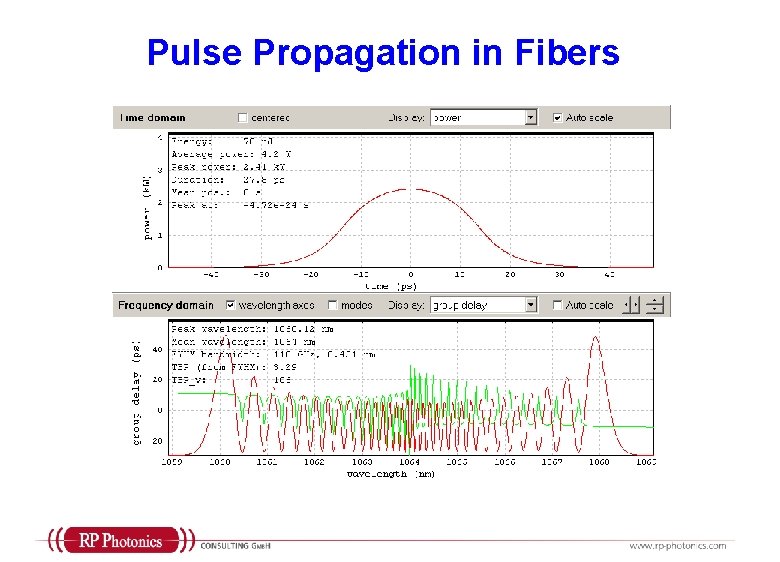
Pulse Propagation in Fibers
Pulse Propagation in Fibers l l Fibers can be used transport optical pulses or to manipulate their properties, e. g. l to broaden their spectrum, e. g. for subsequent pulse compression l to stretch or compress them temporally l to generate a “chirp” l to amplify them with laser gain or Raman gain l to shift their center wavelength Apart from dispersion effects, a variety of nonlinearities can influence the pulse propagation
Pulse Propagation in Fibers Examples for previous activities of R. Paschotta: l Developed numerical computer models for pulse propagation in fibers, e. g. within fiber lasers or amplifiers, for pulse compressors, or for supercontinuum generation RP Fiber Power software: see http: //www. rp-photonics. com/fiberpower. html l Studied a wide range of fiber nonlinearities, including Kerr effect with self-steepening, Raman effect, Brillouin scattering l Studied in detail soliton propagation effects l Designed mode-locked fiber lasers
Pulse Propagation in Fibers Examples for possible consulting activities: l Use a numerical model to simulate the propagation of pulses in a laser, amplifier or compressor l Identify performance limitations of fiber devices l Optimize device designs, or identify problems with existing designs l Compare fiber laser technology with competing technologies (Example: compare picosecond or femtosecond fiber amplifiers with bulk amplifiers)
Noise in Fiber Devices
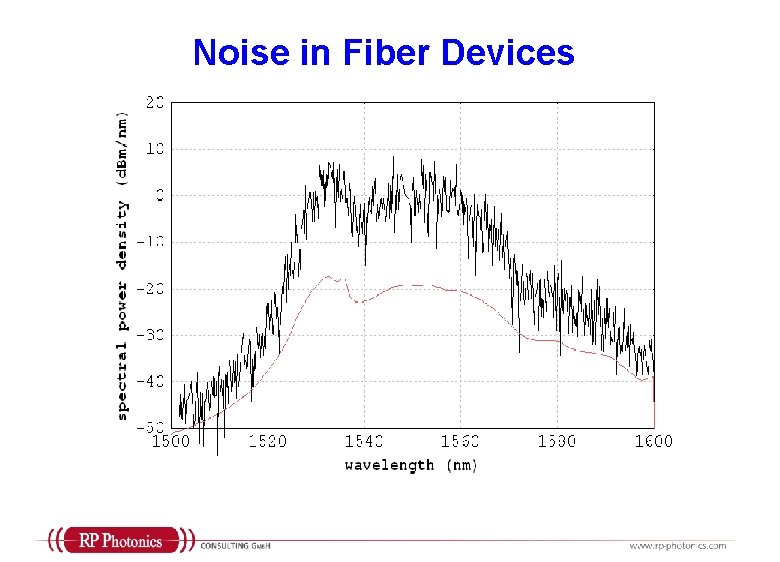
Noise in Fiber Devices l l Optical noise can arise in fiber devices through various effects, e. g. l as amplified spontaneous emission (ASE) l from quantum noise or input noise, amplified through nonlinear effects (e. g. modulational instability) l quantum effects related to nonlinearities (e. g. Raman interaction) Noise often limits the performance of fiber devices; its exact physical and quantitative understanding can be crucial for optimization of devices.
Noise in Fiber Devices Examples for previous activities of R. Paschotta: l Developed a numerical computer model for supercontinuum generation in microstructured fibers, and used it to quantitatively study the noise properties of the output ( spectral coherence) l Developed fiber amplifier models with amplified spontaneous emission (ASE)
Noise in Fiber Devices Examples for possible consulting activities: l Quantify noise effects in a fiber device, using analytical and/or numerical techniques l Identify performance limitations l Compare fiber laser technology with competing technologies (Example: compare timing jitter potential of fiber lasers and other lasers)
Publications on Fiber Technology Books: l R. Paschotta, “Field Guide to Optical Fiber Technology”, SPIE Press, Bellingham (WA) (2010) l R. Paschotta, “Encyclopedia of Laser Physics and Technology”, Wiley. VCH, Weinheim, Germany (2008) l Various scientific articles: see the CV and publication list of Dr. Paschotta
- Slides: 26