
Dr Radegundis Stolze Principles of Document Translation Conference
- Slides: 23
Dr. Radegundis Stolze Principles of Document Translation Conference Professionalization vs. Deprofessionalization: Building Standards for Legal Translators and Interpreters
Principles of Document Translation �Documents �Are written on paper �Give evidence for a social situation �Express a person‘s declaration or will �Various text types
Principles of Document Translation �Validity in the source text �Translation is a secondary text �Content is bound to source culture �Translation is no transfer, but offers transparency
Principles of Document Translation �Translators‘ approach to texts �We translate what we are aware of �The approach is holistic �Combining a macrostrategy with a microstrategy
Principles of Document Translation �Language functions with dual addressees �Dual language level: jurists and general public �Dual coding of words: specialist concepts and lay meaning �Dual translator‘s perspective: legal style and legal content
Principles of Document Translation �Various kinds of legal background �National system with several languages (Switzerland, Canada) �International or supranational law for local languages (like E. U. ) �A text in one national law to be translated in another language (most frequent case in document translation) �Focus on legal concepts �(1) identity of concept in the various languages �(2) competition with concepts in a national local law �(3) difference between concepts in source and target cultures
Principles of Document Translation �Cases of legal translation and text types �Body of legal texts in national system (Switzerland, South Tyrol, Canada) �New texts of national law after political change (Hong Kong, South Africa, former Yugoslavia, etc. ) �International treaties (political level) �Texts from E. U. (directives, new law articles) �Criminal proceedings (arrest warrant, request for international legal assistance, charge or indictment, decision depriving someone of liberty) �Foreign court decisions with included articles of code (criminal and civil proceedings) �Personal administrative documents (birth certificates, diplomas, police reports, medical certificates, insurance policy, receipts, etc. ) �Trade contracts (sales and license agreements
Principles of Document Translation �Fields of law �Criminal �Private �Family �International �Works �Trade �Administrative, etc.
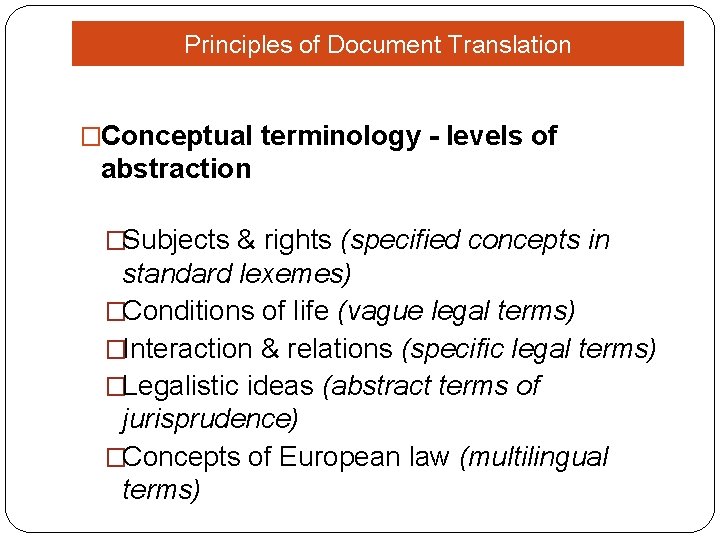
Principles of Document Translation �Conceptual terminology - levels of abstraction �Subjects & rights (specified concepts in standard lexemes) �Conditions of life (vague legal terms) �Interaction & relations (specific legal terms) �Legalistic ideas (abstract terms of jurisprudence) �Concepts of European law (multilingual terms)
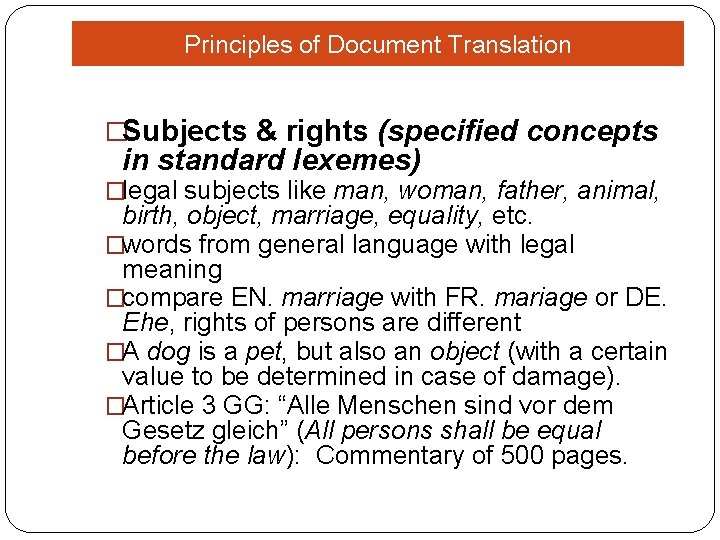
Principles of Document Translation �Subjects & rights (specified concepts in standard lexemes) �legal subjects like man, woman, father, animal, birth, object, marriage, equality, etc. �words from general language with legal meaning �compare EN. marriage with FR. mariage or DE. Ehe, rights of persons are different �A dog is a pet, but also an object (with a certain value to be determined in case of damage). �Article 3 GG: “Alle Menschen sind vor dem Gesetz gleich” (All persons shall be equal before the law): Commentary of 500 pages.
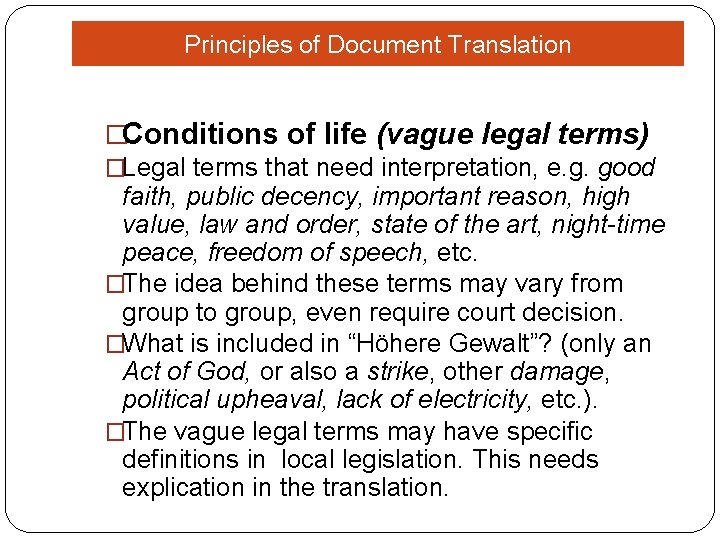
Principles of Document Translation �Conditions of life (vague legal terms) �Legal terms that need interpretation, e. g. good faith, public decency, important reason, high value, law and order, state of the art, night-time peace, freedom of speech, etc. �The idea behind these terms may vary from group to group, even require court decision. �What is included in “Höhere Gewalt”? (only an Act of God, or also a strike, other damage, political upheaval, lack of electricity, etc. ). �The vague legal terms may have specific definitions in local legislation. This needs explication in the translation.
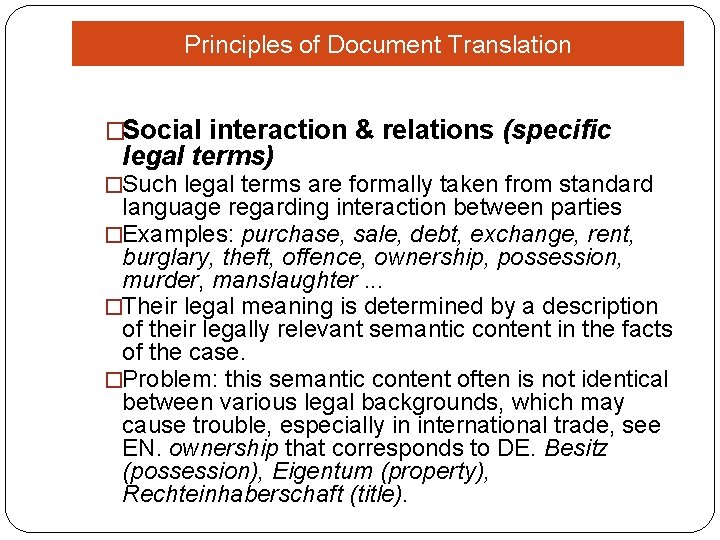
Principles of Document Translation �Social interaction & relations (specific legal terms) �Such legal terms are formally taken from standard language regarding interaction between parties �Examples: purchase, sale, debt, exchange, rent, burglary, theft, offence, ownership, possession, murder, manslaughter. . . �Their legal meaning is determined by a description of their legally relevant semantic content in the facts of the case. �Problem: this semantic content often is not identical between various legal backgrounds, which may cause trouble, especially in international trade, see EN. ownership that corresponds to DE. Besitz (possession), Eigentum (property), Rechteinhaberschaft (title).
Principles of Document Translation �Legalistic ideas (abstract terms of jurisprudence) �On a high level of abstraction, there are terms for phenomena that are only theoretically conceivable. The concepts of such terms are precisely defined by legal provision. �E. g. terms like Rechtsnachfolger (successor in title), Willenserklärung (declaration of will), Gläubigerverzug (creditor’s delay in acceptance), Mängelhaftung (responsibility for defects), Transporterschleichung (transport obtained by devious means, fare dodging), Buchgrundschuld (uncertificated mortgage), etc. �Difficult to understand for lay persons. �As theoretical concepts within a law system they
Principles of Document Translation �Concepts of European law (multilingual terms) �Legal concept in European texts is considered identical �Difference to similar words in local laws with their legal language must be observed �Beware of false friends �Special translation strategies for terminology
Principles of Document Translation �Interrelated linguistic aspects of legal translation �Standard macro-structures �Special terminology �Technical style �Speech acts in legal language �Procedural repetition in formulae
Principles of Document Translation �Linguistic aspects of translation Standard macrostructures Special terminology Technical style Speech acts in legal language Procedural repetition in formulae �Standard macro-structures �Documentary translation will not change form �No adaptation into target text types �Same amount of sentences in contracts �Target text is transparent for source
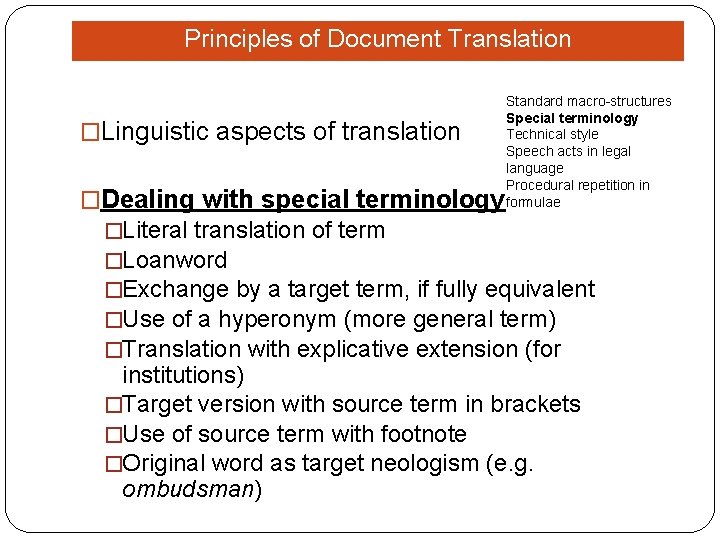
Principles of Document Translation �Linguistic aspects of translation �Dealing with special terminology Standard macro-structures Special terminology Technical style Speech acts in legal language Procedural repetition in formulae �Literal translation of term �Loanword �Exchange by a target term, if fully equivalent �Use of a hyperonym (more general term) �Translation with explicative extension (for institutions) �Target version with source term in brackets �Use of source term with footnote �Original word as target neologism (e. g. ombudsman)
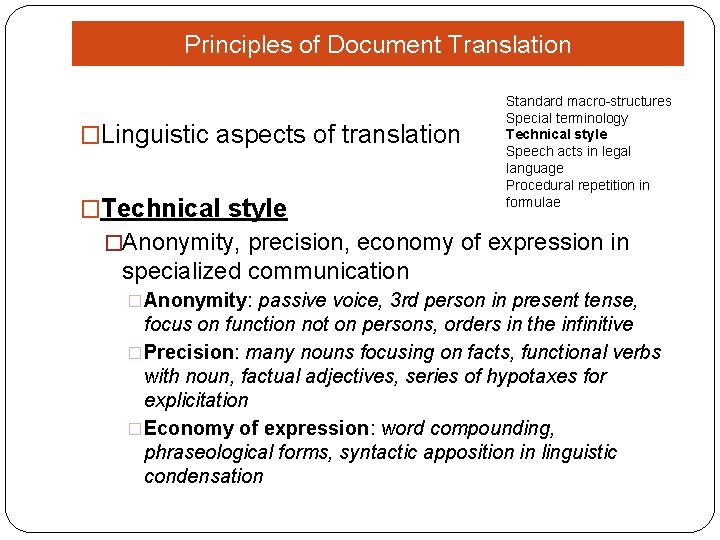
Principles of Document Translation �Linguistic aspects of translation �Technical style Standard macro-structures Special terminology Technical style Speech acts in legal language Procedural repetition in formulae �Anonymity, precision, economy of expression in specialized communication �Anonymity: passive voice, 3 rd person in present tense, focus on function not on persons, orders in the infinitive �Precision: many nouns focusing on facts, functional verbs with noun, factual adjectives, series of hypotaxes for explicitation �Economy of expression: word compounding, phraseological forms, syntactic apposition in linguistic condensation
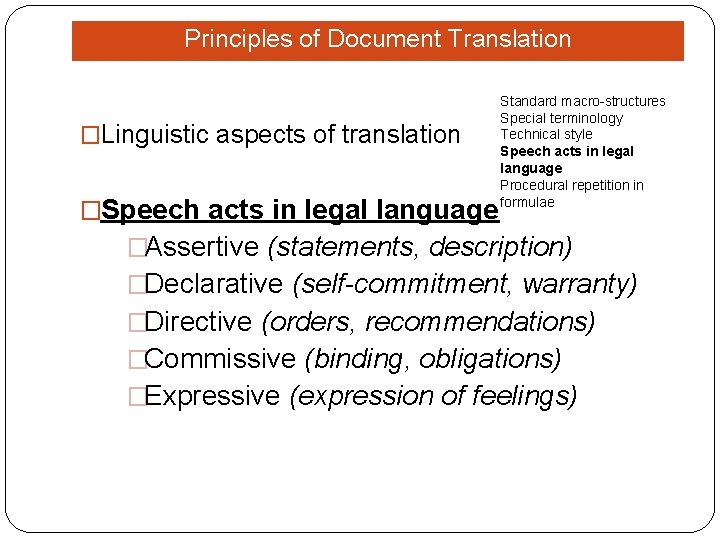
Principles of Document Translation �Linguistic aspects of translation �Speech acts in legal language Standard macro-structures Special terminology Technical style Speech acts in legal language Procedural repetition in formulae �Assertive (statements, description) �Declarative (self-commitment, warranty) �Directive (orders, recommendations) �Commissive (binding, obligations) �Expressive (expression of feelings)
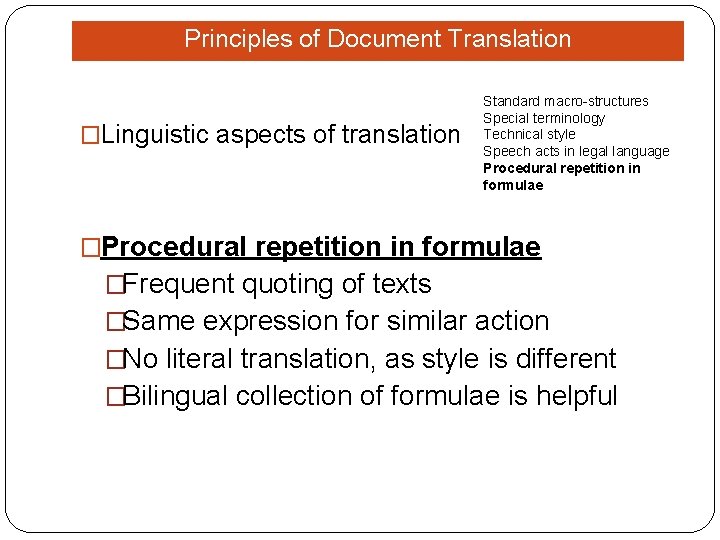
Principles of Document Translation �Linguistic aspects of translation Standard macro-structures Special terminology Technical style Speech acts in legal language Procedural repetition in formulae �Frequent quoting of texts �Same expression for similar action �No literal translation, as style is different �Bilingual collection of formulae is helpful
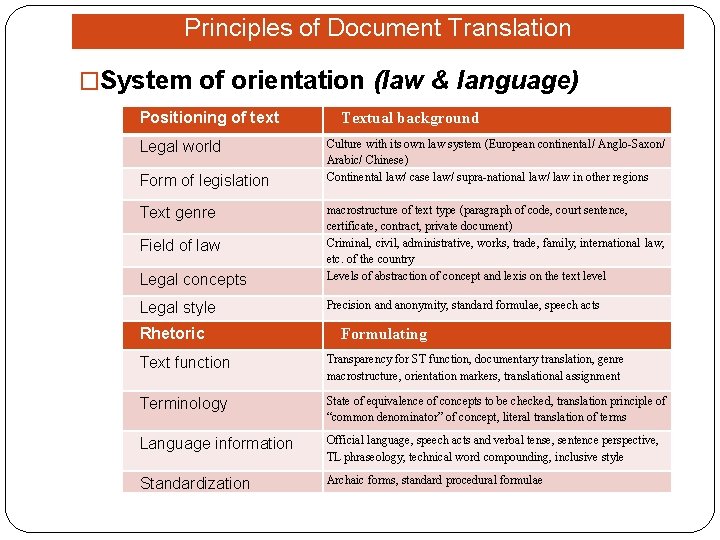
Principles of Document Translation �System of orientation (law & language) Positioning of text Legal world Form of legislation Textual background Culture with its own law system (European continental/ Anglo-Saxon/ Arabic/ Chinese) Continental law/ case law/ supra-national law/ law in other regions Legal concepts macrostructure of text type (paragraph of code, court sentence, certificate, contract, private document) Criminal, civil, administrative, works, trade, family, international law, etc. of the country Levels of abstraction of concept and lexis on the text level Legal style Precision and anonymity, standard formulae, speech acts Text genre Field of law Rhetoric Formulating Text function Transparency for ST function, documentary translation, genre macrostructure, orientation markers, translational assignment Terminology State of equivalence of concepts to be checked, translation principle of “common denominator” of concept, literal translation of terms Language information Official language, speech acts and verbal tense, sentence perspective, TL phraseology, technical word compounding, inclusive style Standardization Archaic forms, standard procedural formulae
Principles of Document Translation �The combination of all those aspects is specifically different in every individual text. �Legal translation is a rather complex task that deserves credit. �A specific knowledge base is required for the legal translator. © Radegundis Stolze
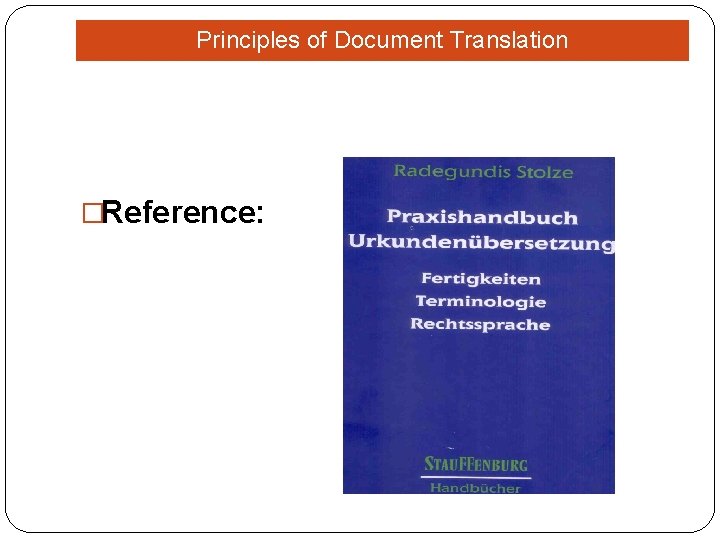
Principles of Document Translation �Reference: