
Dr Nadia Flanigan and Dr Jennifer Zorotovich Social
- Slides: 15
Dr. Nadia Flanigan and Dr. Jennifer Zorotovich Social Gerontology Conference October 11, 2019
§ Cohabitation: when unmarried couples live together (Lamanna, Riedmann, & Stewart, 2018) § Rates of cohabitation in the United States have increased among adults of all ages, but especially among adults ages 50 and older (Stepler, 2017) § The number of cohabiting adults ages 50 and older increased from 2. 3 million to 4 million (75% increase) from 2007 to 2016 § This was the sharpest increase of any age group! § However, most cohabiters are young adults (Stepler, 2017) § In 2016, § About 7% of all adults in the U. S. cohabited § Only 4% of adults 50 and older cohabited § Only 23% of all cohabiting adults were ages 50 and older
§ Most have been married before (Brown, Lee, & Bulanda, 2006) § In 2016, over half (55%) were divorced, 13% were widowed, and 27% had never been married (Stepler, 2017) § Most are between the ages of 50 and 59 (Stepler, 2017) § In 2016, over half (57%) were ages 50 -59, 30% were ages 60 -69, 10% were ages 70 -79, and only 3% were ages 80 and older § They have more stable unions and report higher relationship quality compared to cohabiting young adults (Brown, Bulanda, & Lee, 2012; King & Scott, 2005) § They are more likely to view their unions as a substitute for marriage rather than as a path towards marriage (Brown et al. 2012; King & Scott, 2005)
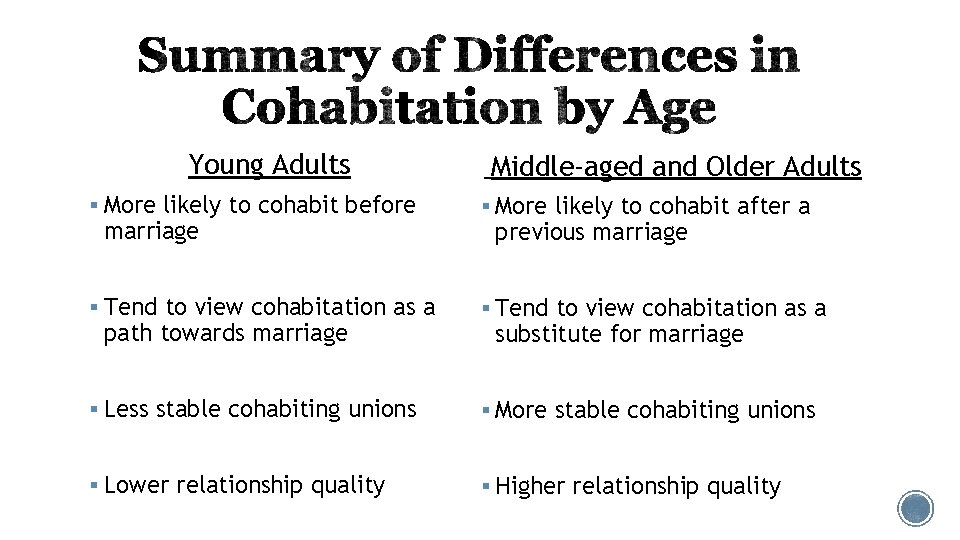
Young Adults Middle-aged and Older Adults § More likely to cohabit before § More likely to cohabit after a § Tend to view cohabitation as a § Less stable cohabiting unions § More stable cohabiting unions § Lower relationship quality § Higher relationship quality marriage path towards marriage previous marriage substitute for marriage
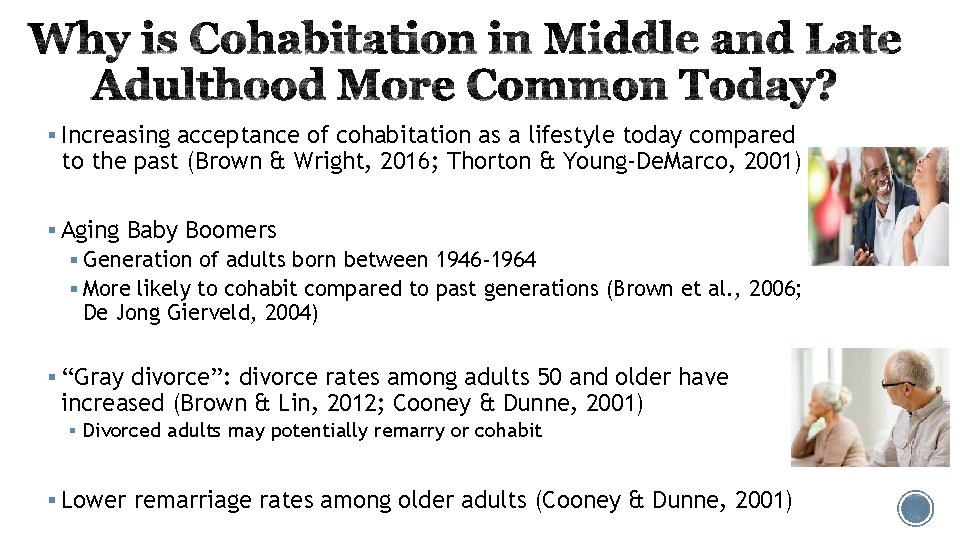
§ Increasing acceptance of cohabitation as a lifestyle today compared to the past (Brown & Wright, 2016; Thorton & Young-De. Marco, 2001) § Aging Baby Boomers § Generation of adults born between 1946 -1964 § More likely to cohabit compared to past generations (Brown et al. , 2006; De Jong Gierveld, 2004) § “Gray divorce”: divorce rates among adults 50 and older have increased (Brown & Lin, 2012; Cooney & Dunne, 2001) § Divorced adults may potentially remarry or cohabit § Lower remarriage rates among older adults (Cooney & Dunne, 2001)
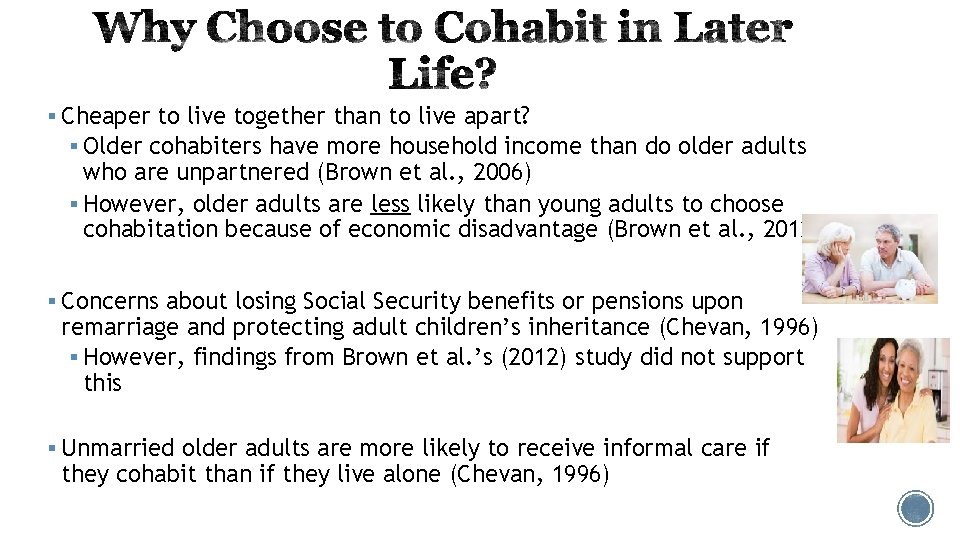
§ Cheaper to live together than to live apart? § Older cohabiters have more household income than do older adults who are unpartnered (Brown et al. , 2006) § However, older adults are less likely than young adults to choose cohabitation because of economic disadvantage (Brown et al. , 2012) § Concerns about losing Social Security benefits or pensions upon remarriage and protecting adult children’s inheritance (Chevan, 1996) § However, findings from Brown et al. ’s (2012) study did not support this § Unmarried older adults are more likely to receive informal care if they cohabit than if they live alone (Chevan, 1996)
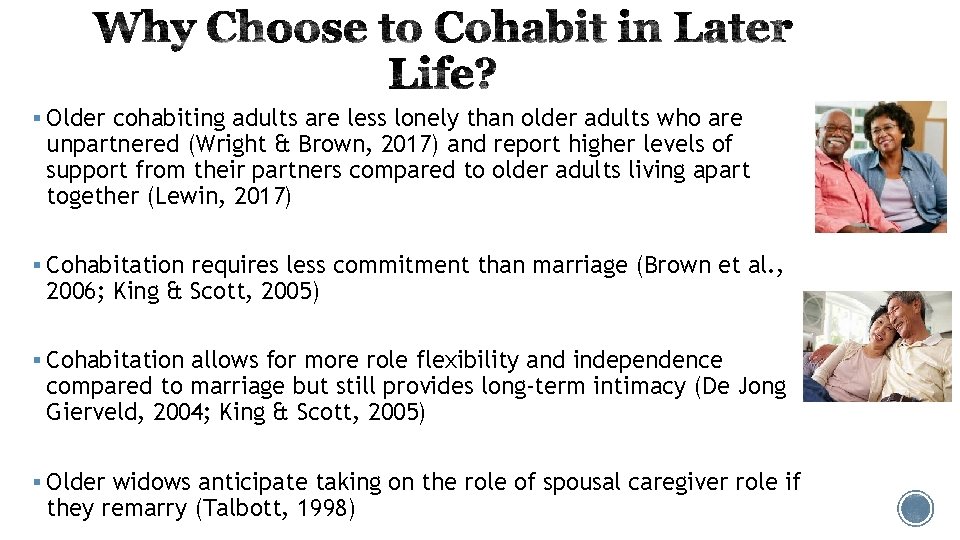
§ Older cohabiting adults are less lonely than older adults who are unpartnered (Wright & Brown, 2017) and report higher levels of support from their partners compared to older adults living apart together (Lewin, 2017) § Cohabitation requires less commitment than marriage (Brown et al. , 2006; King & Scott, 2005) § Cohabitation allows for more role flexibility and independence compared to marriage but still provides long-term intimacy (De Jong Gierveld, 2004; King & Scott, 2005) § Older widows anticipate taking on the role of spousal caregiver role if they remarry (Talbott, 1998)
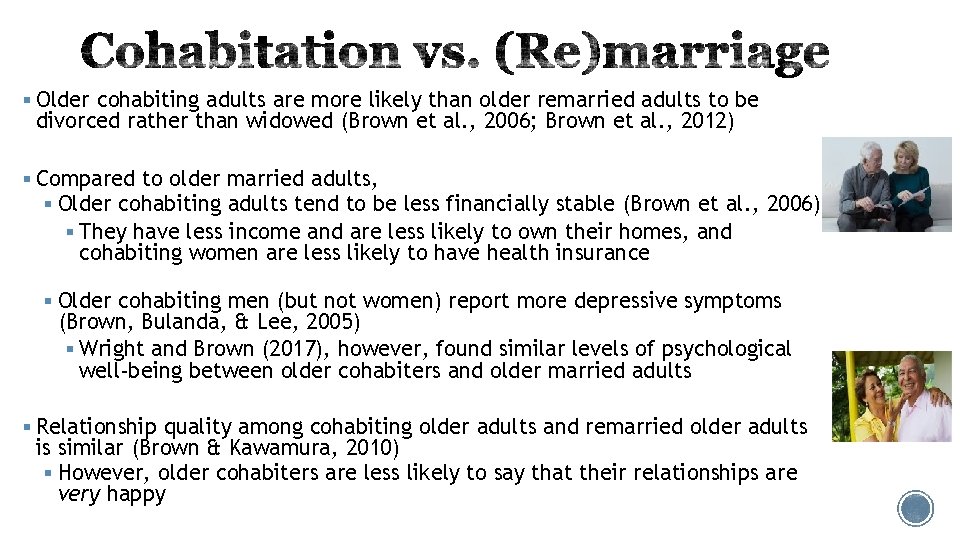
§ Older cohabiting adults are more likely than older remarried adults to be divorced rather than widowed (Brown et al. , 2006; Brown et al. , 2012) § Compared to older married adults, § Older cohabiting adults tend to be less financially stable (Brown et al. , 2006) § They have less income and are less likely to own their homes, and cohabiting women are less likely to have health insurance § Older cohabiting men (but not women) report more depressive symptoms (Brown, Bulanda, & Lee, 2005) § Wright and Brown (2017), however, found similar levels of psychological well-being between older cohabiters and older married adults § Relationship quality among cohabiting older adults and remarried older adults is similar (Brown & Kawamura, 2010) § However, older cohabiters are less likely to say that their relationships are very happy
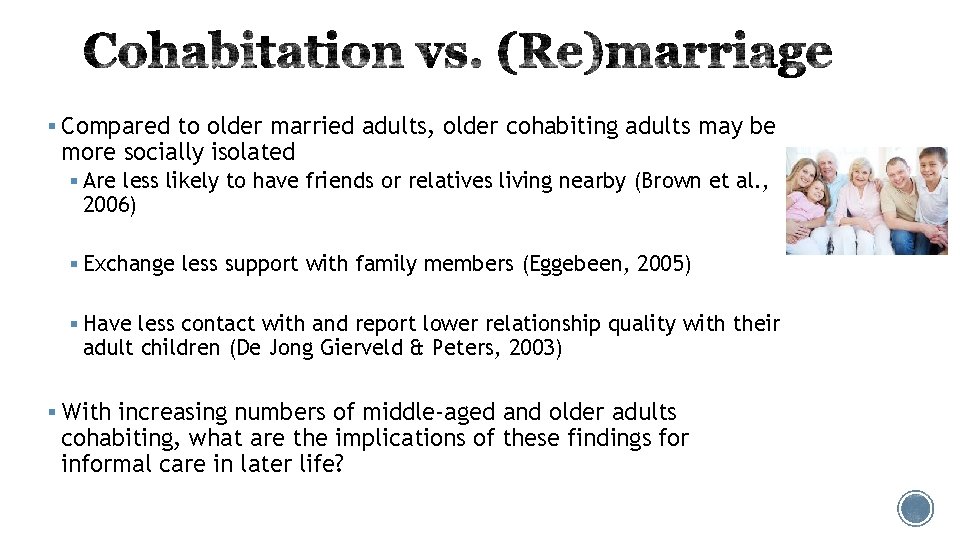
§ Compared to older married adults, older cohabiting adults may be more socially isolated § Are less likely to have friends or relatives living nearby (Brown et al. , 2006) § Exchange less support with family members (Eggebeen, 2005) § Have less contact with and report lower relationship quality with their adult children (De Jong Gierveld & Peters, 2003) § With increasing numbers of middle-aged and older adults cohabiting, what are the implications of these findings for informal care in later life?
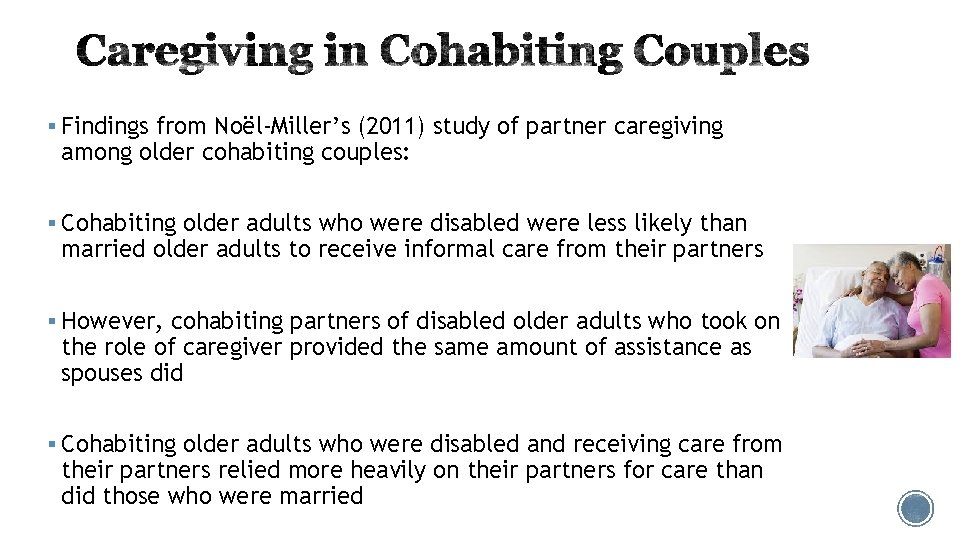
§ Findings from Noël-Miller’s (2011) study of partner caregiving among older cohabiting couples: § Cohabiting older adults who were disabled were less likely than married older adults to receive informal care from their partners § However, cohabiting partners of disabled older adults who took on the role of caregiver provided the same amount of assistance as spouses did § Cohabiting older adults who were disabled and receiving care from their partners relied more heavily on their partners for care than did those who were married
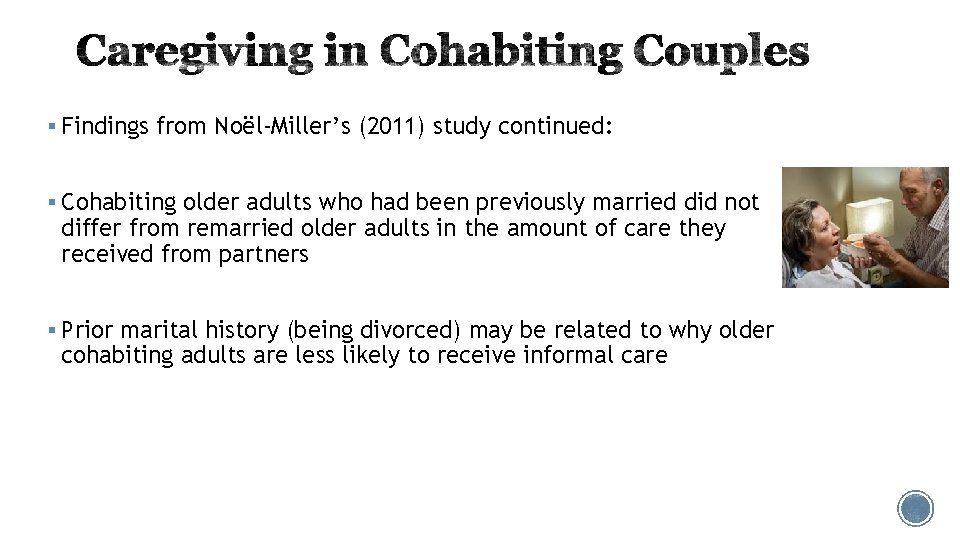
§ Findings from Noël-Miller’s (2011) study continued: § Cohabiting older adults who had been previously married did not differ from remarried older adults in the amount of care they received from partners § Prior marital history (being divorced) may be related to why older cohabiting adults are less likely to receive informal care
§ Cohabitation in middle and late adulthood differs from cohabitation in young adulthood § Rates of cohabitation among adults 50 and older are expected to continue to rise over the next decade § Cohabitating unions and marriages in later life may be more similar than once thought to be § Cohabiting older adults may be disadvantaged when it comes to access to informal support and informal care
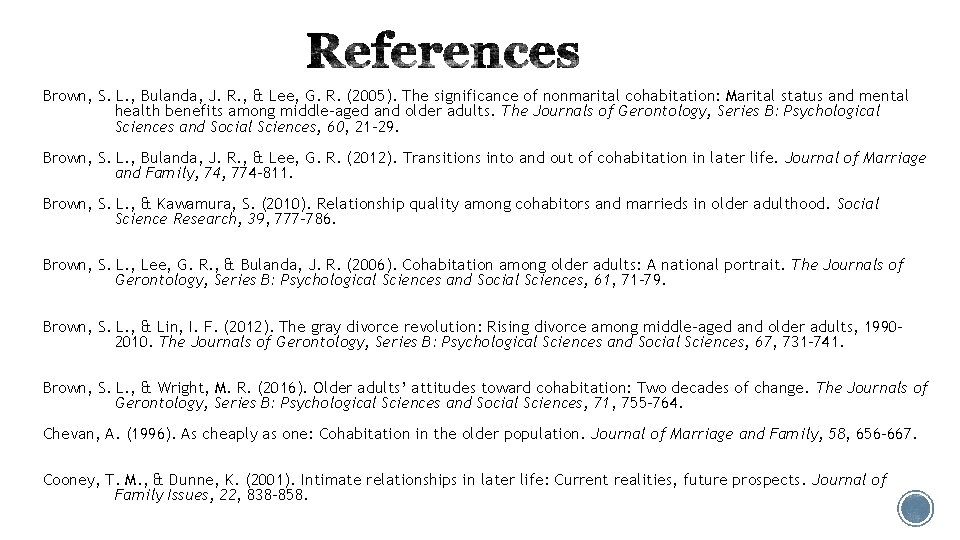
Brown, S. L. , Bulanda, J. R. , & Lee, G. R. (2005). The significance of nonmarital cohabitation: Marital status and mental health benefits among middle-aged and older adults. The Journals of Gerontology, Series B: Psychological Sciences and Social Sciences, 60, 21 -29. Brown, S. L. , Bulanda, J. R. , & Lee, G. R. (2012). Transitions into and out of cohabitation in later life. Journal of Marriage and Family, 74, 774 -811. Brown, S. L. , & Kawamura, S. (2010). Relationship quality among cohabitors and marrieds in older adulthood. Social Science Research, 39, 777 -786. Brown, S. L. , Lee, G. R. , & Bulanda, J. R. (2006). Cohabitation among older adults: A national portrait. The Journals of Gerontology, Series B: Psychological Sciences and Social Sciences, 61, 71 -79. Brown, S. L. , & Lin, I. F. (2012). The gray divorce revolution: Rising divorce among middle-aged and older adults, 19902010. The Journals of Gerontology, Series B: Psychological Sciences and Social Sciences, 67, 731 -741. Brown, S. L. , & Wright, M. R. (2016). Older adults’ attitudes toward cohabitation: Two decades of change. The Journals of Gerontology, Series B: Psychological Sciences and Social Sciences, 71, 755 -764. Chevan, A. (1996). As cheaply as one: Cohabitation in the older population. Journal of Marriage and Family, 58, 656 -667. Cooney, T. M. , & Dunne, K. (2001). Intimate relationships in later life: Current realities, future prospects. Journal of Family Issues, 22, 838 -858.
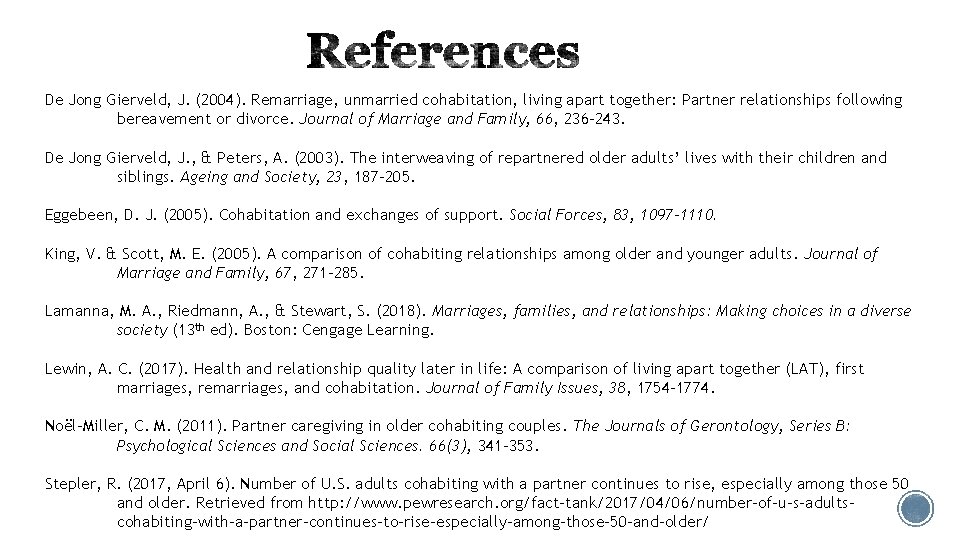
De Jong Gierveld, J. (2004). Remarriage, unmarried cohabitation, living apart together: Partner relationships following bereavement or divorce. Journal of Marriage and Family, 66, 236 -243. De Jong Gierveld, J. , & Peters, A. (2003). The interweaving of repartnered older adults’ lives with their children and siblings. Ageing and Society, 23, 187 -205. Eggebeen, D. J. (2005). Cohabitation and exchanges of support. Social Forces, 83, 1097 -1110. King, V. & Scott, M. E. (2005). A comparison of cohabiting relationships among older and younger adults. Journal of Marriage and Family, 67, 271 -285. Lamanna, M. A. , Riedmann, A. , & Stewart, S. (2018). Marriages, families, and relationships: Making choices in a diverse society (13 th ed). Boston: Cengage Learning. Lewin, A. C. (2017). Health and relationship quality later in life: A comparison of living apart together (LAT), first marriages, remarriages, and cohabitation. Journal of Family Issues, 38, 1754 -1774. Noël-Miller, C. M. (2011). Partner caregiving in older cohabiting couples. The Journals of Gerontology, Series B: Psychological Sciences and Social Sciences. 66(3), 341 -353. Stepler, R. (2017, April 6). Number of U. S. adults cohabiting with a partner continues to rise, especially among those 50 and older. Retrieved from http: //www. pewresearch. org/fact-tank/2017/04/06/number-of-u-s-adultscohabiting-with-a-partner-continues-to-rise-especially-among-those-50 -and-older/
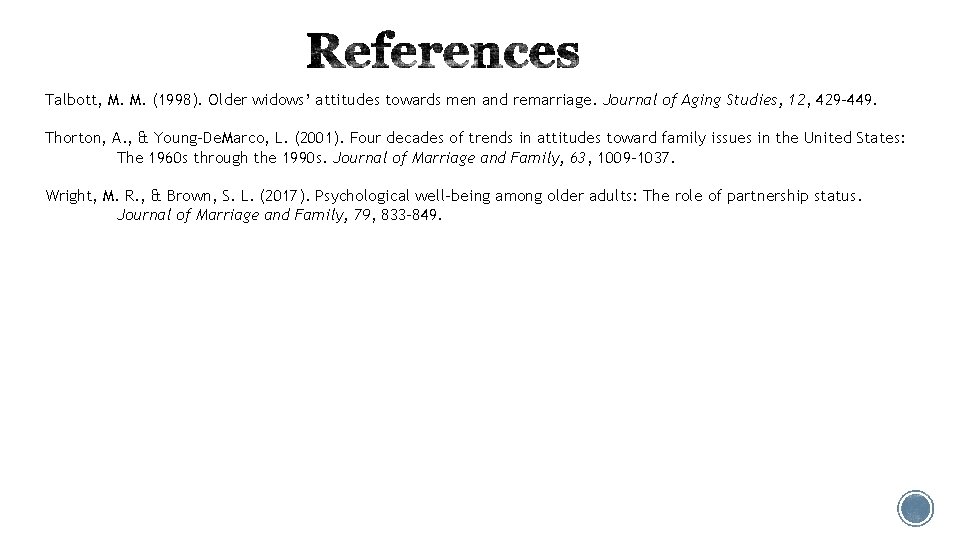
Talbott, M. M. (1998). Older widows’ attitudes towards men and remarriage. Journal of Aging Studies, 12, 429 -449. Thorton, A. , & Young-De. Marco, L. (2001). Four decades of trends in attitudes toward family issues in the United States: The 1960 s through the 1990 s. Journal of Marriage and Family, 63, 1009 -1037. Wright, M. R. , & Brown, S. L. (2017). Psychological well-being among older adults: The role of partnership status. Journal of Marriage and Family, 79, 833 -849.