
Dr Michele Ballan INFNLNL michele ballanlnl infn it
Dr. Michele Ballan INFN-LNL michele. ballan@lnl. infn. it On behalf of the SPES-ISOLPHARM group MEDICIS-PROMED final conference, Erice, 2 nd May 2019
Outline Introduction: ISOLPHARM @ SPES ISOL facility Production target development Beam development Collection target development Erice, 2 nd May 2019 Michele Ballan 2
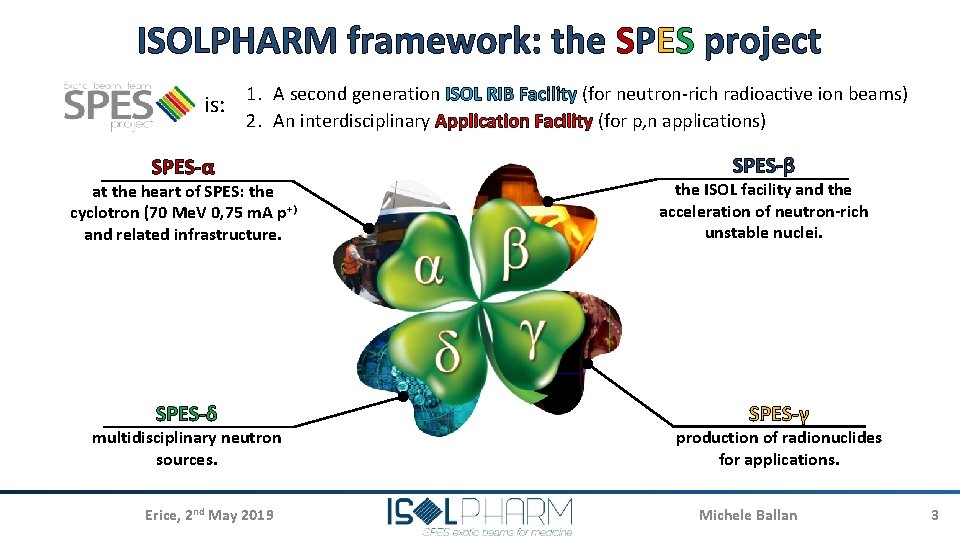
ISOLPHARM framework: the SPES project is: 1. A second generation ISOL RIB Facility (for neutron-rich radioactive ion beams) 2. An interdisciplinary Application Facility (for p, n applications) SPES-α at the heart of SPES: the cyclotron (70 Me. V 0, 75 m. A p+) and related infrastructure. SPES-δ multidisciplinary neutron sources. Erice, 2 nd May 2019 SPES-β the ISOL facility and the acceleration of neutron-rich unstable nuclei. SPES-γ production of radionuclides for applications. Michele Ballan 3
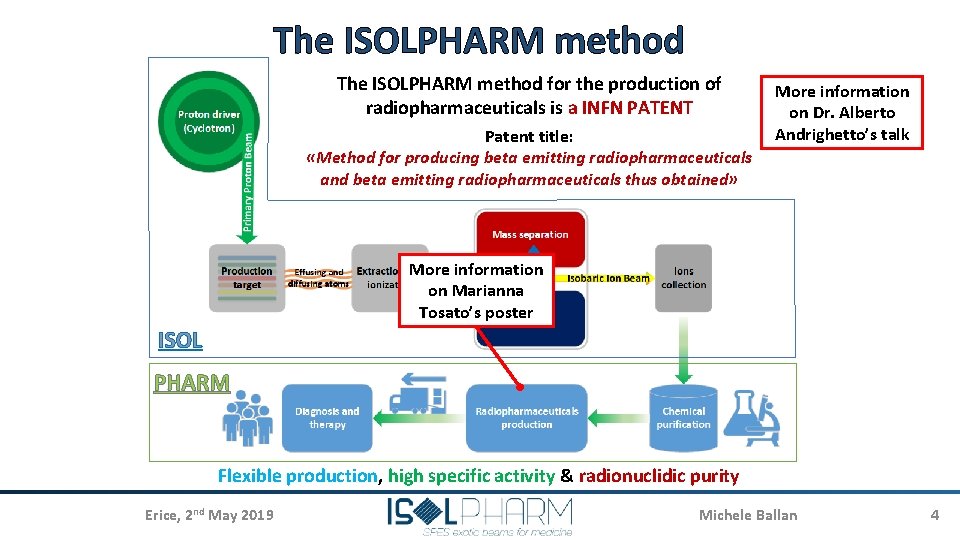
The ISOLPHARM method for the production of radiopharmaceuticals is a INFN PATENT Patent title: «Method for producing beta emitting radiopharmaceuticals and beta emitting radiopharmaceuticals thus obtained» More information on Dr. Alberto Andrighetto’s talk More information on Marianna Tosato’s poster ISOL PHARM Flexible production, high specific activity & radionuclidic purity Erice, 2 nd May 2019 Michele Ballan 4
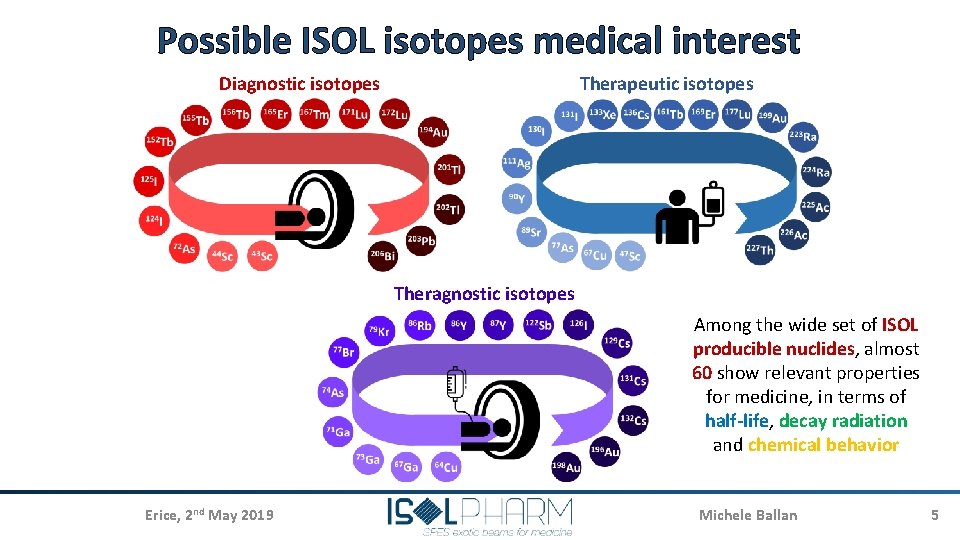
Possible ISOL isotopes medical interest Diagnostic isotopes Therapeutic isotopes Theragnostic isotopes Among the wide set of ISOL producible nuclides, almost 60 show relevant properties for medicine, in terms of half-life, decay radiation and chemical behavior Erice, 2 nd May 2019 Michele Ballan 5
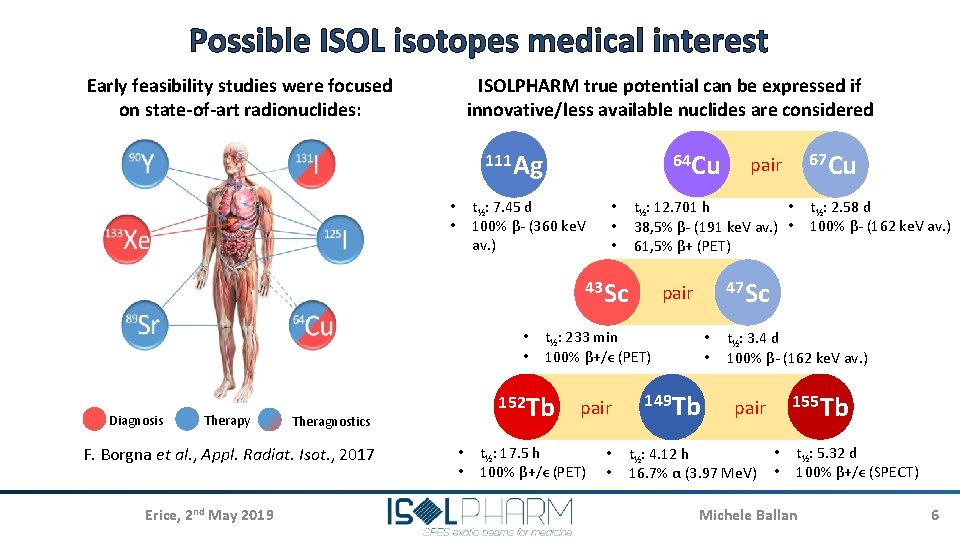
Possible ISOL isotopes medical interest Early feasibility studies were focused on state-of-art radionuclides: ISOLPHARM true potential can be expressed if innovative/less available nuclides are considered 111 Ag 64 Cu t½: 7. 45 d 100% β- (360 ke. V av. ) • • Diagnosis Therapy Theragnostics F. Borgna et al. , Appl. Radiat. Isot. , 2017 Erice, 2 nd May 2019 • • 47 Sc pair t½: 233 min 100% β+/ϵ (PET) 152 Tb pair t½: 17. 5 h 100% β+/ϵ (PET) • • t½: 2. 58 d 100% β- (162 ke. V av. ) • t½: 12. 701 h 38, 5% β- (191 ke. V av. ) • 61, 5% β+ (PET) • • • 43 Sc • • 67 Cu pair • • 149 Tb t½: 3. 4 d 100% β- (162 ke. V av. ) 155 Tb pair t½: 4. 12 h 16. 7% α (3. 97 Me. V) • • t½: 5. 32 d 100% β+/ϵ (SPECT) Michele Ballan 6
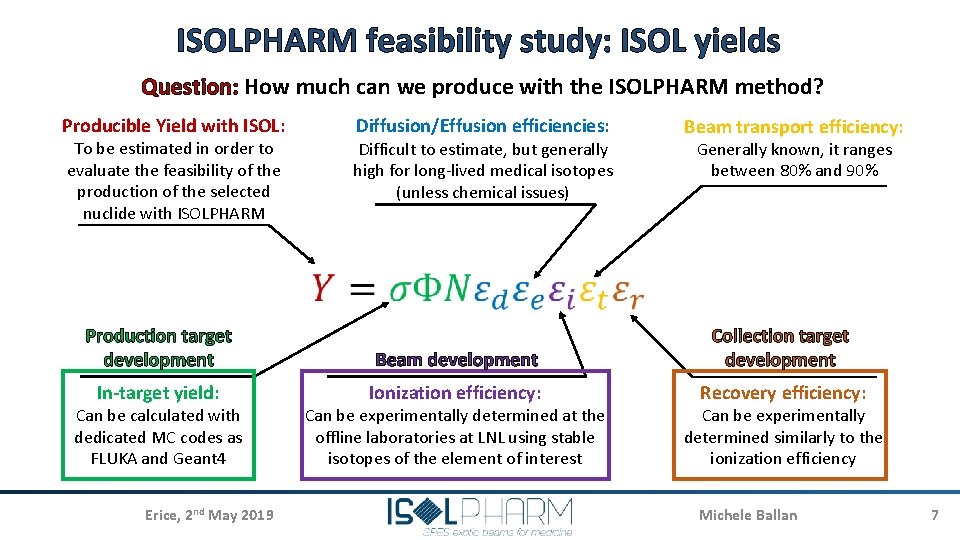
ISOLPHARM feasibility study: ISOL yields Question: How much can we produce with the ISOLPHARM method? Producible Yield with ISOL: To be estimated in order to evaluate the feasibility of the production of the selected nuclide with ISOLPHARM Diffusion/Effusion efficiencies: Difficult to estimate, but generally high for long-lived medical isotopes (unless chemical issues) Beam transport efficiency: Generally known, it ranges between 80% and 90% Production target development Beam development Collection target development In-target yield: Ionization efficiency: Recovery efficiency: Can be calculated with dedicated MC codes as FLUKA and Geant 4 Erice, 2 nd May 2019 Can be experimentally determined at the offline laboratories at LNL using stable isotopes of the element of interest Can be experimentally determined similarly to the ionization efficiency Michele Ballan 7
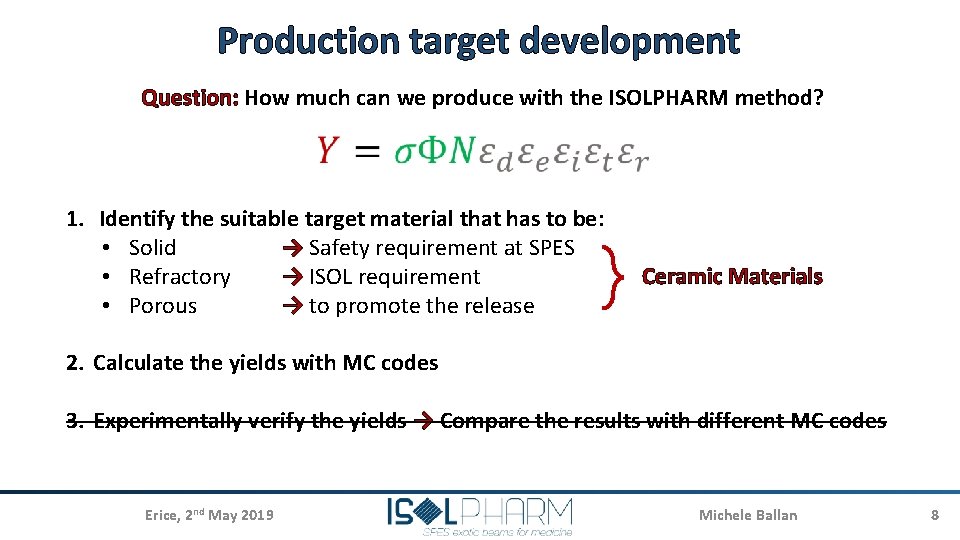
Production target development Question: How much can we produce with the ISOLPHARM method? 1. Identify the suitable target material that has to be: • Solid → Safety requirement at SPES • Refractory → ISOL requirement • Porous → to promote the release Ceramic Materials 2. Calculate the yields with MC codes 3. Experimentally verify the yields → Compare the results with different MC codes Erice, 2 nd May 2019 Michele Ballan 8
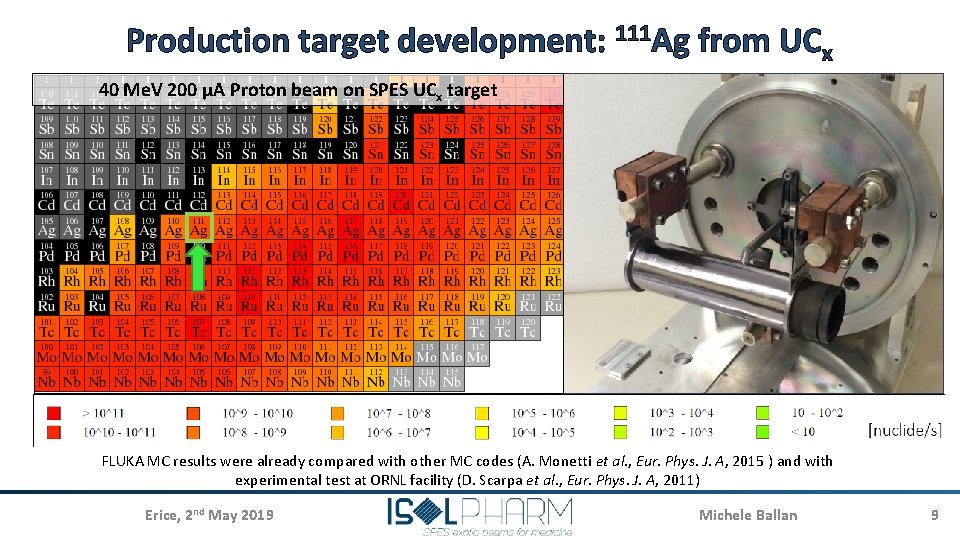
Production target development: 111 Ag from UCx 40 Me. V 200 μA Proton beam on SPES UCx target FLUKA MC results were already compared with other MC codes (A. Monetti et al. , Eur. Phys. J. A, 2015 ) and with experimental test at ORNL facility (D. Scarpa et al. , Eur. Phys. J. A, 2011) Erice, 2 nd May 2019 Michele Ballan 9
![Production target development: 111 Ag from UCx Y [cm] Desgined for stopping a 40](http://slidetodoc.com/presentation_image_h2/34eca8c5064b6ebed72dff0b59628001/image-10.jpg "Production target development: 111 Ag from UCx Y [cm] Desgined for stopping a 40")
Production target development: 111 Ag from UCx Y [cm] Desgined for stopping a 40 Me. V 200 µA PPB (FLUKA) Desgined for working temperatures above 2000°C (ANSYS®) X [cm] [p+/cm 2] Tested and commissioned for high temperature operation [°C] IT = 700 A IIS = 200 A Erice, 2 nd May 2019 Michele Ballan 10
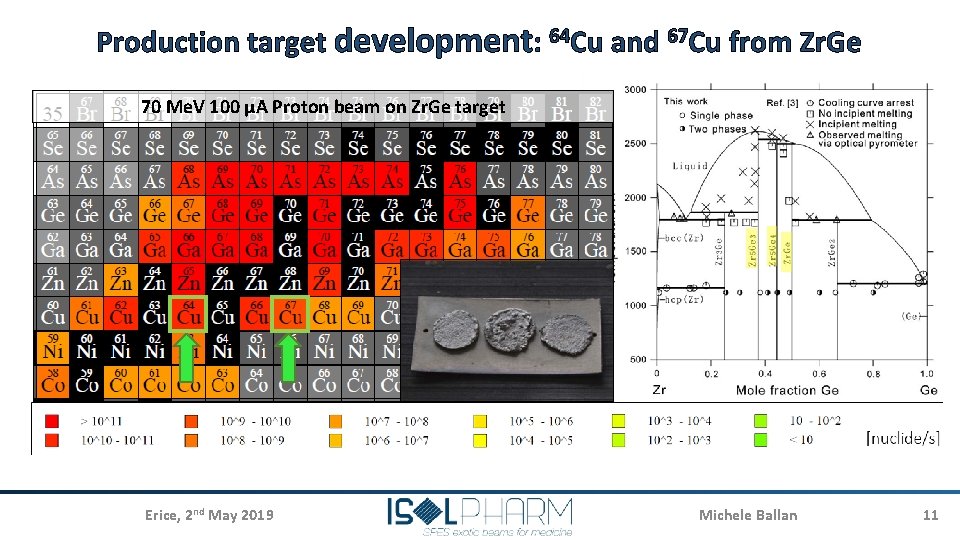
Production target development: 64 Cu and 67 Cu from Zr. Ge 70 Me. V 100 μA Proton beam on Zr. Ge target Erice, 2 nd May 2019 Michele Ballan 11
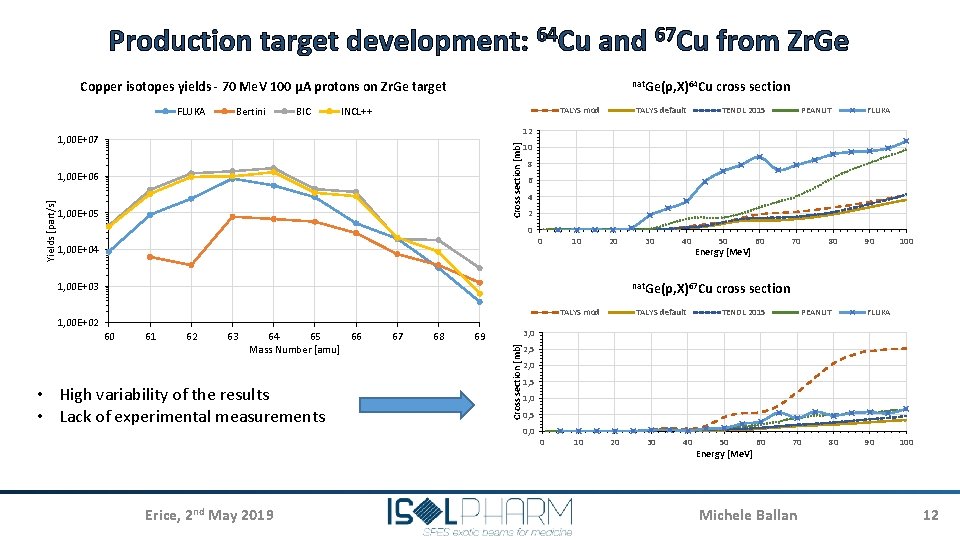
Production target development: 64 Cu and 67 Cu from Zr. Ge Copper isotopes yields - 70 Me. V 100 μA protons on Zr. Ge target FLUKA Bertini BIC nat. Ge(p, X)64 Cu INCL++ TALYS mod TENDL 2015 PEANUT FLUKA 12 1, 00 E+07 Cross section [mb] 10 1, 00 E+06 Yields [part/s] TALYS default cross section 1, 00 E+05 8 6 4 2 0 1, 00 E+04 0 10 20 1, 00 E+03 30 40 50 Energy [Me. V] nat. Ge(p, X)67 Cu TALYS mod 1, 00 E+02 61 62 63 64 65 66 Mass Number [amu] • High variability of the results • Lack of experimental measurements Erice, 2 nd May 2019 67 68 70 80 90 100 cross section TENDL 2015 PEANUT FLUKA 3, 0 69 Cross section [mb] 60 TALYS default 60 2, 5 2, 0 1, 5 1, 0 0, 5 0, 0 0 10 20 30 40 50 Energy [Me. V] 60 70 Michele Ballan 80 90 100 12
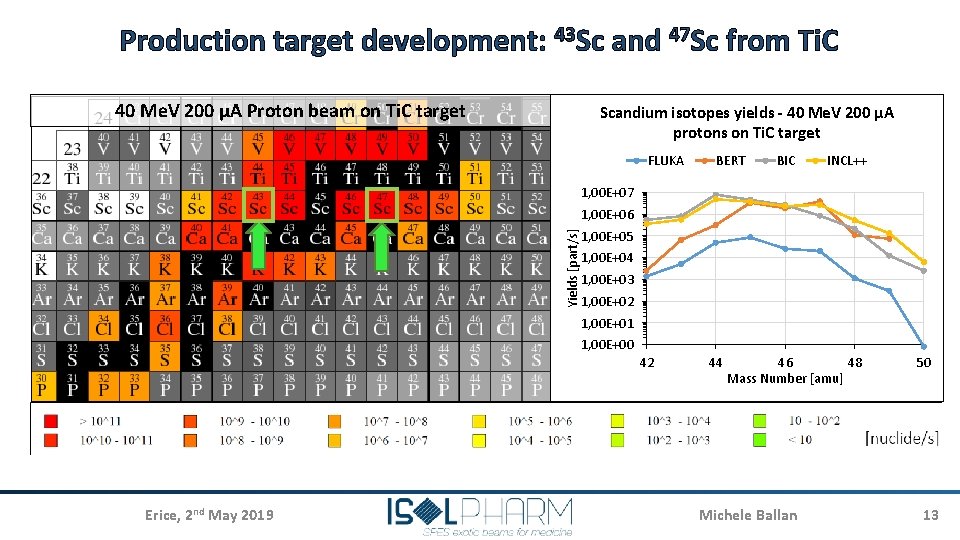
Production target development: 43 Sc and 47 Sc from Ti. C 40 Me. V 200 μA Proton beam on Ti. C target Scandium isotopes yields - 40 Me. V 200 μA protons on Ti. C target FLUKA BERT BIC INCL++ 1, 00 E+07 Yields [part/s] 1, 00 E+06 1, 00 E+05 1, 00 E+04 1, 00 E+03 1, 00 E+02 1, 00 E+01 1, 00 E+00 42 Erice, 2 nd May 2019 44 46 48 Mass Number [amu] Michele Ballan 50 13
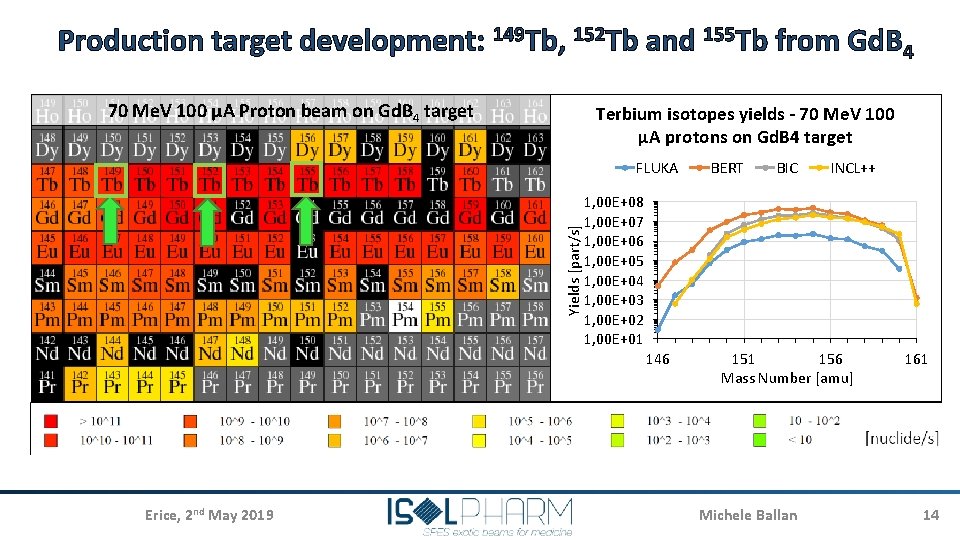
Production target development: 149 Tb, 152 Tb and 155 Tb from Gd. B 4 70 Me. V 100 μA Proton beam on Gd. B 4 target Terbium isotopes yields - 70 Me. V 100 μA protons on Gd. B 4 target Yields [part/s] FLUKA BIC INCL++ 1, 00 E+08 1, 00 E+07 1, 00 E+06 1, 00 E+05 1, 00 E+04 1, 00 E+03 1, 00 E+02 1, 00 E+01 146 Erice, 2 nd May 2019 BERT 151 156 Mass Number [amu] Michele Ballan 161 14
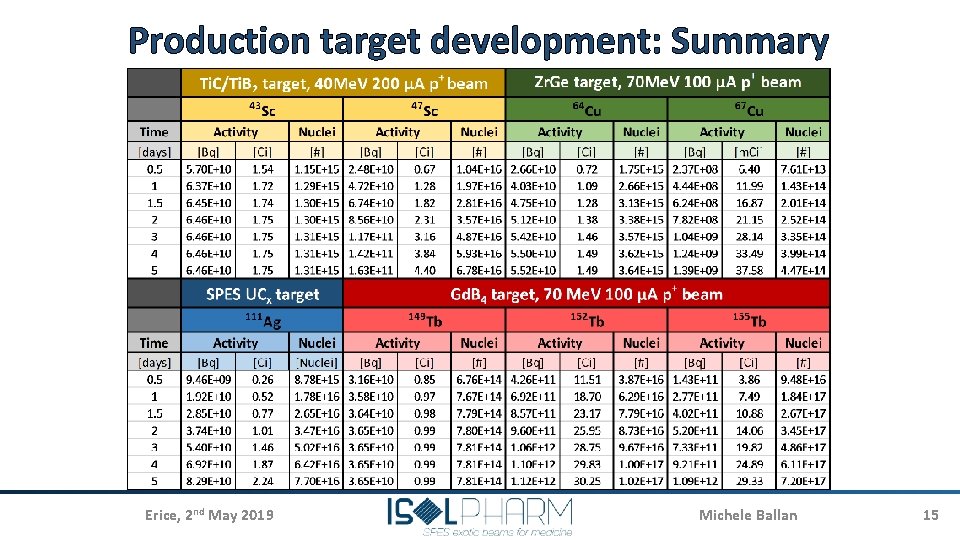
Production target development: Summary Erice, 2 nd May 2019 Michele Ballan 15
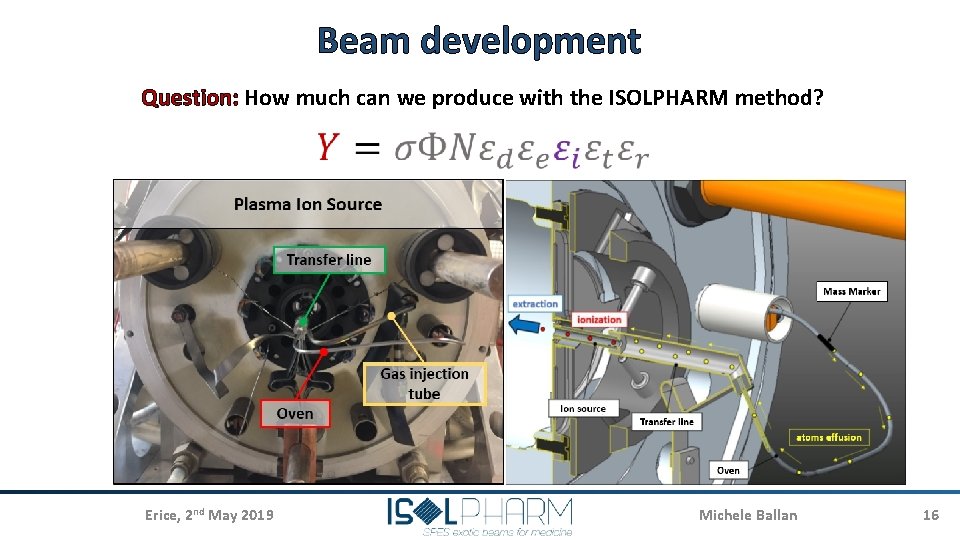
Beam development Question: How much can we produce with the ISOLPHARM method? A. Target. Ion source unit Erice, 2 nd May 2019 B. First triplets and steers and Diagnostic Box 1 C. Wien Filter D. Diagnostic Box 2 and slits E. Second triplets F. Secondary target station Michele Ballan 16
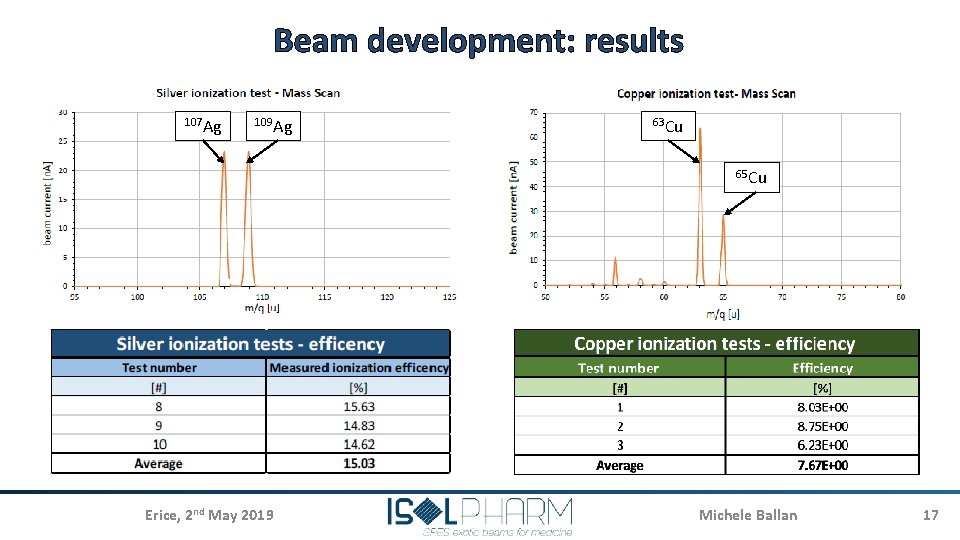
Beam development: results 107 Ag 109 Ag 63 Cu 65 Cu Erice, 2 nd May 2019 Michele Ballan 17
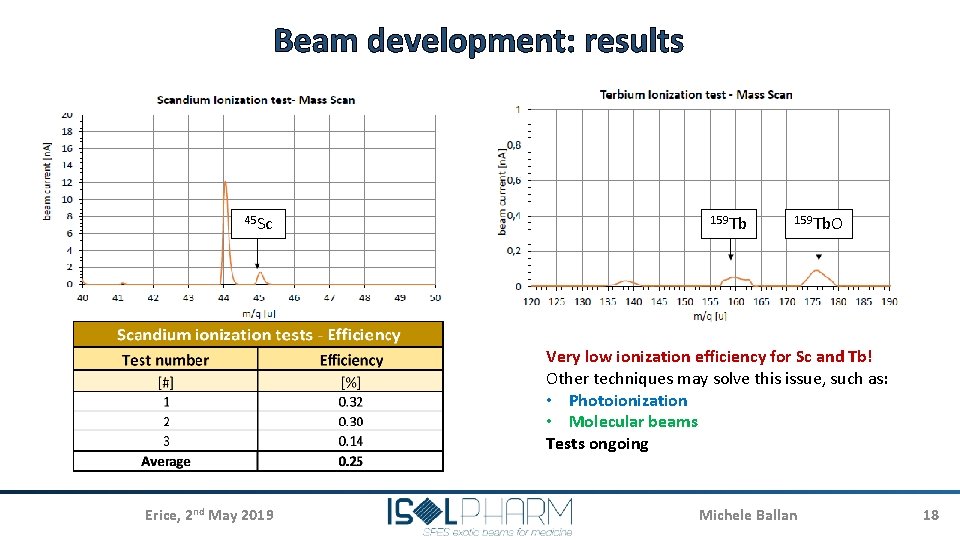
Beam development: results 45 Sc 159 Tb. O Very low ionization efficiency for Sc and Tb! Other techniques may solve this issue, such as: • Photoionization • Molecular beams Tests ongoing Erice, 2 nd May 2019 Michele Ballan 18
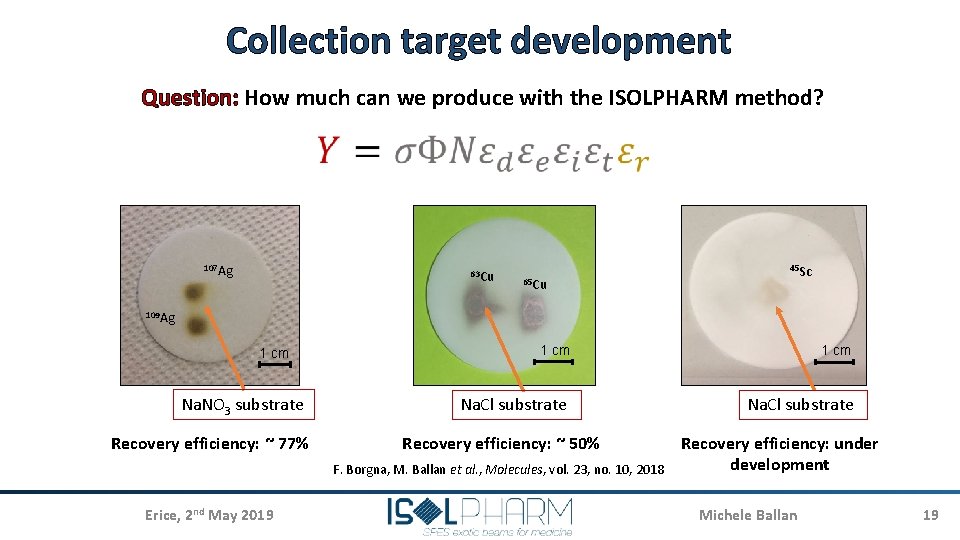
Collection target development Question: How much can we produce with the ISOLPHARM method? 107 Ag 63 Cu 65 Cu 45 Sc 109 Ag 1 cm Na. NO 3 substrate Recovery efficiency: ~ 77% 1 cm Na. Cl substrate Recovery efficiency: ~ 50% F. Borgna, M. Ballan et al. , Molecules, vol. 23, no. 10, 2018 Erice, 2 nd May 2019 Recovery efficiency: under development Michele Ballan 19
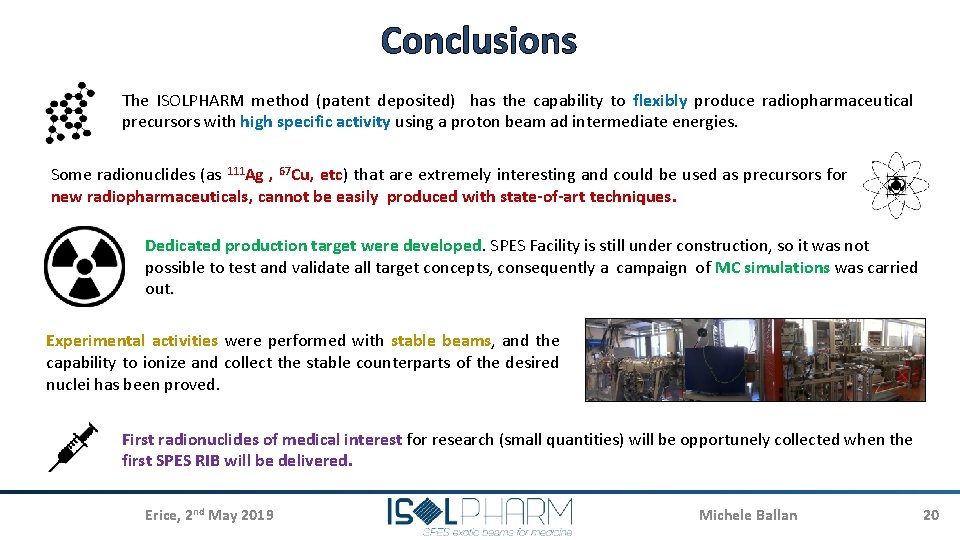
Conclusions The ISOLPHARM method (patent deposited) has the capability to flexibly produce radiopharmaceutical precursors with high specific activity using a proton beam ad intermediate energies. Some radionuclides (as 111 Ag , 67 Cu, etc) that are extremely interesting and could be used as precursors for new radiopharmaceuticals, cannot be easily produced with state-of-art techniques. Dedicated production target were developed. SPES Facility is still under construction, so it was not possible to test and validate all target concepts, consequently a campaign of MC simulations was carried out. Experimental activities were performed with stable beams, and the capability to ionize and collect the stable counterparts of the desired nuclei has been proved. First radionuclides of medical interest for research (small quantities) will be opportunely collected when the first SPES RIB will be delivered. Erice, 2 nd May 2019 Michele Ballan 20
Thank you for your kind attention! Erice, 2 nd May 2019 Michele Ballan 21
- Slides: 21