
Dr M Salman Shah M B B S
Dr. M. Salman Shah M. B. B. S. , MD,
Community Medicine?
“Speciality which deals with populations and comprises those doctors who try to measure the need of population, both sick and well, who plan and administer services to meet those needs, and those who are engaged in research and teaching in the field”
“The test of any civilization is the measure of consideration and care which it gives to its weaker member”
Comprehensive Health Care • Provision of integrated preventive, promotive and curative services from “womb to tomb” to every individual residing in a defined geographical area.
Background • Standard of health care not upto community expectations • Health care not equally distributed between & within countries • Health services favoured the privileged • Fundamental right to health denied to millions of poor people
After Alma –Ata (USSR) 1978 • • Increasing importance to social equity Role of community participation Importance of political will new approaches in health care
WHA in May 1977 resolved • The main social targets of govt. and WHO in coming decades should be attainment by all citizens of the world by year 2000 of a level of health that will permit them to lead a socially & economically productive life
Alma Ata conference 1978 • In September, 1978, a joint WHOUNICEFInternational conference was held at Alma Ata. • The Alma Ata declaration reaffirmed that the goal was HEALTH FOR ALL and the way to get there was through PRIMARY HEALTH CARE. • PHC was not just a package of services, or a level of care or an 8 point programme, • It was a philosophy that placed people’s Health in People’s Hand.
New approach • Integrates at community level all factors needed to improve health status • Presupposes services that are simple & efficient with respect to cost, technique & organization • Alma Ata has called upon all govt to formulate national strategies , plans and policies to launch & sustain PH care as part of their health system
“Essential health care based on practical, scientifically sound & socially acceptable methods & technologies made universally accessible to individuals & families in their community through their full participation & at a cost that the community & country can afford to maintain at every stage of their development in spirit of self determination”.
Elements of Primary Health Care • Education concerning prevailing health problems & methods of preventing & controlling them • Promotion of food supply & proper nutrition • Adequate safe water supply & basic sanitation • MCH including FP • Immunization • Prevention & control of localy endemic diseases • Appropriate treatment of common ailments • Provision of essential drugs
Principles of Primary Health Care Equitable distribution • Health services must be equally shared by all • Shift the centre of gravity of health care from urban to rural areas • Bring health care as near to their homes as possible
Principles of Primary Health Care Community participation • For health services to run well , cooperation is needed from Govt. as well as community for • planning, • implementation & • maintainence • manpower, money and materials
Principles of Primary Health Care Intersectoral coordination • Components of health care cannot be provided by health sector alone. • It includes other sectors like animal husbandry, food industry, education, housing, public works, communication • Cooperation needs certain legislation, allocation of resources & strong political will
Principles of Primary Health Care Appropriate technology • technology, scientifically sound, adaptable to local needs, acceptable to those for whom it is used and can be maintained by people themselves at a cost that the country & community can afford
Primary Health care is Health by the people, placing people’s health in people’s hands
LEVELS OF HEALTH CARE Primary Health Care • First level of contact between the individual and the health system where essential health care is provided. • Majority of health complaints and problems can be satisfactory dealt. • Care is provided by primary health centre & subcentres.
LEVELS OF HEALTH CARE Secondary level More Complex problems are dealt CHC & District Hospital Tertiary level Offers super speciality care Regional & central Hospitals Supports and Compliments the actions taken by lower levels
Primary Health Care in India Village level Sub centre level Primary Health Centre Community Health Centers
Village Level • • Village Health Guides Local Dias AWW ASHA
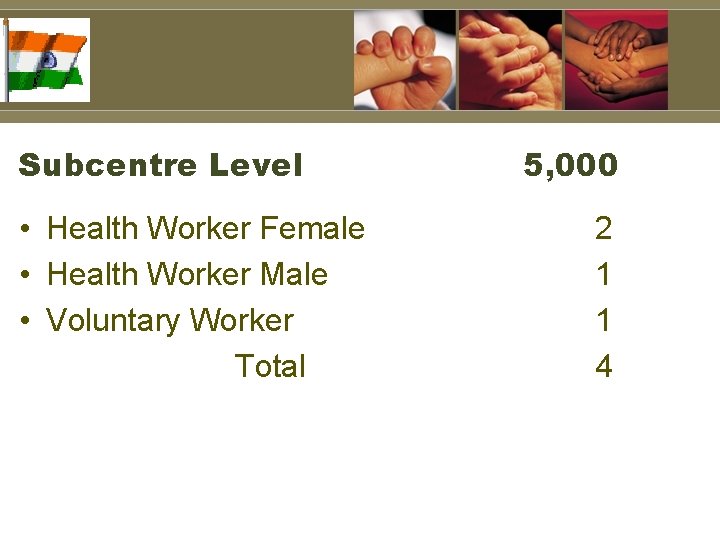
Subcentre Level • Health Worker Female • Health Worker Male • Voluntary Worker Total 5, 000 2 1 1 4
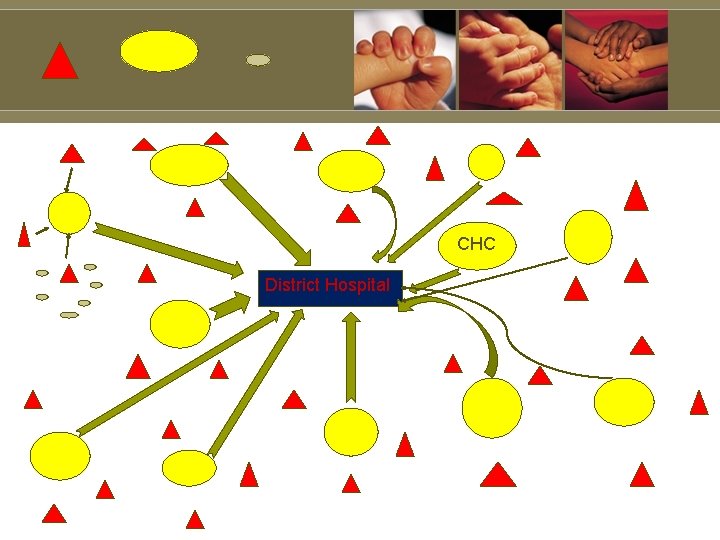
، CHC District Hospital
Subcentre Level (IPHS) • • Antenatal , intranatal , postnatal care Child Health Care Family planning and Contraception Counselling & referral for MTP Adolescent Health Care Assistance to School health Services Water Quality Monitoring Promotion of Sanitation
Subcentre Level (IPHS) • • • Field Visits Community need assessment Curative services for minor ailments Training of TBA / ASHA Co-ordination of AWW, ASHA, ANM National Health Programmes
Primary Health Centre • • • Medical Officer AYUSH practioner Accountant Pharmacist ANM HW (F) Health Educator Health assistant Others » Total 30, 000 3 1 1 2 5 1 1 2 9 25
Primary Health Centre (IPHS) Objectives Comprehensive primary Health care to Community To achieve and maintain an acceptable standard of quality of care To make services more responsive and sensitive to the needs of the community
Primary Health Centre (IPHS) 1. Medical Care OPD (4+2) 24 hrs Emergency IPD ( 6 Beds)
Primary Health Centre (IPHS) 2. Maternal and Child Health Care ANC, Intranatal , post natal care 24 hrs services for Normal Delivery Assisted delivery (forceps & vaccum) Newborn care Essential Newborn Care Facilities for Neonatal resuscitation Management of neonatal hypothermia & jaundice
Primary Health Centre (IPHS) Care of the Child emergency care including IMNCI Care of routine childhood illness Promotion of exclusive breastfeeding Immunization
Primary Health Centre (IPHS) • • • Family planning services (referral for infertility) MTP (MVA technique) HE for prevention & management of RTI/STI Appropriate & prompt referral Record of vital events Manpower training Basic laboratory services Monitoring & supervision Selected surgical procedures
CHC (IPHS) 80, 000 -1, 20000 30 bedded Staff 64 Specialist in surgery, medicine, Obst & Gynae, Pediatrics X-ray & lab services Blood storage facility Referral services
CHC (IPHS) 1. Care of routine & emergency cases in surgery I&D, surgery for Hernia & Hydrocele, appendicitis, heamorrhoids, fistula Emergencies ( Intestinal obstruction, haemorrhage) 2. Care of routine & emergency cases in medicine 3. 24 hrs delivery services 4. Emergency obst. care (Caesarian sections)
• FP services (laparoscopic services) • New born care • Nasal packing, tracheostomy, foreign body removal etc. • National Health Programmes
the needs of the many must prevail over those of few
Thank You
- Slides: 37