
Dr Laurie Jo Moore MD ABPN FRANZCP Dr

Dr Laurie Jo Moore, MD, ABPN, FRANZCP Dr Mila Goldner-Vukov, MD, Ph. D, FRANZCP Cairns Base Hospital MHU
• Definition • Racism in Medicine and Psychiatry • Psychological theories of racism • Obscuring factors • Sociogeny of Frantz Fanon
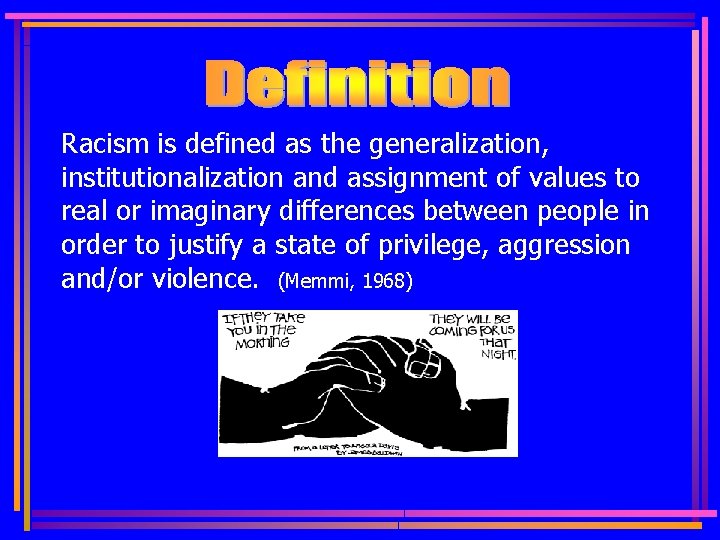
Racism is defined as the generalization, institutionalization and assignment of values to real or imaginary differences between people in order to justify a state of privilege, aggression and/or violence. (Memmi, 1968)
• Racism is poorly understood as the psychological phenomenon of prejudice. • Prejudice is a psychological state, feeling or attitude felt and/or expressed as an antipathy based on erroneous inflexible generalizations. (Allport, 1954)
• Racism is much more than prejudice. • Racism is associated with the overt and covert forceful establishment and maintenance of power by one social group over another. (Wellman, 1977)
• It includes the ideas and actions of individuals, the goals and practices of institutions, the cultural symbols, structures and myths that accentuate the real or imaginary differences of race, and validate the absolute, differential and spurious nature of these beliefs to justify and maintain inequity, exclusion or domination. (Bulhan, 1985)
• Psychiatry has had an ethnocentric, racist heritage and was used as a vehicle of implicit and overt racism (Fernando, 1991; Thomas & Sillen, 1972) • Socially disadvantaged people have unequal access to care, use of services, and poorer clinical outcomes (Moore, 2000). • When socio-economic variables are controlled rates of mental disorders in Blacks are no higher than in other groups. (Williams, 1986)
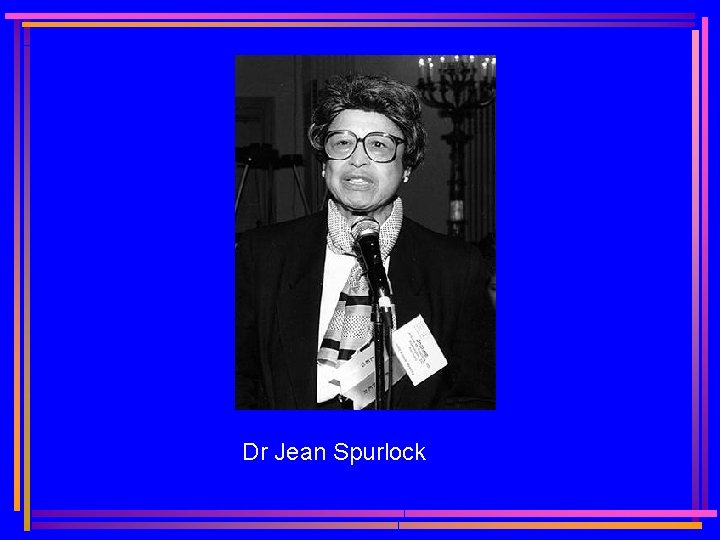
Dr Jean Spurlock
Racism in Psychiatry US, UK (Moore, 2000) • US and UK ethnic minorities are overdiagnosed with schizophrenia and paranoid disorders and under-diagnosed with affective disorders. • This has been attributed to faulty assessment rooted in institutional racism. • Loring and Powell study: 290/488 psychiatrists, vignettes of 2 patients, altering sex and race. Their results confirmed attribution of violence, suspiciousness and dangerousness to Blacks.

Dr Suman Fernando UK
Racism and Psychiatry US (Moore, 2000) • Racial stereotypes influence the access and process of psychotherapy. Fewer Blacks are accepted for psychotherapy, they are assigned to less experienced therapists and seen less often. • In community care Blacks are less likely to be admitted, received care later, have shorter and less intensive care, and receive higher doses of neuroleptics.
While many psychiatrists have failed to see beyond the dominant cultural paradigm, others have worked to explain its roots.

Psychodynamic Interpretations • Psychoanalysts describe racism as a set of beliefs that arise from the deepest level of our lives, from the fabric of assumptions we make about life and the patterns of our fundamental social activities. • Racist beliefs are remnants of infantile wishes incorporated into development within the context of racist cultural myths such that people are prone to find an outlet for their fantasies about dirt, property, power and sexuality in racist beliefs. (Kovel, 1984; West, 1967)

Dr Joel Kovel
Psychoanalytic Interpretations Kovel describes three categories of racists: 1. 2. 3. dominative who act out their bigotry, aversive who exhibit avoidance behaviours, and those who do not reveal their racist tendencies except as unconscious aspects of mass tendencies. • Racism is universal and not confined to any one race. • In British, European and American societies it has been used for centuries as a tool to stabilise society. (Kovel, 1984)
Psychoanalytic Interpretations • There is a fundamental need to split, to objectify, to blame and to dehumanise the object of racial hatred. • Manichaeism was a religious philosophy taught by the Persian Manicheus (3 rd-7 th Centuries) who contended the world was divided into good (light, God, soul) and evil (darkness, Satan, body).
Psychoanalytic Interpretations • Building on this, Pinderhughes hypothesised a universal drive to dichotomise based on biological, social and psychological factors. • We bond affiliatively to certain ideas and people and aggressively and divisively to others. He called this: Paired differential bonding. (Pinderhughes, 1982)

Dr Charles Pinderhughes
Psychoanalytic Interpretations In every violent act there is a paranoid process: the perpetrator externalises or projects onto the object unwanted parts of the self, perceives the victim as an enemy threatening his existence and justifies destruction as bringing the victim to justice. (Pinderhughes, 1972)
Psychoanalytic Interpretations • Violence cannot occur in an introjective relationship when the would-be victim is perceived as an acknowledged and valuable part of the self. (Pinderhughes, 1972)
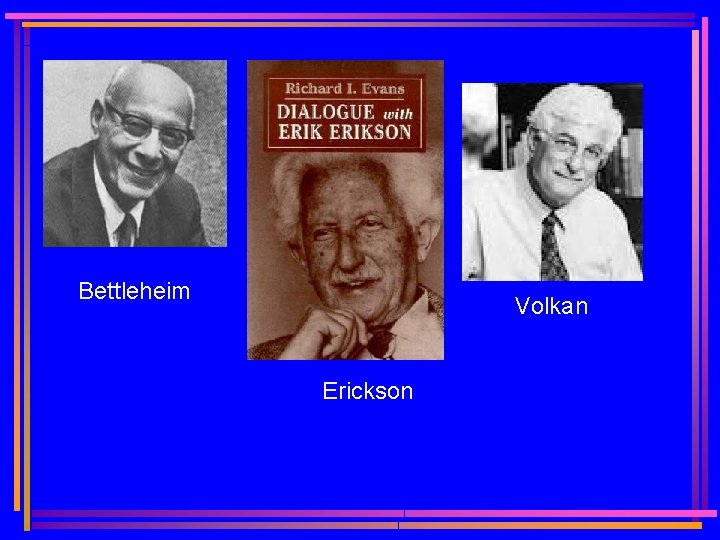
Bettleheim Volkan Erickson
Identity and the Need for Enemies • Bettleheim and Erickson stressed the importance of identity in the development of racism and said identity diffusion was lessened with the expression of intolerance toward an outgroup. • Bettleheim believed hostility to outgroups resulted from childhood deprivation and anxiety about the future. Once an outgroup was blamed, people continued to defend against unwanted internal feelings by maintaining their attack. (Bettleheim, 1960; Erickson, 1950, 1964)
Identity and the Need for Enemies • Bettleheim felt vulnerability to blaming outgroups was related to lack of ego strength and inadequate internal control. • He and many others stress that ethnic intolerance is related to the lack of opportunity for social advancement and is increased in times of economic distress. (Bettleheim, 1960)

Identity and the Need for Enemies • Volkan contends that we need enemies to establish our identity. He claims the need for enemies arises with stranger anxiety at 6/12 age and is accompanied by an upsurge of aggression that leads to displacement, establishing a precursor for the individualised idea of an enemy. Like Bettleheim and Erikson he feels we need enemies as external stabilisers for our sense of identity and inner control. (Volkan, 1988)
Identity and the Need for Enemies • War participants describe their motivation as arising from a need to preserve their lives and lands (territorialism) and a sense of obligation in belonging to ethnic and national groups (ethnic identity). The later was sufficient for some people by itself. (GAP, 1987)
Identity and the Need for Enemies • Ethnic identity is felt to be based on Bion’s basic assumptions that the fight/flight response repeats some of the dynamics of the early mother-child relationship, and that this facilitates identification with the familiar and hostility toward strangers. Large groups are felt to operate on the same assumptions. (GAP, 1987)
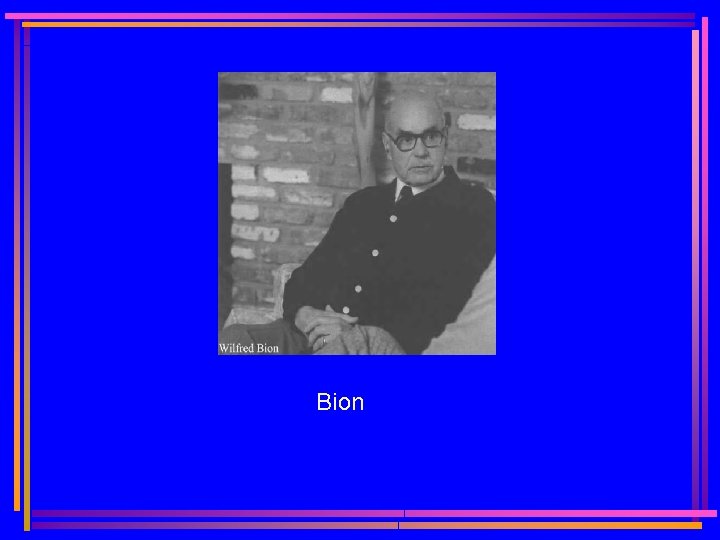
Bion
Identity and the Need for Enemies • Under stress individuals and groups react constructively, but they may regress to early-life modes of reaction including dichotomising and splitting the social world into good and bad. Under stress people overvalue sameness within their group and overemphasise differences between them and their adversaries. (GAP, 1987)
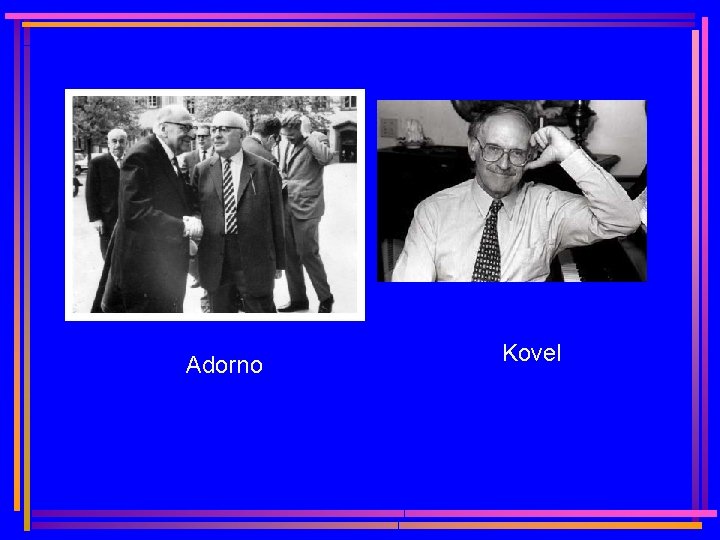
Authoritarianism fosters Hatred • Adorno described bigots as almost invariably occupying subordinate positions but idealising external power. They harbour a hatred derived from the terror of submission mixed with love and keep this hatred unconscious by projecting it onto others. (Adorno & Frenkel-Brunswki, 1950)
Adorno Kovel
Authoritarianism fosters Hatred • Racists have rigid characters, see things as unalterably true, rely on external stability and worship the past. When the fabric of social order is disrupted, bigots rise up with a frantic rage that is most pronounced toward the objects of prejudice who reject their debased role. (Adorno & Frenkel-Brunswki, 1950)
Authoritarianism fosters Hatred • The dominative racist is irrationally and profoundly dependent on the object of his hatred. He cannot leave him alone. Hate implies a kind of love, at least an inability to rid the mind of the obsession. These obsessions are invariably tinged with sexuality. There is a preoccupation with, a deadly curiosity about, the sexual excesses of the hated group, etched in the imagination by the acid of harsh moralism. (Kovel, 1984)
Authoritarianism fosters Hatred • The dominative racist must keep the object of his hatred oppressed, but also see that this person enacts those traits the bigot needs to see in him, needs to vicariously enjoy and needs to punish. (Kovel, 1984)
Racism as a problem of the human character • Reich (1970) felt that Fascism was a politically organised expression of racial hatred. • He felt that racism was a problem of the human character. • In his analysis, he saw that the core of Fascist theory was a mortal fear of natural sexuality.
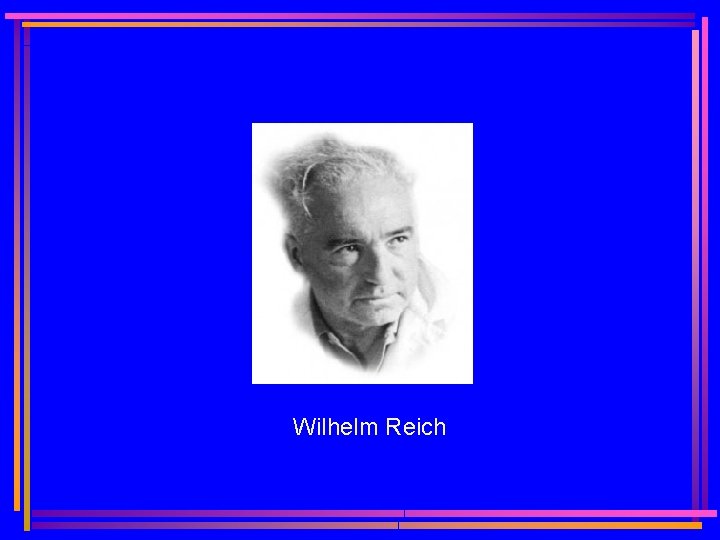
Wilhelm Reich
Racism as a problem of the human character • Reich (1970) emphasised the fundamental importance of sexuality in the development of autonomy and selfhood. • He believed that sexual repression was the most important means of controlling people in an authoritarian patriarchy.
Racism as a problem of the human character • Reich (1970) claimed that suppression of primitive material needs incited rebellion, but • sexual repression caused people to doubt themselves, to be afraid of freedom, to be conservative and, in a word, reactionary. • He felt repressed sexuality changed the structure of economically oppressed people in such a way that they acted, felt and thought in ways contrary to their own interests.
1. Lack of social perspective and ignorance about socioeconomic oppression 2. Psychology of inequality 3. Ethnocentrism 4. Manipulation by totalism
• Society is stratified by race, class & gender. • Resources are distributed along these hierarchies by various forms of exclusion esp economic and political. • Health and well-being are inversely related to socio-economic class. (U’Ren, 2011)
• Socioeconomic oppression is the major vehicle of maintaining inequality. • It is poverty that contributes to violence and illness not race. • Dominants confound the understanding of this and use the consequences such as poverty, violence and self-destructive behavior to justify inequality.
• • • For every 1% rise in unemployment, there is a: 2% rise in mortality, 5 -6% rise in homicides, 3 -4% rise in 1 st psychiatric admissions, 5% rise in infant mortality and 2% rise in cardiovascular deaths. (Kovel, 1984)
Effects of socio-economic oppression • Poverty is associated with: an increase in death by all causes, 2 x > risk of mental illness, an increase in social, interpersonal and intrapersonal violence and > rates of incarceration. • The effects of poverty do not differ by sex, age, race or history of psychiatric disorder. (NIMH ECA, Bruce) • These US findings are consistent with those in UK (Fernando, 1988) , South Africa (Randall, WHO), and AU (Freemantle et al, 2006), (Glasson et al, 2005; Rothstein et al, 2007), (Hunter et al, 2012). (Trewin & Madden, 2005), (Hunter & Milroy, 2006).
Effects of socio-economic oppression • Every social order dispenses rights unequally. An oppressive social order deepens the inequity in how it dispenses life and death. Blacks in the US and South Africa die earlier, suffer greater poverty, disease and dislocation. They have higher rates of incarceration, execution and industrial accidents. Their space, time, mobility and bonding are curtailed, exploited and abused. The consequence is greater physical, social and psychological death. (Bulhan, 1985)
• Dominant groups describe and order reality intentionally to maintain their position. • Dominant groups promote ignorance about inequality as a tool to confuse and disempower people. • Dominant groups support belief systems that incorporate myths that legitimize their dominance, including overall cultural outlook, philosophy, morality, social theory, and science. • Dominants impede the development, freedom and action of subordinates and minimize the existence of inequality. (Miller, 1978)
• “Ethnocentric” means that a person or group believes their view of the world is central to all reality. • Pure ethnocentrism is the denial of cultural difference. An individual at this level knows little or nothing about the culture of subordinate groups. (Bennett, 1993) • Described as “color blindness” implying that when dominants look at subordinates they do not see them with any depth as human beings with their own identities, history, culture, spiritual and/or socioeconomic realities. (Thomas & Sillen, 1972)
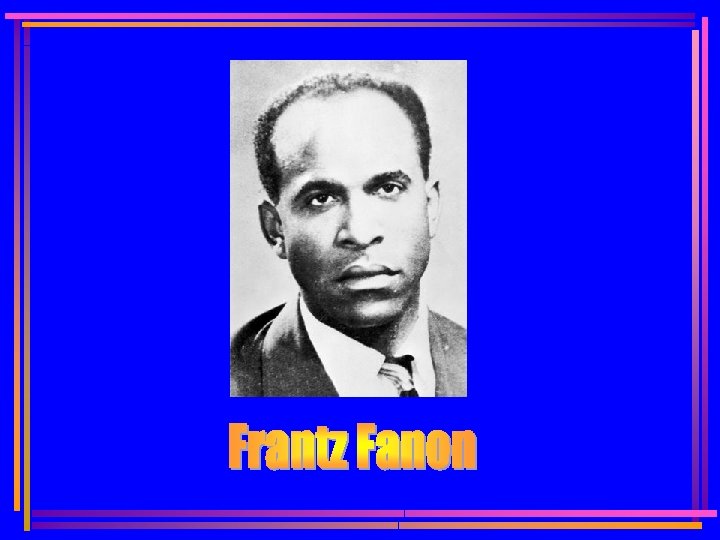
• Fanon reassessed the basic assumptions of psychiatry and felt the precepts of psychoanalysis were culture-bound. • He questioned Freud’s ontogenic perspective that emphasised biological development and Jung’s phylogenetic theories that emphasised evolutionary development. • He stressed, instead, the importance of social forces in shaping human lives. • (Bulhan, 1985)
The Sociogeny of Frantz Fanon • Fanon felt it was not possible to understand Black people without reference to social, economic, cultural and historical contexts. • He felt alienation was a key principle. Alienation was first a result of socio-economic violence and second the internalisation of social inequality and violence. (Bulhan, 1985)
The Sociogeny of Frantz Fanon • Fanon defined abnormality in a way that emphasised the salience of human relations and liberty. A patient was someone whose liberty, will and desires had been broken by the internalisations of social conflict and impositions of liberty such that the self was divided. Psychopathology was a sociohistorical and cultural conflict manifesting in the individual with a low threshold. (Bulhan, 1985)
The Sociogeny of Frantz Fanon • Fanon emphasised the necessity of recognition in development. Through social praxis and socially useful behavior people transform the world and themselves and fulfil their needs for self-determination. Without essential reciprocal recognition and relatedness and the freedom for selfdetermination, humans have no identity, no self-worth and no dignity. Denying people the right to confirm themselves, dooms them to wretched servitude.
The Sociogeny of Frantz Fanon • Fanon unravelled the psychology of the oppressed. He said first and foremost oppression is a problem of violence and it was this aspect that was most prone to be mystified. • He felt that freedom was not given, but must be taken and that once freedom was taken, it could not be regained without risking life. • Oppressors owe their power to the fear of death.
The Sociogeny of Frantz Fanon • In submitting to oppression, one preserves biological life, but suffers social and psychological death as long as one serves the interests of the oppressor. • Oppression violates all aspects of existence: time, energy, mobility, bonding and identity. • These are the foundations of human psychology and any oppression is a question of violation of at least one of these dimensions. ( (Bulhan, 1985)
The Sociogeny of Franz Fanon • Fanon proposed a theory of identity development under oppression: • 1 st capitulation with assimilation, • 2 nd reactive repudiation and romanticising of the indigenous culture, • 3 rd synthesis and commitment to change. (Bulhan, 1985)
Fanon said that the antidote to alienation was creative social praxis, organised conscious and collective social action. (Bulhan, 1985)
Conclusions • Racism is kindled by dominant cultural beliefs that obscure reality and promote simplistic beliefs that play on people’s ignorance, fears and insecurities. • To understand change racism, we need to understand the obscuring factors and the nature of our human vulnerabilities.
Conclusions • Authoritarianism clearly fosters the need to hate. • Authoritarian societies rely on the oppression of women and the repression of natural sexuality. • Freedom is not given and we must be vigilant to fight for and protect our freedom at all times.
Conclusions • Racism is socially and culturally determined. Social forces take advantage of human vulnerabilities to perpetuate racism and maintain social dominance. This happens in simple and complex ways that elude the awareness of even the most educated professions. Our unconscious participation in racist practice as psychiatrists is in part the result of our ignorance and lack of awareness.
Conclusions • Psychiatry is in a unique position to contribute to correcting the ignorance and ethnocentrism surrounding racism. • We need to present a politically sophisticated and comprehensive understanding of racism in psychiatric education. We need to develop and teach ethnorelativity that respects the beliefs and practices of other ethnicities. • As a discipline we must transform our theory and practice and, as Fanon suggests, devote our therapeutic practice to the restoration of freedom and liberty.

of the meaning of we, of you we found ourselves reduced to I and the whole thing became ironic and terrible: we were trying to live a personal life and, yes, that was the only life we could bear witness to. But the great dark birds of history screamed and plun into our personal weather. They were headed somewhere else but their beaks an pinions drove along the shore, through the rags of fog where we stood, saying I.

- Slides: 65