
Dr Kamel Ben Naceur Paris 21 September OECDIEA
Dr. Kamel Ben Naceur Paris, 21 September © OECD/IEA 2016
Context n n n Air pollution is the fourth largest human health risk 3. 5 million premature deaths are linked to energy poverty due to the use of biomass for cooking and kerosene for lighting 3 million premature deaths are linked to outdoor air pollution, mostly in cities Many of its root causes – and cures – are in the energy sector The majority of air pollutant emissions comes from the energy sector, mainly from fuel combustion Currently only 8% of global energy production is combustion free: more than half of the rest has no effective technology in place to control emissions No country in the world has solved the air pollution problem completely, but many are taking important policy steps Can the energy sector step up efforts to combat this global public health crisis? © OECD/IEA 2016
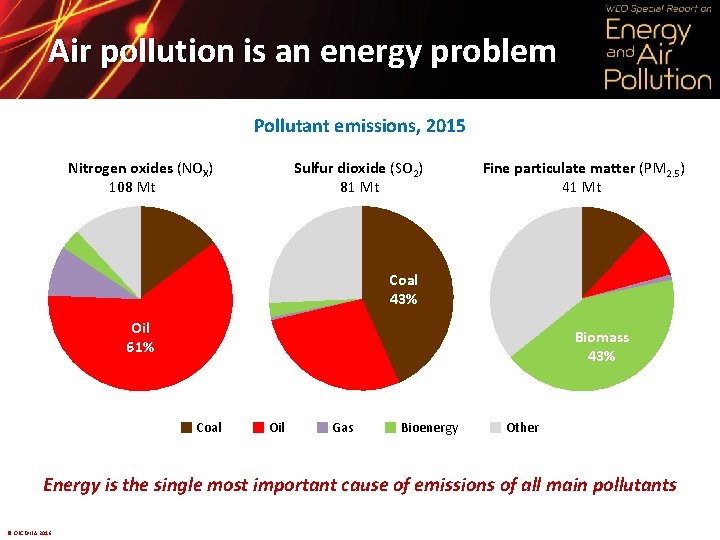
Air pollution is an energy problem Pollutant emissions, 2015 Nitrogen oxides (NOX) 108 Mt Sulfur dioxide (SO 2) 81 Mt Fine particulate matter (PM 2. 5) 41 Mt Coal 43% Oil >99% 61% >99% Coal Energy-related Oil Gas 85% Biomass 43% Non-energy Bioenergy Other Energy is the single most important cause of emissions of all main pollutants © OECD/IEA 2016
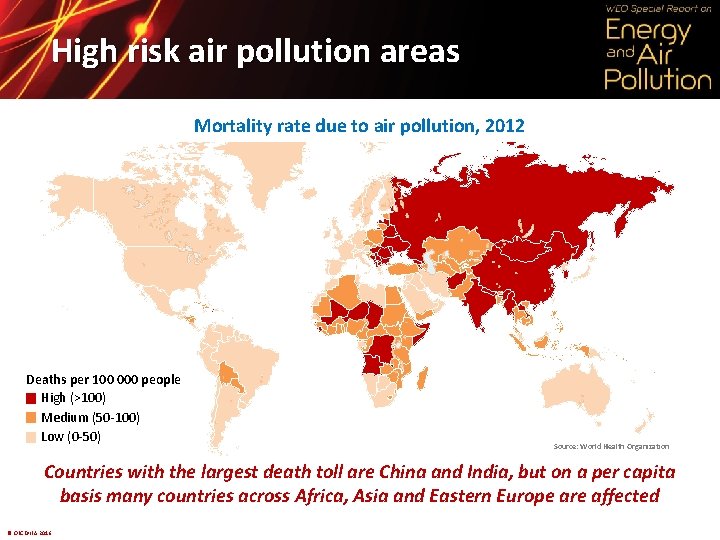
High risk air pollution areas Mortality rate due to air pollution, 2012 Deaths per 100 000 people High (>100) Medium (50 -100) Low (0 -50) Source: World Health Organization Countries with the largest death toll are China and India, but on a per capita basis many countries across Africa, Asia and Eastern Europe are affected © OECD/IEA 2016
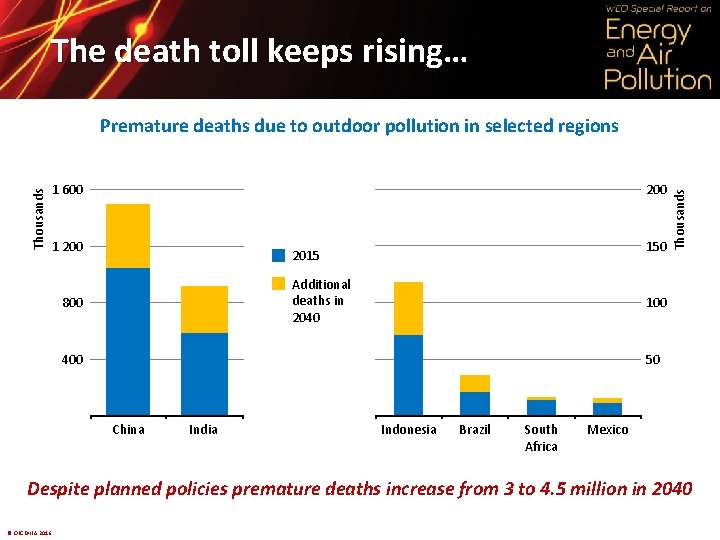
The death toll keeps rising… 1 600 200 150 2015 Additional deaths in 2040 800 Thousands Premature deaths due to outdoor pollution in selected regions 100 400 50 China India Indonesia Brazil South Africa Mexico Despite planned policies premature deaths increase from 3 to 4. 5 million in 2040 © OECD/IEA 2016
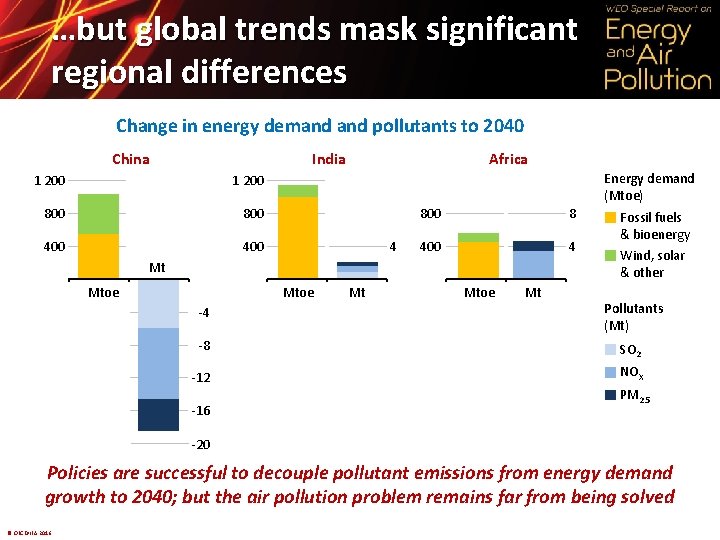
…but global trends mask significant regional differences Change in energy demand pollutants to 2040 China India 1 200 800 400 Africa Energy demand (Mtoe) 4 800 8 400 4 Mt Mtoe Mt Fossil fuels & bioenergy Wind, solar & other -4 Pollutants (Mt) -8 SO 2 -12 NOX -16 PM 2. 5 -20 Policies are successful to decouple pollutant emissions from energy demand growth to 2040; but the air pollution problem remains far from being solved © OECD/IEA 2016
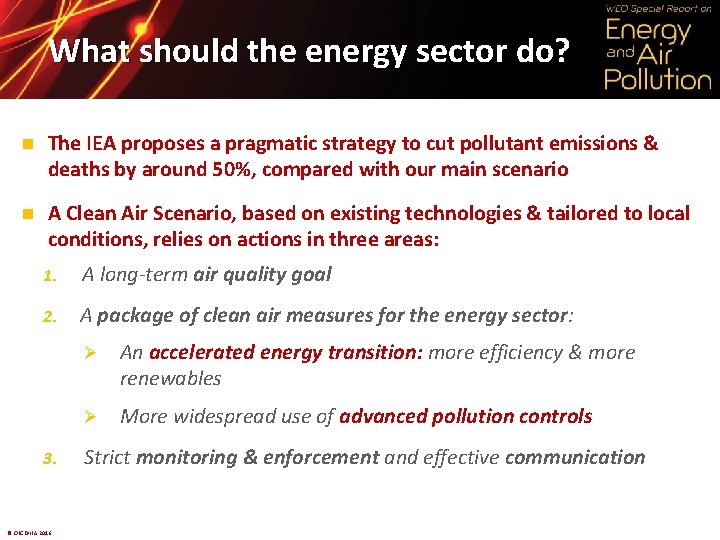
What should the energy sector do? n The IEA proposes a pragmatic strategy to cut pollutant emissions & deaths by around 50%, compared with our main scenario n A Clean Air Scenario, based on existing technologies & tailored to local conditions, relies on actions in three areas: 1. A long-term air quality goal 2. A package of clean air measures for the energy sector: 3. © OECD/IEA 2016 An accelerated energy transition: more efficiency & more renewables More widespread use of advanced pollution controls Strict monitoring & enforcement and effective communication
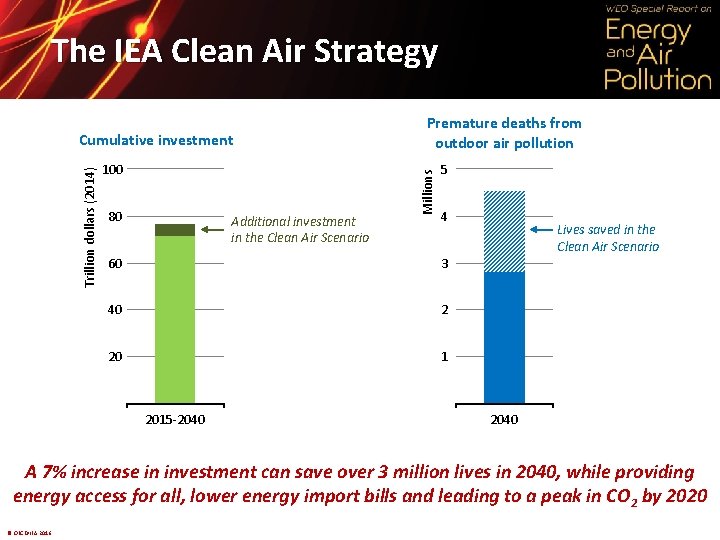
The IEA Clean Air Strategy 100 80 Additional investment in the Clean Air Scenario Millions Trillion dollars (2014) Cumulative investment Premature deaths from outdoor air pollution 5 4 60 3 40 2 20 1 2015 -2040 Lives saved in the Clean Air Scenario 2040 A 7% increase in investment can save over 3 million lives in 2040, while providing energy access for all, lower energy import bills and leading to a peak in CO 2 by 2020 © OECD/IEA 2016
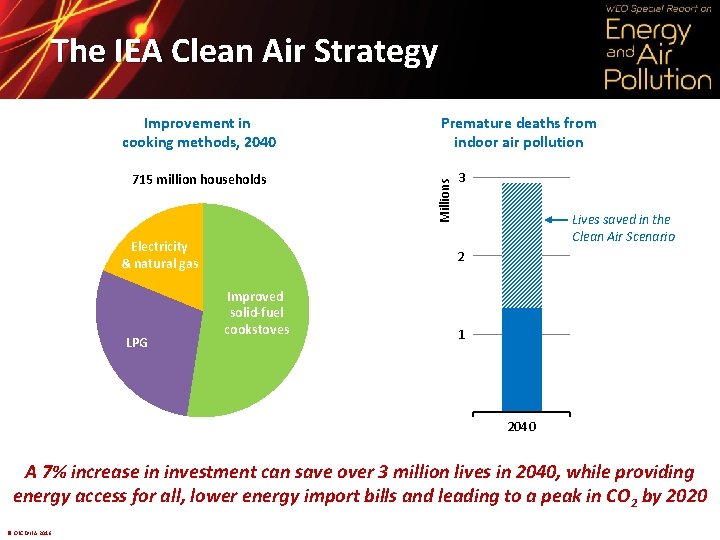
The IEA Clean Air Strategy 715 million households Electricity & natural gas LPG Premature deaths from indoor air pollution Millions Improvement in cooking methods, 2040 3 Lives saved in the Clean Air Scenario 2 Improved solid-fuel cookstoves 1 2040 A 7% increase in investment can save over 3 million lives in 2040, while providing energy access for all, lower energy import bills and leading to a peak in CO 2 by 2020 © OECD/IEA 2016
Conclusions n The impacts of air pollution are concentrated in fast-growing Asia & in Africa, but no country has solved the problem entirely n The overall death toll still rises, despite post-COP decarbonisation policies & targeted pollution measures that mitigate pollution trends n IEA’s Clean Air Strategy cuts 2040 pollutant emissions & premature deaths by around half, with only a 7% increase in investment n A well-designed air quality strategy will have major co-benefits for other policy goals, including energy access & climate change n IEA will continue to promote integrated policy approaches as it strengthens its role as a global hub for clean & efficient energy © OECD/IEA 2016
- Slides: 10