
Dr Huda Gaber Increased psychomotor agitation restlessness and

Dr/ Huda Gaber
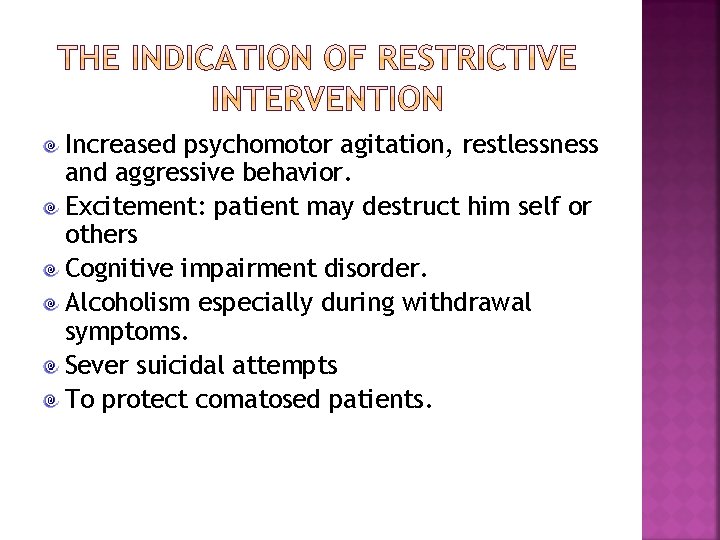
Increased psychomotor agitation, restlessness and aggressive behavior. Excitement: patient may destruct him self or others Cognitive impairment disorder. Alcoholism especially during withdrawal symptoms. Sever suicidal attempts To protect comatosed patients.
To protect patient and other from any aggressive or violent action. To keep a patient from falling out of bed or from sliding out of his chair. To protect patient from his own actions such as pulling out his intravenous or oxygen tubing.
WHAT ARE RESTRAINTS? Restraints are any method, physical or mechanical device, materials or equipment attached or adjacent to the patient’s body that her or she cannot easily remove which restricts a person’s movement, physical activity, or normal access to his or her body.
Is the limitation of patient mobility to specified area or purpose of safety or behavior management.
A mechanical restraint is any manual method, physical, or mechanical device, material, or equipment that immobilizes or reduces the ability of a patient to move his or her arms, legs, body or head freely.
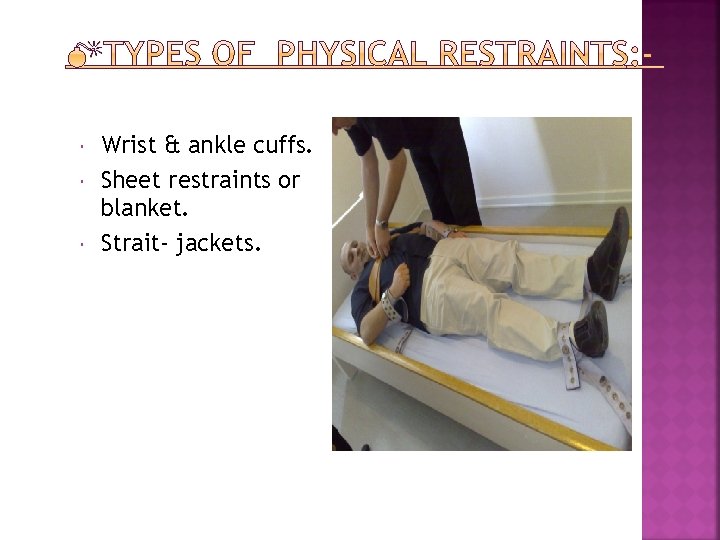
Wrist & ankle cuffs. Sheet restraints or blanket. Strait- jackets.
Wrist restraints are used to restrict arm movement may be used without ankle restraints just to remind the patient not to lessen a dressing or disturb an I. V tube. Three and four point restraints are applied to wrist and ankles in bed. When five point restraints are used, all extremities are secured another restraint is placed a cross the chest.
A drug or medication, when it is used as a restriction to manage the patient’s behavior, restrict the patient’s freedom of movement, or to impair the patient’s ability to appropriately interact with their surroundings.
Diazepam - oral 0. 2 mg - 0. 4 mg/kg (Max 10 mg/dose ) If oral medication not possible: Haloperidol - IM / IV 0. 1 mg - 0. 2 mg/kg (Max 5 mg/dose, usually 2. 5 mg - 5 mg/dose).
Total number of team around(6 -8)persons Restraint seclusion considered as immediate action that is taken when assault occur, 6 -8 members are needed to safety control a patients as follow: 1 - one staff member becomes the team leader to organize and direct to planned , coordinate approach. 2 - Two team member approach from each side and take control of the patient’s arm. 3 - three other staff member quickly take control of patient’s leg and head so that the patient can be carried to the room for seclusion or restraint.
1 - monitor patient for alternation in physical or cognitive function that might lead to unsafe behavior 2 - Get a written doctor order as soon as possible within one hour of starting the procedure 3 -Prepare the equipment needed 4 -Provide sufficient staff to assist with safe application of restraining 5 -Explain procedures, purpose and time period for the intervention to the patient in understandable and non punitive manner 6 -bring the patient to restraint room
6 -bring the patient to restraint room 7 -Place the patient in recumbent position 8 -Restraint the write wrist and left ankle and fasten the straps of the restraint to the bed frame and the reverse 9 -Provide positive reinforcement for the patient cooperation 10 -Monitor skin condition of the extremities (pulse, color, sensation and temperature) 11 -Stay with the patient 12 - Administer the needed medication
13 -Assess the patient for General condition and signs of injury Circulation and range of motion in extremities "every 15 min“ Vital signs (pulse-respiration-temperature-blood pressure) "every 2 hrs“ Nutrition and hydration Hygiene Elimination needs The pt perception toward the procedure 14 -Involve the pt, when appropriate, in making decision to move to less restrictive form of intervention or ending the procedure 15 -Remove restraint, gradually, one at a time, in four point restraint as doctor order. 16 -Document the procedure
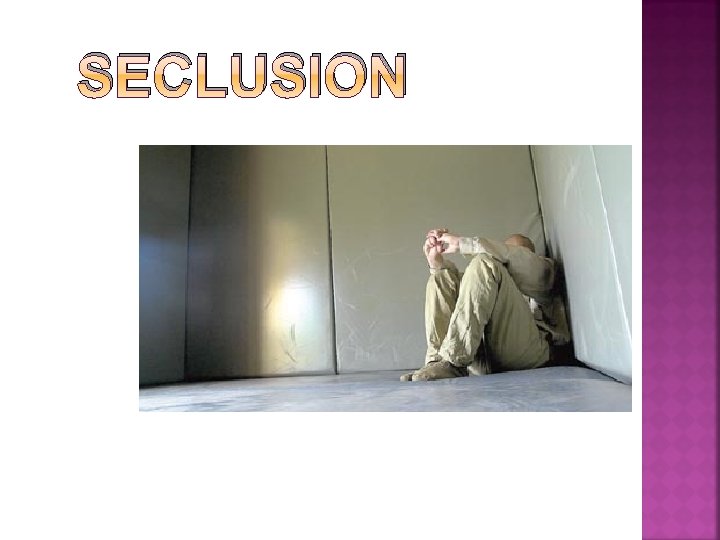
SECLUSION
Solitary containment in a fully protective environment with close supervision by nursing staff for purpose of safety or behavior management
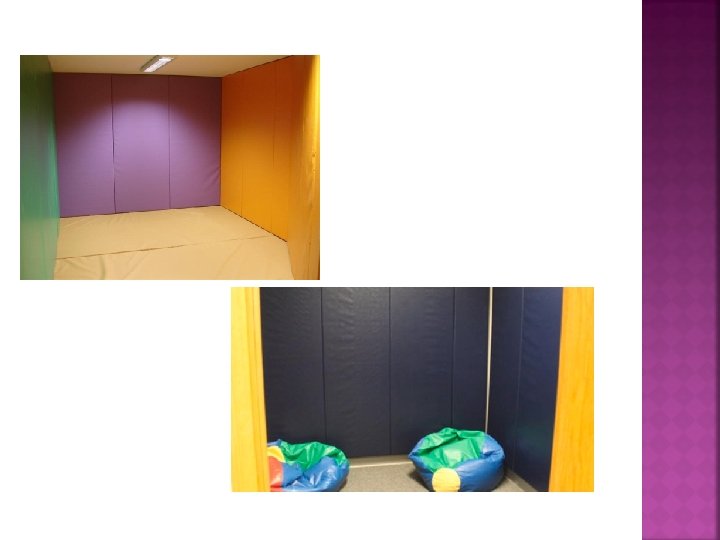
Put patient in room with closed but unlocked door Put patients in a room with locked room with matters but no linens and with limited opportunity for communications
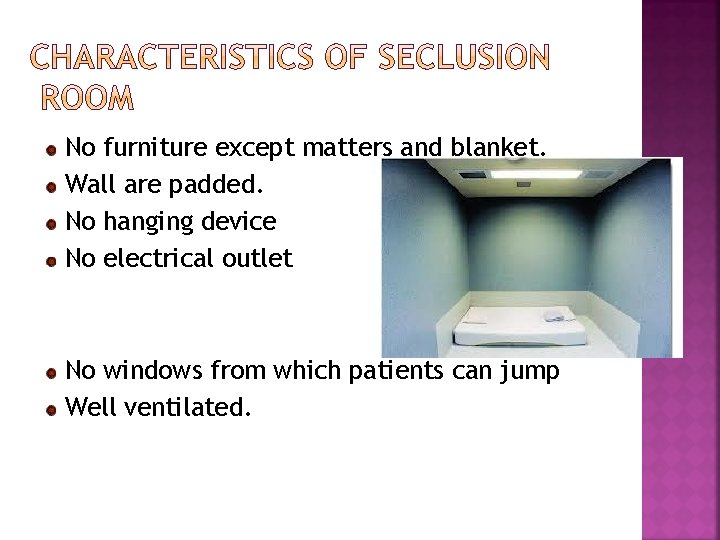
No furniture except matters and blanket. Wall are padded. No hanging device No electrical outlet No windows from which patients can jump Well ventilated.
1 -Monitor patient for alternation in physical or cognitive function that might lead to unsafe behavior 2 -Get a written doctor order as soon as possible within one hour of starting the procedure 3 -Prepare the equipment and seclusion room 4 -Provide sufficient staff to assist with the safe application of the procedure 5 -Explain procedures, purpose and time period for the intervention to the patient in understandable and non punitive terms. 6 -Place the pt in seclusion room 7 -Provide positive reinforcement for the patient cooperation 8 -Administer the needed medication as doctor order
9 - Assess the patient for: General condition and Signs of injury "at least every 1/4 hrs" Vital signs (pulse-respirationtemperature-blood pressure) "at least every 2 hrs"Nutrition and hydration Hygiene Elimination needs The patient perception of the seclusion 10 - Involve the pt in making a decision to move to less restrictive form of intervention or ending the procedure when appropriate. 11 - End the patient seclusion as doctor order 12 - Document the procedure
written orders for restraint or seclusion are limited to 4 hours for clients aged 18 years and older, 2 hours for children 9 to 17 years, 1 hour for children younger than 9 year of age. v If additional time is necessary, staff must obtain a new order from the physician or licensed independent practitioner (LIP). v A reduction in the length of seclusion or restraint time as possible is very important factor in reducing the negative effect of the procedure.

- Slides: 26