
Dr Himanshu Bhushan Jaruhar Assistant Professor Department of

Dr Himanshu Bhushan Jaruhar Assistant Professor Department of Botany S. P. D. College, Garhwa Program : B. Sc. Hons: Botany Course Plant Morphology and Anatomy Unit : Cells and differentiation Topic Cell Differentiation
Cell Differentiation • • • In multicellular organism development consist of Growth; Differentiation and Morphogenesis Growth means : 1. increase in size of cell and 2. increase in Number of cells. Differentiation : it is a successive change in forms , structure and function of cells. Differentiation occurs in those cells which either progeny of the oospore or zygote or the meristematic cells and diffrerentiated cells organizez into tissues and organs. Histogenesis: When a cells differentiated into tissues, the process is called Histogenesis. Organogenesis: When a cell differentiated to form organ the process is called organogenesis. Differentiation also refers to processes by which a cell showing heterogenicity, specialization and patterened organization from its mother cell. The meristematic cell or fertilized egg cell cytologically complex and are themselves products of differentiation. Thus to say them as undifferentiated cell is simply a convention (Harris, 1974).
Contd. The degree of differentiation and attended specialization in cells vary greatly. Some cells diverse relatively little from their precursors cell and retain the power to divide e. g. Parenchyma tissues. Others are more profoundly modified and lost all or most of their meristematic potentialities e. g. schlereids , sieve elements, laticifers , treachery elements etc. The variously differentiated cells are called mature cells in the sense that they have reached the kind of specialization and physiological stability that normally characterize them as component of certain tissues of an adult plant. According to Mc Dowell, 2001, Mature cells maybe defined as cells which has lost complete protoplast and that may resume meristematic activity when properly stimulated. The stimulation may be induced by mechanical injury, or invasive pathogen. The regaining of meristematic property of the cell is called dedifferentiation. Dedifferentiation: It is a progressive course of development that brings about a physiological change in mature cells to resume the capacity to divide and behaves as meristematic cell. Determination: It is a progressive commitment to a specific course of development that brings about a weakening or loss of capacity to resume growth (Mc Doniel, 1984 a, b; lyndon, 1988).
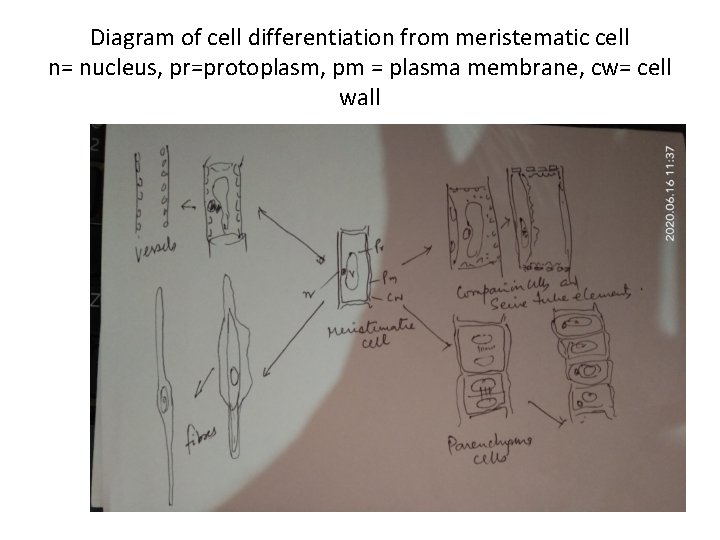
Diagram of cell differentiation from meristematic cell n= nucleus, pr=protoplasm, pm = plasma membrane, cw= cell wall
Contd. • Competence: As defined by Mc. Daniel (1984 a, b), competence refers to the ability of a cell to develop • in response to a specific signal, such as light. It implies • that the competent cell is able to recognize the signal • and translate it into a response. • During its development, a plant assumes a specific • form. Thus the plant undergoes morphogenesis (from • Greek words for shape and origin). The term commonly • is used with reference to both external form and internal • organization, and just like differentiation, morphogenesis • is revealed at all levels of organization, from cell components to whole plants.
Cellular Changes in Differentiation • • During differentiation, histologic diversity results from changes in the characteristics of individual cells and from alterations in intercellular relationships. The common features of more or less differentiated cells, including the structure and function of individual cell components, are described in Chapters 2 and 3. The changes in cell wall structure during cell differentiation are considered in Chapter 4. Differential increase in thickness of primary and secondary cell walls, changes in cell wall texture and chemistry, and development of special sculptural patterns introduce d One of the Early Visible Changes in Differentiating Tissues Is the Unequal Increase in Cell Size Some cells continue to divide with small increase in size, whereas others cease dividing and enlarge considerably (Examples of differential growth in cell size are found in the elongation of procambial cells and lack of similar elongation in the adjacent parenchyma cells of pith and cortex; elongation of protophloem (first formed) sieve elements in roots, in contrast to the adjacent pericyclic cells that continue to divide transversely differences among cells.
Contd. • widening of vessel elements in contrast to the surrounding cells that remain narrow size differences between two adjacent cells may result also from asymmetric, or unequal, cell divisions, which generate cells with different fates (Gallagher and Smith, 1997; Scheres and Benfey, 1999). For example, during pollen formation, an asymmetric cell division produces a larger tube, or vegetative, cell and a smaller generative cell (Twell et al. , 1998). In some plants, root hairs develop from cells that are the smaller of two sister cells formed by the asymmetric division of a protodermal cell
Contd. • • • . Unequal divisions also occur in the formation of stomata. The increase in cell size may be relatively uniform along all diameters, but frequently the cell enlarges more in one direction than in others. Such cells may become strikingly different in shape from their meristematic precursors (long primary phloem fi bers, branched sclereids). Many, however, become modifi ed in a more moderate manner by increasing the number of cell facets but retaining a polyhedral shape (Hulbary, 1944). The predominant cell arrangement in a tissue may be determined by the growth form of its meristem (rib meristem, plate meristem). The relative position of walls in contiguous cell rows also gives a distinctive appearance to a tissue (Sinnott, 1960). The walls at right angles to the cell row may alternate with one another in adjacent rows or may occur in the same plane.
CAUSAL FACTORS IN DIFFERENTIATION • • thigmomorphogenesis The response to mechanical interference Plant Cells Differentiate According to Position: that is, what kind of cell it will become—is determined by its final position in the developing organ. Plant hormones, or phytohormones, are chemical signals that play a major role in regulating growth and development.

• Thank you
- Slides: 10