
Dr habil Gabor JUHASZ Ph D Associate Professor
Dr. habil. Gabor JUHASZ, Ph. D. Associate Professor University of Pécs Faculty of Humanities Research Center for Social Inclusion and Social Economy
Globalization and Social Policy • • • Course name: GLOBALIZATION (GLOBALIZATION AND SOCIAL POLICY) Educational program: Social Work BA Departement: Departement of Community and Social Studies Class type: Lecture Type of the exam: Colloquium Requirements: written test + oral presentations during the semester. Course description: The main goal to evaluate the relevance and implications of globalisation in relation to both the academic study of social policy and social welfare provision and analyse how social policy contribute to and shape globalising strategiees. Main topics and questions: Globalization (definition and issues, elements); Examples of globalization; What political, economic and social factors led to globalization? Global politics; The social effects of globalization; Social globalization; Examples of social globalization; Why is social globalization important? How is globalization relevant to social policy? The main impacts of globalization on welfare states and social policy; Global social policy; The role of international governmental organizations and international non-governmental organizations in forming global social policy and regulating global capitalism. Required and recommended reading: – Beck, U. (2000), What is Globalization? Cambridge: Polity Press/Blackwell. – Deacon, B. (2000), Globalization and Social Policy: the Threat to Equitable Welfare, occasional paper 5, Geneva: UNRISD – Esping-Andersen, G. (ed. ), (1996), Welfare States in Transition: National Adaptations in Global Economies. London: Sage. – Yeates, Nicola (2001): Globalization and Social Policy. Open University. – George, V. and Wilding, P. (2002), Globalization and Human Welfare. Basingstoke: Palgrave. Lecturer: Dr. habil. Gabor JUHASZ, Ph. D. associate professor
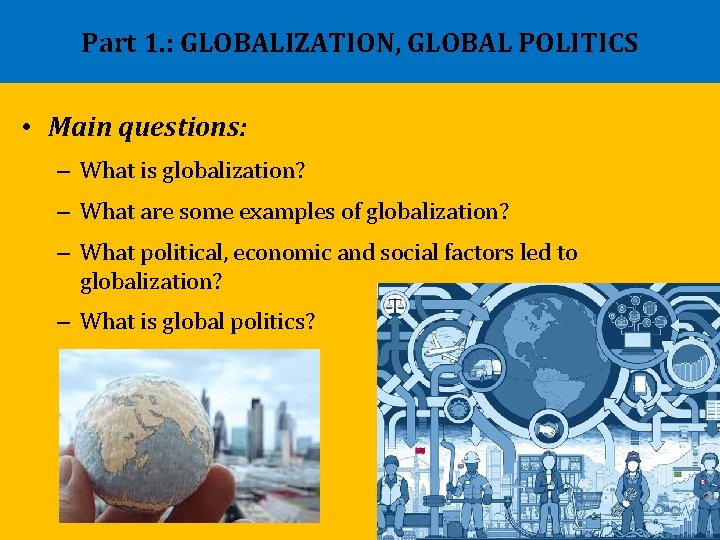
Part 1. : GLOBALIZATION, GLOBAL POLITICS • Main questions: – What is globalization? – What are some examples of globalization? – What political, economic and social factors led to globalization? – What is global politics?
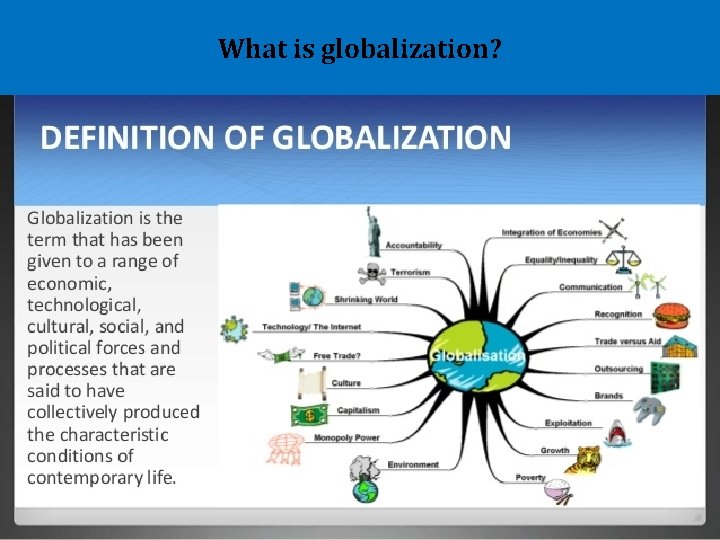
What is globalization?
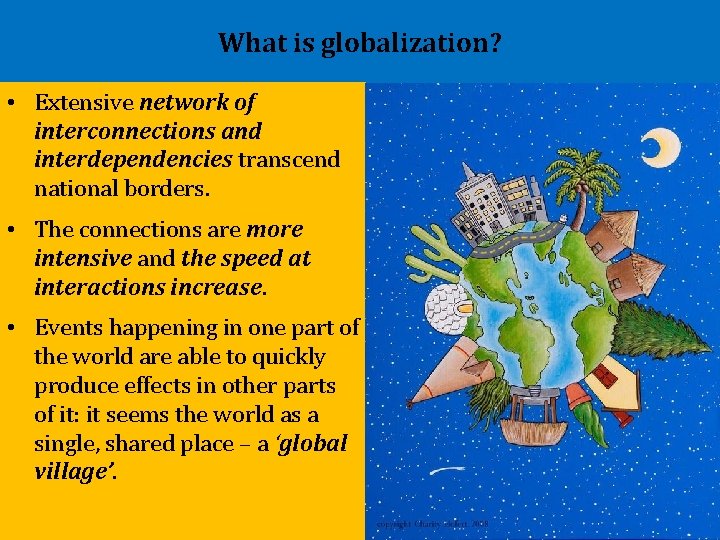
What is globalization? • Extensive network of interconnections and interdependencies transcend national borders. • The connections are more intensive and the speed at interactions increase. • Events happening in one part of the world are able to quickly produce effects in other parts of it: it seems the world as a single, shared place – a ‘global village’.
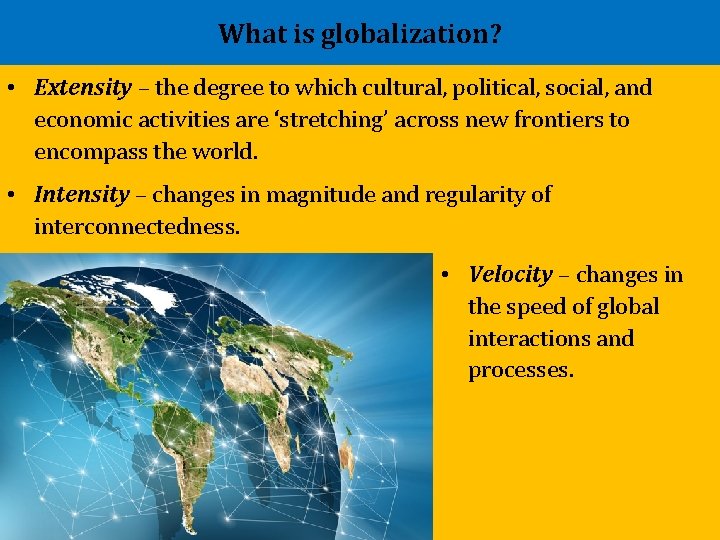
What is globalization? • Extensity – the degree to which cultural, political, social, and economic activities are ‘stretching’ across new frontiers to encompass the world. • Intensity – changes in magnitude and regularity of interconnectedness. • Velocity – changes in the speed of global interactions and processes.
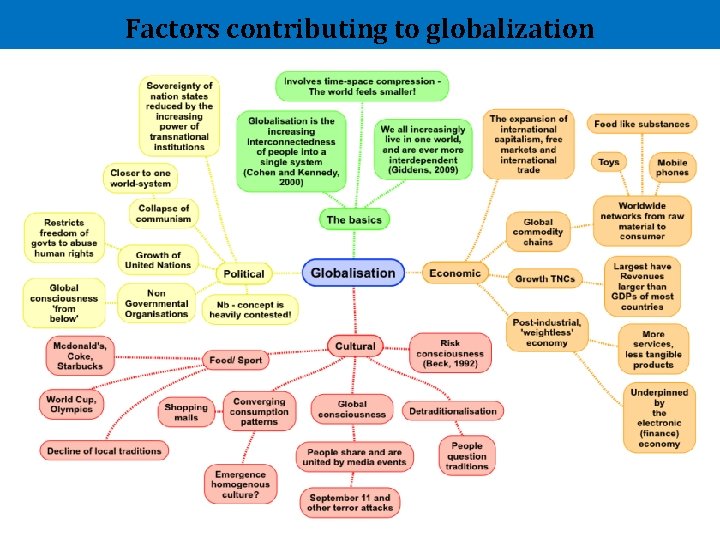
What is globalization? • Globalization domains: economic, political, cultural, social, ecological, and technological. • Politically, the result of globalization is the erosion of nation states and national sovereignty by new international actors. • The states can lost their control over their national economies through the activities of transnational corporations (TNCs) whose decisions (for example, on the location of factories) are seen to be increasingly made in a global context. • Economic policy formation is increasingly being influenced by multilateral economic institutions (MEIs) such as the IMF and WB.
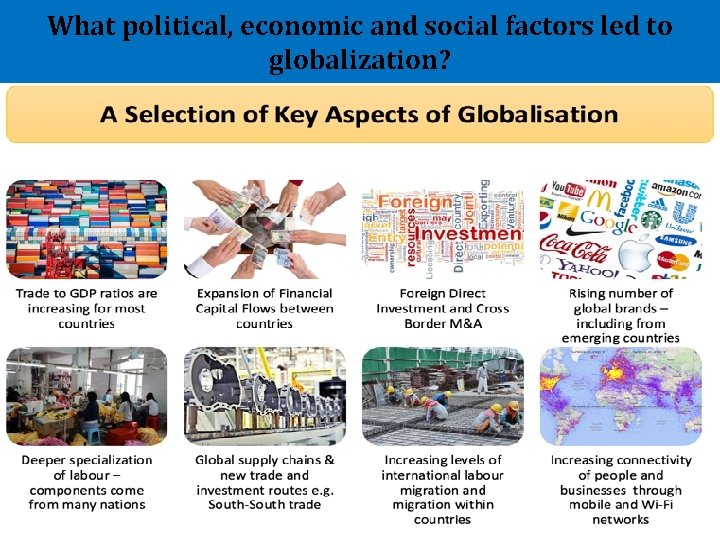
Elements of globalization • International capital flows • Global integration of business activities • Flows of images, ideas, information, and values through media and communications • Spread of consumerism and individualism worldwide • International mobility of people (for leisure, work) and ideas • Impact of human activity on the global ecological system and the environment • Consciousness by the public of global issues, events, and risks • Therise of overnmental and non-governmental organizations • Political action across borders and directed at supranational forums
What are some examples of globalization?
What are some examples of globalization?
What are some examples of globalization?
What political, economic and social factors led to globalization?
Factors contributing to globalization
What is global politics?
PART 2. : SOCIAL GLOBALIZATION • Main questions: – What are the social effects of globalization? – What is social globalization? – What are some examples of social globalization? – How does globalization affect social?
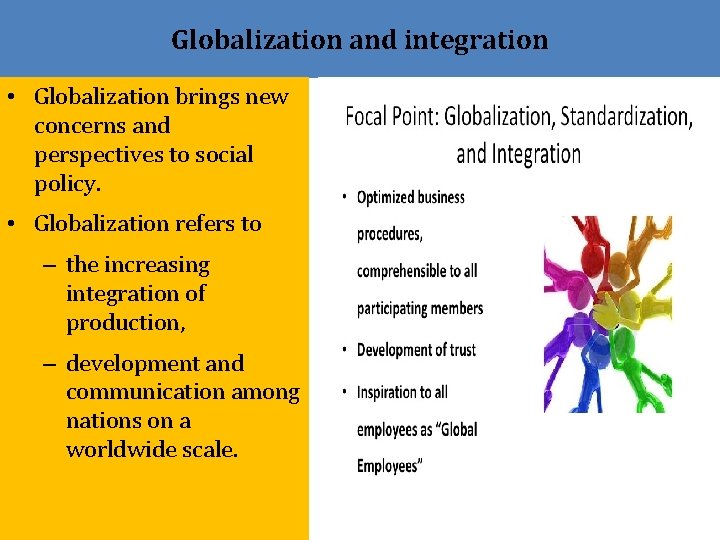
Globalization and integration • Globalization brings new concerns and perspectives to social policy. • Globalization refers to – the increasing integration of production, – development and communication among nations on a worldwide scale.
Globalization, economies and societies • Globalization is focuses on the progressive integration of economies and societies. • It is driven by – new technologies, – new economic relationships and – the national and international policies of a wide range of actors, including • international organizations, • governments, • business and • civil organizations.
Main aspects of globalization • The process of globalization has two main aspects: – The first refers to those factors, – such as trade, investment, technology, cross-border production systems, flows of information and communication – which bring societies and citizens closer together. – The second refers to policies and institutions, – such as trade and capital market liberalization, international standards for labour, the environment, corporate behaviour and other issues, agreements on intellectual property rights etc. – which support the integration of economies and countries.
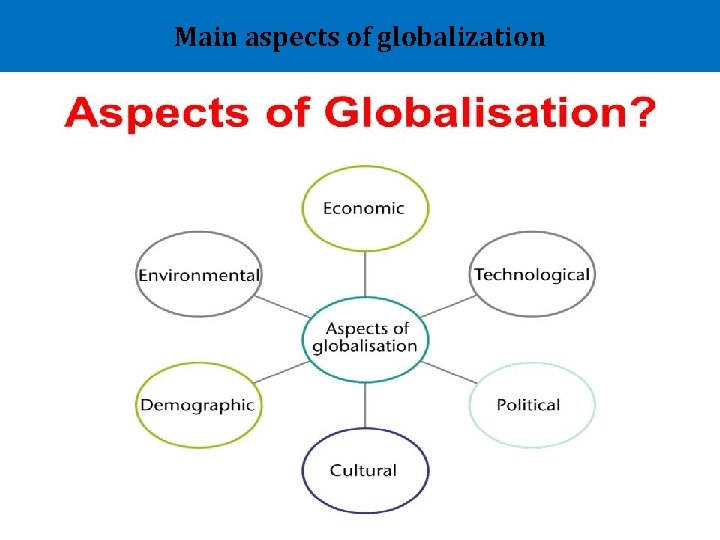
Main aspects of globalization
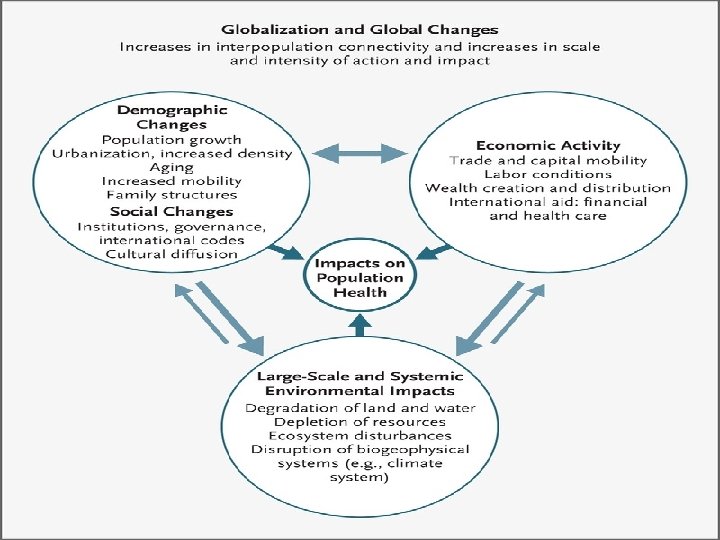
The social effects of globalization • The social dimension of globalization refers to the impact of globalization – on the life and work of people, – on their families, and their societies. • Concerns and issues are often raised about the impact of globalization – on employment, working conditions, – income and social protection. • Beyond the world of work, the social dimension encompasses – security, – culture and identity, – inclusion or exclusion and the – cohesiveness of families and communities.
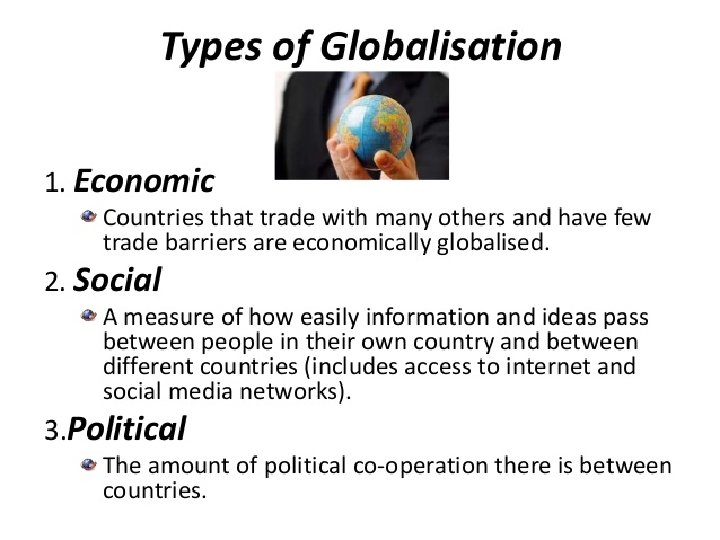
Social globalization • Social globalization pertains to human interaction within cultural communities, encompassing topics like family, religion, work and education. • Examples of social globalization: – Social globalisation refers to the sharing of ideas and information between and through different countries. – In today's world, the Internet and social media is at the heart of this. – Good examples of social globalisation could include internationally popular films, books and TV series.
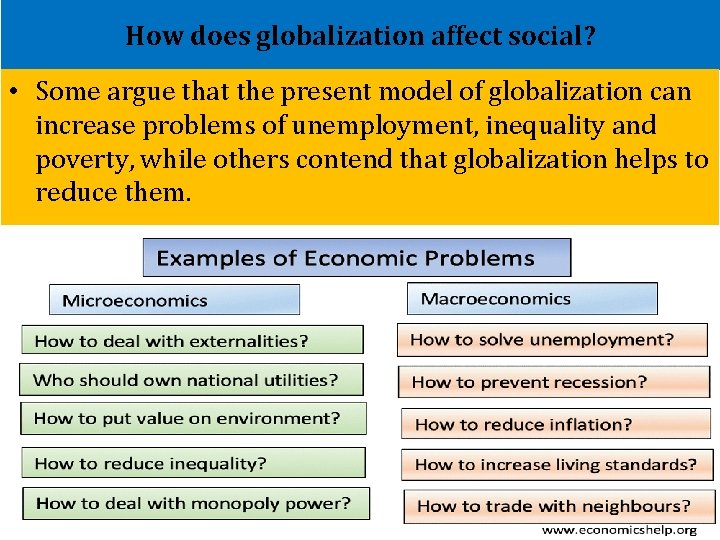
How does globalization affect social? • Some argue that the present model of globalization can increase problems of unemployment, inequality and poverty, while others contend that globalization helps to reduce them.
PART 3. : GLOBALIZATION AND SOCIAL POLICY • Main questions – What are the main impacts of globalization on welfare states and social policy? – What is global social policy? – What are the role of international governmental organizations and international nongovernmental organizations in forming global social policy and regulating global capitalism?
What are the main impacts of globalization on welfare states and social policy? • A globalization perspective also brings new perspectives and subject matter to social policy, extending its field of enquiry. – Governmental and nongovernmental organizations responding not only to domestic issues and sources of pressure but also to circumstances, events, and developments in other countries. – The policies of foreign governments, international organizations, and financial institutions. – Decisions and activities of overseas headquarters or branches of TNCs. • Globalization draws attention to the ways in which societies, economies, and polities – including labour markets and welfare systems – of different countries are entangled in one another.
Some possible effects of globalization on social policy • Sets welfare states in competition with each other. Amongst the anticipated effects are: – lowering of social and labour standards – privatization of public services – creation of global health and welfare markets – growing reliance on voluntary and informal provision. • Raises the issues with which social policy is concerned to the level of supranational institutions, agencies, and forums, both world-regional (e. g. EU) and global (WB etc). • Brings new players into the making of social policy (e. g. Bretton Woods institutions, various UN agencies; development banks; international commercial, voluntary, and philanthropic organizations). • Generates ‘new’ political coalitions within and between countries (regionally and globally) concerned with social policy reform. • Creates new/additional social risks and opportunities for individuals, households, workers, and communities.
Global social policy • People’s life chances and the shape of welfare states are shaped by policies of international forums, institutions, and agencies. • The importance of these organizations and their social policies generated a new field of enquiry – ‘global social policy’. • The activities of NGOs and social movements organized a range of mass demonstrations and specific campaigns and have highlighted the role of these organizations in often adversely shaping economic and social development worldwide. • Over the last decade a number of financial crises have highlighted the degree of ‘enmeshment’ of national economies and societies.
International governmental organizations and international non-governmental organizations • Supranational organizations operate at both regional and global levels. • Some aim to achieve their policy goals through powers of persuasion (ILO, OECD), • others do so through conditionalities attached to loans (IMF, WB), • while others still may impose fines or force governments to provide compensation should they fail to implement agreements/law (EU, WTO). • Many governments belong to both regional and global IGOs, while • regional formations engage in trans-regional collaboration (e. g. EUMercosur; ASEM) around social and economic policy issues. • Governments also pursue their policy objectives through a complex system of bilateral agreements to pursue their trade, social, and other objectives.
International governmental organizations and international non-governmental organizations • International governmental organizations and forums, networks of international non-governmental organizations monitor on social policy issues. • INGOs are involved in both the formulation of social policy (e. g. conducting political campaigns of research and activism, advisory roles) and its implementation through service delivery (emergency and development aid).
- Slides: 30