
Dr Elizabeth Gadd LU Dr Ian Rowlands KCL
Dr Elizabeth Gadd (LU) & Dr Ian Rowlands (KCL) How could bibliometric services improve? Views of the end-user community
Overview • • Why did we run it? Who responded? What were the main messages? Recommendations
Survey origins • Perceived mismatch between end-users needs and supplier services • Is this real or perceived? • If real, how do we bridge the gap? • Ran a short survey inviting end-users to list ‘Three things’ they’d like to communicate to their suppliers • Open Feb/March 2018 • Advertised to Lis-Bibliometrics, ARMA-Metrics-SIG & RESMETIG
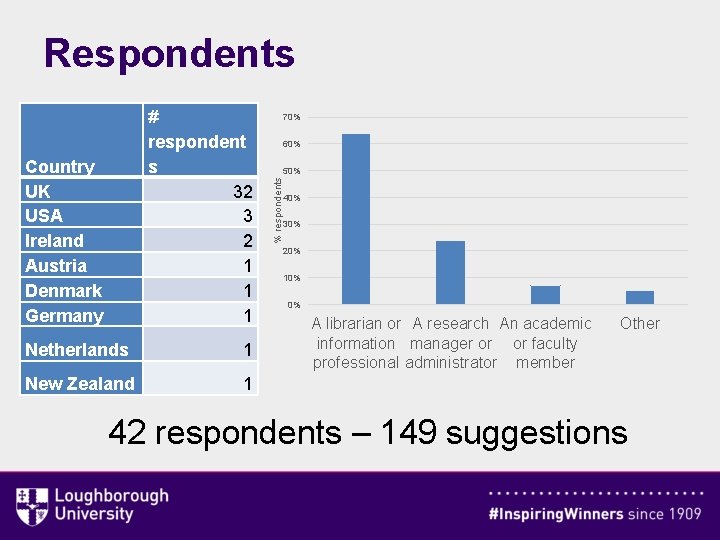
Respondents Country UK USA Ireland Austria Denmark Germany Netherlands 1 New Zealand 1 70% 60% 50% % respondents # respondent s 32 3 2 1 1 1 40% 30% 20% 10% 0% A librarian or A research An academic information manager or or faculty professional administrator member Other 42 respondents – 149 suggestions
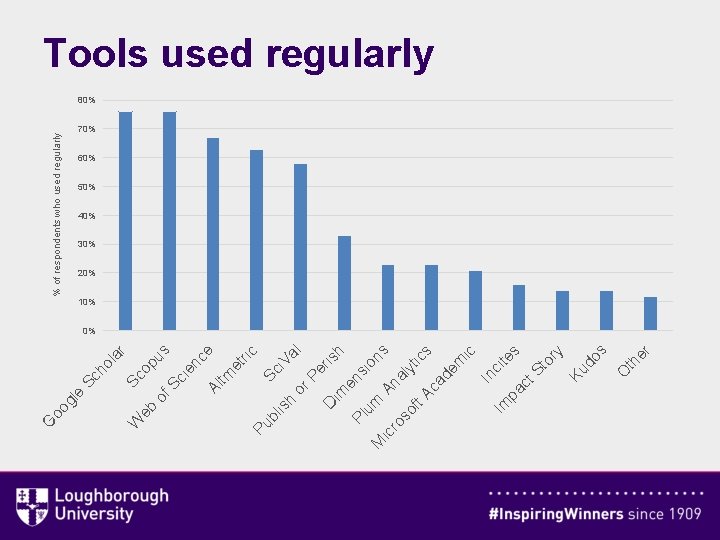
al M er O th ns ic A na ro so ly t ft Ac ics ad em ic In ci Im pa tes ct St or y Ku do s si o ris h Pe en im um Pl D or Sc i. V c et ri tm s r e ie nc Sc op u Sc ho la Sc Al of is h eb Pu bl W le oo g G % of respondents who used regularly Tools used regularly 80% 70% 60% 50% 40% 30% 20% 10% 0%
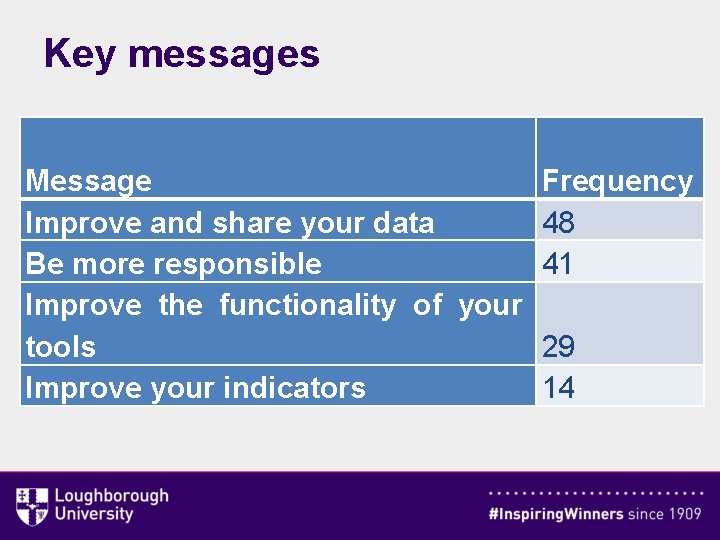
Key messages Message Frequency Improve and share your data 48 Be more responsible 41 Improve the functionality of your tools 29 Improve your indicators 14
A: Improve and share your data This Photo by Unknown Author is licensed under CC BY-NC-ND
A 1: We want greater coverage (for free!), but failing that, please be clear about coverage limits • “The Arts & Humanities are not covered well enough. You might be trying to get better coverage but it’s not happening fast enough” • “Current bibliometric databases are missing a lot of the really important stuff for some departments, e. g. working papers” • “We don't have the money to pay for any bibliometric or altmetric services”
Recommendations • Suppliers should provide easily available, regularly updated lists of current coverage and signal more clearly any significant scope and coverage limitations • Suppliers should make it easier for customers to suggest new sources to plug gaps in disciplines and output types • Suppliers should make clearer statements on their plans for coverage expansion
A 2: We want better quality data (or at least be honest about its limitations) • “Data: Better consistency in format and granularity of publication dates, including tiding up old publications metadata. ” • “Scopus: improve the quality of the indexing of authors and institutions' profiles (e. g. : too many duplicates, spelling mistakes etc). ” • “Accuracy is everything! Scopus is much better than it used to be but there are still too many errors. I appreciate that there are millions of records but institutions are paying for it to be accurate, not to have to constantly report corrections. “
Recommendation • Suppliers should establish and report on KPIs around data quality improvement
A 3: We live in a mashup culture – enable end-users to export, use and repurpose data • “Data we can export, transform and reuse in a transparent way is more important than prepackaged proprietary visualisations and reports. ” • “Allow the import and export/reporting of a unique identifier (e. g. a Pure UUID, or sequential unique range of values) in order to be able to better link input and output for further analysis outside of a tool/service”
Recommendations • Suppliers should relax their system download limits • Suppliers should ensure that a standard and consistent range of identifiers is available for all data exports on their platforms to facilitate data integration and mashups
A 4: Remember to whom the data belongs – a desire to re-assert a sense of community ownership. • “Metrics belong to the scholarly community and should be freely available” • “All publishers should open up their reference lists” • “I believe we are in the dark in comparison to publishers in terms of gathering information about how our research is being used. ”
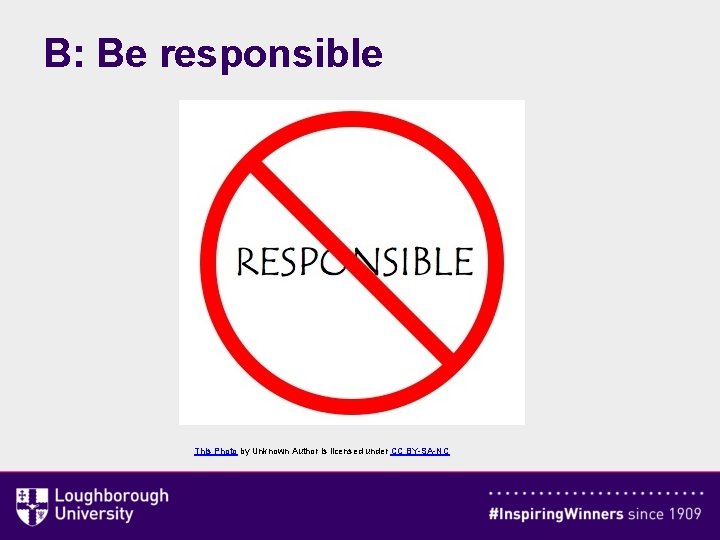
B: Be responsible This Photo by Unknown Author is licensed under CC BY-SA-NC
B 1: Suppliers have a duty of care to their end-users • “Metrics providers have a duty of care to the research community. ” • “There is nothing wrong with offering metrics solutions in academic contexts, but you should do this in a responsible manner. ” • “That signing DORA and/or publicly adhering to the principles of the Leiden Manifesto would be a positive step in the right direction. ”
Recommendations • Suppliers should develop their own statements on the responsible use of metrics and adhere to them • Suppliers should keep abreast of developments in the field of responsible metrics and update their tools accordingly
B 2: Suppliers should provide better labelling for their products • “Easy-to-find and comprehensive list of data sources for that product. ” • “Stability/confidence intervals to contextualise indicators based on mean citations would be very welcome - it'd help us not to place too much emphasis on small differences. ” • “Clear description of methodologies and data used to develop metrics and allowing for independent (user) validation. ”
B 2 …& better education activities and use cases • “Real-world examples of how we need to use the data. ” • “Webinars and user group meetings are highly helpful. ” • “Give guidance on how your metrics could be used in combination with peer review. ”
Recommendations • Suppliers should provide clear, up-to-date guidance as to how indicators are calculated, with worked examples • Suppliers should provide clear warnings alerting end -users to the dangers of using certain metrics at fine levels of granularity, when the publication sets are too small to be statistically robust • Suppliers should provide confidence levels around their indicators, where appropriate • Suppliers should set aside a certain percentage of their revenue for educational activities to support responsible metrics
C: Improve your tools This Photo by Unknown Author is licensed under CC BY
C 1: Find the sweet spot between innovation vs the basics • “I care about data quality: please invest in coverage & accuracy (even if it isn't as glamorous as new developments). ” • “Mysterious 'black box' metrics and systems are not very useful to us - transparency is really important. ” • “I want intuitive and thoughtful UX. ” • “More sophisticated visualisations - e. g. box plots, not just average values, for comparison. ”
Recommendations • Suppliers should involve end-users more actively in setting development priorities • Suppliers should provide a clear evidence trail for their development priorities
D: Improve your indicators This Photo by Unknown Author is licensed under CC BY-NC-ND
D 1: The ability to benchmark by small or niche fields would be highly valued • “There is no good way to benchmark small departments, especially in niche areas. ” • “That each researcher and research project are different, homogenising doesn't work well. ” • “Research areas in departments differ A LOT both across institutions. ”
D 2: Article-level subject indexing is needed • “Sci. Val: improve filters so that system can filter at article level rather than journal level. ” • “Subject classification at the journal level isn't clear enough. Subject keywords should be used to get better granularity. ”
Recommendations • Suppliers should work to facilitate the sharing of benchmarking groups between members of the community • Suppliers should explore ways develop more effective services (including enhanced benchmarking functionality) through output-level subject indexing
D 3: Altmetrics are still nascent but better standards and integration would be welcome • “The variety of metrics is overwhelming, something that consolidates biblio and alt metrics would be great. ” • “One altmetric standard - so that I can compare eggs with eggs. It must count web/social media sources, news and media mentions, and policy and grey literature mentions. ”
Recommendations • Suppliers should integrate altmetric and bibliometric data to a greater extent • Suppliers should seek to standardise altmetric indicators and sources to better enable their interpretation.

What next? • Report published in Insights (UKSG) journal early October • Blog post on The Bibliomagician • Accepted manuscript available at: • https: //dspace. lboro. ac. uk/2134/34685 • Data available at: • https: //doi. org/10. 17028/rd. lboro. 7022213. v 1
Thank you for listening Dr Elizabeth Gadd Research Policy Manager (Publications) Loughborough University Skype: lizziegadd Twitter: @lizziegadd Email: e. a. gadd@lboro. ac. uk http: //orcid. org/0000 -0003 -4509 -7785 http: //about. me/elizabeth. gadd
- Slides: 31