
Dr David Galbreath Lecturer in Politics and International
Dr. David Galbreath Lecturer in Politics and International Relations d. galbreath@abdn. ac. uk Office: F 36 Edward Wright Building Hours: Tuesday: 10 -12
The European Union and Enlargement PI 2003 International Organisations in Europe – Week 9
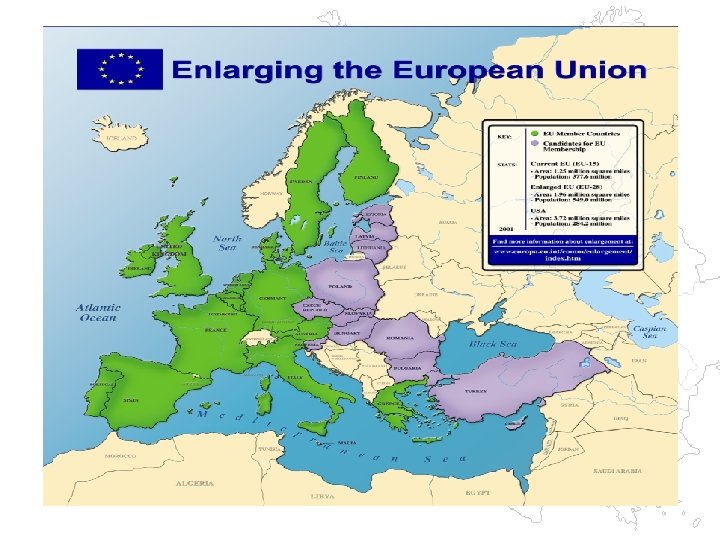
Previous Enlargement • Original members: Belgium, France, Germany, Italy, Luxembourg and the Netherlands. ● 1973 Denmark, Ireland the United Kingdom ● 1981 Greece ● 1986 Portugal and Spain ● 1995 Austria, Finland Sweden ● 2004 10 new members
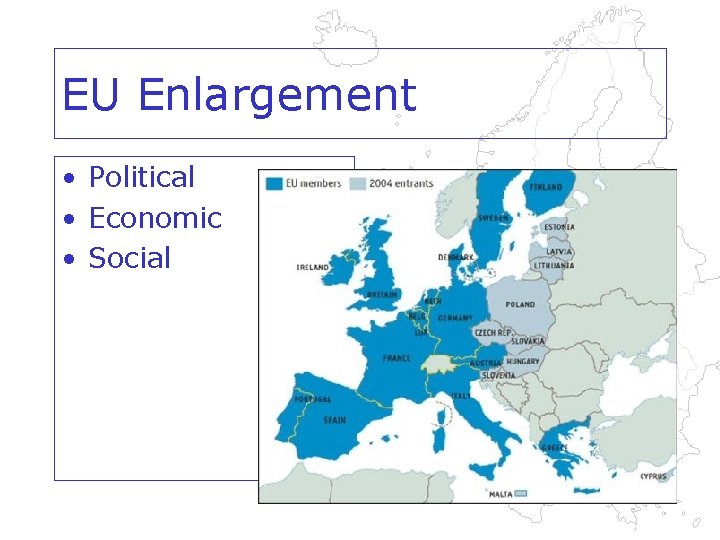
EU Enlargement • Political • Economic • Social
EU Enlargement: Questions • Why did the EU expand? • How did the EU expand? • What were the political implications of expansion? • How did EU change to prepare for 15 new members? • What were the political, economic and social requirements of new memberstates? • What is the future for EU expansion?
Why did the EU expand? • Changes the internal order of the EU; • Allows for greater divisions in the EU; • Forces painful economic and institutional adaptations required of the applicant country; • Encourages anxiety over immigration in the existing member-states.
Why did the EU expand? • Three views: 1. Rationalist approach 2. Ethical-political approach 3. Moral approach
Why did the EU expand? • Three views and hypotheses: 1. Rationalist approach • The EU would concentrate only on those states that offered the most gain 2. Ethical-political approach • The EU would concentrate on those states that had an element of kinship 3. Moral approach • The EU would concentrate on democratic states outside the community
Who supported enlargement? • ‘Drivers’ vs. ‘Brakemen’ ● Drivers • those bordering the CEEC’s (except for Italy and Greece) ● Brakemen • Recent new states (ex. Spain) • All others (except for Britain)
Who supported enlargement? • Drivers: two groups ● Limited round focusing on Central Europe (Hungary, Czech Republic, Slovakia, Poland, Slovenia) ● The ‘big bang’ enlargement
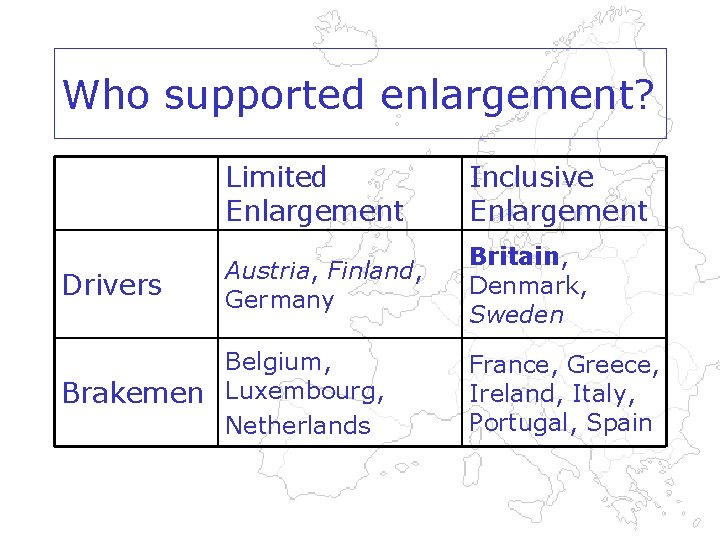
Who supported enlargement? Drivers Limited Enlargement Inclusive Enlargement Austria, Finland, Germany Britain, Denmark, Sweden Belgium, Brakemen Luxembourg, Netherlands France, Greece, Ireland, Italy, Portugal, Spain
Who supported enlargement? • Reasons for support ● Geographical proximity • Interdependence • Shared borders • Economic gains
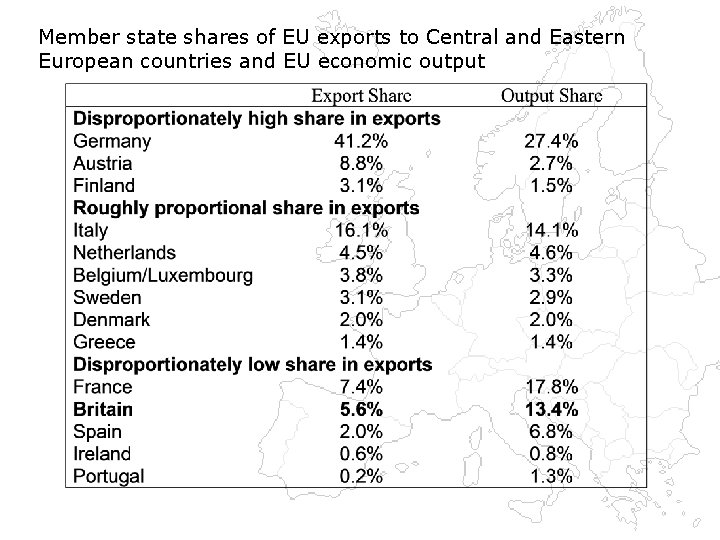
Member state shares of EU exports to Central and Eastern European countries and EU economic output
Who supported enlargement? • Reasons for support ● Geographical proximity? ● Economic gain? ● Influence?
EU Enlargement • Institutional Arrangements ● Copenhagen Criteria ● Acquis Communautaire ● Madrid European Council ● Agenda 2000
EU Enlargement • Copenhagen Criteria ● stability of institutions guaranteeing democracy, the rule of law, human rights and respect for and protection of minorities; ● the existence of a functioning market economy as well as the capacity to cope with competitive pressure and market forces within the Union; ● the ability to take on the obligations of membership including adherence to the aims of political, economic & monetary union.
EU Enlargement • Acquis Communautaire ● Treaty of Amsterdam 1993 ● The body of EU law that must be adopted into domestic law ● Acquis politigue ● Finalité politique
EU Enlargement • Madrid European Council ● Administration ● Judicial Structures
EU Enlargement • Agenda 2000 ● Amsterdam IGC 1997 and Luxembourg European Council 1998 • Development of EU • Challenges of Enlargement – Accession Process – Regular Reports • Financial framework beyond 2000
EU Enlargement • Agenda 2000 (regular reports) ● 1998 -2003 1. 2. 3. 4. Minorities Adoption of Acquis No delay for 6 Relied on other institutions and NGO’s
EU Enlargement • The logistics ● Should the Commission be reweighted? ● Should voting change in the Council? ● How will the new states be represented in Parliament?
Political Conditions • Democracy ● Transition ● Consolidation ● European Union and Democratisation
Political Conditions • Political Conditionality ● ‘This is achieved by specifying conditions or even preconditions for support, involving either promises of material aid or political opportunities. ’ ● Democratic Conditionality
Political Conditions • Democratic Conditionality (three stages) 1. Pre-negotiations 2. Actual negotiations 3. Once membership begins
Financial Issues • PHARE ● (Poland Hungary: Aid for Economic Restructuring) ● Three aims: 1. Pre-accession Funds for adoption of the Acquis 2. Structural Funds 3. Aimed at Regions and regional institutions
Financial Issues • PHARE ● Three phases: • Mark I (1989 -97) • Mark II (1997 -2000) • Mark III (2000 -)
Financial Issues • Common Agriculture Policy ● Reforms at the Copenhagen summit in December 2002 ● Direct payments phased-in ● Lock-in strategy
Financial Issues • The Economic and Monetary Union ● Euro is obligation for new states ● Although when and how is up to state ● No states ready yet (euobserver. com) ● Criteria: exchange rates, price stability, interest rates, deficits and the status of central banks
What is the future for EU expansion? • Romania and Bulgaria (2007) • Turkey (2010? ) • The Balkans (Croatia, Bosnia, Serbia, Macedonia, Albania)? • Belarus, Ukraine, Georgia? • North Africa?
Conclusion • Why did the EU expand? • How did the EU expand? • What were the political implications of expansion? • How did EU change to prepare for 15 new members? • What were the political, economic and social requirements of new memberstates? • What is the future for EU expansion?
- Slides: 31