
Dr Darren Ellis To experiment with analysis of

![� Participant 4: [OK are emoticons helpful? ] What’s that sorry emoticons? [I: You](https://slidetodoc.com/presentation_image/e23181d470f7b2b0a584206325ebe685/image-25.jpg "� Participant 4: [OK are emoticons helpful? ] What’s that sorry emoticons? [I: You")
- Slides: 28
Dr Darren Ellis
� To experiment with analysis of the data set through using concepts from Alfred North Whitehead’s Process and Reality (1929) � Looking at some ‘actual entities’ of social media in relation to ‘prehensions’ and ‘concrescence’
� Previous research � Everyday experiences of Surveillance (Dr David Harper and Ian Tucker) � Affective Atmospheres of Surveillance. Theory and Psychology 2013 � The Dynamics of Impersonal Trust and Distrust in Surveillance Systems. Sociological Research Online 2013
� Everyday Social Media � How people use social media � What sort of information do they share � Issues related to security and trust � Issues related to affective activity on the internet: e. g. – how are feelings and emotions communicated? � Also looked at ‘real-time’ use of social media through a programme entitled Morae
� Philosophical disposition (attitude) �To analyse phenomena not in terms of the constellation of ‘things’ ‘material substances’ ‘essences’ � But �As fundamental forces, activities, movements, processes – in constant transition �As moments of becoming � Process has priority over product
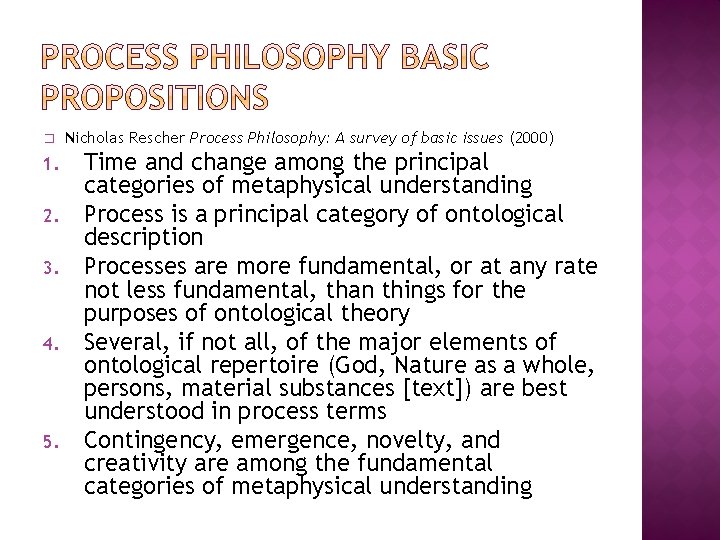
� 1. 2. 3. 4. 5. Nicholas Rescher Process Philosophy: A survey of basic issues (2000) Time and change among the principal categories of metaphysical understanding Process is a principal category of ontological description Processes are more fundamental, or at any rate not less fundamental, than things for the purposes of ontological theory Several, if not all, of the major elements of ontological repertoire (God, Nature as a whole, persons, material substances [text]) are best understood in process terms Contingency, emergence, novelty, and creativity are among the fundamental categories of metaphysical understanding
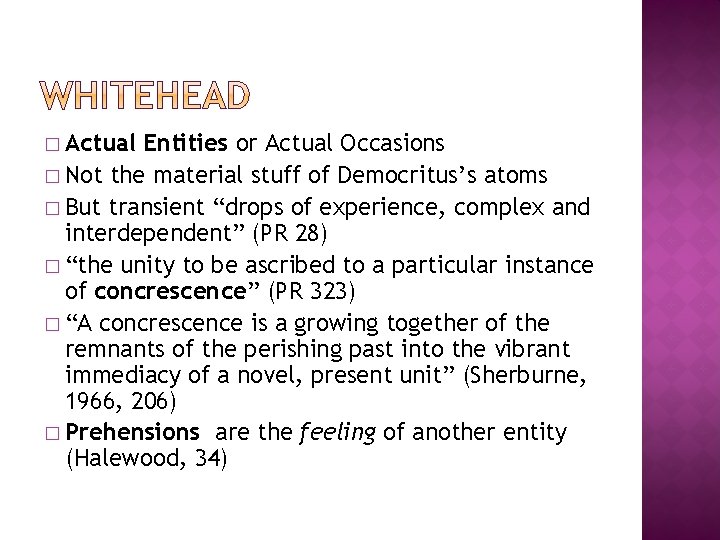
� Actual Entities or Actual Occasions � Not the material stuff of Democritus’s atoms � But transient “drops of experience, complex and interdependent” (PR 28) � “the unity to be ascribed to a particular instance of concrescence” (PR 323) � “A concrescence is a growing together of the remnants of the perishing past into the vibrant immediacy of a novel, present unit” (Sherburne, 1966, 206) � Prehensions are the feeling of another entity (Halewood, 34)
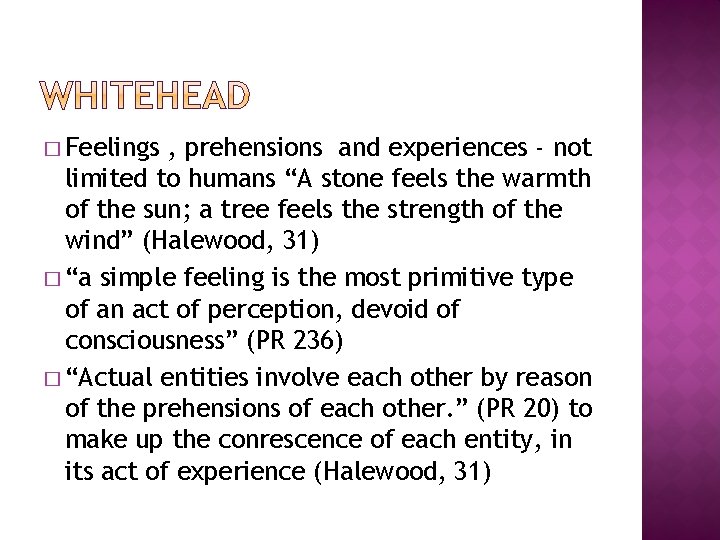
� Feelings , prehensions and experiences - not limited to humans “A stone feels the warmth of the sun; a tree feels the strength of the wind” (Halewood, 31) � “a simple feeling is the most primitive type of an act of perception, devoid of consciousness” (PR 236) � “Actual entities involve each other by reason of the prehensions of each other. ” (PR 20) to make up the conrescence of each entity, in its act of experience (Halewood, 31)
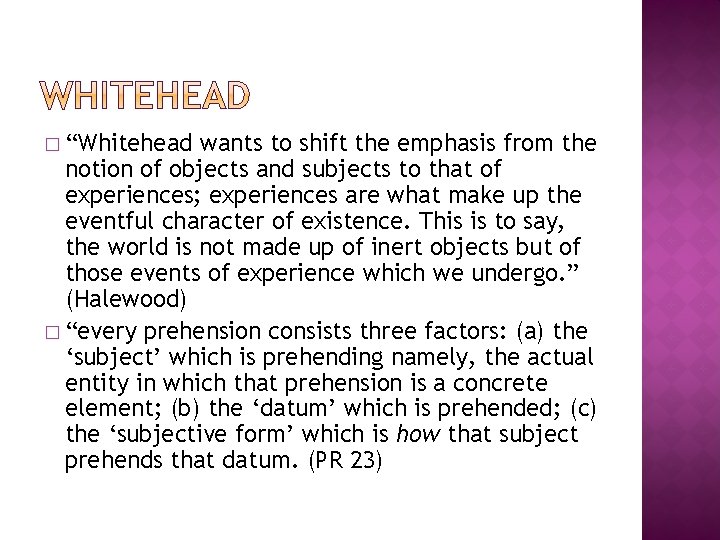
� “Whitehead wants to shift the emphasis from the notion of objects and subjects to that of experiences; experiences are what make up the eventful character of existence. This is to say, the world is not made up of inert objects but of those events of experience which we undergo. ” (Halewood) � “every prehension consists three factors: (a) the ‘subject’ which is prehending namely, the actual entity in which that prehension is a concrete element; (b) the ‘datum’ which is prehended; (c) the ‘subjective form’ which is how that subject prehends that datum. (PR 23)
� “The point is not to wonder about the legitimacy of Whitehead’s speculative definition of what truly exists, as if Process and Reality unfolded some kind of ultimate perspective. A perspective is certainly produced, but it cannot be separated from an experience of disclosure; and this experience does not concern actual entities as such, but the very possibility of changing the problem, to escape the oppositions our modern world definitions induce. ” (Stengers, 2007 – cited in Halewood, 30) � Nexus, Society, Creativity, Satisfaction, Superject, Transmutation etc…….
ACTUAL ENTITIES OF SOCIAL MEDIA 1 Personal Information
� Marketers Distinguish between � Market-level or modelled data: character of consumer group, market segment, media audience, geographic location etc. (more frequently used) � Personal or individual specific data: names, addresses, demographic characteristics, lifestyle interests, shopping preferences and purchase histories � Five general categories generally used for marketing: demographic characteristics, lifestyle characteristics (including media habits), shopping/purchasing habits, financial data, and personal identifiers (e. g. names, addresses, social security numbers) (Phelps, Nowak and Ferrell, 2000) � Participants generally adhered to these notions of PI
SOCIAL MEDIA PROCESS ANALYTICS � � “[I: So what sorts of personal information do you put up on-line? ] Participant 4: “Personal information – the only personal information I put down is where they ask you where you from – your name – so me personally would say that’s probably the only personal information I put up” Participant 5: “Just like the date of birth everything like that’s already there – like relationships and stuff like that – that’s pretty much it” Participant 6: “My name – my date of birth – and maybe my email will be visible” � � Notions here of PI: information that is prehended by both (they) SM designers and end users to facilitate processes of conrescence to unfold actual entities of identification – These in turn are prehended by marketers again through acts of concrescence towards the desires of commodification (typically through social media analytics) – already there –- experienced as markers of the self – predefined and enduring categories made visible (for those who desire to prehend) Stuff like that – ironically relatively impersonal information
SOCIAL MEDIA PROCESS ANALYTICS � Understood through discursive processes of concrescence perhaps related to the commodification of the self � Attributes of subjectification driven by the desires of marketers (etc. ) to facilitate forms of ‘social sorting’ � Forming feedback loops (prehensions) that can easily be hooked into through acts of concrescence � Perhaps enabling a sense of ‘self’ stability through the ‘data-double’
So, process philosophy invites us to think of the ‘actual entities’ the becomings of ‘personal information’ as events of experience that are undergone rather than inert characteristics
FROM IMPERSONAL INFORMATION TO PERSONAL INFORMATION � Participant 9: “I’ve got my email address – my sex female – and what borough I live in” � “[I: What ways do you communicate your feelings online? ] Erm through a photo – or a erm just through my status” � Interesting distinction emerges here – ‘feelings’, ‘photos’ and ‘status’ not prehended her as PI
FROM IMPERSONAL INFORMATION TO PERSONAL INFORMATION � � Participant 2: “Me I am not really one to put up personal information I would rather (pause) I don’t like putting up personal information online” Participant 2: “[I: In what ways do you communicate your emotions online? ] Well you know you can. For example you know whatsapp - my status on whatsapp usually reflect my life yeah same thing as facebook – however you feel you write it on your status because status is how you feel at the current moment so yeah definitely” � Status less fixed than PI – an actual entity of the current (but already past) moment
� Participant 1: “[I: So what sorts of personal information do you put up on-line? ] I’m an open person so I tell everyone everything, so like when I wake up and open my eyes I had a beautiful dream about Marvin last night - I tell everyone everything I have nothing to hide [I: Marvin from JLS? ] Yeah I love JLS I love them”
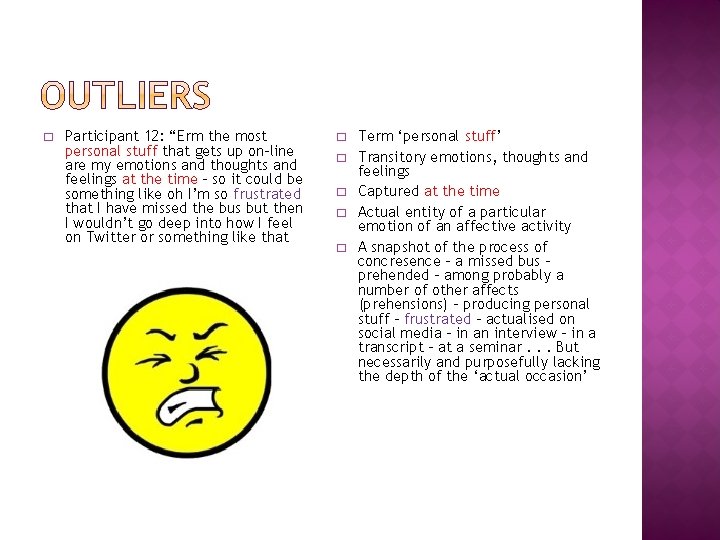
� Participant 12: “Erm the most personal stuff that gets up on-line are my emotions and thoughts and feelings at the time - so it could be something like oh I’m so frustrated that I have missed the bus but then I wouldn’t go deep into how I feel on Twitter or something like that � � � Term ‘personal stuff’ Transitory emotions, thoughts and feelings Captured at the time Actual entity of a particular emotion of an affective activity A snapshot of the process of concresence – a missed bus – prehended - among probably a number of other affects (prehensions) – producing personal stuff – frustrated - actualised on social media – in an interview – in a transcript – at a seminar. . . But necessarily and purposefully lacking the depth of the ‘actual occasion’
ACTUAL ENTITIES OF SOCIAL MEDIA 2 Emoticons
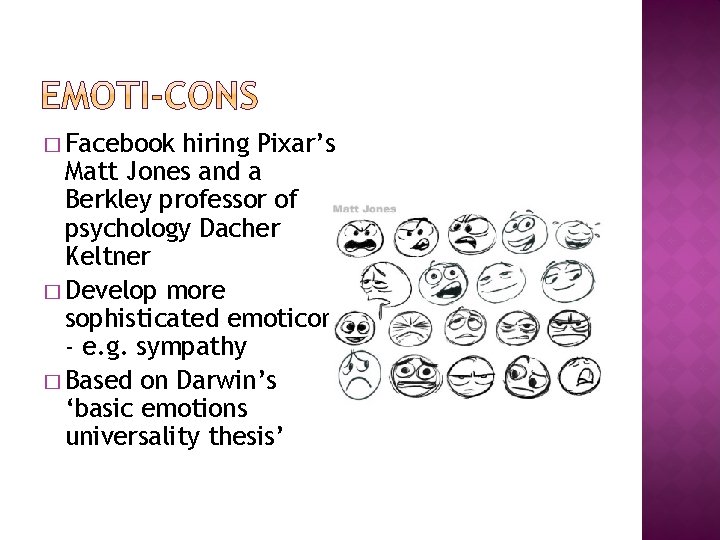
� Facebook hiring Pixar’s Matt Jones and a Berkley professor of psychology Dacher Keltner � Develop more sophisticated emoticons - e. g. sympathy � Based on Darwin’s ‘basic emotions universality thesis’
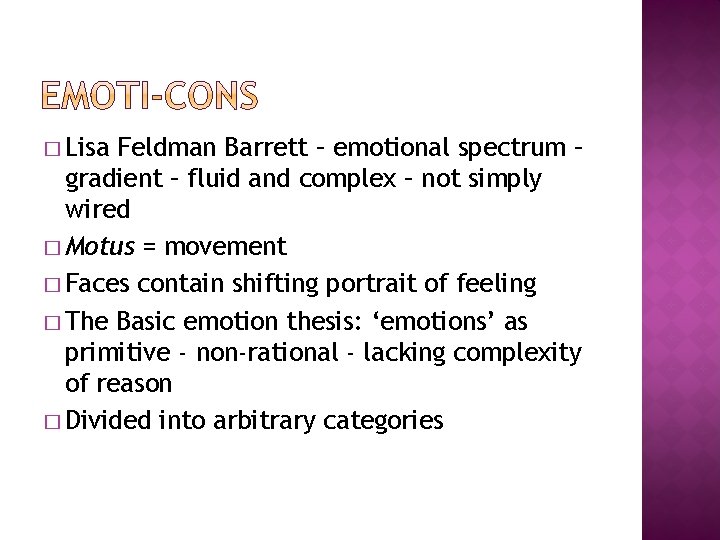
� Lisa Feldman Barrett – emotional spectrum – gradient – fluid and complex – not simply wired � Motus = movement � Faces contain shifting portrait of feeling � The Basic emotion thesis: ‘emotions’ as primitive - non-rational - lacking complexity of reason � Divided into arbitrary categories
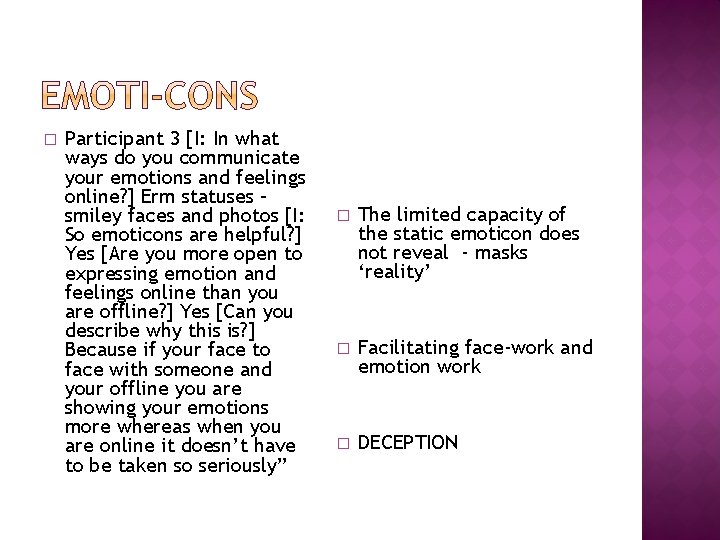
� Participant 3 [I: In what ways do you communicate your emotions and feelings online? ] Erm statuses – smiley faces and photos [I: So emoticons are helpful? ] Yes [Are you more open to expressing emotion and feelings online than you are offline? ] Yes [Can you describe why this is? ] Because if your face to face with someone and your offline you are showing your emotions more whereas when you are online it doesn’t have to be taken so seriously” � The limited capacity of the static emoticon does not reveal - masks ‘reality’ � Facilitating face-work and emotion work � DECEPTION
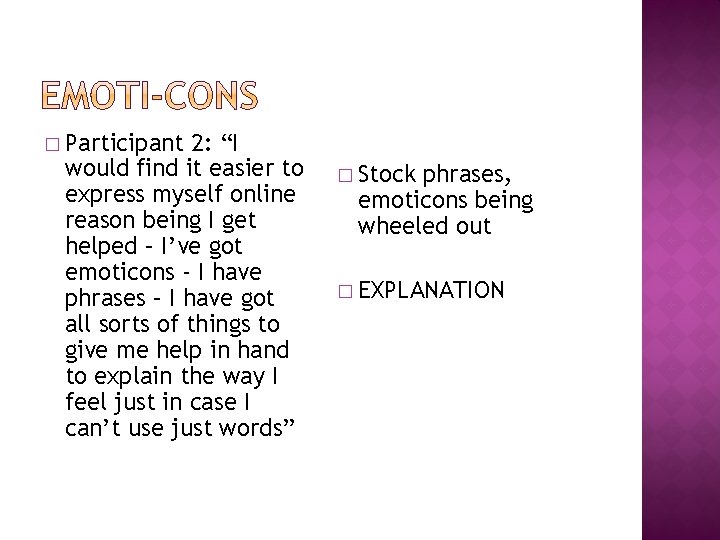
� Participant 2: “I would find it easier to express myself online reason being I get helped – I’ve got emoticons - I have phrases – I have got all sorts of things to give me help in hand to explain the way I feel just in case I can’t use just words” � Stock phrases, emoticons being wheeled out � EXPLANATION
� Participant 4: [OK are emoticons helpful? ] What’s that sorry emoticons? [I: You know – the little smiley faces] Erm yeah I believe they are I mean in terms of over text because you know you won’t want people on Facebook to know what you’re typing to people – you could say something with a smiley face at the end and it could mean different things to different people so in that respect yeah I think they are” � Reducing the ambiguity of the text � OBJECTIFICATION
� Participant 10: “[I: In what ways do you communicate your emotions and feelings online? ] I block and remove people”
SOCIAL MEDIA PROCESS ANALYTICS � The actual entities of emoticons are the result of the concrescence of prehensions ‘actualised’ through multiple desires (e. g. to deceive, express and objectify) � In each case creating a fixing and qualifying of affect (: multiple prehensions) � Stripping complexity through seemingly stable form of the emoticon
� Analysis of the becomings of the actual entities within social media through prehensions and concrescence moves the focus from that which is produced to the processes of production � PI prehended as static enduring entities – almost as if it does not belong to me any more and so relatively impersonal - static marketable categories – fixed identifiers � Emoticons perhaps more personal – but have a universal and basic quality – fixing and stripping affect (prehensions) in attempts to simplify and qualify an actual occasion