
Dr Ann Henry Tues 13 th November 2012

Dr Ann Henry Tues 13 th November 2012 Forensic & Applied Cognitive Psychology
� Different � Criminal types of mental illness/ disorder Justice System � Treatments in mental health settings
� Risk Assessment (brief overview) � Theories � Sexual of crime Offending – paedophiles & child molestation
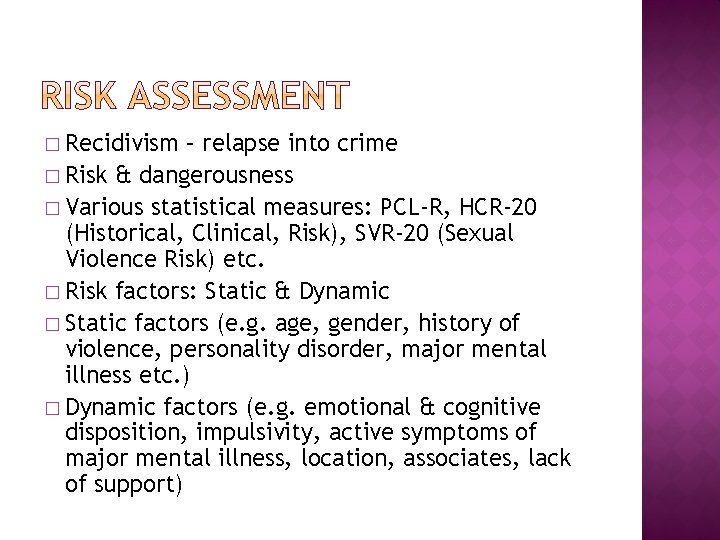
� Recidivism – relapse into crime � Risk & dangerousness � Various statistical measures: PCL-R, HCR-20 (Historical, Clinical, Risk), SVR-20 (Sexual Violence Risk) etc. � Risk factors: Static & Dynamic � Static factors (e. g. age, gender, history of violence, personality disorder, major mental illness etc. ) � Dynamic factors (e. g. emotional & cognitive disposition, impulsivity, active symptoms of major mental illness, location, associates, lack of support)
� Howitt (2006) outlines a broad range of theories. � Macro-level or Societal � Community or locality � Group & socialisation influence � Individual/ Psychological
� Marxist Conflict theory � Merton’s Strain Theory � Feminist Theory
� Marxist � Society conflict theory has evolved in a state of conflict between competing groups in society over material resources & institutionalised power. � Dominant class uses laws to control other groups & maintain its command or hegemony (political leadership)
� Merton’s Strain Theory � Recognises that society’s goals (prosperity, achievement etc. ) are only available to a limited few. The rest can only achieve goals through deviant means. � Others adapt to the strain by retreating into alcoholism, drug addiction, suicide, vagrancy.
� Feminist � Holds Theory that criminality is associated with males. Males seek to maintain power in the gendered social system through the deployment of violence against women & children. � Male control is through their access to power over social institutions such as the law. � Powerless men are inclined to the cruder expressions of power which lead to their imprisonment.
� Differential Opportunity theory � Explains the patterns of crime likely to be exhibited by individuals in terms of the range of crime opportunities close to home. � Different individuals display different modes of adjustment or adaptation to their particular social strains.
� Subcultural Delinquency Theories � Differential Association Theory � Lifestyle & Routine Activities Theory � Social Learning Theory � Criminogenic factors in childhood
� Subcultural Delinquency Theories � Youngsters with problems especially to do with the home & school tend to associate with gangs & other groupings in which they can achieve some status. � Through criminal activity, delinquent groups may provide an opportunity to achieve a sense of self-esteem.
� Differential Association Theory � Circumstances of upbringing determines their exposure to crime & pressure to commit crime. � Hence, learning to be a criminal applies to different strata of society e. g. middle class might be exposed to fraud, tax evasion etc.
� Lifestyle � Argues & Routine Activities Theory that most crime is trivial & impulsive – thus elements of opportunism (Cohen & Felson, 1979)
� Social Learning Theory � Bandura (1973, 1983) Vicarious learning through observing other people. � However, doesn’t explain under what circumstances criminal behaviour will or will not be learnt, so has limited explanatory power.
� Criminogenic � � � factors in childhood Glueck & Glueck, 1962, 1968) claim that the following are antecedents of antisocial & criminal behaviour: Punitive child-rearing practices & attitudes (strict discipline, corporal punishment, authoritarian attitudes) Lack of love or rejection Laxness (poor monitoring, lack of supervision) Family disruption (separation, divorce, instability, marital conflict) Deviant parental characteristics (criminality, mental health problems, substance abuse)
� Criminogenic factors in childhood (cont) � Yoshikawa (1995) argued that delinquency is product of interaction of multiplicity of factors: � Neurological & biological factors � Low cognitive ability � Childhood history of antisocial behaviour � Parental substance abuse � Violent or socially disorganised neighbourhoods � Media violence
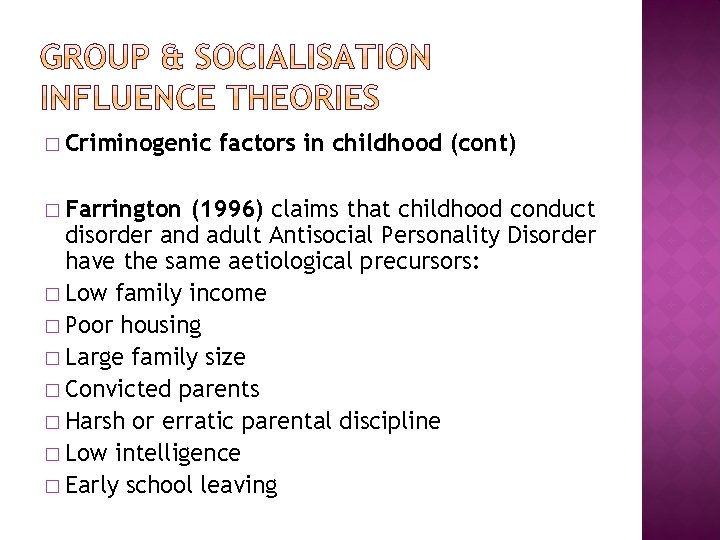
� Criminogenic � Farrington factors in childhood (cont) (1996) claims that childhood conduct disorder and adult Antisocial Personality Disorder have the same aetiological precursors: � Low family income � Poor housing � Large family size � Convicted parents � Harsh or erratic parental discipline � Low intelligence � Early school leaving
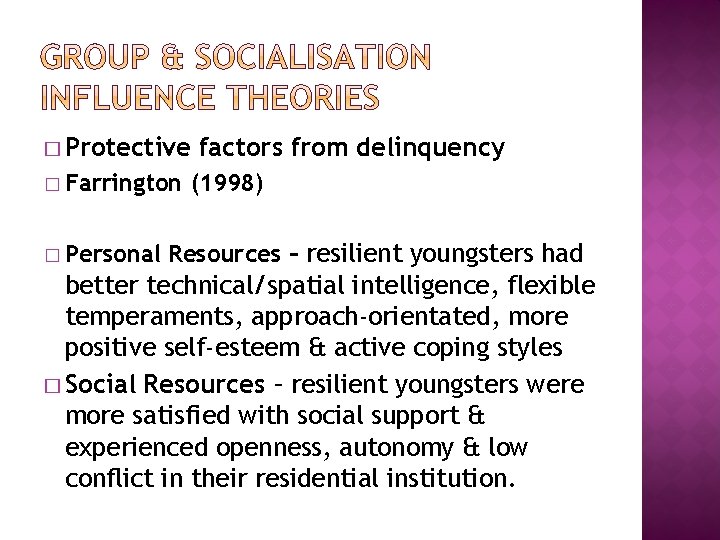
� Protective � Farrington � Personal factors from delinquency (1998) Resources – resilient youngsters had better technical/spatial intelligence, flexible temperaments, approach-orientated, more positive self-esteem & active coping styles � Social Resources – resilient youngsters were more satisfied with social support & experienced openness, autonomy & low conflict in their residential institution.
� Personality Theories � Biological Theories � Attachment Theory � Isomorphism hypothesis
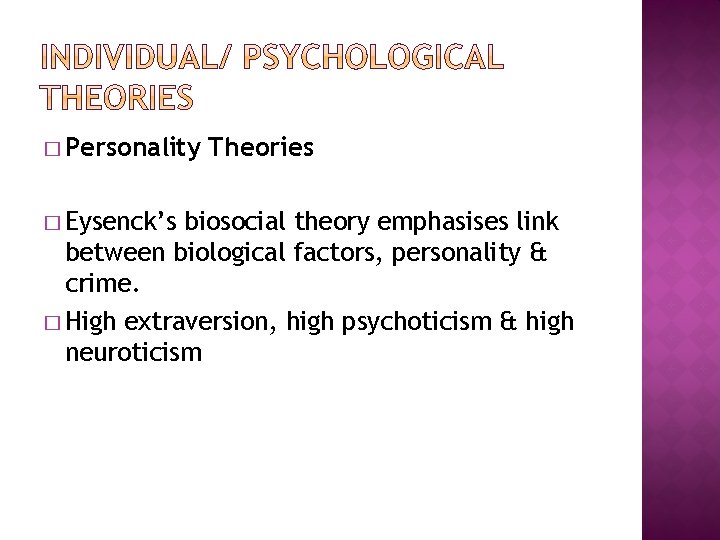
� Personality � Eysenck’s Theories biosocial theory emphasises link between biological factors, personality & crime. � High extraversion, high psychoticism & high neuroticism
� Biological Theories � Genetics e. g. genetic make-up, brain activity, hormonal imbalances � Evolutionary theory – inherited genes � Body shape type: mesomorph, endomorph & ectomorph � Evidence is contradictory and controversial
� Attachment theory � Based on John Bowlby’s work in 1950 s � Bonding & attachment in infancy & early childhood � Internal Working Model � Different types of attachment: Secure and � Insecure � Ainsworth (1970 s)- classified insecure into � Anxious-Avoidant, Anxious-Ambivalent & Disorganised
� Isomorphism hypothesis � Close relationship between the characteristics of abuse and its effect on the victim. � Widom (1989) explored links between childhood abuse and adult criminality. Victims of physical abuse have highest rates of violent offences (16% of sample) Victims of neglect had similar levels of violence (13%) Controls (not abused as children) had 7% risk of violent offending in adulthood Hence, evidence is inconclusive & other factors need to be taken into consideration (see previous list re criminogenic factors) � �
� Howitt (2006) summarises that there is little reliable evidence of the link between intelligence level and crime. � Controversial topic as also linked to the debate about race and intelligence.
� Constructions � Social � Cultural � Historical of crime
� Media coverage – recent Jimmy Saville case & other cases of paedophilia/ child sexual abuse/ abusers � Extreme hostility & negative stigma towards paedophiles � Recidivism comparatively low � Megan’s law (USA) Megan abducted & murdered in 1994 � Controversial & inconclusive research on role of pornography & sexual offending � Internet paedophiles
� paedophiles � Rapists & child molesters (cover in lecture 4 on Tues 20 th Nov)
� Classifications of child molesters (Groth & Birnbaum, 1978) � Fixated Offenders � Developmentally fixated on a permanent or temporary basis. Sexual interest in children rather than adults.
� Regressed � Men Offenders matured in their sexuality but return to an earlier level of psychosexual development. � Psychosexual history shows primary interest in peer aged or adult individuals, rather than younger ones
� How common is paedophilia? � Unclear as depends on definition of sexual abuse used e. g. indecent assault, gross indecency, buggery, intercourse, rape. � Non-paedophile sexual arousal – conflicting findings (Hall et al, 1995) � Youthful offenders � Graves et al (1996) in USA found that up to half of child sexual abuse carried out by persons under age of 21
� Theories of Paedophilia � Preconditions model � Psychotherapeutic/ cognitive model � Sexualisation model � Pathways model
� Preconditions model of child molestation Araji & Finkelhor (1985) � 1) Emotional congruence with children (lack selfesteem, psychosocially immature, may have need to dominate) � 2) Social arousal by children (child pornography, hormonal abnormalities/ imbalances) � 3) Blockages preventing adult contact (lack effective social skills, problems relating to adult females, repressive sexual socialisation in childhood) � 4) Disinhibition of norms against adult/child sex (offenders may be senile, alcohol may decrease inhibitions, incest-tolerant subculture) �
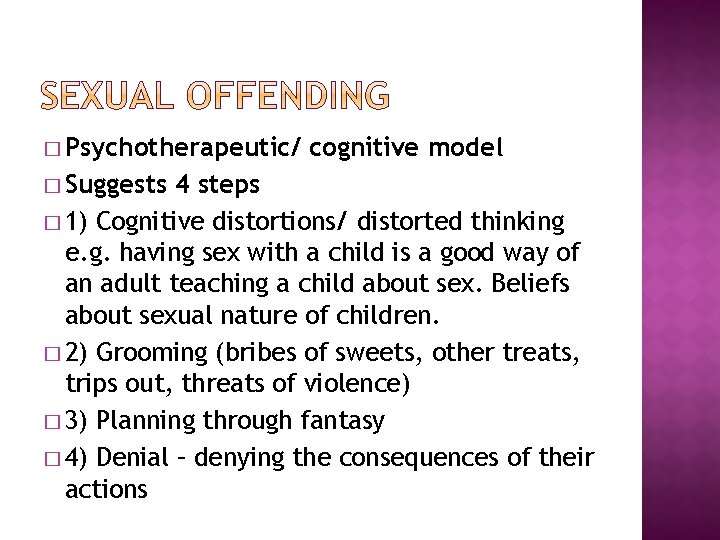
� Psychotherapeutic/ � Suggests cognitive model 4 steps � 1) Cognitive distortions/ distorted thinking e. g. having sex with a child is a good way of an adult teaching a child about sex. Beliefs about sexual nature of children. � 2) Grooming (bribes of sweets, other treats, trips out, threats of violence) � 3) Planning through fantasy � 4) Denial – denying the consequences of their actions
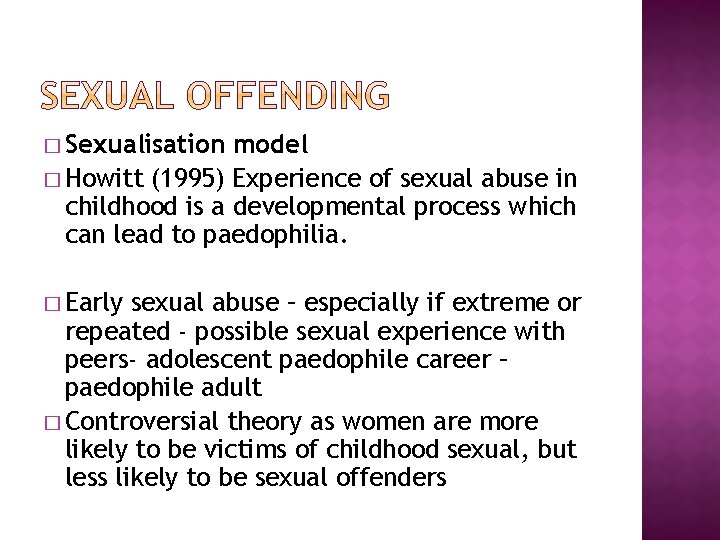
� Sexualisation model � Howitt (1995) Experience of sexual abuse in childhood is a developmental process which can lead to paedophilia. � Early sexual abuse – especially if extreme or repeated - possible sexual experience with peers- adolescent paedophile career – paedophile adult � Controversial theory as women are more likely to be victims of childhood sexual, but less likely to be sexual offenders
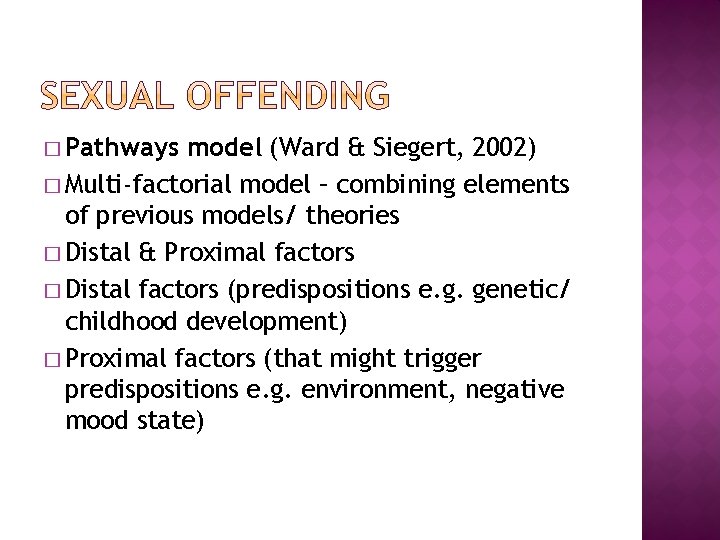
� Pathways model (Ward & Siegert, 2002) � Multi-factorial model – combining elements of previous models/ theories � Distal & Proximal factors � Distal factors (predispositions e. g. genetic/ childhood development) � Proximal factors (that might trigger predispositions e. g. environment, negative mood state)
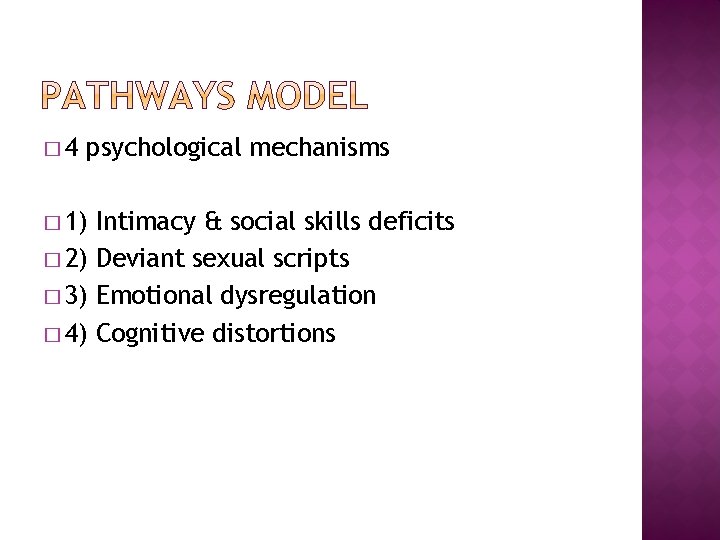
� 4 psychological mechanisms � 1) Intimacy & social skills deficits � 2) Deviant sexual scripts � 3) Emotional dysregulation � 4) Cognitive distortions
� Children as sexual objects � Entitlement- to have their sexual needs met � Dangerous world – children seen as reliable & trusting & gives offender comfort against danger � Uncontrollable – claims not to be on control of own actions & blames outside factors e. g. drugs/ alcohol � Nature of Harm – believes not all sexual activity is harmful & children can benefit from sexual activity with adults
� Internet Paedophile offending � Controversial topic – whether linked to contact paedophilia or not � Robbins & Darlington (2003) 27, 000 people in the world go onto child pornography sites every day. I million images of child sexual abuse in circulation. � Internet chat rooms � Sexual fantasy vs contact sexual acts with children
� Risk Assessment � Theories � Sexual of crime Offending – paedophiles & child molestation
� Murphy, W. D. & Mc. Grath, R. (2008). � Best Practices in Sex Offender Treatment, Prison Service Journal, issue 178, pgs 3 -9. � Strickland, S. M (2008). Female Sex Offenders: Exploring Issues of Personality, Trauma and Cognitive Distortions, J Interpers Violence 2008; 23; p. 474 -489. � Towl, G. J. , Farrington. , D. P. , Crighton, D. A. & Hughes, G. (2008). Dictionary of Forensic Psychology, Devon, Willan Publishing. � Ward. T. & Stewart, C. (2003). The relationship between human needs and criminogenic needs, Psychology, Crime & Law, September 2003, Vol. 9(3), pp. 219 /224

� No Lecture on Mon 19 th Nov � Rapists � Treatment of Sexual offenders � Violent Offending
- Slides: 42