
Dr Ahmed Fathalla Ibrahim TRANSVERSE SECTION T 1
Dr. Ahmed Fathalla Ibrahim
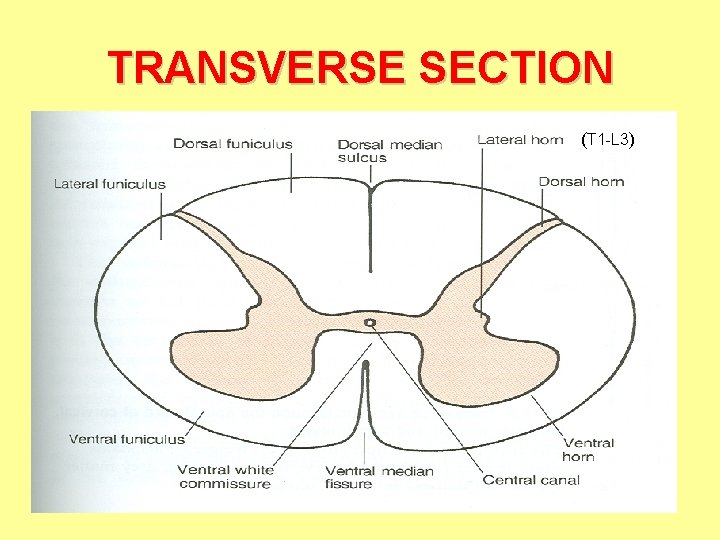
TRANSVERSE SECTION (T 1 -L 3)
GREY MATTER OF SPINAL CORD • DORSAL HORN: contains sensory neurones • VENTRAL HORN: contains motor neurones (lower motor neurones): 1. Alpha motor neurones: innervate extrafusal muscle fibers 2. Gamma motor neurones: innervate intrafusal muscle fibers • LATERAL HORN (T 1 -L 3): contains autonomic neurones
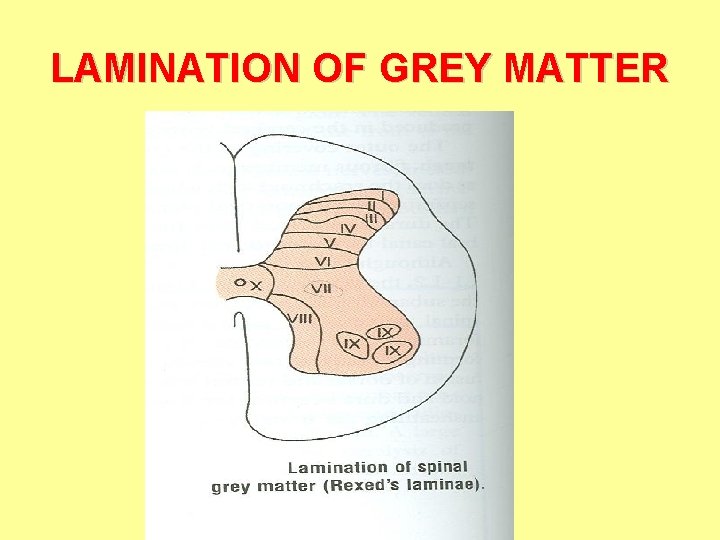
LAMINATION OF GREY MATTER
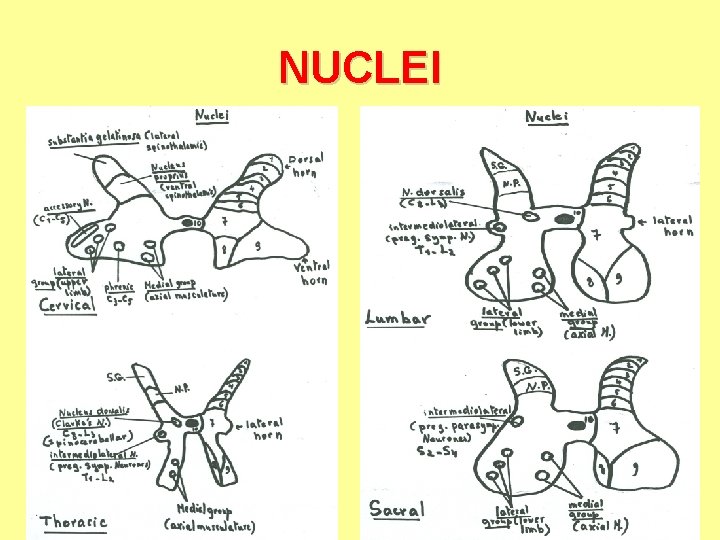
NUCLEI
NUCLEI OF DORSAL HORN Substantia gelatinosa: • • • Site: tip of dorsal horn, laminae I-III Level: all levels Function: contains second order neurones for pathway of pain & temperature sensations from the body to sensory cortex (lateral spinothalamic tract)
NUCLEI OF DORSAL HORN Nucleus proprius: • Site: ventral to substantia gelatinosa, laminae IV-V • Level: all levels • Function: contains second order neurones for pathway of crude touch sensation from the body to sensory cortex (ventral spinothalamic tract)
NUCLEI OF DORSAL HORN Nucleus dorsalis (Clarke’s column): • Site: base of dorsal horn, lamina VII • Level: C 8 – L 3 • Function: contains second order neurones for pathway of proprioceptive &exteroceptive sensations to cerebellum (dorsal spinocerebellar tract)
NUCLEI OF VENTRAL HORN Medial group: • Site: medial part of ventral horn, lamina VIII • Level: all levels • Function: contains cell bodies of neurones innervating axial muscles
NUCLEI OF VENTRAL HORN Lateral group: • Site: lateral part of ventral horn, lamina IX • Level: all levels: 1. More prominent in cervical & lumbosacral segments 2. Represented by one nucleus in thoracic segments • Function: 1. In cervical & lumbosacral segments: contains cell bodies of neurones innervating limb muscles 2. In thoracic segments: contains cell bodies of neurones innervating intercostal muscles
NUCLEI OF VENTRAL HORN Phrenic nucleus: • Site: central part of ventral horn, lamina IX • Level: C 3 – C 5 • Function: contains cell bodies of neurones innervating the diaphragm
NUCLEI OF VENTRAL HORN Accessory nucleus: • Site: base of ventral horn, lamina IX • Level: C 1 – C 5 • Function: contains cell bodies of neurones innervating sternomastoid & trapezius
NUCLEI OF LATERAL HORN Intermediolateral nucleus: • Level: T 1 – L 3 • Function: contains preganglionic sympathetic neurones • N. B. : the nucleus is present in S 2 -S 4 segments (with no lateral horn) & contains preganglionic parasympathetic neurones
WHITE MATTER OF SPINAL CORD • DORSAL COLUMN (FUNICULUS) • LATERAL COLUMN (FUNICULUS) • VENTRAL COLUMN (FUNICULUS) The white matter is formed of tracts: 1. Ascending 2. Descending 3. Both ascending & descending
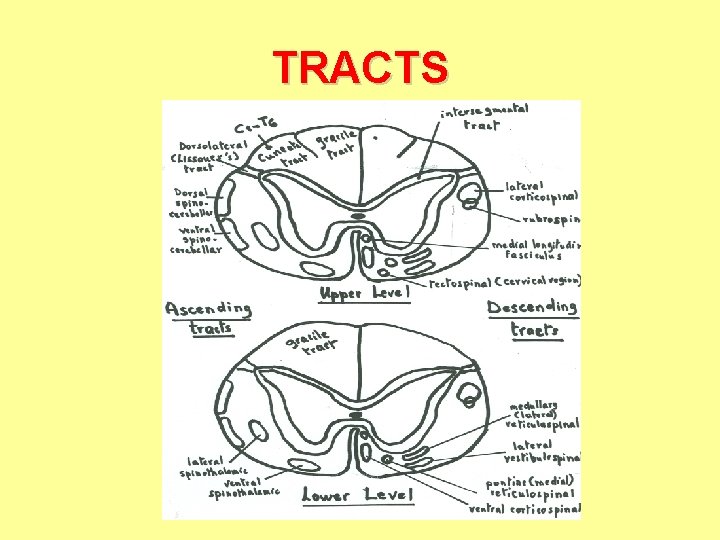
TRACTS
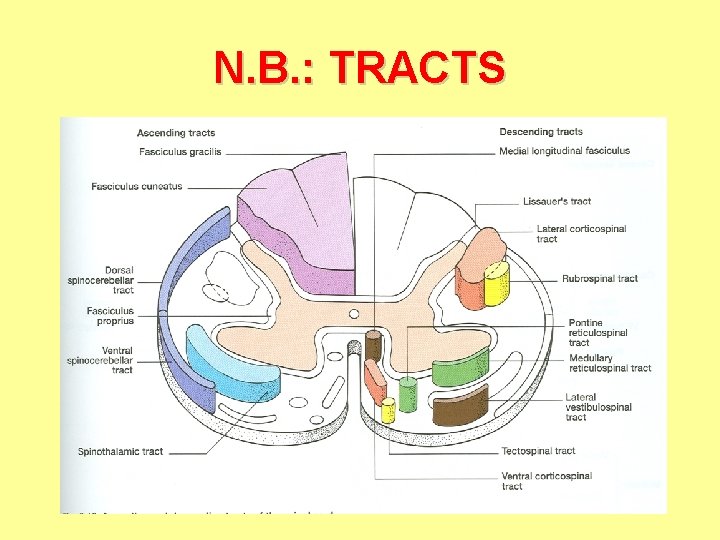
MAIN ASCENDING TRACTS DORSAL COLUMN TRACT: • Site: occupies the whole dorsal column, column gracile tract is medial to cuneate tract • Level: 1. Gracile tract: all levels 2. Cuneate tract: from T 6 to C 1 • Second order neurones: Gracile & cuneate nuclei in medulla oblongata • Types of fibers: proprioceptive & discriminative (fine) touch fibers 1. Gracile tract: from lower half of body 2. Cuneate tract: from upper half of body • Termination: sensory cortex
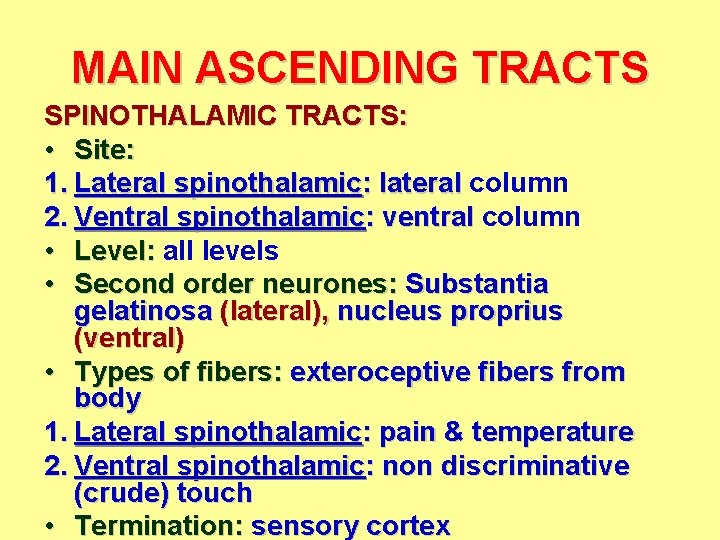
MAIN ASCENDING TRACTS SPINOTHALAMIC TRACTS: • Site: 1. Lateral spinothalamic: lateral column 2. Ventral spinothalamic: ventral column • Level: all levels • Second order neurones: Substantia gelatinosa (lateral), nucleus proprius (ventral) • Types of fibers: exteroceptive fibers from body 1. Lateral spinothalamic: pain & temperature 2. Ventral spinothalamic: non discriminative (crude) touch • Termination: sensory cortex
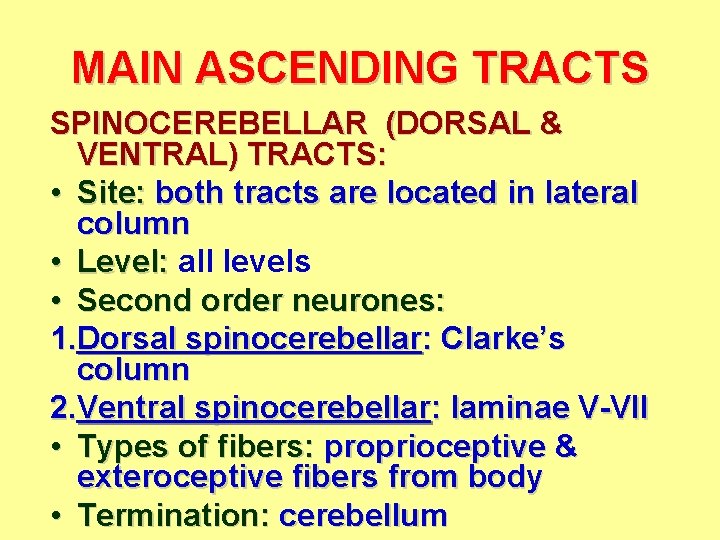
MAIN ASCENDING TRACTS SPINOCEREBELLAR (DORSAL & VENTRAL) TRACTS: • Site: both tracts are located in lateral column • Level: all levels • Second order neurones: 1. Dorsal spinocerebellar: Clarke’s column 2. Ventral spinocerebellar: laminae V-VII • Types of fibers: proprioceptive & exteroceptive fibers from body • Termination: cerebellum
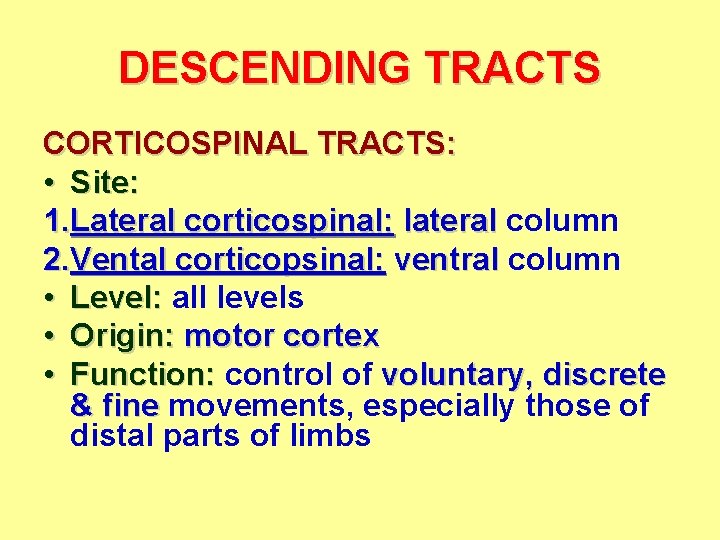
DESCENDING TRACTS CORTICOSPINAL TRACTS: • Site: 1. Lateral corticospinal: lateral column 2. Vental corticopsinal: ventral column • Level: all levels • Origin: motor cortex • Function: control of voluntary, discrete & fine movements, especially those of distal parts of limbs
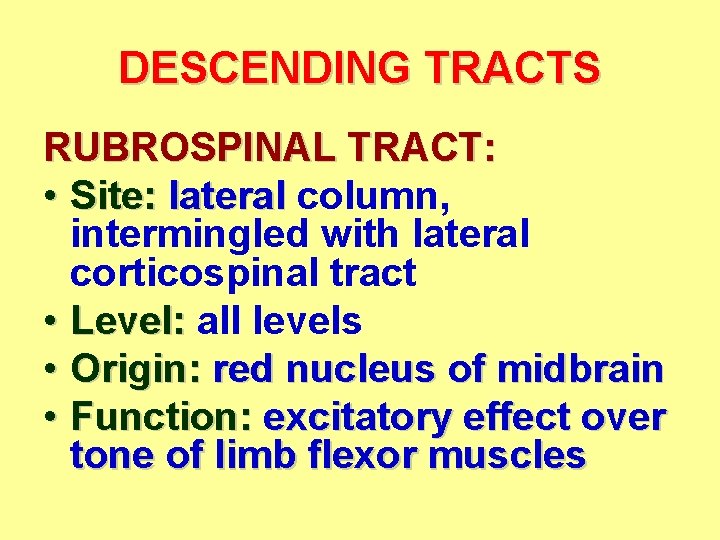
DESCENDING TRACTS RUBROSPINAL TRACT: • Site: lateral column, intermingled with lateral corticospinal tract • Level: all levels • Origin: red nucleus of midbrain • Function: excitatory effect over tone of limb flexor muscles
DESCENDING TRACTS TECTOSPINAL TRACT: • Site: ventral column • Level: in cervical region • Origin: superior colliculus of midbrain • Function: mediates reflex movements in response to visual stimuli
DESCENDING TRACTS VESTIBULOSPINAL TRACTS: • Site: both tracts are located in ventral column • Level: all levels • Origin: 1. Lateral vestibulospinal: lateral vestibular nucleus in pons & medulla 2. Medial vestibulospinal: forms the descending fibers of the medial longitudinal fasciculus • Function: control body posture & balance
DESCENDING TRACTS RETICULOSPINAL TRACTS: • Site: both tracts are located in ventral column • Level: all levels • Origin: 1. Medial reticulospinal: pontine reticular formation 2. Lateral reticulospinal: medullary reticular formation 3. Function: inhibitory or excitatory effect on muscle tone
BOTH ASCENDING & DESCENDING TRACTS • FASCICULUS PROPRIUS (INTERSEGMENTAL TRACT): occupies a narrow band immediately peripheral to grey matter, serves for coordination between upper & lower limb mucles • LISSAUER’S TRACT: lies superficial to the tip of dorsal horn, by the help of this tract, exteroceptive fibers can establish synaptic contacts over several segments of spinal cord
N. B. : TRACTS
N. B. : TRACTS ASCENDING: 1. Dorsal column: contains only dorsal column tracts 2. Ventral column: contains ventral spinothalamic tract 3. Lateral column: contains the rest of tracts DESCENDING: 1. All desending tracts are present in ventral column EXCEPT: lateral corticospinal & rubrospinal tracts (present in lateral column) column 2. No descending tract present in dorsal column
N. B. : TRACTS • All ascending tracts have same first order neurones: cells of dorsal root ganglion • All descending tracts have same termination: cells of ventral horn (lower motor neurones)
- Slides: 27