
Dr Ahmed Fathalla Ibrahim OLFACTORY PATHWAY OLFACTORY PATHWAY
Dr. Ahmed Fathalla Ibrahim

OLFACTORY PATHWAY
OLFACTORY PATHWAY • Composed of two neurones • Only sensory pathway that does not project via thalamus
OLFACTORY PATHWAY q. First Order Neurone: ciliated nerve cells in olfactory epithelium of nasal cavity § Axons (olfactory nerve fibers) enter cranial cavity through cribriform plate of ethmoid to reach the olfactory bulb
OLFACTORY PATHWAY q. Second Order Neurone: mitral cells in olfactory bulb § Axons form the olfactory tract that passes backward on inferior surface of frontal lobe then divides (just before reaching optic chiasma) into 3 stria (lateral, intermediate & medial) § Most of fibers run in lateral olfactory stria (in depth of lateral fissure) & terminate in Primary Olfactory Cortex (Uncus)
OLFACTORY PATHWAY § Primary Olfactory cortex is connected to the Olfactory Association Cortex (anterior part of parahippocampal gyrus or entorhinal cortex) § Both Primary & Association cortex are called Pyriform Cortex
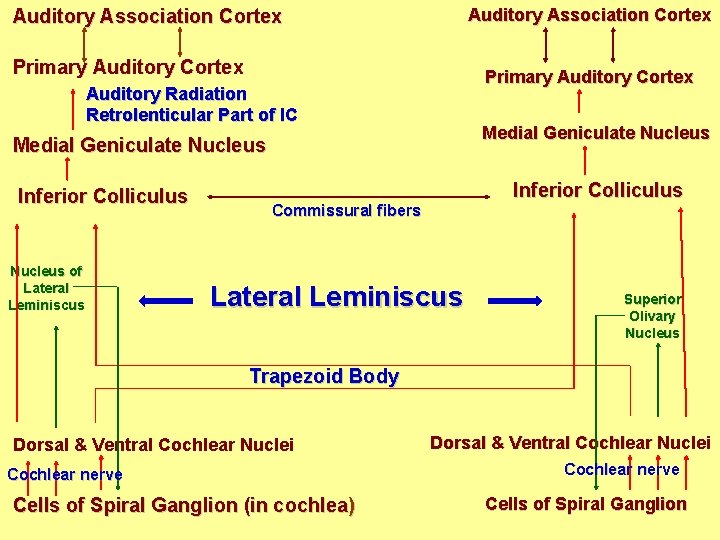
Auditory Association Cortex Primary Auditory Cortex Auditory Radiation Retrolenticular Part of IC Medial Geniculate Nucleus Inferior Colliculus Nucleus of Lateral Leminiscus Inferior Colliculus Commissural fibers Lateral Leminiscus Superior Olivary Nucleus Trapezoid Body Dorsal & Ventral Cochlear Nuclei Cochlear nerve Cells of Spiral Ganglion (in cochlea) Dorsal & Ventral Cochlear Nuclei Cochlear nerve Cells of Spiral Ganglion
NOTES ON AUDITORY PATHWAY • Cochlear nerve makes dendritic contact with hair cells of Organ of Corti (in Cochlear Duct) • Superior Olivary Nucleus & Nucleus of Lateral Leminiscus: modulate transmission of auditory information to cochlear nerve by: 1. Sending inhibitory fibers through vestibulocochlear nerve ending in Organ of Corti 2. Establishing connection with motor neurones supplying tensor tympani & stapedius muscles
NOTES ON AUDITORY PATHWAY • Representation of cochlea is bilateral at all levels rostral to cochlear nuclei
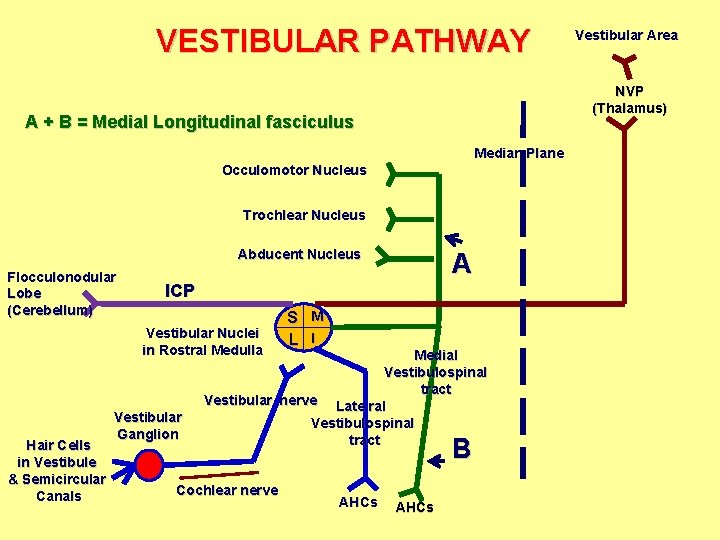
VESTIBULAR PATHWAY NVP (Thalamus) A + B = Medial Longitudinal fasciculus Median Plane Occulomotor Nucleus Trochlear Nucleus Abducent Nucleus Flocculonodular Lobe (Cerebellum) Hair Cells in Vestibule & Semicircular Canals A ICP Vestibular Nuclei in Rostral Medulla Vestibular Ganglion S M L I Medial Vestibulospinal tract Vestibular nerve Late ral Vestibulospinal tract Cochlear nerve B AHCs Vestibular Area AHCs
NOTES ON VESTIBULAR PATHWAY q. The first Order Neurones: Cells of Vestibular ganglion located in Internal Auditory Meatus q The second Order Neurones: Cells of Superior, Lateral, Medial & Inferior Vestibular Nuclei located beneath the lateral part of floor of 4 th ventricle
NOTES ON VESTIBULAR PATHWAY q. Medial Longitudinal fasciculus: formed of both descending & ascending fibers: 1. Descending (medial vestibulospinal tract) to anterior horns cells for control of body posture & balance 2. Ascending to Occulomotor, Trochlear & Abducent Nuclei (Motor Nuclei for extraoccular muscles for coordination of head & eye movements
NOTES ON VESTIBULAR PATHWAY q. Vestibular area: 1. Located in the lower part of postcentral gyrus (head area) 2. Responsible for conscious awareness of vestibular sensation
- Slides: 13