
Dr Ahmed Fathalla Ibrahim NOTOCHORD NOTOCHORD NOTOCHORD 1
Dr. Ahmed Fathalla Ibrahim

NOTOCHORD
NOTOCHORD
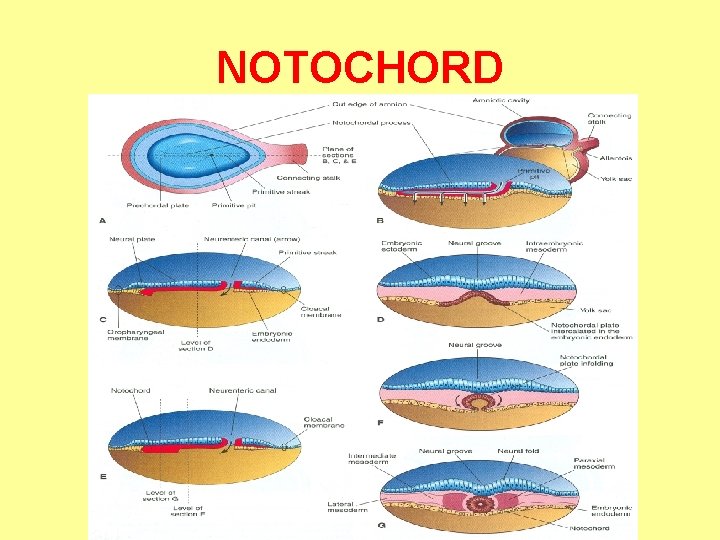
NOTOCHORD • • 1. 2. 3. 4. DEFINITION: Notochord is a solid cylinder of intra-embryonic mesoderm extending in the midline of the trilaminar embryonic disc from the primitive node to the prochordal plate IMPORTANCE: Stimulates formation of vertebral column Indicates the site of vertebral bodies Forms the nucleus pulposus of the intervertebral disc Stimulates formation of neural tube

FORMATION OF NEURAL TUBE
NEURULATION: FORMATION OF NEURAL TUBE • Occurs after development of notochord • Neural plate: a thickening of the ectoderm overlying notochord • By the end of 3 rd week, the lateral edges of the neural plate becomes elevated to form the neural folds while the depressed median region forms the neural groove • The neural folds gradually approach each other in the midline & finally fuse (in cephalo-caudal direction) • The neural groove is converted into neural tube • The neural tube soon separates from the surface ectoderm that forms a layer over the neural tube. • Neurulation is completed during the 4 th week
NEURAL CREST • Some ectodermal cells lying along the crest of each neural fold lose their connection to neighboring cells & form the neural crest • Neural crest form a flattened mass between the neural tube & surface ectoderm • Neural crest soon separates into right & left parts that migrate to the dorsolateral aspects of the neural tube
DERIVATIVES OF NEURAL TUBE 1. 2. 3. 4. 5. Brain Spinal cord Retina of the eye Posterior lobe of pituitary gland Pineal body
DERIVATIVES OF NEURAL CREST 1. Sensory ganglia of spinal nerves (dorsal root ganglia) 2. Sensory ganglia of cranial nerves 3. Autonomic ganglia 4. Neurolemmal sheath (Schwann cells) of peripheral nerves 5. The pia & arachnoid mater 6. The cells of suprarenal medulla 7. The pigment cells (melanoblasts) of the skin 8. Chromaffin tissue 9. Several skeletal & muscular components in the head
DERIVATIVES OF SURFACE ECTODERM 1. Epidermis of skin 2. Derivatives of epidermis: hairs, nails epithelial cells of sebaceous, sweat & mammary glands 3. Lens of eye 4. Anterior lobe of pituitary gland 5. Epithelium of sensory organs in the ear & nose 6. Enamel of teeth
- Slides: 10