
DR ABHISHEK SINGH PARIHAR FELLOWSHIP IN REPRODUCTIVE MEDICINE

DR. ABHISHEK SINGH PARIHAR • FELLOWSHIP IN REPRODUCTIVE MEDICINE & IVF, CRAFT Hospital, Cochin • Ultrasound training from Craft hospital, Cochin, Kerala and Institute of Ultrasound Training, Delhi • MS Obs & Gyne, RGUHS Bangalore (2008) • MBBS Pondicherry University (2003) AREAS OF CLINICAL INTEREST � Reproductive Medicine, IVF, Andrology Member : � Federation of Obstetrics and Gynecological societies of India (FOGSI) � Ghaziabad Obsterics and Gynecological society � Gynecological Endocrine Society of India (GESI) � Indian Medical Association (IMA), Ghaziabad branch � Delhi Gynecologist’s Forum (DGF) � Indian Fertility Society (IFS) Invited as guest speaker at various societies & Conferences Executive member, Ghaziabad Obs & Gynec Society
INTRAUTERINE INSEMINATION DR. ABHISHEK SINGH PARIHAR M. S. ( OBS & GYNAE), FELLOW REPRODUCTIVE MEDICINE. CONSULTANT : Life care IVF Center, New Delhi Abalone Clinic, Maternity & Fertility Center, NOIDA
INFERTILITY � Infertility is defined classically as the inability to conceive after 1 year of unprotected and regular intercourse. This definition is based on the cumulative probability of pregnancy.
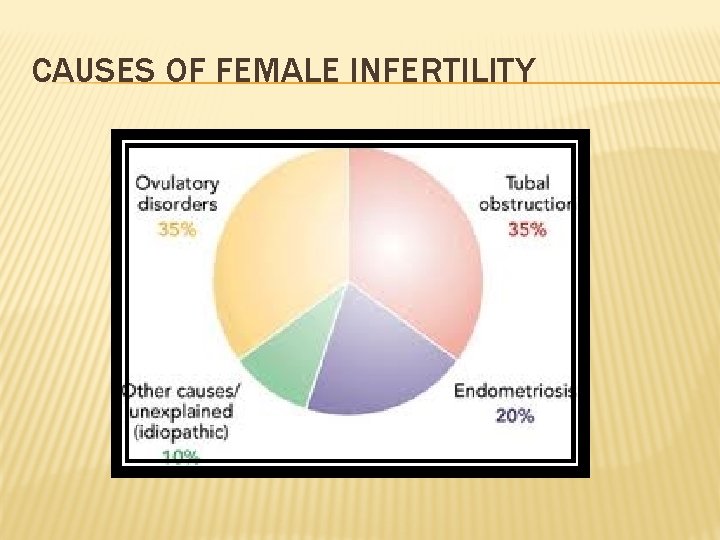
CAUSES OF FEMALE INFERTILITY
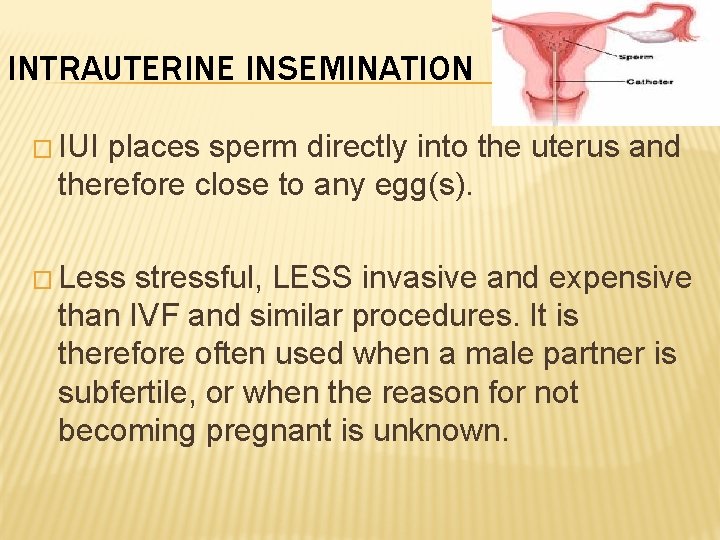
INTRAUTERINE INSEMINATION � IUI places sperm directly into the uterus and therefore close to any egg(s). � Less stressful, LESS invasive and expensive than IVF and similar procedures. It is therefore often used when a male partner is subfertile, or when the reason for not becoming pregnant is unknown.
HISTORY Oldest assisted reproductive technique � Most widely used worldwide � A I techniques were first investigated in the 17 th century, as a treatment for infertility related to male sexual dysfunction (e. g. the inability to ejaculate). � Dutch scientists first reported conception following artificial insemination in 1742, when they successfully fertilised the eggs of fish, by artificially inseminating female fish with fish sperm. � Human insemination began in the late 18 th century � Instrument called the Fecondateur, a syringe to assist insemination, was developed in 1866. �
History of IUI As a technique: • Direct intrauterine insemination (neat semen) - Disadvantage: Abandoned - PG cramps (Stone et al, - Infection. 1986) • Split ejaculate • The advances in IVF, ET. reviving IUI.
Reviving the interest in IUI Advances in: • Progress in semen processing and sperm isolation methods. + • Improved ovarian stimulation protocols (developed primarily to meet IVF requirements) side effects. IUI progress is due to advances in IVF, ET.
Advantages of IUI • Bypass ( Vaginal acidity + cervical mucus • • hostility) Deposition of a well prepared sperms as close as possible to the oocytes (Short distance) Non invasive Inexpensive. Antenatal & perinatal complications ( similar to pregnancies from normal S I)
STEPS OF IUI � Patient selection and work-up � Ovarian stimulation � Monitoring of follicular growth and endometrial development � Timing of insemination � Number of inseminations � Semen preparation � Insemination procedure � Luteal support
PREREQUISITES � Age < 40 years � Patient capable of spontaneous or induced ovulation � Atleast one patent fallopian tube with good tubo- ovarian relationship � Sperm count of more than 10 million/ml pre-wash or a post-wash count of >3 -5 million motile sperms with percentage motility of more than 40% � Easy access to the uterine cavity via a negotiable cervical canal
Controlled ovarian stimulation along with intrauterine insemination –effective form of treatment - select group of couples.
INDICATIONS � Male factor � Female factor
MALE FACTOR Subnormal semen parameters Oligozoospermia, Asthenozoospermia, Teratozoospermia, Hypospermia, Highly viscous semen � Retrograde ejaculation. � Ejaculatory failure� Anatomical � Neurological � Psychological � Drug induced �
FEMALE FACTOR � Unexplained infertility � Cervical factor ( Cervical mucus hostility, poor cervical mucus ) , Antisperm antibodies � Ovulatory dysfunction (ovulating but no pregnancy and associated with male factor. ESHRE/ASRM) � Minimal to mild endometriosis � Vaginismus � Allergy to seminal plasma � HIV serodiscordant couples
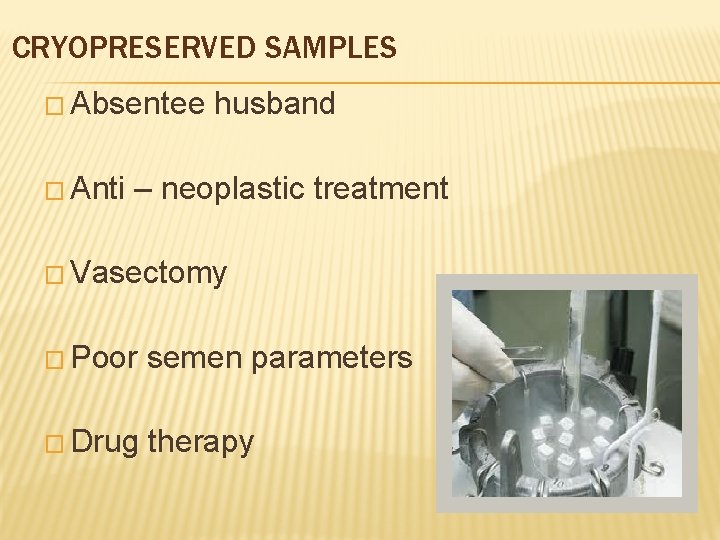
CRYOPRESERVED SAMPLES � Absentee husband � Anti – neoplastic treatment � Vasectomy � Poor semen parameters � Drug therapy
IUI WITH DONOR SPERM � Severe abnormal semen parameters ( OAT ). � Azoospermia ( OA – CBAVD, NOA) � Hereditary disease in male partner. � Repeated failure at IVF/ICSI. � Infectious disease in male partner( HIV). � Severe Rh incompatibility � Single Women
CONTRAINDICATIONS � Tubal pathology � Genital tract infection � Severe male factor infertility � Severe endometriosis � Genetic abnormality in husband � Unexplained genital tract bleeding � Older women more than 40 years � Multiple failures at IUI
OVULATION INDUCTION � Oral drugs with gonadotropins � Gonadotropins alone � Gonadotropins with Gnrh analogs � Gonadotropins with Gnrh antagonists
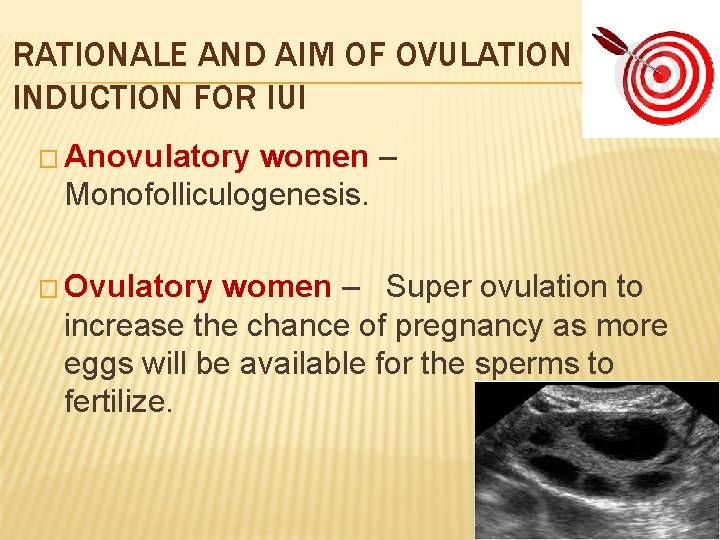
RATIONALE AND AIM OF OVULATION INDUCTION FOR IUI � Anovulatory women – Monofolliculogenesis. � Ovulatory women – Super ovulation to increase the chance of pregnancy as more eggs will be available for the sperms to fertilize.
IDEAL OVARIAN STIMULATION PROTOCOL? ? � Maximizes conception- ideally expressed as singleton live birth at term. � Minimizes multiple pregnancy and OHSS. � Avoiding risks of preterm delivery, perinatal morbidity and mortality to the neonate and risks to the mother from OHSS
OVULATION TRIGGER � HCG � Gnrh AGONIST � Recombinant HCG. � Routine administration of HCG adds little to improving conception rates. Indicated only when absent or delayed ovulation or for timing IUI or intercourse. (Fertil steril 2007)
SEMEN PREPARATION TECHNIQUES � Standard sperm wash � Swim up � Swim down method � Density gradient
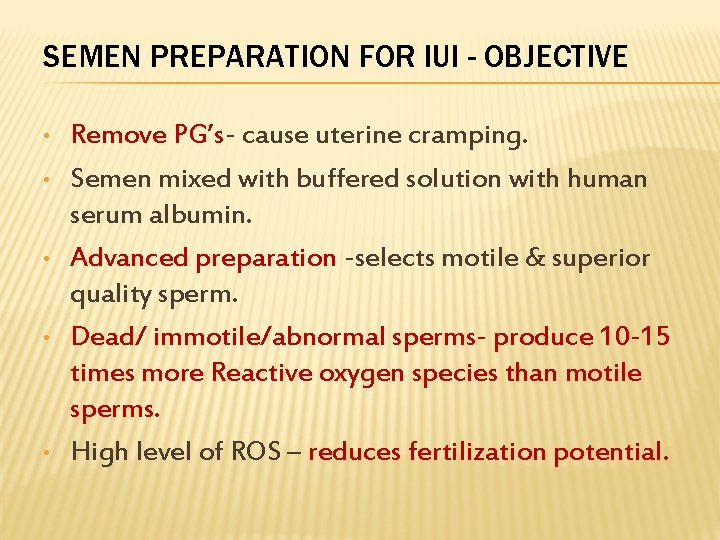
SEMEN PREPARATION FOR IUI - OBJECTIVE • • • Remove PG’s- cause uterine cramping. Semen mixed with buffered solution with human serum albumin. Advanced preparation -selects motile & superior quality sperm. Dead/ immotile/abnormal sperms- produce 10 -15 times more Reactive oxygen species than motile sperms. High level of ROS – reduces fertilization potential.
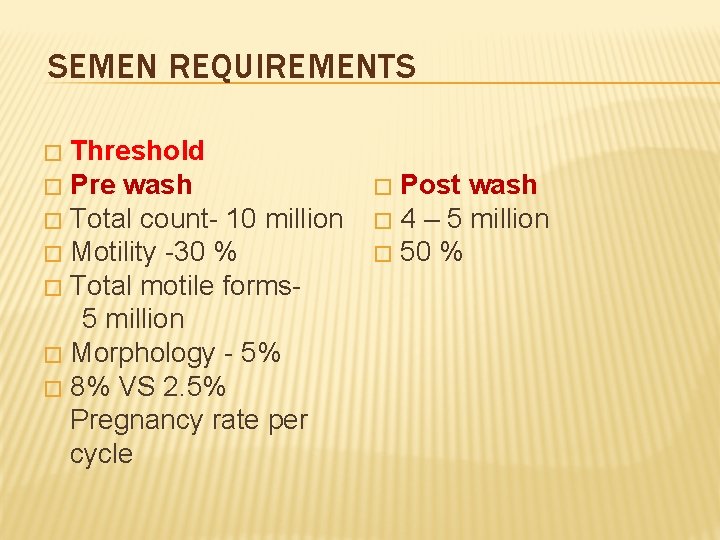
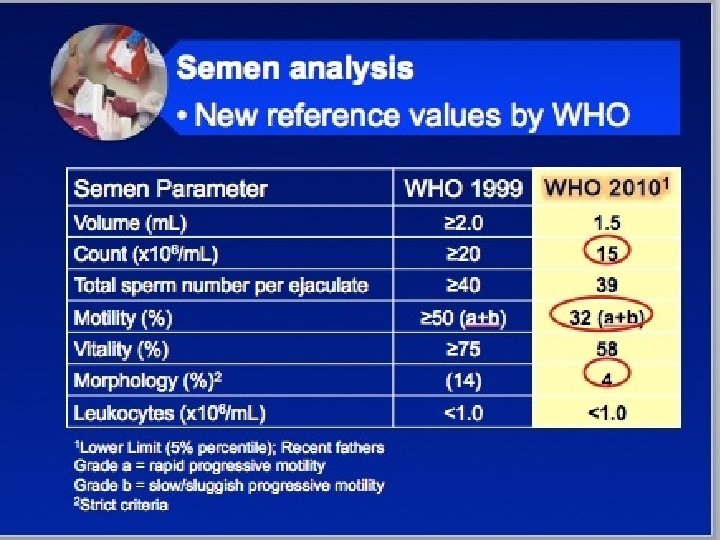
SEMEN REQUIREMENTS Threshold � Pre wash � Total count- 10 million � Motility -30 % � Total motile forms- 5 million � Morphology - 5% � 8% VS 2. 5% Pregnancy rate per cycle � Post wash � 4 – 5 million � 50 % �
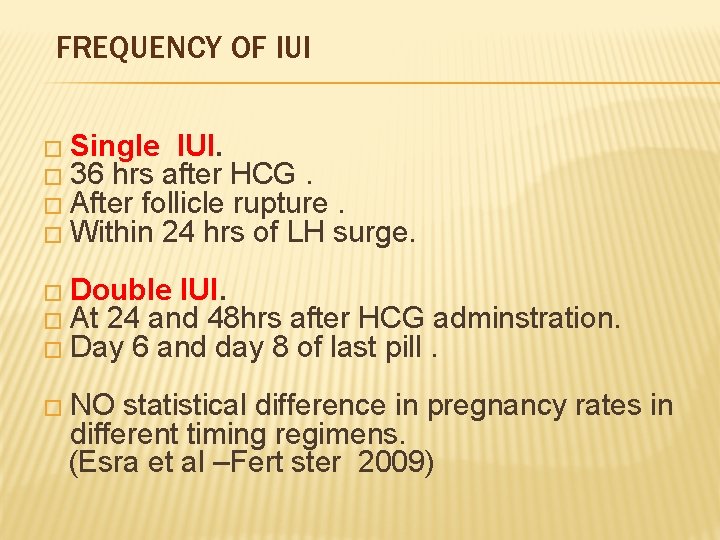
FREQUENCY OF IUI � Single IUI. � 36 hrs after HCG. � After follicle rupture. � Within 24 hrs of LH surge. � Double IUI. � At 24 and 48 hrs after HCG adminstration. � Day 6 and day 8 of last pill. � NO statistical difference in pregnancy rates in different timing regimens. (Esra et al –Fert ster 2009)
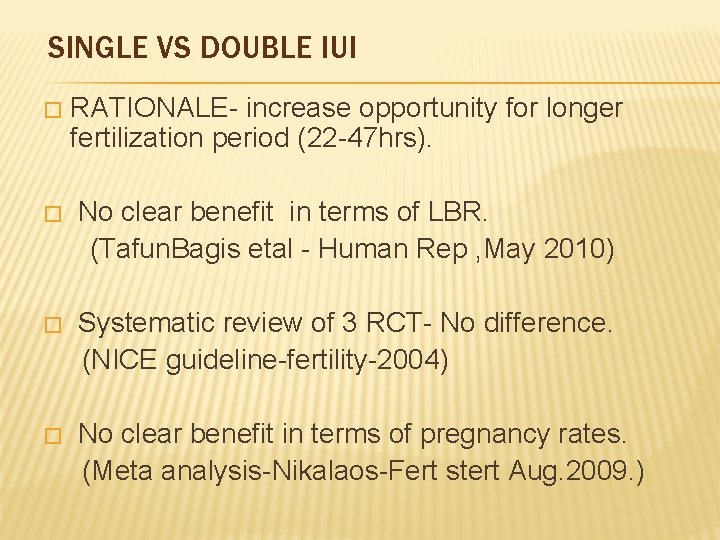
SINGLE VS DOUBLE IUI � RATIONALE- increase opportunity for longer fertilization period (22 -47 hrs). No clear benefit in terms of LBR. (Tafun. Bagis etal - Human Rep , May 2010) � Systematic review of 3 RCT- No difference. (NICE guideline-fertility-2004) � No clear benefit in terms of pregnancy rates. (Meta analysis-Nikalaos-Fert stert Aug. 2009. ) �
TIMING OF IUI � Pre- ovulatory USG. Fresh unwashed semen - 6 -8 hrs before ovulation. Washed semen – No sooner than 4 hrs after ovulation. Cryopreserved semen – As close to ovulation. � LH testing kit. Within 24 hrs of color change.
METHODS OF AI � Intra vaginal insemination � Intra cervical insemination � Intra uterine tuboperitoneal insemination � Direct intra peritoneal insemination � Fallopian tube perfusion.
IUI PROCEDURE
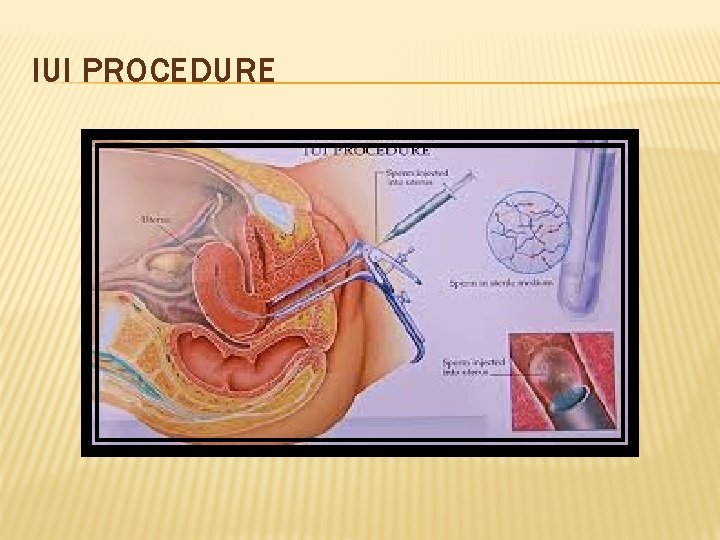
IUI PROCEDURE � The patient is positioned. � Cervix exposed with cuscos bivalve speculum, excessive vaginal secretions are wiped away and the cervical os is cleansed with the standard buffer solution using a cotton swab. � IUI cannula is flushed with 1 -2 ml of flushing media to wash away any toxic factors present.
� Specimen ( 0. 4 - 0. 5 ml) drawn into the catheter and syringe. � The catheter is gently introduced into the cervix to pass beyond cervical os until the catheter enters the uterus. � The catheter is advanced to a depth of at least 4 cm but no more than 6 cm to avoid trauma to the endometrium � When the catheter is in place and before ejecting the specimen , the opened forceps is positioned on either side of the cervix and the opposing ends gently squeezed together with just enough pressure to prevent fluid escaping.
� The specimen is slowly ejected from the syringe. � The air remaining in the syringe is expressed as the catheter is withdrawn, to form an air block in the cervix. � Pressure on the forceps should be maintained until the cramping subsides, usually within one minute
ROLE OF BED REST AFTER IUI 15 min of bed rest after IUI has shown to improve ongoing pregnancy and LBR (RCT-Custers etal BMJ 2009).
LUTEAL SUPPORT � Luteal support in IVF cycles is associated with increased pregnancy rates � Luteal support is necessary when Gnrh agonist, hcg and antagonist is used. � Luteal support in the form of various forms of progesterone and HCG can be given depending on the clinical situation.
LUTEAL SUPPORT � Oral dydrogesterone 10 mg BD from day of IUI. � Micronized progesterone 100 mg BD vaginally. � Inj. Hcg 3000 iu i. m. once every 3 days. � Role of estradiol is not clearly defined.
SUCCESS RATES � 08 -14% per cycle for all causes of infertility. � Semen parameters- Count , Motility and Morphology (Van et al—Fert & Ster 2001) (Lee et al –Int. J. Andr, 2002)
Factors affecting success of IUI Couple: (Age, Duration of infertility, Cause of infertility, BMI). Treatment: • Semen processing technique. • Protocol of COH. • Timing of insemination.
PROGNOSTIC FACTORS � Age � Semen source and quality � No of follicles � Reason for treatment � Previous treatment cycles
COMPLICATIONS � Failure of treatment � Pelvic infection: 0. 01 -0. 2% � Uterine contractions and anaphylaxis � OHSS < 1% � Multiple pregnancy � Ectopic pregnancy � Miscarriages � Pain and vaso vagal attack
CONCLUSION While many gynecologists offer IUI office procedure, many of them are not specialized enough to provide a comprehensive service. This means that: 1. Patients need to run from gynecologist to ultrasound scan center to the lab. 2. Fragmented care because of poor coordination. SO An ideal clinic is that which offers all the services under one roof.
THANK YOU !!
- Slides: 44