
DPT 321 INJECTION MOULD DESIGN Centre for Diploma
- Slides: 16
DPT 321 INJECTION MOULD DESIGN Centre for Diploma Studies Part Defect
COURSE CONTENT & COURSE OUTCOMES COURSE CONTENT Chapter 7: Part Defect DEFINE, DESCRIBE and EXPLAIN the volumetric shrinkage of parts, and IDENTIFY the sources of warpage and warpage avoidance strategies. DESCRIBE and EXPLAIN the other part defects likes flash, bubbles, shot short, black spot, mould release fault, sink mark, weld line and silver streaks. COURSE OUTCOMES CO 1 Able to solve plastic injection moulding problem during process and designing part, and solve the part defect. DPT 321 INJECTION mould DESIGN
DPT 321 INJECTION MOULD DESIGN DEFECT FACTORS
DEFECT FACTORS In plastic injection moulding, the moulded part produced are higher potential to have a plastics defects. These defects may be due to: moulds/part design moulds fabrication process, moulds material, plastic materials (resin), machine parameters and others
DPT 321 INJECTION mould DESIGN MOULDING
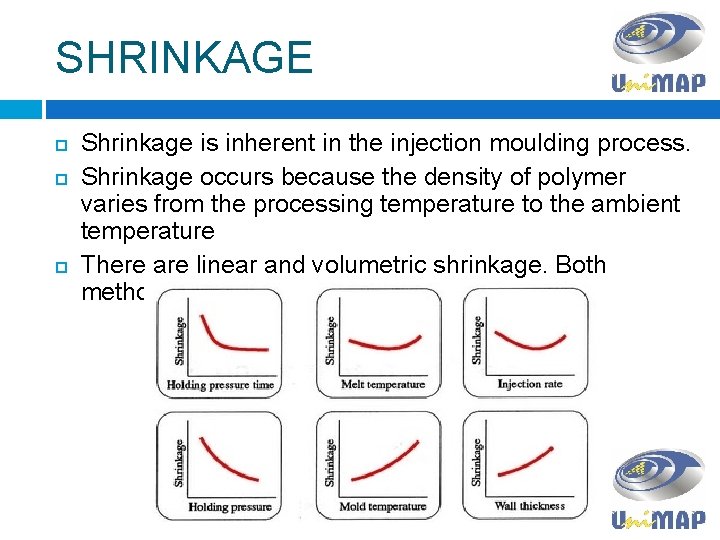
SHRINKAGE Shrinkage is inherent in the injection moulding process. Shrinkage occurs because the density of polymer varies from the processing temperature to the ambient temperature There are linear and volumetric shrinkage. Both methods are difficult to measure accurately.
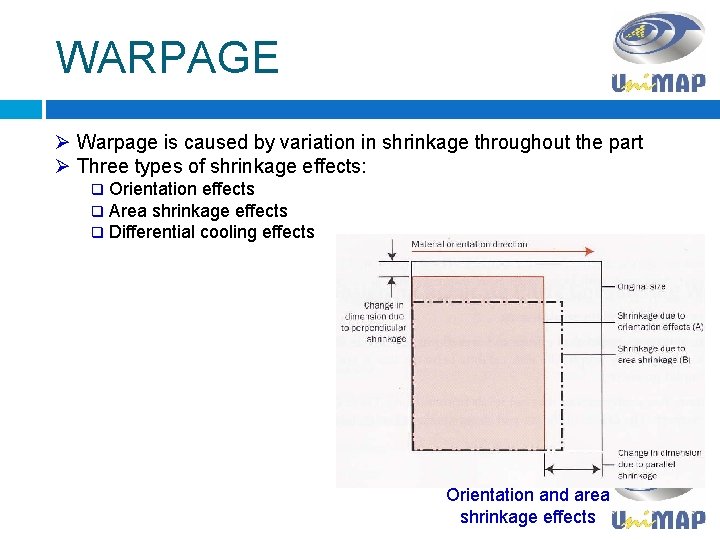
WARPAGE Ø Warpage is caused by variation in shrinkage throughout the part Ø Three types of shrinkage effects: q q q Orientation effects Area shrinkage effects Differential cooling effects Orientation and area shrinkage effects
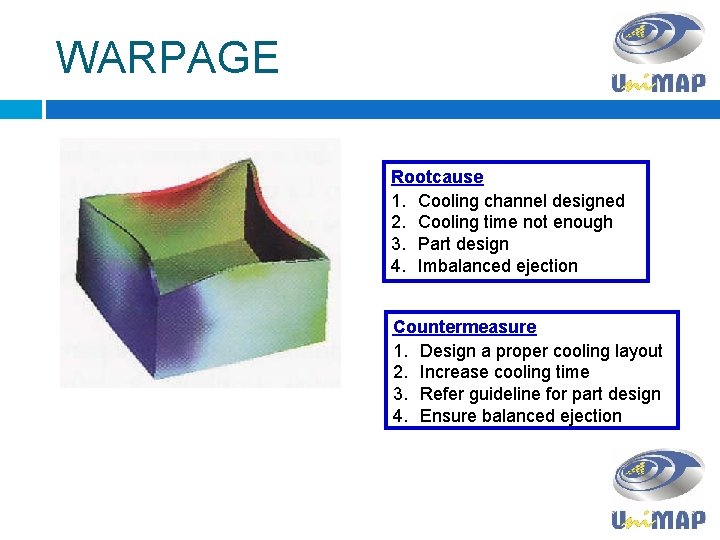
WARPAGE Rootcause 1. Cooling channel designed 2. Cooling time not enough 3. Part design 4. Imbalanced ejection Countermeasure 1. Design a proper cooling layout 2. Increase cooling time 3. Refer guideline for part design 4. Ensure balanced ejection
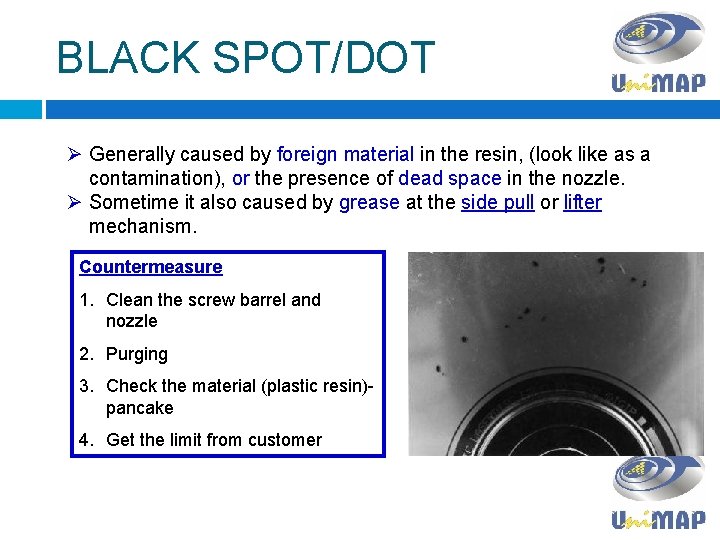
BLACK SPOT/DOT Ø Generally caused by foreign material in the resin, (look like as a contamination), or the presence of dead space in the nozzle. Ø Sometime it also caused by grease at the side pull or lifter mechanism. Countermeasure 1. Clean the screw barrel and nozzle 2. Purging 3. Check the material (plastic resin)pancake 4. Get the limit from customer
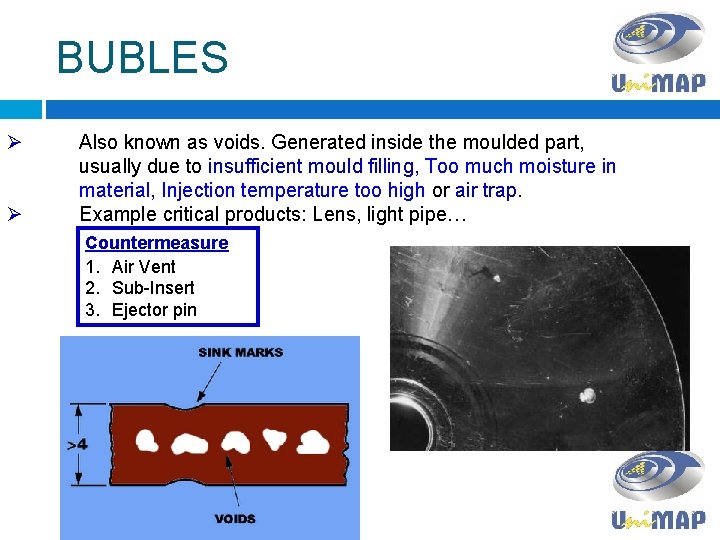
BUBLES Ø Ø Also known as voids. Generated inside the moulded part, usually due to insufficient mould filling, Too much moisture in material, Injection temperature too high or air trap. Example critical products: Lens, light pipe… Countermeasure 1. Air Vent 2. Sub-Insert 3. Ejector pin
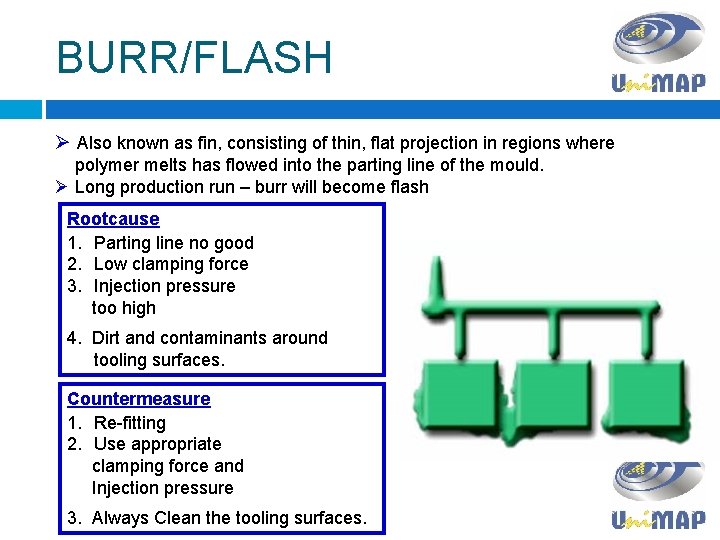
BURR/FLASH Ø Also known as fin, consisting of thin, flat projection in regions where polymer melts has flowed into the parting line of the mould. Ø Long production run – burr will become flash Rootcause 1. Parting line no good 2. Low clamping force 3. Injection pressure too high 4. Dirt and contaminants around tooling surfaces. Countermeasure 1. Re-fitting 2. Use appropriate clamping force and Injection pressure 3. Always Clean the tooling surfaces.
MOULD RELEASE FAULT Ø Defect in the moulded part due to poor release or improper ejection from the mould. Usually caused by overfilling of mould with polymer melt and/or by insufficient draft/taper in the mould. Defect 1. Pin Mark 2. Drag/Pull Mark Countermeasure 1. Proper polishing 1. Ensure balanced ejection 2. Appropriate cooling time 3. Appropriate draft/taper Rootcause 1. Pin Mark q Improper polishing q Unbalanced ejection q Cooling time not enough 2. Drag/Pull Mark q Improper polishing q Draft/taper not enough
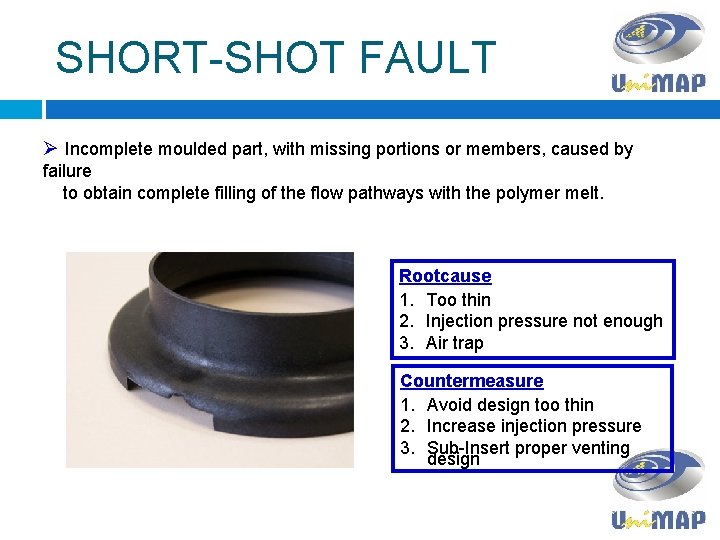
SHORT-SHOT FAULT Ø Incomplete moulded part, with missing portions or members, caused by failure to obtain complete filling of the flow pathways with the polymer melt. Rootcause 1. Too thin 2. Injection pressure not enough 3. Air trap Countermeasure 1. Avoid design too thin 2. Increase injection pressure 3. Sub-Insert proper venting design
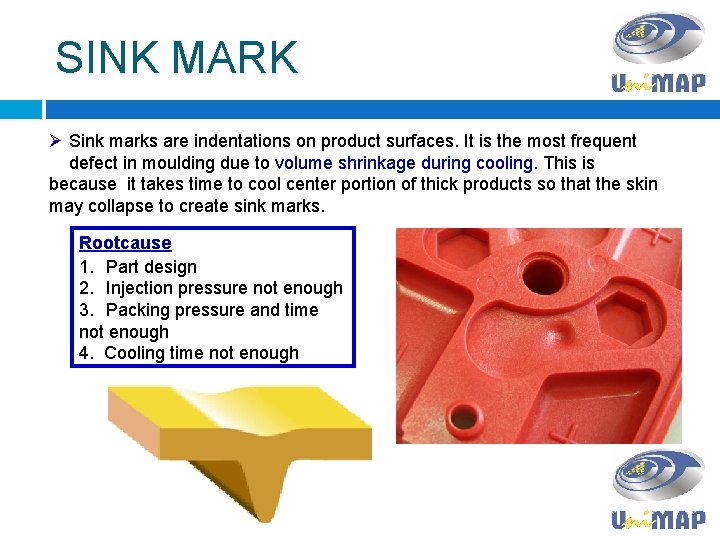
SINK MARK Ø Sink marks are indentations on product surfaces. It is the most frequent defect in moulding due to volume shrinkage during cooling. This is because it takes time to cool center portion of thick products so that the skin may collapse to create sink marks. Rootcause 1. Part design 2. Injection pressure not enough 3. Packing pressure and time not enough 4. Cooling time not enough
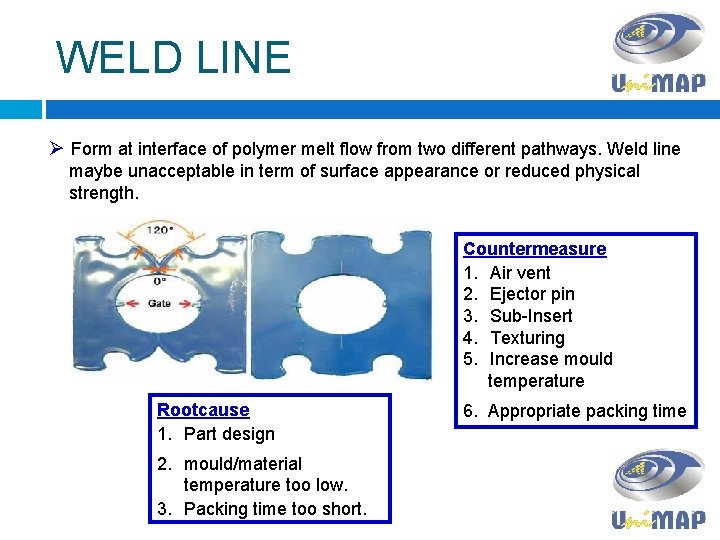
WELD LINE Ø Form at interface of polymer melt flow from two different pathways. Weld line maybe unacceptable in term of surface appearance or reduced physical strength. Countermeasure 1. Air vent 2. Ejector pin 3. Sub-Insert 4. Texturing 5. Increase mould temperature Rootcause 1. Part design 2. mould/material temperature too low. 3. Packing time too short. 6. Appropriate packing time
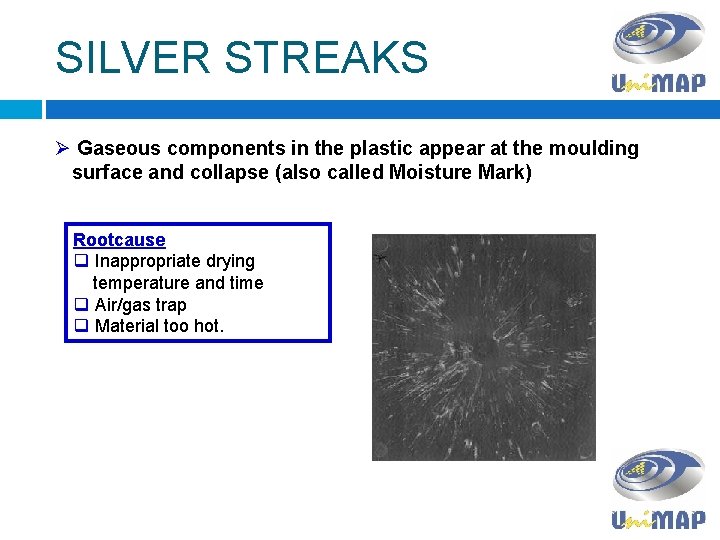
SILVER STREAKS Ø Gaseous components in the plastic appear at the moulding surface and collapse (also called Moisture Mark) Rootcause q Inappropriate drying temperature and time q Air/gas trap q Material too hot.