
DPS 601 GLOBAL SUPPLY CHAIN MANAGEMENT MBA PROGRAMME
DPS 601: GLOBAL SUPPLY CHAIN MANAGEMENT MBA PROGRAMME BY: MAGUTU O. P Department Of Management Science School Of Business SEPT DEC 2011
TOPIC ONE: GLOBALIZATION AND ITS IMPLICATIONS
Outline Globalisation and its implications Thinking globally, acting locally The new organisational paradigm Some Global Strategies Globalization drivers - Why Companies Go Global? Consequences Of Globalization Managing the supply chain of the future 3
Introduction In today’s global economy, firms must decide ◦ where to locate productive activities ◦ what the long-term strategic role of foreign production sites should be ◦ whether to own foreign production activities or outsource those activities ◦ how to manage a globally dispersed supply chain and what the role of Internet-based information technology should be in the management of global logistics ◦ whether to manage global logistics or outsource
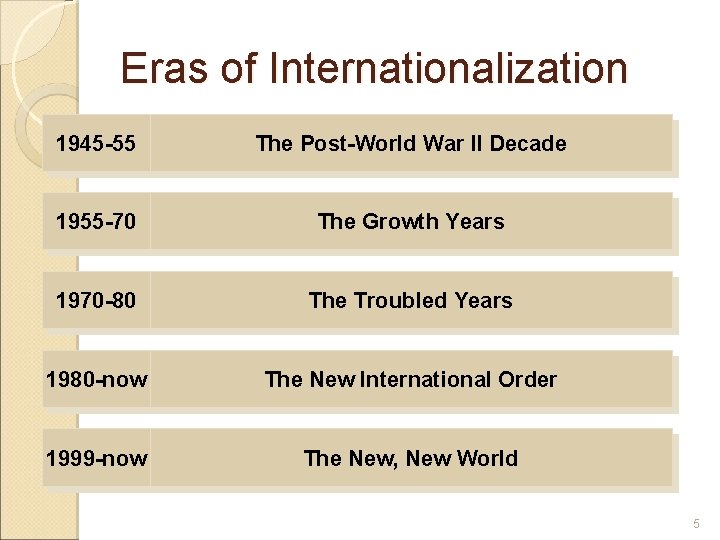
Eras of Internationalization 1945 -55 The Post-World War II Decade 1955 -70 The Growth Years 1970 -80 The Troubled Years 1980 -now The New International Order 1999 -now The New, New World 5
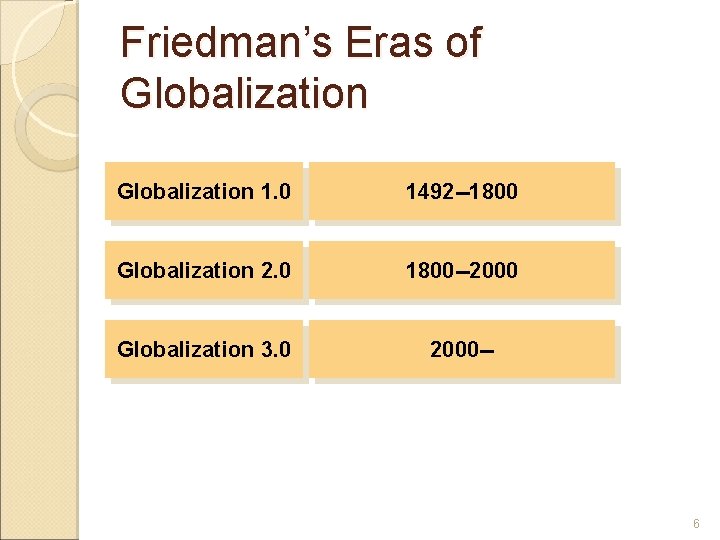
Friedman’s Eras of Globalization 1. 0 1492 --1800 Globalization 2. 0 1800 --2000 Globalization 3. 0 2000 -- 6
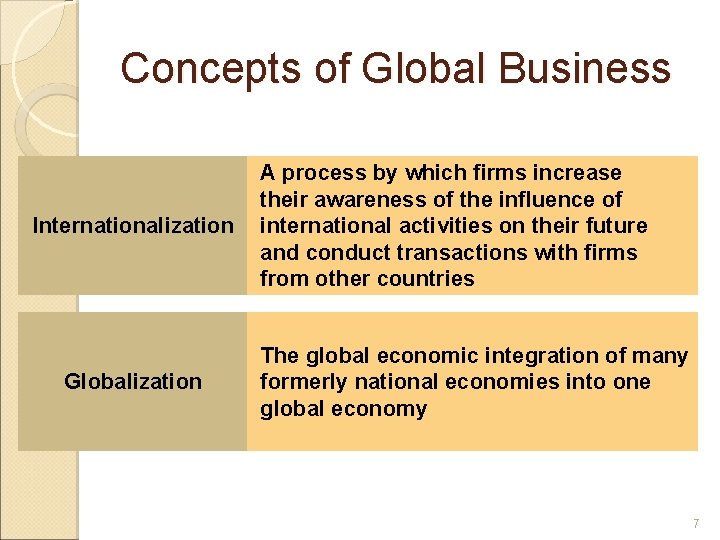
Concepts of Global Business Internationalization Globalization A process by which firms increase their awareness of the influence of international activities on their future and conduct transactions with firms from other countries The global economic integration of many formerly national economies into one global economy 7
The new global manager Managers are responsible for utilizing human, financial, informational, and physical resources in ways that facilitate their organization’s overall objectives in turbulent and sometimes hostile environments about which they often understand very little. These challenges can be particularly problematic when operations cross national boundaries. 8
Strategy, Production, and Logistics Question: How can production and logistics be conducted internationally to 1. lower the costs of value creation 2. add value by better serving customer needs? Production refers to activities involved in creating a product Logistics refers to the procurement and physical transmission of material through the supply chain, from suppliers to customers
Strategy, Production, and Logistics The strategic objectives of the production and logistics function are ◦ to lower costs ◦ to increase product quality by eliminating defective products from both the supply chain and the manufacturing process These two objectives are interrelated
Some Global Strategies International business - engages in cross- border transactions Multinational Corporation - has extensive involvement in international business, owning or controlling facilities in more than one country Global company - integrates operations from different countries, and views world as a single marketplace Transnational company - seeks to combine the benefits of global-scale efficiencies with the benefits of local 11
Some Global Strategies ◦ International Strategy: uses exports and licenses to penetrate the global area ◦ Multidomestic Strategy: uses decentralized authority with substantial autonomy at each business ◦ Global Strategy: Uses a high degree of centralization, with headquarters coordinating to seek standardization and learning between plants ◦ Transnational Strategy: Exploits economies of scale and learning, as well as pressure for responsiveness, by recognizing that core competencies reside everywhere in the 12
Globalisation Trends Worldwide cross-border trade is estimated to increase from US$5. 9 trillion in 1999 to US$8. 4 trillion in 2005. 51 of the 100 largest economies in the world are corporations, not countries. Wal-mart is bigger than Indonesia, NTT is bigger than Ireland. Global brands now dominate most markets: Coca- cola, IBM, Toyota, etc. These companies seek to extend its markets worldwide whilst seeking costreductions through scale economies by sourcing globally 13
What is globalization? Globalization is the inexorable integration of markets, capital, nation-states, and technologies to a degree never seen before. -- Thomas Friedman 14
Why the upsurge in globalization? Globalization drivers Increased customer demands and access to competing products and services. Increased technological innovation and application. Increased power and influence of emerging markets and economies. Shared R&D and global sourcing. Increased globalization of financial markets. Evolving government trade policies. Global trade liberalisation; Trade barriers diminishing Multi-national companies evolving into real global organisations Production out-sourcing to lower cost regions Improved logistics infrastructure and operations (pp. 5 -6) 15
Forces toward Globalization Global market forces. Technological forces. Global cost forces. Political and economic forces.
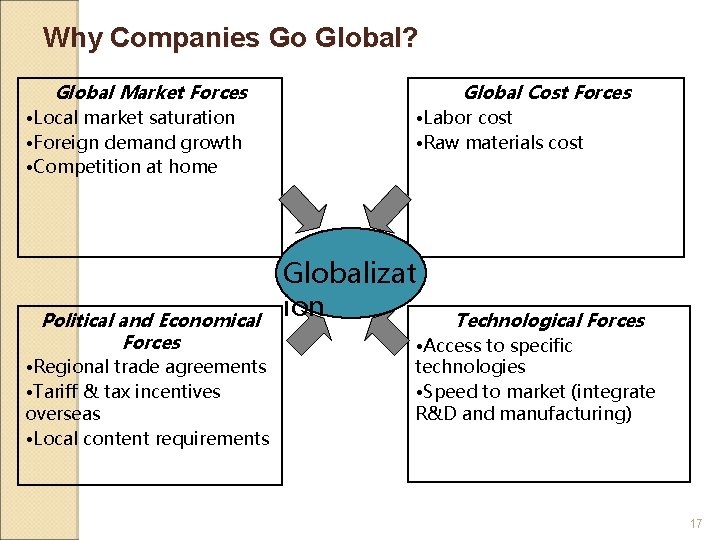
Why Companies Go Global? Global Market Forces • Local market saturation • Foreign demand growth • Competition at home Political and Economical Forces • Regional trade agreements • Tariff & tax incentives overseas • Local content requirements Global Cost Forces • Labor cost • Raw materials cost Globalizat ion Technological Forces • Access to specific technologies • Speed to market (integrate R&D and manufacturing) 17
Global market forces: Political & economical forces: Technological Forces: “Access to special technologies” -- e. g. India & China -- IT/software technologies Taiwan -- Electrical & computer engineering “Integrating R&D and manufacturing” -- Many companies outsource manufacturing to Asian countries. It may be necessary to have R&D locally. Why? 1. Use local human resources for R&D; 2. Speed to market, easier to integrate with manufacturing
Global Market Forces Pressures created by foreign competitors, as well as the opportunities created by foreign customers. Presence of foreign competitors in home markets can affect their business significantly. Much of the demand growth available to companies is in foreign and emerging markets. Increasing demand for products throughout the world through the global proliferation of information.
Global Market Forces “Foreign demand growth” -- In 1970, US market accounted for 40% of the world market. Today it is less than 30%. This is not that US market is shrinking in the absolute term. Many developing countries have a faster growing demand for world-wide products. “Competition at home” -- foreign companies penetration at home market forces to “retaliate” and have presence at the competitor’s countries E. g. European & American auto-makers have significant presence at each other’s markets
Global Market Forces Particular markets often serve to drive technological advances in some areas. Companies forced to develop and enhance leading-edge technologies and products. Such products can be used to increase or maintain market position in other areas or regions where the markets are not as competitive
Technological Forces Related to the products Various subcomponents and technologies available in different regions and locations Successful firms need to use these resources quickly and effectively. Locate research, design, and production facilities close to these regions. Frequently collaborate, resulting in the location of joint facilities close to one of the partners. Global location of research-and-development facilities driven by two main reasons: ◦ As product cycles shrink, locate research facilities close to manufacturing facilities. ◦ Specific technical expertise may be available in certain areas or regions
Technological Forces “Regional trade agreement” -- e. g. NAFTA -- north American free trade zone (US, Canada, Mexico) -- eliminates cross-border trade barriers & tariffs “Tariff & tax incentives” -- e. g. China has many free-tariff industrial parks to encourage foreign companies to operate within the park. “Local content requirements” -- A certain percentage of the value added must be produced inside the country. So if you want to export products to a country, you may have to open factories in that countries. E. g. Intel & TI have semiconductor facilities in Europe.
Technological Forces “Access to special technologies” -- e. g. India & China -- IT/software technologies Taiwan -- Electrical & computer engineering “Integrating R&D and manufacturing” -- Many companies outsource manufacturing to Asian countries. It may be necessary to have R&D locally. Why? 1. Use local human resources for R&D; 2. Speed to market, easier to integrate with manufacturing
Global Cost Forces Often dictate global location decisions Costs of cheaper unskilled labor more than offset by the increase in other costs associated with operating facilities in remote locations. In some cases cheaper labor is sufficient justification for overseas manufacturing. Other global cost forces have become more significant ◦ Cheaper skilled labor is drawing an increasing number of companies overseas.
Political and Economic Forces Exchange rate fluctuation Regional trade agreements Tariff system Trade protection mechanisms More subtle regulations ◦ Local content requirements ◦ Voluntary export restrictions ◦ Government procurement policies
CONSIDER: WHAT ARE THE CONSEQUENCES OF GLOBALIZATION? 1. 2. 3. What are some of the positive consequences of globalization? What are some of the negative consequences? How can managers and their companies work to mitigate these negative consequences? 27
But…Global Operations are Not Simple • Issues & risks in global supply chains: -- Infrastructure in developing countries -- Cultural, language, labor skill differences -- Government stability, legal systems, regulations -- Currency exchange rate fluctuation -- Duties & tariffs -- Different corporate tax rates -- Import/export quotas -- Local content rules -- Product design issues (local customer needs) -- Longer transportation lead times -- Quality/reliability of local suppliers 28
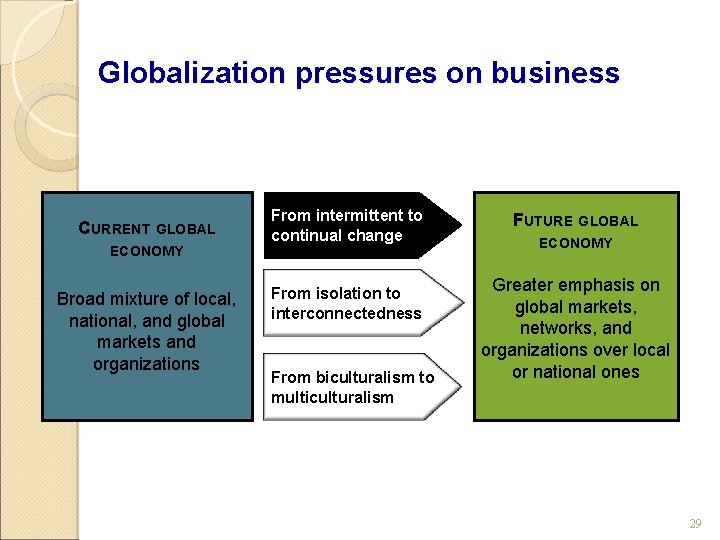
Globalization pressures on business CURRENT GLOBAL ECONOMY Broad mixture of local, national, and global markets and organizations From intermittent to continual change From isolation to interconnectedness From biculturalism to multiculturalism FUTURE GLOBAL ECONOMY Greater emphasis on global markets, networks, and organizations over local or national ones 29
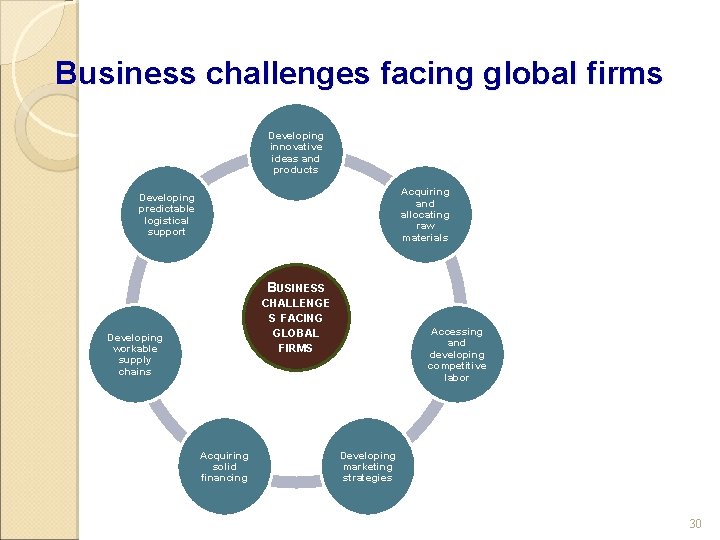
Business challenges facing global firms Developing innovative ideas and products Acquiring and allocating raw materials Developing predictable logistical support BUSINESS CHALLENGE S FACING GLOBAL FIRMS Developing workable supply chains Acquiring solid financing Accessing and developing competitive labor Developing marketing strategies 30
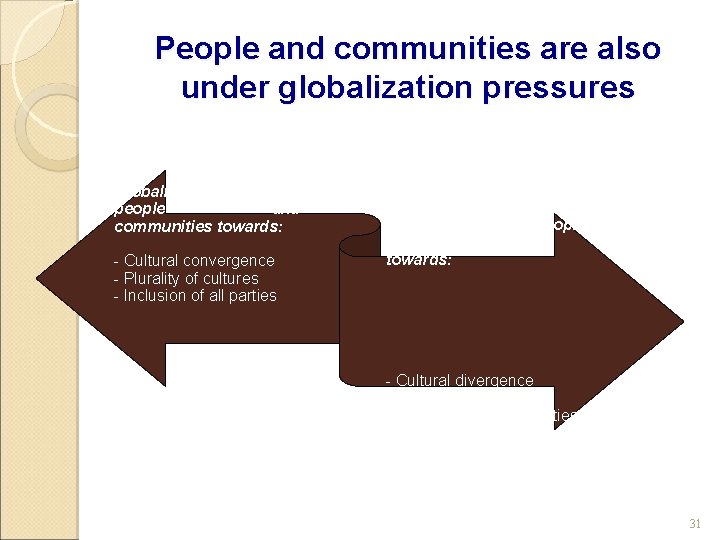
People and communities are also under globalization pressures Globalization pressures people and communities towards: - Cultural convergence - Plurality of cultures - Inclusion of all parties But also pressures people and communities towards: - Cultural divergence - Cultural pluralism - Exclusion of some parties 31
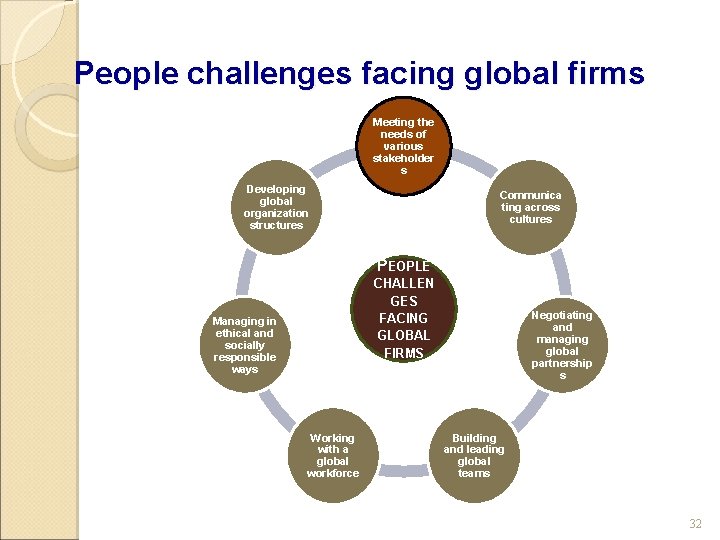
People challenges facing global firms Meeting the needs of various stakeholder s Developing global organization structures Communica ting across cultures PEOPLE CHALLEN GES FACING GLOBAL FIRMS Managing in ethical and socially responsible ways Working with a global workforce Negotiating and managing global partnership s Building and leading global teams 32
Nike: the logistics challenge of global business Nike: re-created the sport shoe as “high-tech, high-performance” products that is an icon of youth subculture, with a price to match! Core business: ◦ state-of-the-art R&D capabilities ◦ ruthless low-cost manufacturing “Air Max Penny” basketball shoe: designed in Oregon and Tennessee, manufactured in South Korea and Indonesia from 52 components sourced from Japan, South Korea, Taiwan, Indonesia and USA. (Long lead times!) Nike markets over 300 new shoe design each year, leading to costly overstocks if sales forecasts not achieved. Distribution in USA is outsourced to third-party logistics providers with IT linkage to Nike’s global sales and customer support systems, enabling sales/inventory information to be accessible to all decision makers concerned. When the supply chain is global and the products are fashionoriented, the management of logistics becomes a key determinant of business success or failure. 33
Domestic vs. Global Business What is a global business? ◦ More than just a company that exports ◦ source materials and components from more than one country ◦ geographically dispersed manufacturing/assembly locations ◦ market products worldwide 34
Challenges facing global businesses local variations in markets (consumer preferences) ◦ e. g. left-hand drive and right-hand drive cars ◦ e. g. voltage and socket variations by country ◦ production process complications complex logistics of global supply chains ◦ co-ordination of production and transportation ◦ cross-docking, merge-in-transit ◦ economies of scale --> global cost competition 35
Key Issues in Global Strategy Appropriate degree of centralisation? ◦ Management ◦ Manufacturing ◦ Distribution How can the needs of local markets be met while gaining economies of scale through standardisation? 36
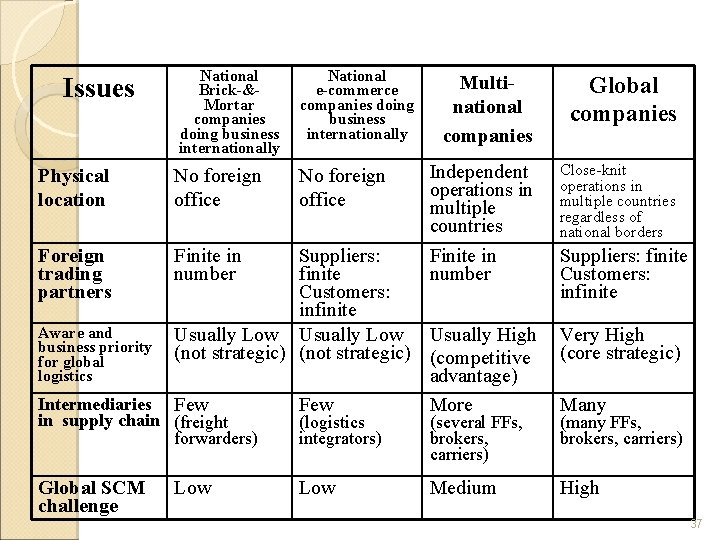
National Brick-&Mortar companies doing business internationally National e-commerce companies doing business internationally Physical location No foreign office Foreign trading partners Finite in number Issues Suppliers: finite Customers: infinite Usually Low (not strategic) Multinational companies Global companies Independent operations in multiple countries Close-knit operations in multiple countries regardless of national borders Finite in number Suppliers: finite Customers: infinite Very High (core strategic) High Intermediaries Few in supply chain (freight forwarders) Few Usually High (competitive advantage) More Global SCM challenge Low Medium Aware and business priority for global logistics Low (logistics integrators) (several FFs, brokers, carriers) Many (many FFs, brokers, carriers) 37
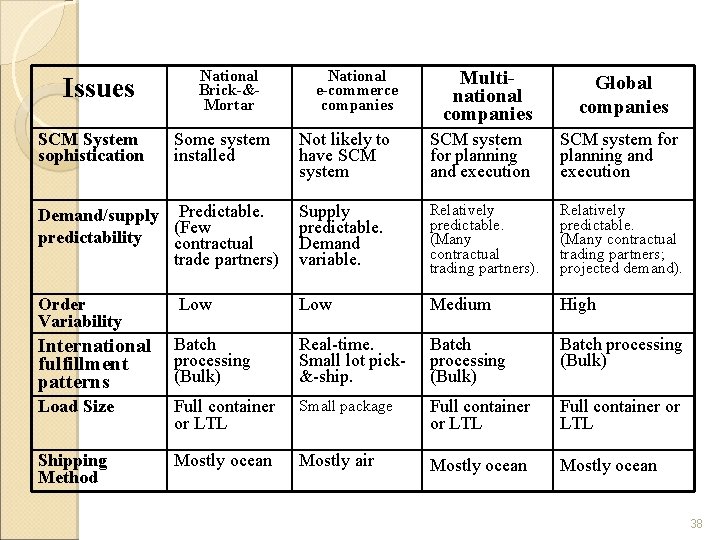
Issues SCM System sophistication National Brick-&Mortar Some system installed National e-commerce companies Multinational companies Global companies Not likely to have SCM system for planning and execution Demand/supply Predictable. (Few predictability contractual trade partners) Supply predictable. Demand variable. Relatively predictable. (Many contractual trading partners). Relatively predictable. (Many contractual trading partners; projected demand). Order Variability Low Medium High International fulfillment patterns Batch processing (Bulk) Real-time. Small lot pick&-ship. Batch processing (Bulk) Load Size Full container or LTL Small package Full container or LTL Shipping Method Mostly ocean Mostly air Mostly ocean 38
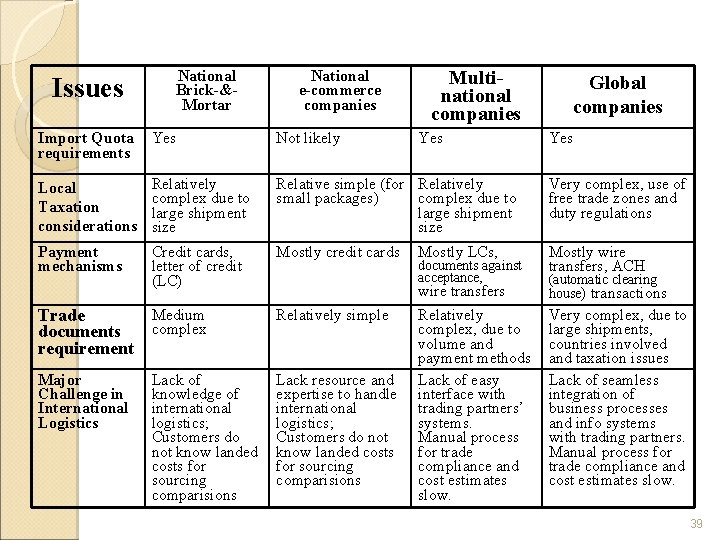
Issues National Brick-&Mortar National e-commerce companies Multinational companies Import Quota requirements Yes Not likely Local Taxation considerations Relatively complex due to large shipment size Relative simple (for Relatively small packages) complex due to large shipment size Very complex, use of free trade zones and duty regulations Payment mechanisms Credit cards, letter of credit (LC) Mostly credit cards Mostly wire transfers, ACH Medium Trade complex documents requirement Relatively simple Major Challenge in International Logistics Lack resource and expertise to handle international logistics; Customers do not know landed costs for sourcing comparisions Lack of knowledge of international logistics; Customers do not know landed costs for sourcing comparisions Yes Global companies Mostly LCs, documents against acceptance, wire transfers Relatively complex, due to volume and payment methods Lack of easy interface with trading partners’ systems. Manual process for trade compliance and cost estimates slow. Yes (automatic clearing house) transactions Very complex, due to large shipments, countries involved and taxation issues Lack of seamless integration of business processes and info systems with trading partners. Manual process for trade compliance and cost estimates slow. 39
Extended supply lead times and transit times Long manufacturing lead-times are sometimes artificial ◦ Mind-set change from make-to-stock to make-to-order Intermediate inventory needed to buffer against unreliable transit times ◦ sea freight from Rotterdam to Japan takes 5 weeks (a lot of inventory tied up at sea!) ◦ air-freight options may be attractive if total costs considered International shipping, consolidation and customs delays are significant As variability increases, local managers tend to compensate by over-ordering, double-buffering and requesting more allocation ◦ Instead, should explore transportation options and examine supply chain to reduce variability, increase shipment visibility and tracking 40
Complex Consolidation/Break. Bulk Supply Network Multiple Shipment options: ◦ direct ship from each source to final market in full containers ◦ consolidate in the supply region for final market in full containers ◦ Consolidate from each source for each consumer region with breakbulk/intermediate inventory in region ◦ Consolidate in the supply region and also break-bulk in the consumer region 41
Multiple freight mode and costs options Variety of shipping services available Air vs sea freight: ◦ air freight transport cost expensive, but may be worthwhile when inventory holding costs, potential lost revenue and market flexibility taken into account Integrators provide “door-to-door” service ◦ DHL, Fed. Ex, UPS, TNT ◦ shorter and more reliable transit times ◦ swifter and less complicated procedures, e. g. customs clearance ◦ worldwide tracking and tracing capability Need for end-to-end pipeline management ◦ co-ordinate export dept, shipping dept, freight forwarder Compartmentalised decision-making (e. g. shipping dept, export dept) may focus on ‘wrong’ or ‘partial’ objectives and lead to sub-optimal decisions. 42
The new organisational paradigm Traditionally, organisations are hierarchical, vertical and functionally defined Current and future business environment: ◦ focus on “speed”, just-in-time, short product life-cycles ◦ volatile demand ◦ flexibility in customer requirements Challenge: how to be a responsive 43
Distinguishing features of the responsive organisation Focus will shift: From functions to processes From profit to performance From products to customers From inventory to information From transactions to relationships 44
From functions to processes Conventional organisations ◦ organised around functional silos ◦ inwardly focussed, concentrates on use of resources Organisations actually compete on “capabilities” ◦ product development, order fulfilment, etc. ◦ through these processes are the customers satisfied ◦ capabilities reflect processes which require coordination and co-operation horizontally across t he organisation 45
From profit to performance Profit is the end, but the means important too “What gets measured gets managed” Performance drives profitability “New” performance indicators ◦ customer satisfaction: customer retention, brand preference, dealer satisfaction, service performance ◦ flexibility: commonality of components, reduction of process complexity, set-up times ◦ people commitment: employer turnover, suggestions submitted and implemented, internal service climate and culture, training and development 46
From products to customers Move away from focus on products e. g. brand managers, product group managers Re-focus on customer satisfaction and demand management Emphasis on customer value Need to be supported by accounting systems that better identify the cost of servicing the customers Logistics and marketing need to be managed conjointly 47
From inventory to information “uncertainty is the mother of inventory” “forecasts are never right” Feedback information on actual usage! ◦ Substitute information for inventory Benetton: ◦ capture information at point-of-sale early in the season ◦ flexibility in production process ◦ reduce reliance on (highly inaccurate) fashion forecasts 48
From transactions to relationships Tradition: focus on market share and winning customers Keeping customers important ◦ the longer customers stay, the more profitable ◦ customers who drift from one supplier to another more difficult to satisfy than loyal and committed customers Benefits of “single sourcing”: ◦ ◦ ◦ improved quality innovation sharing reduced costs integrated scheduling of production and deliveries barriers to entry of competitors 49
Managing the supply chain of the future Since it is through people that change is created, attention must be paid to how the organisation develops a set of skills and competencies that are appropriate to the constantly changing external environment. - Martin Christopher 50
Managing the supply chain of the future 51
Summary Continuing trend towards globalisation global brands, global sourcing, focussed factories serving the world market Increased complexities: longer supply chains, more out-sourcing Need to balance the varying needs of local markets against the economic advantages of standardised procedures/products Challenge: a flexible and agile supply chain yet achieves economies of scale/scope Requires organisational change within firm and with supply change partners Integrated logistics planning; information technologies Identify the concepts of internationalization and globalization of business. Summarize arguments for and against globalization. Explain the evolving role and problems with multinational corporations in the global environment. 52
SO, WHAT DO MANAGERS NEED TO KNOW TO WORK SUCCESSFULLY ACROSS CULTURES? 53
Challenges facing global managers 1. Develop a learning strategy to guide both short and long-term professional development as a global manager. 2. Develop a basic knowledge of how different cultures work, what makes them unique, and how managers can work successfully across such environments. 3. Develop effective strategies for working with managers from other cultures who may process information differently and view their roles and responsibilities in unfamiliar ways. 4. Develop an understanding of the competing interests and demands of various stakeholders in an organization, as well as the organizational processes necessary for achieving targeted outcomes. 5. Develop an understanding of how business enterprise can be organized differently across cultures, as well as the implications of these differences for management, cooperation, and competition. 6. Develop effective cross-cultural communication skills. 7. Develop an understanding of leadership processes across cultures, and how managers can work with others to achieve synergistic outcomes. 8. Develop a knowledge of how cultural differences can influence the nature and scope of employee motivation, as well as what global managers might do to enhance on-the-job participation and performance. 9. Develop effective negotiating skills and an ability to use these skills to build and sustain global partnerships. 10. Develop an understanding of how ethical and legal conflicts relate to managerial and organizational effectiveness, as well as how managers can work and manage in an ethical, fair, and socially responsible manner. 54
Application: Learning objectives How will increasing globalization affect future management careers like yours? 2. What can you learn from this class to help prepare you for these challenges? 3. What are your learning goals for this class? What specific objectives would you like to achieve? 4. What are you—as individuals and groups—prepared to invest to achieve these goals? 1. 55

Think about it: Becoming a global manager 1. How important are global issues and challenges to your future career aspirations? 2. What principal skills do you currently bring to a global manager’s job? 3. What skills do you believe you need to acquire or further develop in order to succeed in today’s increasingly competitive business environment? 56
TOPIC TWO: INTRODUCTION TO GLOBAL SUPPLY CHAIN MANAGEMENT
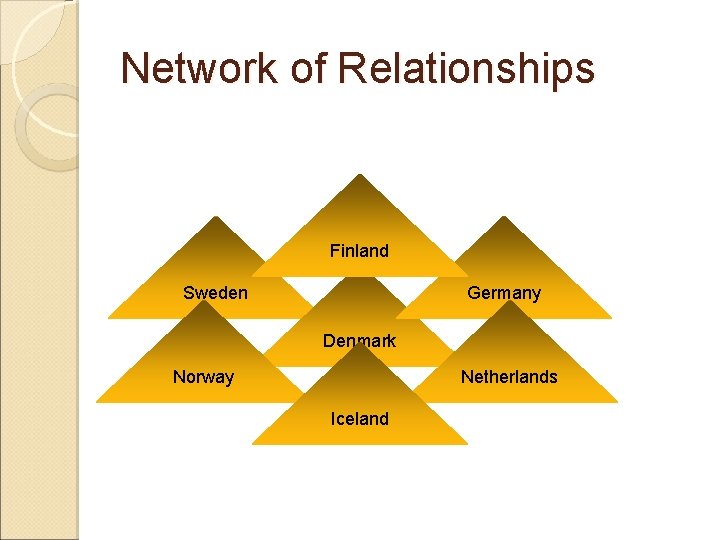
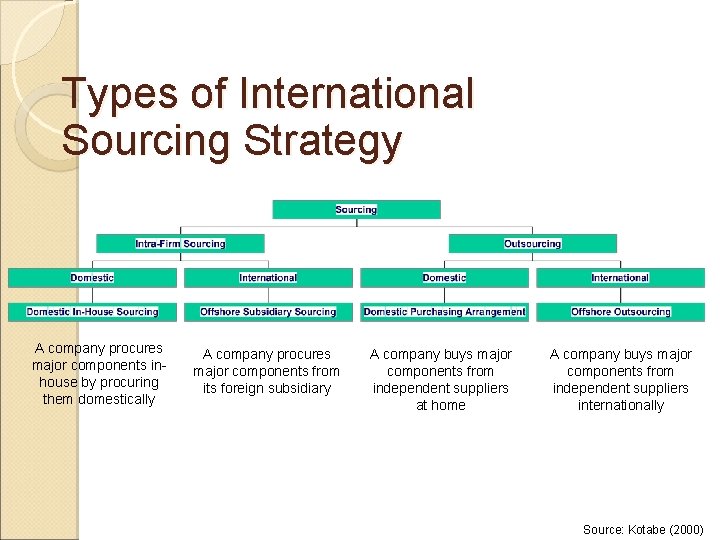
Outline What is supply chain Supply Chain Structure Critical Factors in Successful Partnership Relations Supply Chain Management Historical developments in supply chain management Globalization era Global Supply Chain Management Network of Relationships Types of International Sourcing Strategy Global SCM Factors Competencies Needed for Efficient Global SCM
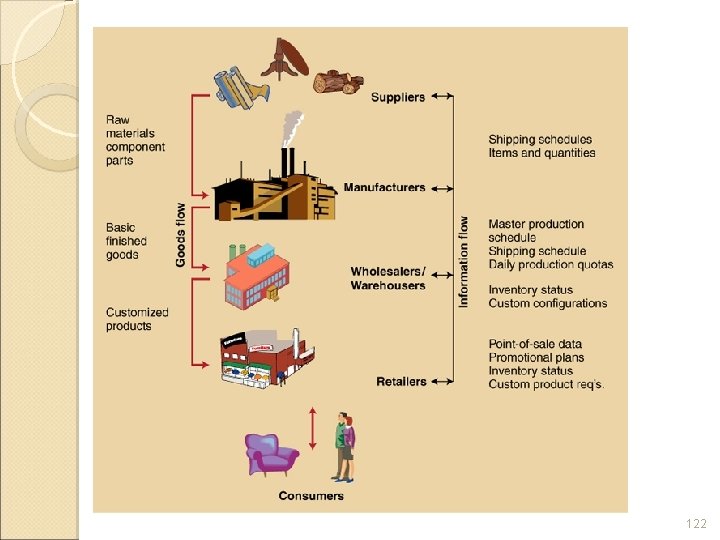
What is supply chain? A connected set of activities concerned with planning, coordinating and controlling materials, parts, and finished goods from supplier to customer. It is concerned with two distinct flows (material and information) through the organization.
What does it mean to manage a supply chain? The supply chain needs to be managed as a single entity. Strategic management: design of the supply chain itself; Tactical management: establishing contracts (incentives and penalties) between interacting partners in the supply chain.
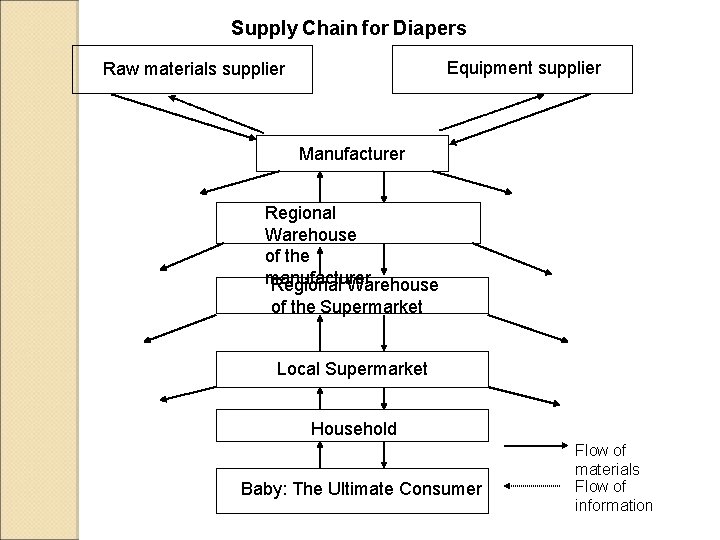
Supply Chain for Diapers Equipment supplier Raw materials supplier Manufacturer Regional Warehouse of the manufacturer Regional Warehouse of the Supermarket Local Supermarket Household Baby: The Ultimate Consumer Flow of materials Flow of information
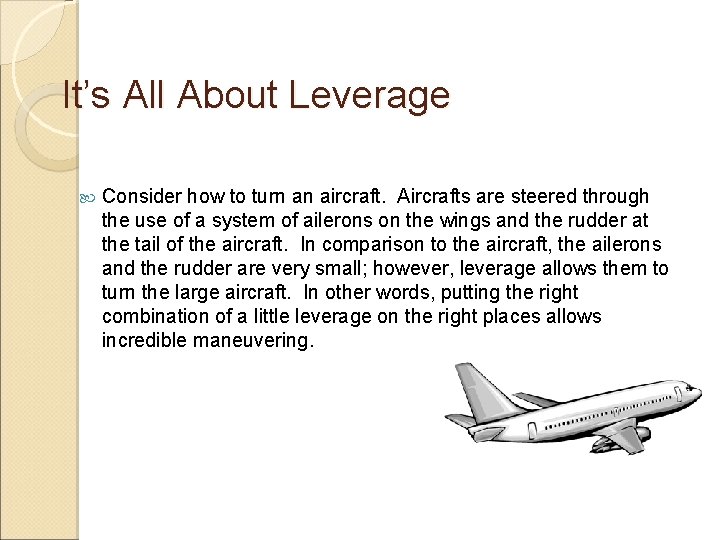
It’s All About Leverage Consider how to turn an aircraft. Aircrafts are steered through the use of a system of ailerons on the wings and the rudder at the tail of the aircraft. In comparison to the aircraft, the ailerons and the rudder are very small; however, leverage allows them to turn the large aircraft. In other words, putting the right combination of a little leverage on the right places allows incredible maneuvering.
What is a Supply Chain? Supply chains are linkages of partially discrete, yet interdependent entities that collectively transform raw materials into finished products. Supply chains connect the functions of inbound activities (such as purchasing) with outbound activities (such as logistics and “place” activities). A. . . . End Customer
Formal Definition of a Supply Chain A supply chain is a “network of facilities and activities that performs the functions of product development, procurement of material from suppliers, the movement of materials between facilities, the manufacturing of products, the distribution of finished goods to customers, and after-market support for sustainment” (Mabert and Venkataraman 1998).
Supply Chain Management A supply chain is a set of organizations directly linked by one or more of the upstream and downstream flows of products, services, finances, and information from a source to a customer. Managing a supply chain is 'supply chain management' Supply chain management (SCM) is the management of a network of interconnected businesses involved in the ultimate provision of product and service packages required by end customers. Supply chain management spans all movement and storage of raw materials, workin-process inventory, and finished goods from point of origin to point of consumption (supply chain). 65
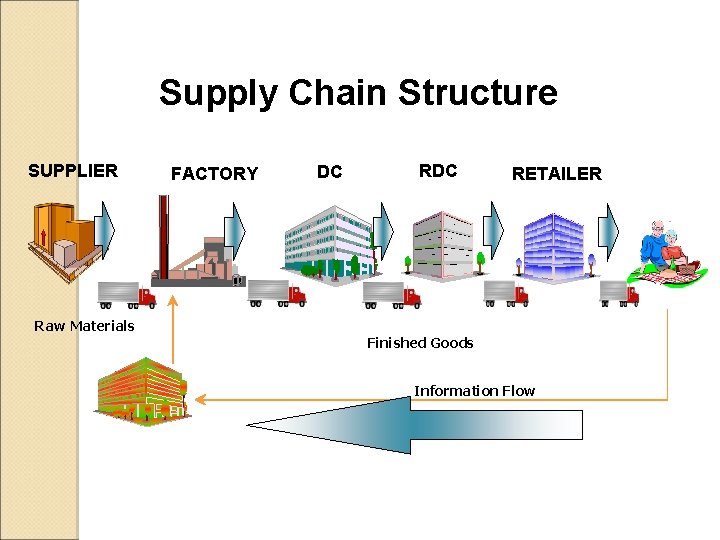
Supply Chain Structure SUPPLIER Raw Materials FACTORY DC RETAILER Finished Goods Information Flow
Historical developments in supply chain management Six major movements can be observed in the evolution of supply chain management studies: Creation, Integration, and Globalization, Specialization Phases One and Two, and SCM 2. 0. 67
Historical developments in supply chain management Creation era The term supply chain management was first coined by a U. S. industry consultant in the early 1980 s. However, the concept of a supply chain in management was of great importance long before, in the early 20 th century, especially with the creation of the assembly line. The characteristics of this era of supply chain management include: 68
Historical developments in supply chain management ◦ The need for large-scale changes, ◦ Re-engineering, ◦ Downsizing driven by cost reduction programs, and ◦ Widespread attention to the Japanese practice of management 69
Historical developments in supply chain management Integration era This era of supply chain management studies was highlighted with the development of Electronic Data Interchange (EDI) systems in the 1960 s and developed through the 1990 s by the introduction of Enterprise Resource Planning (ERP) systems. This era has continued to develop into the 21 st century with the expansion of internet-based collaborative systems. This era of supply chain evolution is characterized by both increasing value-adding and cost reductions through integration. 70
Historical developments in supply chain management Globalization era The third movement of supply chain management development, the globalization era, can be characterized by the attention given to global systems of supplier relationships and the expansion of supply chains over national boundaries and into other continents. Although the use of global sources in the supply chain of organizations can be traced back several decades (e. g. , in the oil industry), it was not until the late 1980 s that a considerable number of organizations started to integrate global sources into their core business. 71
Historical developments in supply chain management This era is characterized by the globalization of supply chain management in organizations with the goal of increasing their competitive advantage, value-adding, and reducing costs through global sourcing. 72
Historical developments in supply chain management Specialization era—phase one: outsourced manufacturing and distribution In the 1990 s, industries began to focus on “core competencies” and adopted a specialization model. Companies abandoned vertical integration, sold off non-core operations, and outsourced those functions to other companies. This changed management requirements by extending the supply chain well beyond company walls and distributing management across specialized supply chain partnerships. 73
Historical developments in supply chain management This transition also re-focused the fundamental perspectives of each respective organization. The specialization model creates manufacturing and distribution networks composed of multiple, individual supply chains specific to products, suppliers, and customers who work together to design, manufacture, distribute, market, sell, and service a product. The set of partners may change according to a given market, region, or channel, resulting in a proliferation of trading partner environments, each with its own unique characteristics and demands. 74
Historical developments in supply chain management Specialization era—phase two: supply chain management as a service Specialization within the supply chain began in the 1980 s with the inception of transportation brokerages, warehouse management, and non-asset-based carriers and has matured beyond transportation and logistics into aspects of supply planning, collaboration, execution and performance management. At any given moment, market forces could demand changes from suppliers, logistics providers, locations and customers, and from any number of these specialized participants as components of supply chain networks. This variability has significant effects on the supply chain infrastructure, from the foundation layers of establishing and managing the electronic communication between the trading partners to more complex requirements including the configuration of the processes and work flows that are essential to the management of the network itself. 75
Historical developments in supply chain management Supply chain specialization enables companies to improve their overall competencies in the same way that outsourced manufacturing and distribution has done; it allows them to focus on their core competencies and assemble networks of specific, best-in-class partners to contribute to the overall value chain itself, thereby increasing overall performance and efficiency. The ability to quickly obtain and deploy this domain-specific supply chain expertise without developing and maintaining an entirely unique and complex competency in house is the leading reason why supply chain specialization is gaining popularity. 76
Historical developments in supply chain management Supply chain management 2. 0 (SCM 2. 0) Building on globalization and specialization, the term SCM 2. 0 has been coined to describe both the changes within the supply chain itself as well as the evolution of the processes, methods and tools that manage it in this new "era". 77
Historical developments in supply chain management Web 2. 0 is defined as a trend in the use of the World Wide Web that is meant to increase creativity, information sharing, and collaboration among users. At its core, the common attribute that Web 2. 0 brings is to help navigate the vast amount of information available on the Web in order to find what is being sought. It is the notion of a usable pathway. SCM 2. 0 follows this notion into supply chain operations. It is the pathway to SCM results, a combination of the processes, methodologies, tools and delivery options to guide companies to their results quickly as the complexity and speed of the supply chain increase due to the effects of global competition, rapid price fluctuations, surging oil prices, short product life cycles, expanded specialization, near-/far- and offshoring, and talent scarcity. 78
What the supply chain is not Ø The definitions described and developed earlier and recent industry collaborative activities indicate that supply chain management is not a standalone process. Many supply chain efforts have fallen short of the potential advantages because the term is often viewed as only relating to the supply side of the business or to the purchasing function. As indicated above, supply chain management is much more that just procurement. 79
Among the misunderstanding evidenced, SCM is not: Ø Inventory management; Ø Logistics management; Ø Supplier partnerships; Ø Driven from the supply side; Ø A shipping strategy; Ø Distribution management; Ø The logistics pipeline; Ø Procurement Ø A computer system 80
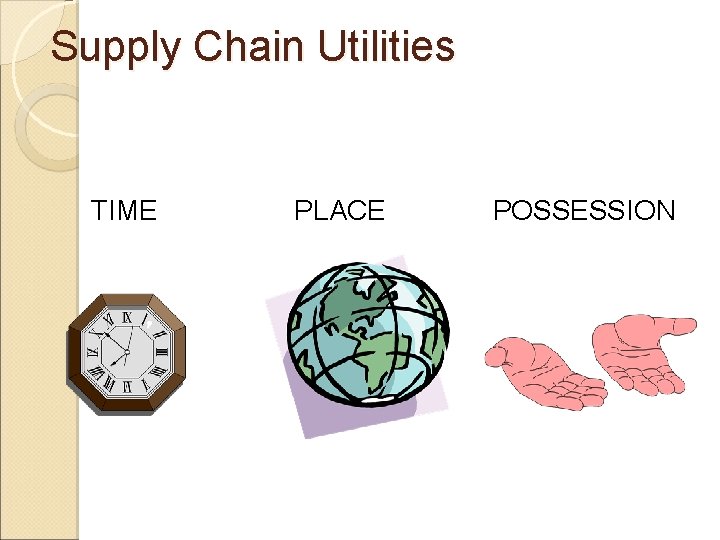
Global Supply Chain Management Meaning of Supply Chain Management ◦ Describes managers’ effort to oversee the flows of raw materials, components, information, and finance through their network of suppliers, assemblers, and distributors, and customers located around the world.
Supply Chain Utilities TIME PLACE POSSESSION
Network of Relationships Finland Sweden Germany Denmark Norway Netherlands Iceland
Ford Example Belfast Carburetors and distributors Enfield Instruments, fuel and water gauges, plugs Treforest Radiators, water pump assembly, engine components Genk Body Spark plug insulators panels, road wheels Leamington Wülfrath Foundry production of engine components Dagenham Final assembly Transmissio n parts, engine components Cologne Diecast transaxle casings, gear and engine components Bordeaux Transmissions Basildon Valencia Saarlouis Final assembly
Types of International Sourcing Strategy A company procures major components inhouse by procuring them domestically A company procures major components from its foreign subsidiary A company buys major components from independent suppliers at home A company buys major components from independent suppliers internationally Source: Kotabe (2000)
International Supply Chain Organization A supply chain organization is a relatively enduring interfirm cooperative that uses resources from international participants to accomplish shared and independent goals of its members.
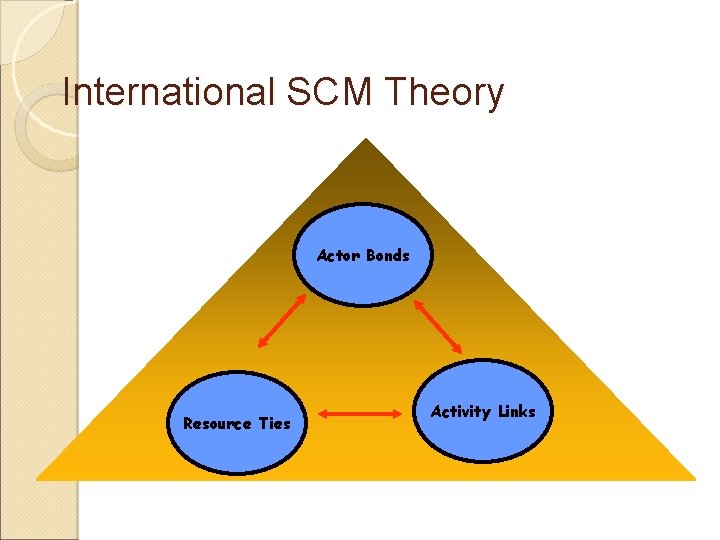
International SCM Theory Actor Bonds Resource Ties Activity Links
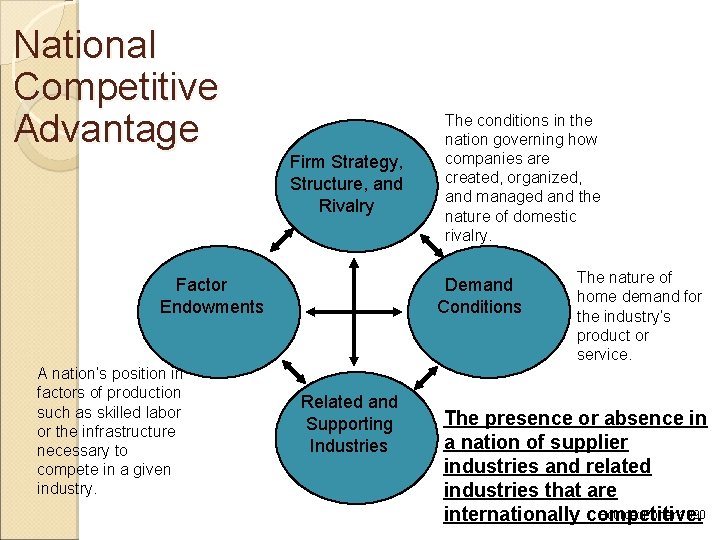
National Competitive Advantage Firm Strategy, Structure, and Rivalry Factor Endowments A nation’s position in factors of production such as skilled labor or the infrastructure necessary to compete in a given industry. The conditions in the nation governing how companies are created, organized, and managed and the nature of domestic rivalry. Demand Conditions Related and Supporting Industries The nature of home demand for the industry’s product or service. The presence or absence in a nation of supplier industries and related industries that are Source: Porter 1990 internationally competitive.
The Value Chain Michael Porter, professor at Harvard Business School, uses the value chain as a systematic means of displaying and categorizing business activities. The term value chain means that at each stage of the order-to-delivery system, value is added to the product or service.
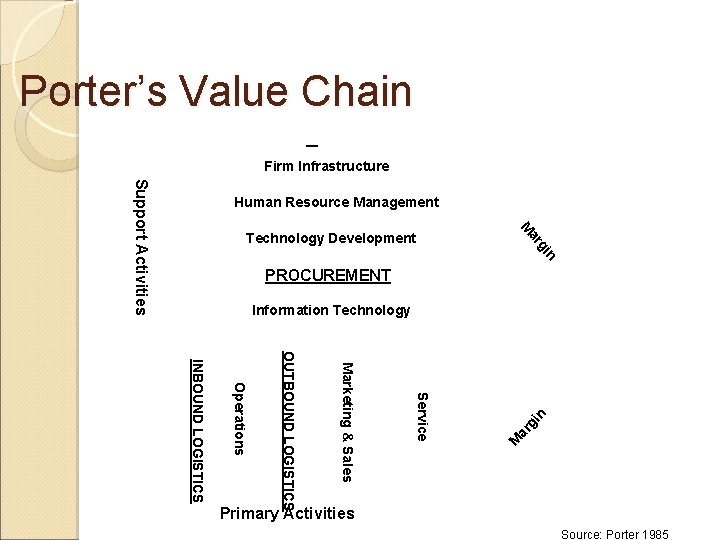
Porter’s Value Chain Firm Infrastructure Support Activities Human Resource Management n gi ar M Technology Development PROCUREMENT ar gi M Service Marketing & Sales OUTBOUND LOGISTICS Operations INBOUND LOGISTICS n Information Technology Primary Activities Source: Porter 1985
Primary Activities Primary activities are the five basic functions needed to physically produce a product or service, deliver and market it to buyers, and support it after the sale. Each contributes value in specific ways. ◦ Inbound logistics refers to activities/actions required before physical production of a product can begin or before service can be performed (inputs such as materials handling, warehousing, inventory control, vehicle scheduling and returns to suppliers). ◦ Outbound logistics refers to all activities from the point of a finished product to its delivery to the market or customer or those activities that follow the completion of a service (such as distribution, delivery vehicle operations, order processing, and scheduling).
Support Activities provide inputs or infrastructure in support of primary activities. These supporting activities stretch across the entire value chain since they impact each primary activity. ◦ Procurement is obtaining purchased inputs, such as raw material, parts, equipment, etc.
From the Value Chain… Five continuous and interactive steps are involved in developing a global supply chain strategy along the value chain: 1. Identify the separable links (R&D, manufacturing, and marketing) in the company’s global value chain. 2. In the context of those links, determine the global location of the company’s competitive advantages, considering both economies of scale and scope. 3. Ascertain the level of transaction costs (e. g. , cost of negotiation, cost of monitoring activities, and uncertainty resulting from contracts) between links in the global value chain, both internal and external, and select the lowest cost mode that provides the most value.
From the value chain… 4. Determine the comparative advantages of countries (including the company’s home country) relative to each link in the value chain and to relevant transaction costs. 5. Develop adequate flexibility in corporate decision making and organizational design so as to permit the company to respond to changes in both its competitive advantages and the comparative advantages of countries.
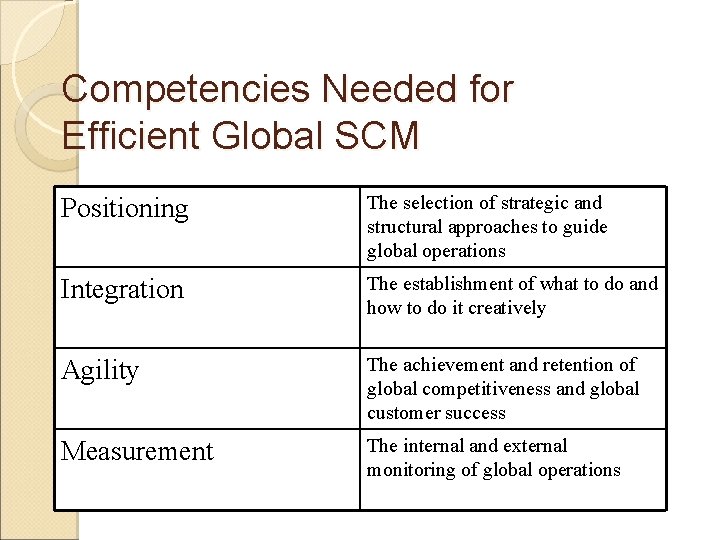
Competencies Needed for Efficient Global SCM Positioning The selection of strategic and structural approaches to guide global operations Integration The establishment of what to do and how to do it creatively Agility The achievement and retention of global competitiveness and global customer success Measurement The internal and external monitoring of global operations
Global SCM Factors Costs ◦ Local labor rates ◦ International freight tariffs ◦ Currency exchange rates Customs Duty ◦ Duty rates differ by commodity and level of assembly ◦ Impact of GATT/WTO: Changes over time
Global SCM Factors Continued Export Regulations • Denied parties list • Export licenses Time • Lead time • Cycle time • Transit time • Export license approval cycle • Customs clearance
Global SCM Factors Continued Taxes on Corporate Income ◦ Different markups by country ◦ Tax havens and not havens ◦ Make vs. buy effect Offset Trade and Local Content ◦ Local content requirement for government purchases ◦ Content for preferential duty rates
Questions to Answer Manufacturing ◦ ◦ Strategy: How many plants do I need? Where should each plant be located? What products should each make? What process technologies should each have and how much of each process is needed? ◦ What part of the world should each plant serve?
Questions to Answer Continued Supply Base Design / Vendor Consolidation: ◦ How do I simultaneously perform supplier selection for all the parts in the same commodity group? ◦ How many suppliers is best and which suppliers should send which parts to which plants? ◦ Am I missing opportunities by sourcing one part at a time? Outsourcing: ◦ What parts of my supply chain should I keep "in-house" and what parts to outsource? ◦ What if a third party has a higher variable cost but a lower fixed cost than in-house production?
Questions to Answer Continued Impact Trade: of Duty / Drawback, Taxes, Local Content & Offset ◦ If the duty rates come down according to GATT/WTO, how should I change my supply chain design? ◦ Does it make sense to still locate production inside the Triad areas or what trading block areas should we consider? ◦ What is the best use of the tax havens (Singapore, Puerto Rico, Ireland)? Spare Parts Logistics: ◦ How many echelons of repair and stocking is best? ◦ How many repair shops are needed, where should they be located, what products should each handle, and what geographic area should each serve? ◦ How do the drivers of product value, weight, complexity, and frequency of repair affect this decision?
Questions to Answer Continued New Product Pipeline Design: • What should the supply chain look like for a new product? • How should I fit the new product into my current supply chain? • Should I single or double source this product? • How much do my fixed costs affect this decision? • What is the cross-over point to open up a second and third source of supply?
TOPIC THREE: NETWORK DESIGN IN THE SUPPLY CHAIN
Outline Objectives you should be able to do the following: Understand the critical need in certain companies for new and improved logistics/supply chain networks. Identify factors that may suggest a need to redesign a logistics/supply chain network. Multi-echelon networks Structure an effective process for logistics/supply chain network design. Types of Relationships in Supply Chains
Network Design Decisions Facility role Facility location Ex: Toyota, Amazon. com Capacity allocation Market and supply allocation
Introduction Every organization is part of a supply chain, either as a customer or as a supplier. Supply chains include all the processes needed to make a finished product, from the extraction of raw materials through the sale to the end user. SCM is the integration and coordination of these efforts. Global supply chains increase geographic distances between members, causing greater uncertainty in delivery times. Companies make insourcing and outsourcing decisions. These make-or-buy decisions are based on financial and strategic criteria. Integrated SCM usually begins with the manufacturer integrating internal processes first. The, the company tries to integrate the external suppliers. The last step is integrating the external distributors.
Introduction ◦ As firms continue their searches for new ways to lower costs and improve service to their customers, the issue of where to locate logistics and manufacturing facilities has never been more complex or critical. ◦ In addition to enhancing the efficiency and effectiveness of a logistics/supply chain operation, the redesign of a firm’s overall network can help to differentiate a firm in the marketplace.
The Need for Long-Range Planning ◦ In the short run, a firm’s logistics/supply chain network and the locations of its key facilities are fixed. ◦ Site availability, leases, contracts, and investments make changing facility locations impractical in the short run. ◦ In the long run, however, the design of the overall network must be thought of as variable.
Case in Supply Chain Network Design: Procter & Gamble In the 1990 s, P&G was facing competitive pressure primarily with regard to overall cost. Excess capacity at plants, largely due to successful quality initiatives in the 80 s, and reduced distribution requirements, largely due to redesigned “compactified” products, presented P&G with an opportunity to re-design their supply chain. Comprised of over 50 product categories, over 60 plants, 15 distribution centers, and over 1000 customers, the redesign was a major project involving over 500 people organized in more than 30 teams. Analysis of this supply chain led to the formulation of a large-scale mixed integer linear program, An important feature of the DSS developed around this model was the visualization capability afforded by integrating a Geographic Information System (GIS) into the user interface. The GIS gave managers a good grip on solutions generated by the DSS under various scenarios, such as that of closing specific plants. The documented pre-tax savings of roughly $200 million annually is proof of the pudding indeed in the case of this DSS. Sources: "Blending OR/MS, Judgment, and GIS: Restructuring P&G's Supply Chain" by Jeffrey Camm et al. 109
3 M Supply Chain Design EXPANSION AND CONTRACTION Buckley plans to spend $1. 5 billion on 18 new plants or major expansions around the world, including 11 outside the U. S. , with four new factories in China alone. The thinking is that the new factories will add much needed capacity—especially abroad, where 3 M pulls in more than 60% of its revenues, and where it expects to get up to 75% over the next several years. Despite a vast, complicated network of 64 international subsidiary companies, just 35% of 3 M's manufacturing capacity is overseas. In Buckley's view, the plant expansions won't just add capacity—they are an opportunity to make the whole logistics chain more efficient by shortening supply lines and bringing production closer to local markets. How did things get that way at 3 M? For a long time, one of the tenets of the 3 M catechism was "make a little, sell a little. " 110
Once a project was green-lighted, it might receive funding, but the developer or scientist would have to make small quantities of the product in an ad hoc manner by using idle spots of time at factories throughout the 3 M system. It was a way to minimize the financial risk of a new product, and it served the company quite well—when its infrastructure and sales were centered mainly in the U. S. KEEPING INVENTORY MOVING Now, "make a little, sell a little" means that a typical product might be extruded in Canada, machined in France, packaged in Mexico, and sold in Japan. That's costly, and it means that half of 3 M products spend 100 days traveling through the supply line, according to Buckley, even before it has to jump any local bureaucratic hurdles. The net result is that 3 M has a lot of money tied up in inventory around the world that's just sitting on boats, in trucks, and in warehouses. In the fourth quarter of 2006, for instance, sales rose about $500 million. But working capital went up $450 million and receivables increased $250 million, Buckley says. If that trend continues, "You'd be borrowing money to grow, " he says. © 2010 Wiley 111
The Impact of Uncertainty on Network Design Supply chain design decisions include investments in number and size of plants, number of trucks, number of warehouses These decisions cannot be easily changed in the short- term There will be a good deal of uncertainty in demand, prices, exchange rates, and the competitive market over the lifetime of a supply chain network Therefore, building flexibility into supply chain operations allows the supply chain to deal with uncertainty in a manner that will maximize profits
Strategic Importance of Supply Chain Network Design ◦ All businesses operate in a very dynamic environment in which change is the only constant. ◦ It is questionable whether any existing logistics/supply chain network can be truly up to date.
Changing Customer Service Requirements ◦ Logistical requirements of customers are changing in numerous ways. ◦ Some customers have intensified their demands for more efficient and more effective logistics services. ◦ Others are seeking relationships with suppliers who can take logistical capabilities and performance to new, unprecedented levels. ◦ As a result, the need to reevaluate and redesign logistics/supply chain networks is of great contemporary interest. ◦ While customer service requirements may experience change, the types of customers served may also evolve over time.
Factors Influencing Network Design Decisions Strategic Factors Technological Macroeconomic Political Infrastructure Competitive Customer Response Time and Local presence Logistics and facility costs
Other factors driving design change ◦ Change in Corporate Ownership ◦ Cost Pressures ◦ Competitive Capabilities ◦ Corporate Organizational Change
Supply Chains & SCM A supply chain is the network of all the activities involved in delivering a finished product/service to the customer ◦ Sourcing of raw materials, assembly, warehousing, order entry, distribution, delivery Supply Chain Management is the vital business function that coordinates all of the network links ◦ Coordinates movement of goods through supply chain from suppliers to manufacturers to distributors ◦ Promotes information sharing along chain like forecasts, sales data, & promotions 117
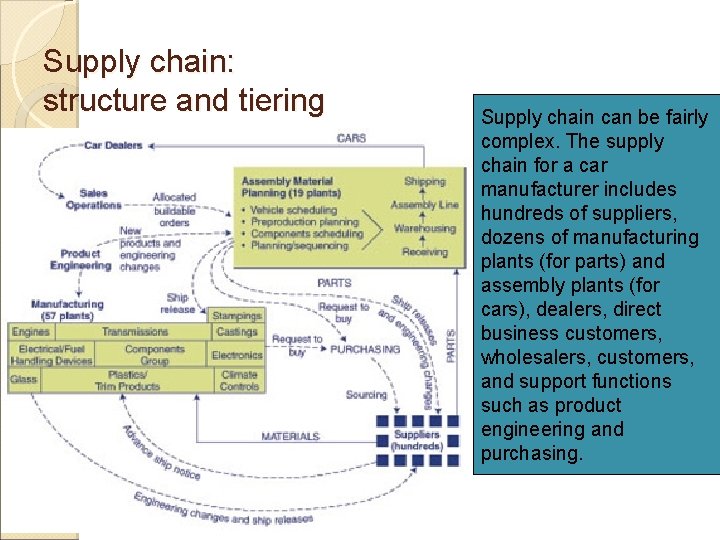
Supply chain: structure and tiering Supply chain can be fairly complex. The supply chain for a car manufacturer includes hundreds of suppliers, dozens of manufacturing plants (for parts) and assembly plants (for cars), dealers, direct business customers, wholesalers, customers, and support functions such as product engineering and purchasing.
A Supply Chain can provide strategic advantage Why Nokia Is Leaving Moto in the Dust Nokia's supply-chain management may be the best of any company in the world. It has a big head start in fast-growing markets such as China and India. And it has $9. 5 billion in cash and practically no debt, so it can invest far more than rivals on developing new products or conquering new markets—and thus build even more intimidating economies of scale. "We are about to report our billionth customer, so we must be doing something right, " says Anssi Vanjoki, a Nokia executive committee member responsible for multimedia devices. Thanks to those advantages, Nokia's global market share has climbed to 37%, and some in the industry think it could hit 40% this year. Business Week July 19, 2007 119
Global Supply Chain Management is Challenging! Even More Boeing 787 Delays? Given assembly and design issues, deliveries of the 787 Dreamliner aren't likely until late 2009. Some dissatisfied customers are discussing compensation Deliveries of the Dreamliner are already 10 months behind schedule and glitches along Boeing's complex global supply chain slowed production and forced the company to redesign its wing box. Asked on Apr. 3 about the possibility of yet another delay, Boeing (BA) spokeswoman Yvonne Leach simply acknowledged that an announcement of a revised schedule is coming soon. Business Week April 4, 2007 120
A Supply Chain can be a matter of life & death Iran has the second largest natural gas reservoir of the world but its supply network has been overwhelmed by high demand. Both reformists and conservatives are increasingly asking the president why Iranians are dying from the cold while sitting on the massive gas fields. As much as 22 inches of snow fell in areas of northern and central Iran in early January, the heaviest snowfall in more than a decade. Local media have reported 64 cold-related deaths this winter and say gas cuts are to blame. Breitbart. com, January 21, 2008 121
122
Suppliers Key Material Decisions ◦ Location ◦ Capacity ◦ Lot sizes; that is, how much to make in a production run ◦ Inventory (mainly raw material) Key Information & Related Decisions ◦ Customer orders ◦ Costs, market prices ◦ EDI; web-based; … 123
Manufacturers/Assemblers Key Material Decisions ◦ Location ◦ Capacity ◦ Sourcing of components necessary resources: labor, fuel, equipment ◦ Lot sizes; that is, how much to make in a production run ◦ Inventory (in all forms) Key Information & Related Decisions ◦ Supplier shipments ◦ Customer orders ◦ Costs, market prices 124
Warehouse/Distribution Centers Key Material Decisions ◦ Location ◦ Capacity ◦ Inventory (finished & semi-finished) Key Information & Related Decisions ◦ Customer orders ◦ Manufacturer/Assembler shipments 125
Retailers Key Material Decisions ◦ Location ◦ Inventory (finished goods) Key Information & Related Decisions ◦ Customer orders ◦ Shipments from Warehouses/DCs ◦ Market prices 126
Links Logistical or Physical ◦ Routes ◦ Modes ◦ Capacities Cyber ◦ Rates ◦ Tracking of shipments ◦ Orders ◦ Contracts ◦ Regulations 127
Components of a Supply Chain External Suppliers– source of raw material ◦ Tier one supplier supplies directly to the processor ◦ Tier two supplier supplies directly to tier one ◦ Tier three supplier supplies directly to tier two Internal Functions include – processing functions ◦ Processing, purchasing, planning, quality, shipping External Distributors transport finished products to appropriate locations ◦ Logistics managers are responsible for traffic management and distribution management 128
Components of a Supply Chain External Distributors transport finished products to appropriate locations ◦ Logistics managers are responsible for managing the movement of products between locations. Includes; traffic management – arranging the method of shipment for both incoming and outgoing products or material distribution management – movement of material from manufacturer to the customer 129
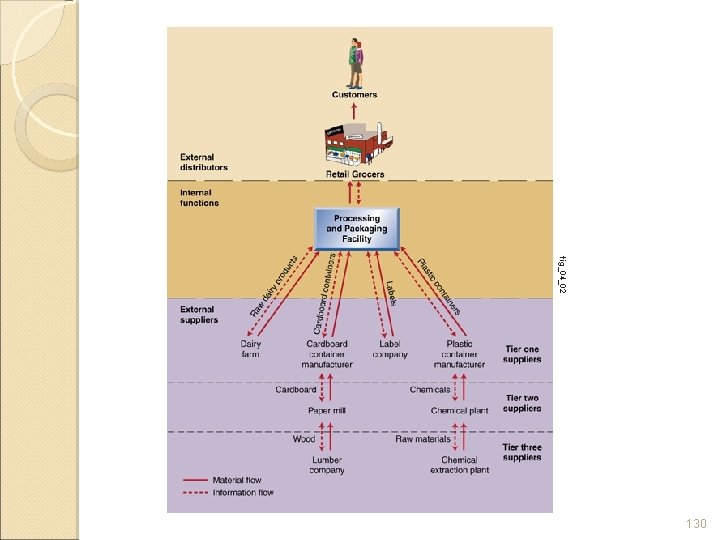
fig_04_02 130
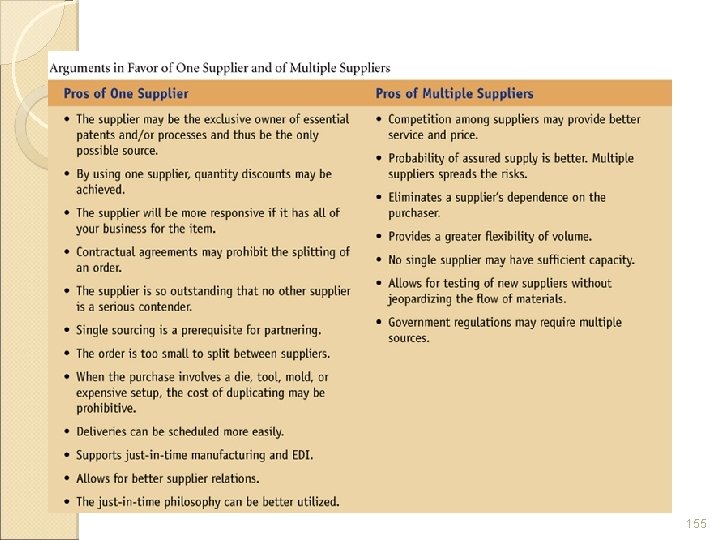
Sourcing Issues Which products to produce in-house and which are provided by other supply chain members Vertical integration – a measure of how much of the supply chain is owned by the manufacturer ◦ Backward integration – owning or controlling of sources of raw material and component parts ◦ Forward integration – owning or control the channels of distribution Vertical integration related to levels of insourcing or outsourcing products or services 131
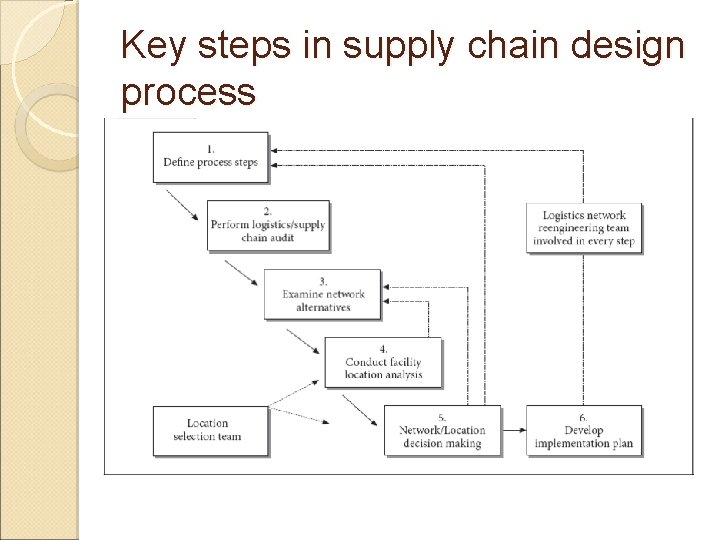
Key steps in supply chain design process
A Framework For Network Design Decisions Define SC Strategy ◦ Base the strategy on the competitive strategy, economies of scale or scope. Define the regional facility configuration ◦ Approx. no. of facilities, regions where facilities will be set up, whether a facility will produce all products of a given market, etc Select desirable sites within a given region ◦ Based on the analysis of infrastructure availability Location choices ◦ Select a precise location and capacity allocation for each facility
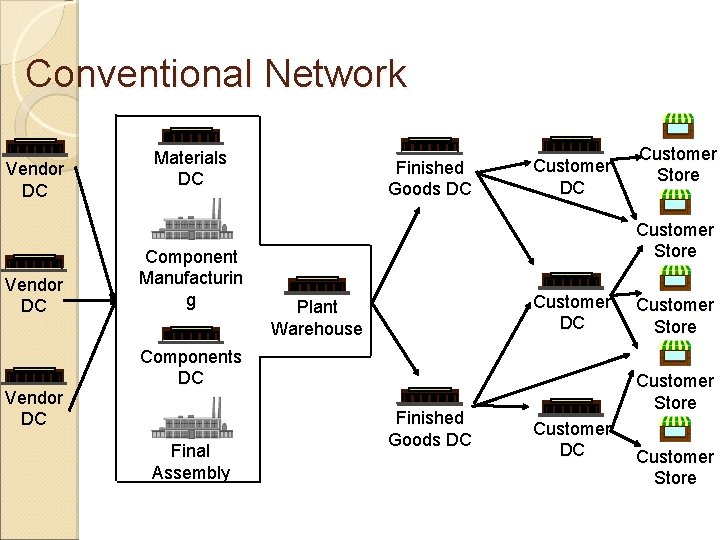
Conventional Network Vendor DC Materials DC Component Manufacturin g Finished Goods DC Customer Store Customer DC Plant Warehouse Components DC Final Assembly Customer Store Finished Goods DC Customer Store Customer DC Customer Store
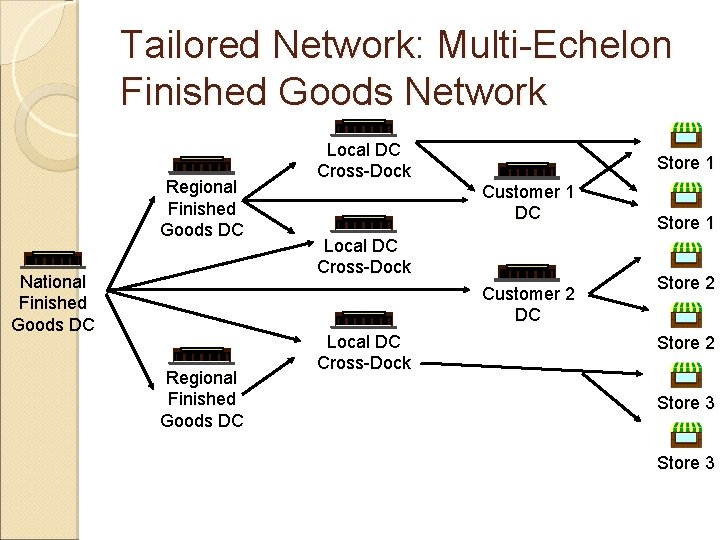
Tailored Network: Multi-Echelon Finished Goods Network Regional Finished Goods DC National Finished Goods DC Local DC Cross-Dock Store 1 Customer 1 DC Local DC Cross-Dock Customer 2 DC Regional Finished Goods DC Local DC Cross-Dock Store 1 Store 2 Store 3
Key steps in supply chain audit
Insourcing vs. Outsourcing What questions need to be asked before sourcing decisions are made? ◦ Is product/service technology critical to firm’s success? ◦ Is product/service a core competency? ◦ Is it something your company must do to survive? 137
Make or Buy Analysis will look at the expected sales levels and cost of internal operations vs. cost of purchasing the product or service 138
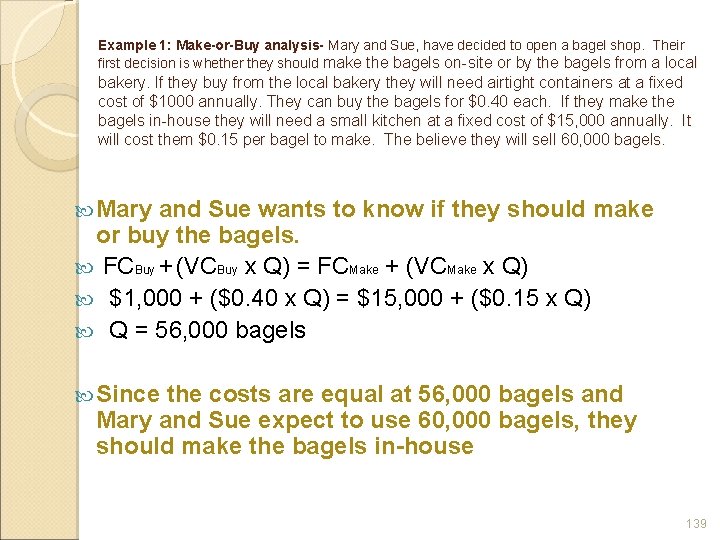
Example 1: Make-or-Buy analysis- Mary and Sue, have decided to open a bagel shop. Their first decision is whether they should make the bagels on-site or by the bagels from a local bakery. If they buy from the local bakery they will need airtight containers at a fixed cost of $1000 annually. They can buy the bagels for $0. 40 each. If they make the bagels in-house they will need a small kitchen at a fixed cost of $15, 000 annually. It will cost them $0. 15 per bagel to make. The believe they will sell 60, 000 bagels. Mary and Sue wants to know if they should make or buy the bagels. FCBuy + (VCBuy x Q) = FCMake + (VCMake x Q) $1, 000 + ($0. 40 x Q) = $15, 000 + ($0. 15 x Q) Q = 56, 000 bagels Since the costs are equal at 56, 000 bagels and Mary and Sue expect to use 60, 000 bagels, they should make the bagels in-house 139
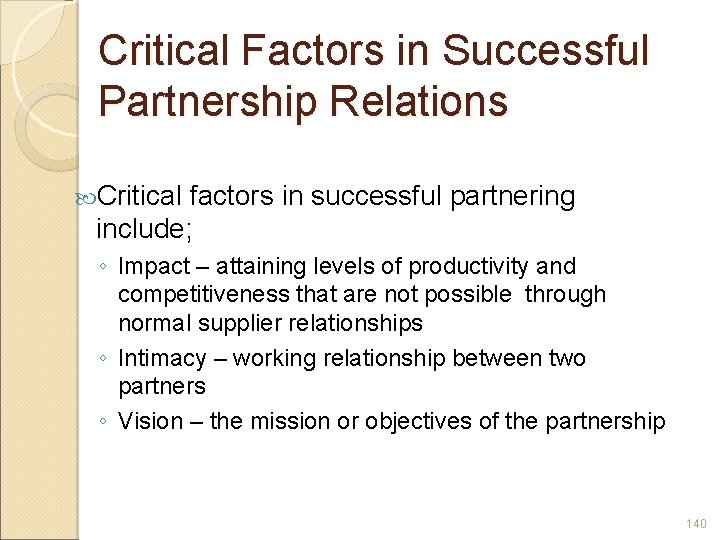
Critical Factors in Successful Partnership Relations Critical factors in successful partnering include; ◦ Impact – attaining levels of productivity and competitiveness that are not possible through normal supplier relationships ◦ Intimacy – working relationship between two partners ◦ Vision – the mission or objectives of the partnership 140
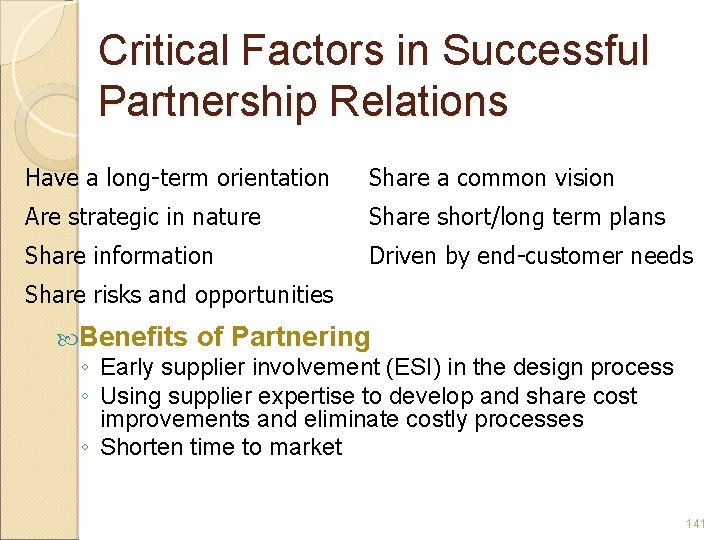
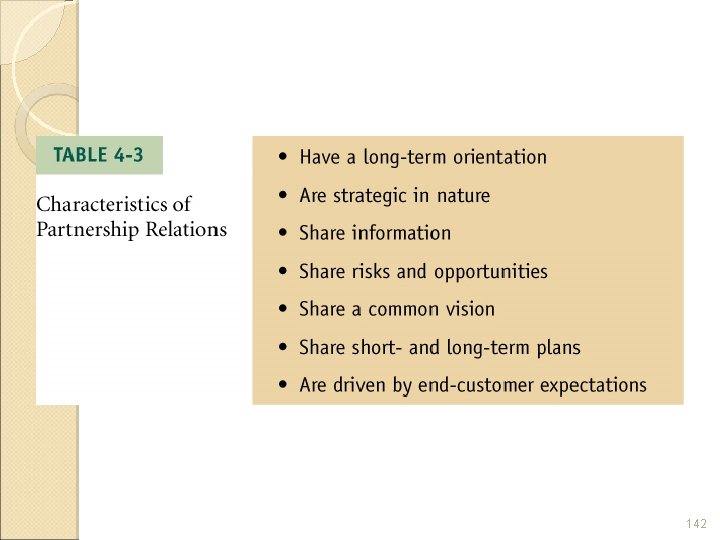
Critical Factors in Successful Partnership Relations Have a long-term orientation Share a common vision Are strategic in nature Share short/long term plans Share information Driven by end-customer needs Share risks and opportunities Benefits of Partnering ◦ Early supplier involvement (ESI) in the design process ◦ Using supplier expertise to develop and share cost improvements and eliminate costly processes ◦ Shorten time to market 141
142
Suppliers & Partnerships http: //www. businessweek. com/magazine/content/01_23/b 3735036. htm? ch an=search The key to Stallkamp's first revolution was the emphasis on cooperation among carmakers and their suppliers. Rather than dictate lower parts prices to suppliers, he offered incentives. If suppliers found a way to save a dollar, Stallkamp let them keep 50 cents. And instead of playing competitors off against one another, he pledged loyalty to Chrysler's incumbent suppliers, as long as they could meet contract terms. The idea is to create alliances of suppliers who have agreed to centralize the control of their supply-chain operations. Suppose that a dozen companies are involved in the manufacturing and assembly of a car seat. Today, the small fry make and deliver parts to a larger integrator, who assembles the seat and delivers it to a General Motors Corp. (GM ) or a Ford Motor Co. (F ) The staff at each of these companies watches over the flow of goods, manages delivery dates, and tends to their clients. 143
Suppliers & Partnerships http: //www. businessweek. com/magazine/content/01_23/b 3735036. htm? ch an=search Q: Why do we need to change the way we deal with the supply chain? A: [Stallkamp] In a nutshell, I still believe that supply chains need to be actively managed by someone. When I was at [Chrysler], we had a concerted policy to help our suppliers and cooperatively manage the supply chain. Now, the OEMs [original equipment manufacturers--i. e. , the auto makers] seem to be moving away from active management to more passive management. When that happens, I believe it's up to the supply base itself to try to find another alternative © 2010 Wiley 144
Types of Relationships in Supply Chains 1 - Integrated Hierarchy 2 - Semi-Hierarchy 3 - Co-Contracting 4 - Coordinated contracting 5 - Coordinated revenue links
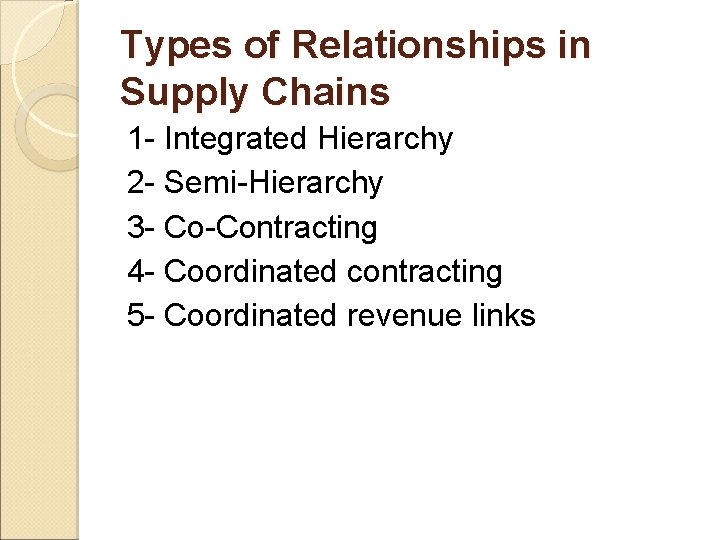
Types of Relationships in Supply Chains 1) Integrated hierarchy means that a firm houses all activities in the supply chain FROM raw material source TO distribution of products to end users (figure). This is also called Full Vertical Integration.
Types of Relationships in Supply Chains 2) In a Semi-hierarchy organization, the firms in the Supply Chain are owned by the same holding Company, But they operate as Separate Business Units. For example, An Oil Company delegates the following activities to the following business units: Oil extraction, Oil refining, Petrol Distribution, and Petrol Retailing.
Types of Relationships in Supply Chains 3) Co-contracting is a term used to describe alliances between organizations that have Long term relationships but do not Merge together. They rather transfer some Equity (ownership), technology, Information, AND People. Such alliances are evident in aerospace industry (Airbus transfers technology with others).
Types of Relationships in Supply Chains 4) Coordinated Contracting involves a prime contractor who employs a set of subcontractors. For example, a building trader (or decorator) employs a set of sub-contractors, such as carpenters, electricians, and bricklayers AND calls them when needed. There is a long-standing relationship between contractor and sub-contractors.
Types of Relationships in Supply Chains The contractor provides Materials and usually take responsibility for the planning and control of the entire job. But the sub-contractor provides the necessary equipment required for its profession.
Types of Relationships in Supply Chains 5) The category of Coordinated revenue links is used primarily for Licensing and Franchising. (e. g. , fast food chains)
Types of Relationships in Supply Chains It is a form of relationship that transfers ownership to other firms (usually smaller) while guaranteeing an income for the franchiser or the licensor.
Types of Relationships in Supply Chains In this form of contract Franchiser, - Has the property rights of the product - sets the territory in which the franchisee can operate - sets the process specification to be used in operations, and - monitors the performance of the franchisee.
154
155
Summary of Learning Objectives What is the role of network design decisions in the global supply chain? What are the factors influencing supply chain network design decisions?
TOPIC FOUR: GLOBAL SUPPLY CHAIN PLANNING AND SOURCING
Outline Supply Chain Planning Processes Supply Chain Planning Decisions Strategic global sourcing Motives of buying overseas Challenges on international souring
What is Supply Chain Planning ? Supply Chain is a set of activities (e. g. purchasing, manufacturing, logistics, distribution, marketing) that perform the function of delivering value to end customer Traditionally, all the business units along a supply chain have their own objectives and these are often conflicting There is no single plan to carry out supply chain activities
What is Supply Chain Planning ? There is need for a mechanism through which the execution of various business activities along a supply chain can be planned in an integrated fashion. The supply chain planning is an effort to achieve the primary goal of “producing and distributing the merchandise at the right quantity, to the right locations, and at the right time with minimum system wide cost” in the presence of conflicting goals of various business units
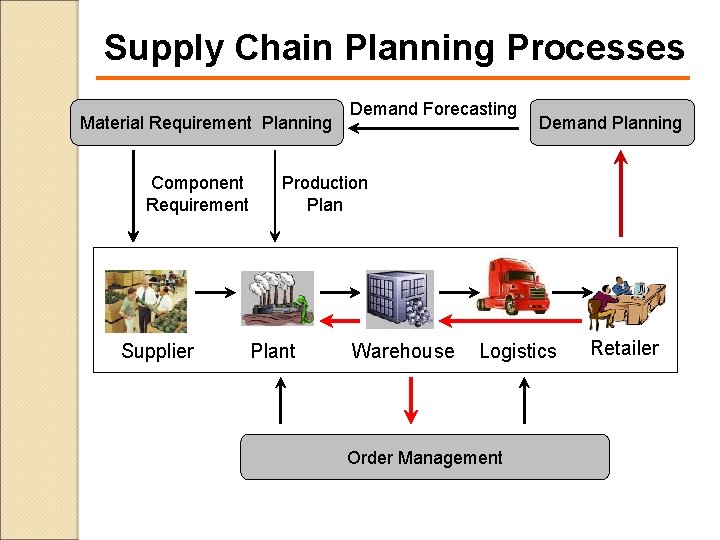
Supply Chain Planning Processes Material Requirement Planning Component Requirement Supplier Demand Forecasting Demand Planning Production Plant Warehouse Logistics Order Management Retailer
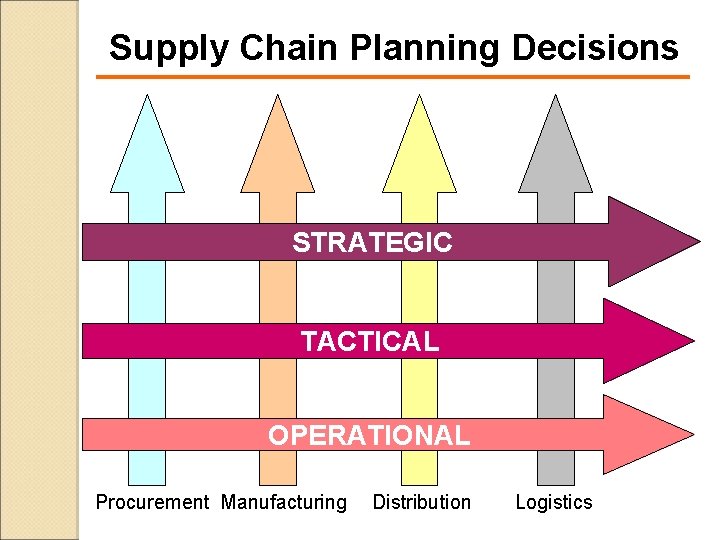
Supply Chain Planning Decisions STRATEGIC TACTICAL OPERATIONAL Procurement Manufacturing Distribution Logistics
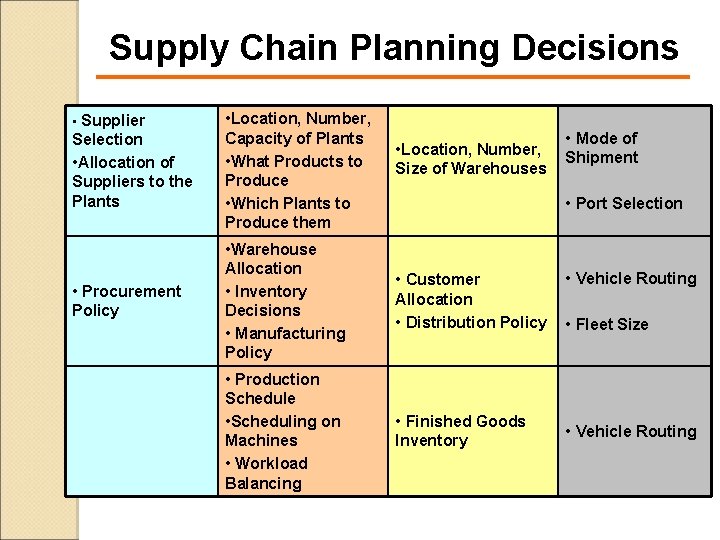
Supply Chain Planning Decisions Selection • Allocation of Suppliers to the Plants • Location, Number, Capacity of Plants • What Products to Produce • Which Plants to Produce them • Procurement Policy • Warehouse Allocation • Inventory Decisions • Manufacturing Policy • Customer Allocation • Distribution Policy • Production Schedule • Scheduling on Machines • Workload Balancing • Finished Goods Inventory • Supplier • Location, Number, Size of Warehouses • Mode of Shipment • Port Selection • Vehicle Routing • Fleet Size • Vehicle Routing
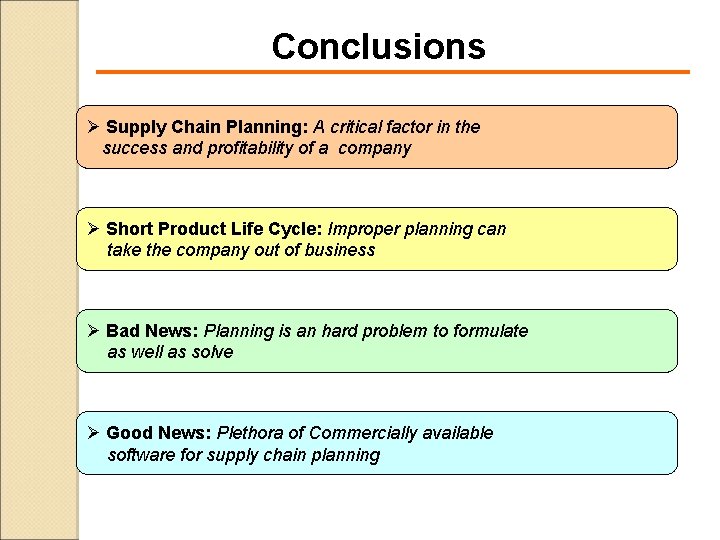
Conclusions Ø Supply Chain Planning: A critical factor in the success and profitability of a company Ø Short Product Life Cycle: Improper planning can take the company out of business Ø Bad News: Planning is an hard problem to formulate as well as solve Ø Good News: Plethora of Commercially available software for supply chain planning
Strategic global sourcing The coordination and integration of procurement requirements across worldwide business unit looking at common items, processes, technologies and suppliers. Sourcing no longer equates to instant cost gratification, but is now defined as a strategic component used to drive maximum competitive advantage. Strategic sourcing is itself a benchmark. It relates to getting the best products and services at the best value. It is designed to segment external spend and ensure that procurement resources are focused on the most important categories. What sets strategic sourcing apart is its continuous attention to improving and re-evaluating the purchasing activities of a company, thus enabling
Strategic global sourcing Global sourcing is a sense of competativeness It can cover the cost of Raw materials and enhance quantity It offers a company an ******* to quickly enter new markets and new products
Strategic global sourcing Any organization most therefore determine an appropriate enter selecting suppliers for its SC to remain steady and Robost Global sourcing therefore provides an opportunity to foster a relationship with antoehr supplier, to build bridges in other countries where both companies are stakeholders is the success or trade of profits Consistence in production, lower SC costs, health quality goods and motivation to staff is a SC are thus they objectives and decision areas in SCM. The total cost of ownership is also key when
Strategic global sourcing The question that must be utilized when making sourcing decisions in GSCs includes; (i) What is the process of selecting a high quality global supplier (ii) How do we balance between the total cost of ownership and the selection criteria (iii)What are the steps in building a costing relationship with global suppliers (iv) What is the sensitivity of the inputs in the SC (v) What is the total cost of ownership in the global sourcing
Strategic global sourcing Supplier selection process Choosing the right global supplier in cruised in the success of global sourcing Developing a process flow for the supplier selection process lays an important role in determining low to select a high quality suppliers. The process must be determined by benchmarking against companies that have been successful is global sourcing for a period of time Domestically, its easier to identify, negotiate and communicate with the lowest unit cost supplier While in global sourcing is more complex and compromise need to be made
Strategic global sourcing There are many factors to be analyzed during the supplier selection process Availability of the technological pace to produce the required material / service Availability of selected labor force necessary to produce / provide service / goods A requisite standard quality / quantity programmes
Strategic global sourcing The technical support for maintaining the components / service ******* flexibility to management different hot sizes Effectiveness in protecting the management from proprietary Reliability of transportation company between the supplier location and that of the management The lower country risks especially the political power national / mass made disasters and cover commodity risk.
Strategic global sourcing The actual steps involved in selecting a supplier in global SCS involved ◦ Pre selection of two global suppliers – utilize the in country consultants to help identify suppliers that have the capacity to produce / provide tax goods / services Any supplier is considered a potential candidate The size of the company can be considered length of time in the industry and capacity ◦ Prepare a request for quote (RFQ ) – Ac RFQ is critical to the decision making process as it ensures fair and accurate companies across suppliers It is ****** of a questionnaire used to borrow the number of suppliers that but the general criteria RFQ, allows the supplier to be innovative and give them room to offer act structure that could further reduce costs Contents of RFQ Back good information Evaluation criteria Lost of key contacts Confidentiality and conditions agreement
Strategic global sourcing RFQ instructions Technical specification Material handling instructions - The information requested from supplier company include; The company information The technological support Customer service Quality control
Strategic global sourcing Cost sheets (iii) Analyze RFQ response After all the RFQ response have been received they must be checked for commissions and consistency
Strategic global sourcing Estimate the overall costs and benefits including the strengths and weaknesses It should be done with experienced and unbiased view points Strategic considerations can be made with recommendations on cost benefit analysis.
GLOBAL SOURCING Global sourcing is a strategic sourcing strategy that effectively broadens the scope of the procurement process to include companies that operate in other countries. The use of global sourcing has been the driving force behind the development and expansion of the global economy. Including suppliers from around the world in the bidding process for large contracts reduces prices and increases competition. The creation of this type of infrastructure allows firms to create subsidiary offices in locations around the world. There are three main industries that are ideal for global souring: manufacturing, skilled services and telephone call centers
Motives of buying overseas: 1. Changes in business environment e. g. : - ◦ Intense international competition. ◦ Pressure to reduce costs. ◦ Need for manufacturing flexibility. ◦ Need for shorter product development cycle. ◦ Stringent quality standards. ◦ Ever changing technology.
2. Factors relating to the needs and competitiveness of the enterprise e. g. : ◦ Unavailability of raw materials locally. ◦ Insufficient domestic capacity to meet demand insurance reasons such as buying abroad to ensure continuity of supplies when domestic sources are threatened by shortages or strikes. ◦ Competitiveness of oversee sources, including lower prices, improved delivery and better quality. ◦ Reciprocal trading and countertrade resulting from policy reasons or government pressure due to balance of payment considerations. ◦ Access to worldwide technology. ◦ To obtain a penetration of growth market.
Benefits of international sourcing: 1) Access to lower priced goods. 2) Enhanced competitive position. 3) Access to high quality goods. 4) Access to world wide technology. 5) Better delivery performance. 6) Better customer service. 7) Increased number of suppliers. 8) Helps meet countertrade obligations.
Challenges on international souring: 1) JIT sourcing requirements. 2) Finding qualified foreign sources. 3) Logistics support for longer supply links. 4) Culture and language differences. 5) Duty and customs.
- Slides: 180