
DPPDL A Dynamic PartialParallel Data Layout for Green
- Slides: 13
DPPDL: A Dynamic Partial-Parallel Data Layout for Green Video Surveillance Storage Zhizhuo Sun, Quanxin Zhang, Yuanzhang Li, and Yu-An Tan 1 IEEE TRANSACTIONS ON CIRCUITS AND SYSTEMS FOR VIDEO TECHNOLOGY, VOL. 28, NO. 1, JANUARY 2018
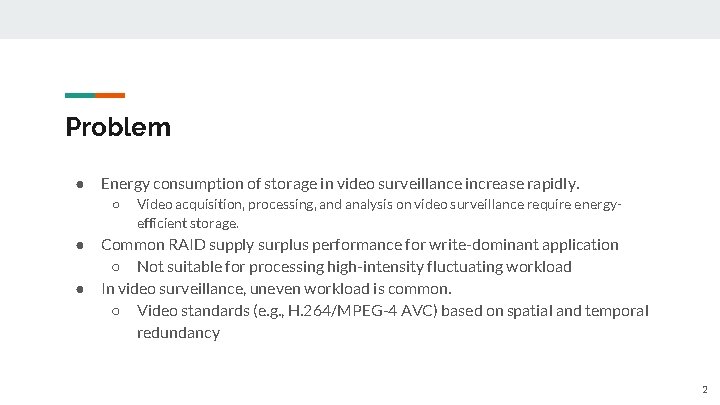
Problem ● Energy consumption of storage in video surveillance increase rapidly. ○ ● ● Video acquisition, processing, and analysis on video surveillance require energyefficient storage. Common RAID supply surplus performance for write-dominant application ○ Not suitable for processing high-intensity fluctuating workload In video surveillance, uneven workload is common. ○ Video standards (e. g. , H. 264/MPEG-4 AVC) based on spatial and temporal redundancy 2
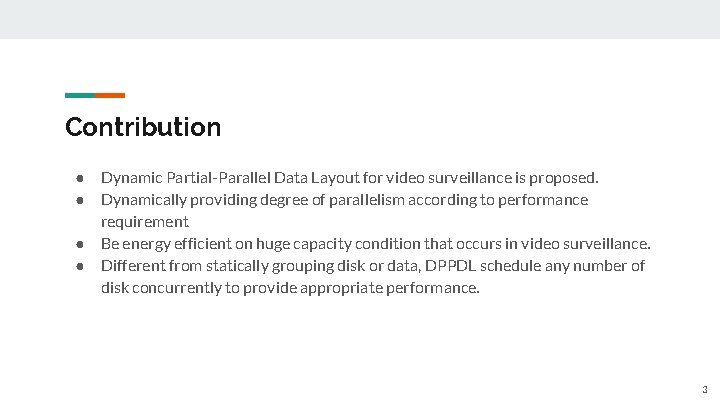
Contribution ● ● Dynamic Partial-Parallel Data Layout for video surveillance is proposed. Dynamically providing degree of parallelism according to performance requirement Be energy efficient on huge capacity condition that occurs in video surveillance. Different from statically grouping disk or data, DPPDL schedule any number of disk concurrently to provide appropriate performance. 3
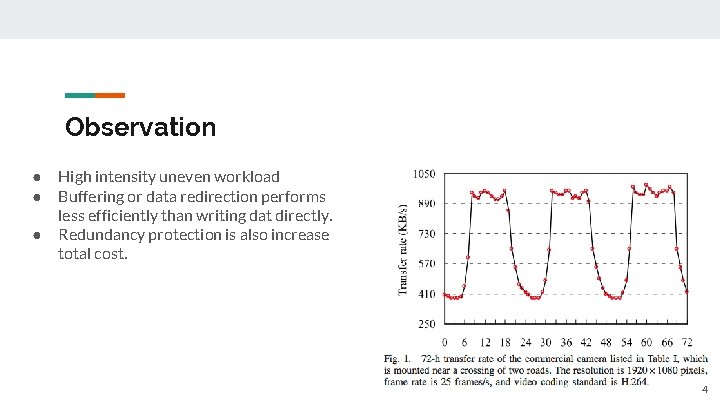
Observation ● ● ● High intensity uneven workload Buffering or data redirection performs less efficiently than writing dat directly. Redundancy protection is also increase total cost. 4
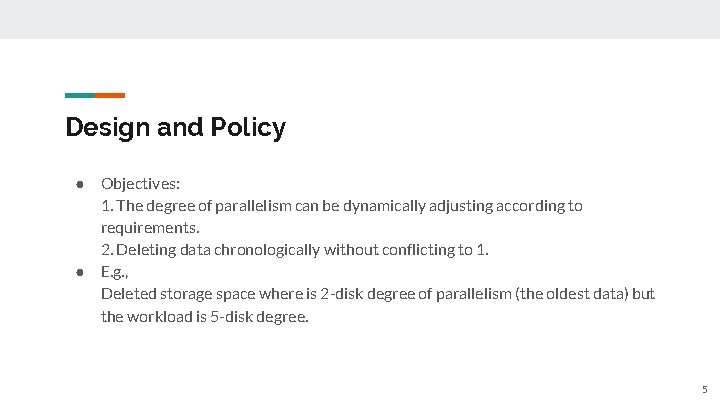
Design and Policy ● ● Objectives: 1. The degree of parallelism can be dynamically adjusting according to requirements. 2. Deleting data chronologically without conflicting to 1. E. g. , Deleted storage space where is 2 -disk degree of parallelism (the oldest data) but the workload is 5 -disk degree. 5
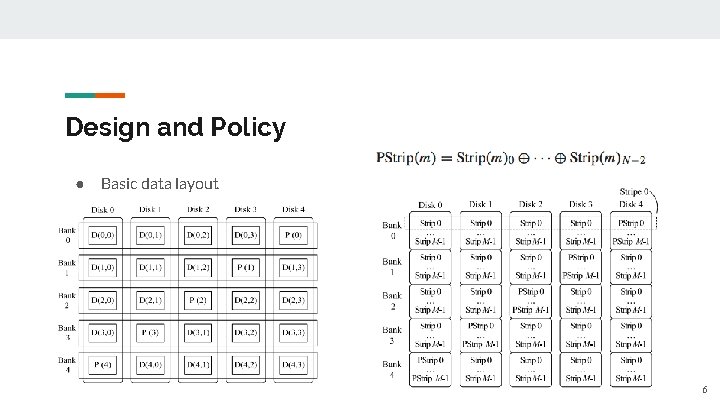
Design and Policy ● Basic data layout 6
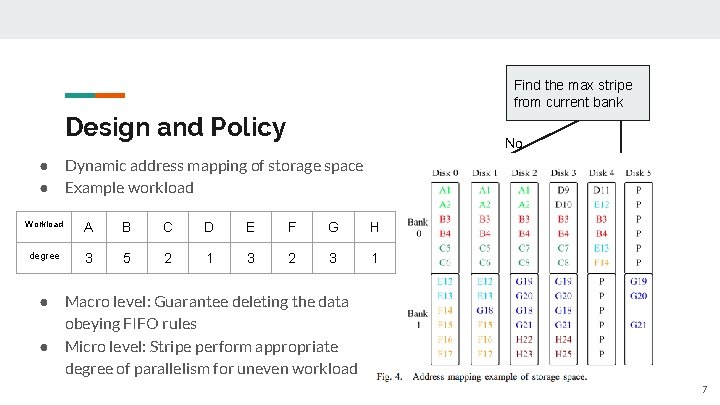
Find the max stripe from current bank Design and Policy ● ● No Dynamic address mapping of storage space Example workload Find stripe from next bank Workload A B C D E F G H degree 3 5 2 1 3 2 3 1 ● ● Macro level: Guarantee deleting the data obeying FIFO rules Micro level: Stripe perform appropriate degree of parallelism for uneven workload No Yes Release the space from next bank Mapping to disk address 7
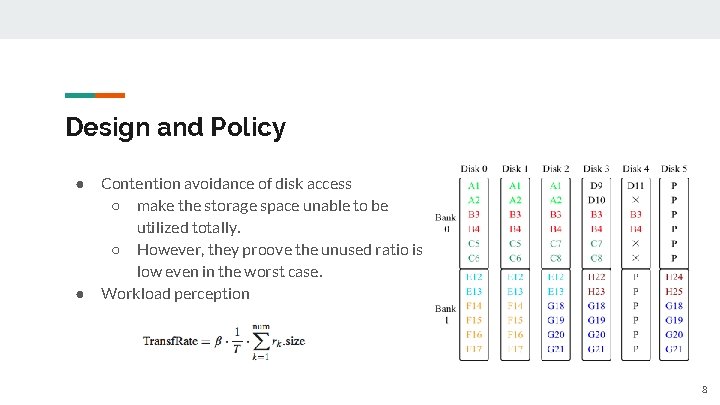
Design and Policy ● ● Contention avoidance of disk access ○ make the storage space unable to be utilized totally. ○ However, they proove the unused ratio is low even in the worst case. Workload perception 8
Evaluation ● ● ● HD video surveillance system comprising 60 cameras ○ For each camera, avg. transfer rate is 712 KB/s 12 disks with 6 TB capacity and 1 disk for parity Linux 3. 2. 81 kernel. Raid 5. c under /driver/md to realize DPPDL Storage server ○ Intel core and memory is 8 GB ○ LSI SAS storage controller on motherboard Peak transfer rate: 1 MB/s; trough transfer rate: 410 KB/s; moderate file size(240 -600 MB) Baseline: PARAID, e. RAID, MAID, Hibernator, Cache. RAID, and Semi-RAID 9
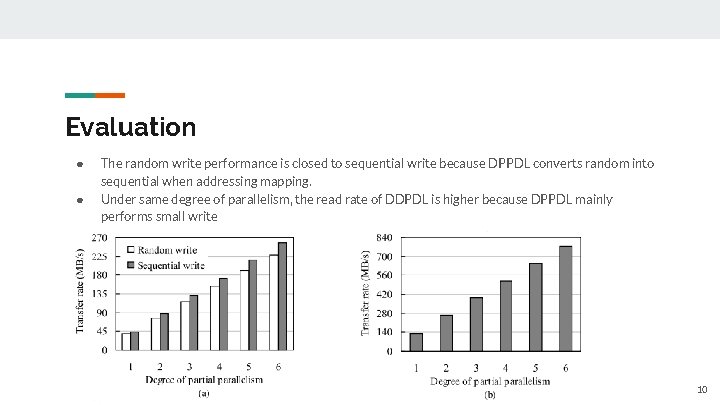
Evaluation ● ● The random write performance is closed to sequential write because DPPDL converts random into sequential when addressing mapping. Under same degree of parallelism, the read rate of DDPDL is higher because DPPDL mainly performs small write 10
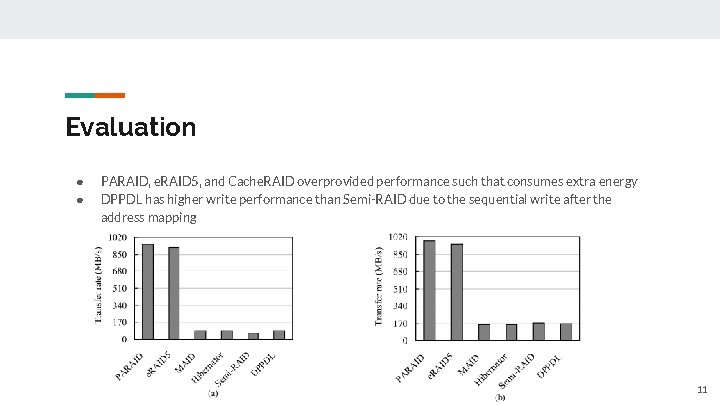
Evaluation ● ● PARAID, e. RAID 5, and Cache. RAID overprovided performance such that consumes extra energy DPPDL has higher write performance than Semi-RAID due to the sequential write after the address mapping 11
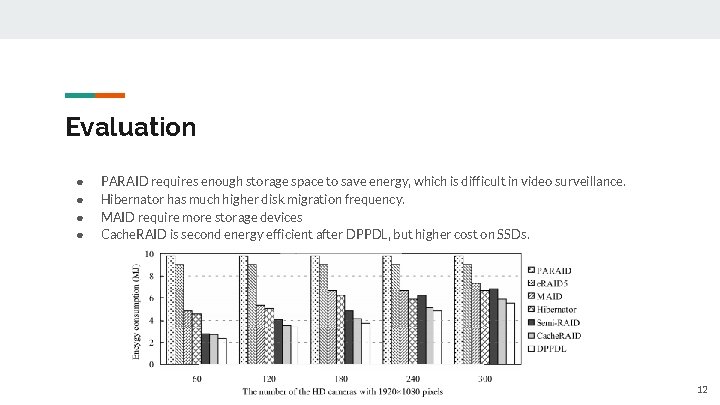
Evaluation ● ● PARAID requires enough storage space to save energy, which is difficult in video surveillance. Hibernator has much higher disk migration frequency. MAID require more storage devices Cache. RAID is second energy efficient after DPPDL, but higher cost on SSDs. 12
Conslusion ● DPPDL is proposed for green surveillance storage. ● Promote energy efficiency while tolerating single disk failure. ● Meet the performance requirement but require almost fewest storage devices. 13