
DP CLASS NOTATIONS IMO MSCCIR 645 Guidelines for


















- Slides: 48
DP CLASS NOTATIONS IMO MSC/CIR 645 “Guidelines for vessel with dynamic positioning” dated 06/06/1994, has defined equipment classes (see Chapter 2. 2). Than there are four classes of DP: DP CLASS 0 (DYNAPOS AUTS) Dynamic positioning system without redundancy. IMO equipment class not applicable DP CLASS I (DYNAPOS-AUT) Dynamic positioning system with an independent joystick system back-up and a position reference back-up. It has one terminal DP (Operation Station); besides it has 1 VRS, 1 Wind sensor and 1 Gyro-compass. 1
SDP 11 - BASIC SYSTEM 2
SDP 12 - INTEGRATED SYSTEM 3
DP CLASS II (DYNAPOS-AUTR) Dynamic positioning system with redundancy in technical design and with an independent joystick system back-up. It has two terminal DP (Operation Stations). One of two is used some main and other is redundancy. Besides it has 2 VRS, 2 Wind sensors and 2 Gyro-compass. 4
SDP 21 - BASIC SYSTEM 5
SDP 22 - INTEGRATED SYSTEM 6
DP CLASS III (DYNAPOS-AUTRO) Dynamic positioning system with redundancy in technical design and with an independent joystick system back-up. Plus a back-up dynamic positioning control system in a emergency dynamic positioning control centre, designed with physical separation for components that provide redundancy. It has three terminal DP (Operation Stations). One is main terminal and others two are redundancy. One of three is located in separate zone and it’s protected of bulkhead type A-60. Besides it has 3 VRS, 3 Wind sensors and 3 Gyro-compass. 7
SDP 31 - BASIC SYSTEM 8
IMO Equipment Class 31 systems • At least SDP 21 as main system • At least SDP 11 as backup system • Separate input from sensors and PRS • Separate output • Separated with A 60 division • Manual switchover 9
SDP 32 - INTEGRATED SYSTEM 10
RULES & REGULATIONS 12
Authorities and Organizations • Governmental Authorities • International Associations related to the oil industry • Classification Societies • Oil companies • Shipping companies • Professional and industrial bodies 13
International Maritime Organization • UN Organization • MSC/Circ. 645 dated 6 June 1994 – Definitions – Equipment classes – Functional Requirements – Operational Requirement – Survey, testing and FSVAD 14
IMO - Definitions • • DP vessel DP system Position keeping Power system Thruster system DP-control system Computer system Redundancy 15
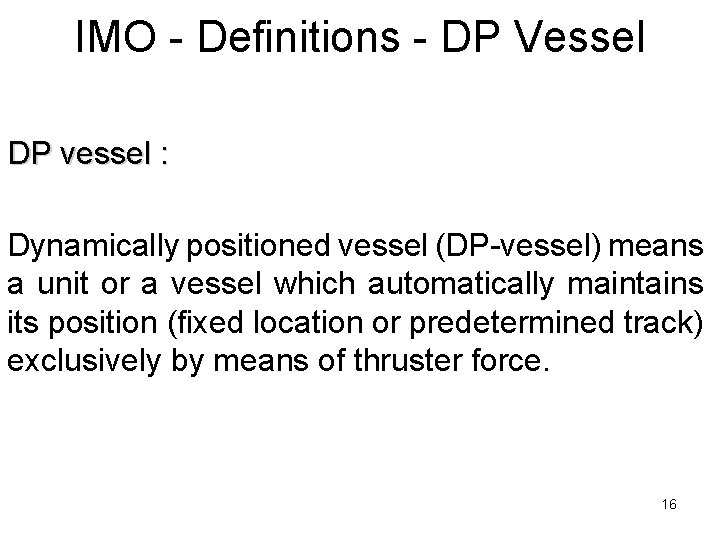
IMO - Definitions - DP Vessel DP vessel : Dynamically positioned vessel (DP-vessel) means a unit or a vessel which automatically maintains its position (fixed location or predetermined track) exclusively by means of thruster force. 16
IMO - Definitions - DP System DP system : Dynamic positioning system (DP-system) means the complete installation necessary for dynamically positioning a vessel comprising the following sub-systems : • . 1 power system, • . 2 thruster system, and • . 3 DP-control system. 17
IMO - Definitions - DP System Redundancy : Redundancy means ability of a component or system to maintain or restore its function, when a single failure has occurred. Redundancy can be achieved for instance by installation of multiple components, systems or alternative means of performing a function. 18
IMO - Equipment Classes: There are three different equipment classes all defined by their worst case failure mode. Equipment Class 1: For equipment class 1, loss of position may occur in the event of a single fault. 19
Equipment Class 2: For equipment class 2, a loss of position is not to occur in the event of a single fault in any active component or system. Normally static components will not be considered to fail where adequate protection from damage is demonstrated, and reliability is to the satisfaction of the Administration. Single failure criteria include: –. 1 Any active component or system (generators, thrusters, switchboards, remote controlled valves, etc. ). –. 2 Any normally static component (cables, pipes, manual valves, etc. ) which is not properly documented with respect to protection and reliability. 20
Equipment Class 3: For equipment class 3, a single failure includes: –. 1 Items listed above for class 2, and any normally static component is assumed to fail. –. 2 All components in any one watertight compartment, from fire or flooding. –. 3 All components in any one fire sub-division, from fire or flooding (for cables, see also 3. 5. 1). 21
IMO - Functional Requirements: The guidelines includes functional requirements for the following parts of a DP system: – Power System – Thruster System – DP-control system including computers, position reference systems and vessel sensors – Cables and piping systems – Requirements for essential non DP systems 22
IMO - Operational Requirements: The guidelines includes operational requirements concerning: – Checklists for the DP operations – Automatic Consequence Analysis – Checklist, test procedures and instructions relevant for both the operation and the annual and periodical tests 23
IMO - Survey, testing and FSVAD: The guidelines includes one section about the survey, testing and FSVAD related to a DP vessel. Surveys and testing: – – Initial surveys Periodical surveys Annual surveys related defects observed and corrected and accidents Flag State Verification and Acceptance Document (FSVAD): – Compliance with the guidelines 24
IMO - Requirements for each class: 25
International Marine Contractors Association (IMCA): • International trade association representing offshore diving, marine and underwater engineering companies • IMCA guidelines have been references as an industry standard by IMO • Publishing different reports, documents and guidelines • IMCA M 103 - “Guidelines for design and operation of dynamically positioned vessels” • IMCA M 161 - “Guidelines for the design and operation of dynamically positioned vessels - Two-Vessel Operations” 26
Classification Societies: • Different classification societies; DNV, BV, LR, RINA, ABS • Concerned about the DP equipment and system onboard • Gives vessels a classification notation in accordance with the requirements stated 27
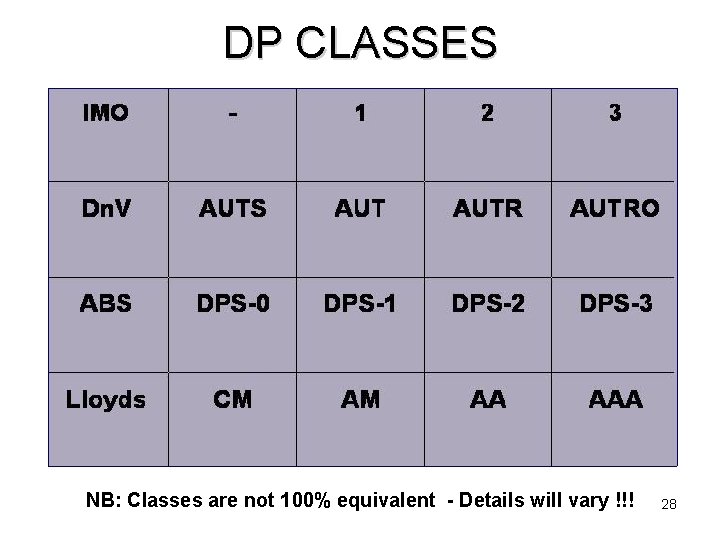
DP CLASSES NB: Classes are not 100% equivalent - Details will vary !!! 28
BV - NOTATIONS 29
BV - NOTATIONS • PDY TA: Automatic tracking. The unit is maintained along a predetermined path. • PDY TA R: Automatic redundant systems. • PDY TA RS: Automatic tracking, with redundant, physically separated systems. tracking, with 30
BV – requirements for each class notation 31
RINA - NOTATIONS ed • Units. IPD-1: positioning system with centralized remote manual control. • IPD-2: automatic provided Units anwith dynamic positioning system and with a standby one with manual control. • automatic IPD-3: provided two Unit with dynamic positioning systems (one as a standby to the other). 32
RINA : requirements for each class notation 33
DP CONSEQUENCE ANALYSIS : MCS/Circ. 645, 6 June 1994 - section 3. 4. 2. 4 : “For equipment classes 2 and 3, the DP-control system should include a software function, normally known as 'consequence analysis', which continuously verifies that the vessel will remain in position even if the worst case failure occurs. ” 34
NORVEGIAN SECTOR • Norwegian Maritime Directorate (NMD): – NMD Regulation for Mobile Offshore Units, 1987 – NMD Guidelines and Notes No. 23, 1993 – NMD Guidelines and Notes No. 28, 1993 • Norwegian Petroleum Directorate (NPD): – Guidelines relating to specification and operations of dynamically positioned diving support vessels, dated 1 May 1983 35
NMD DEFINITIONS : • Consequence classes: – for units with DP consequence class approved by NMD – NMD Guidelines and Notes No. 28, 1993 ==> Enclosure B = MCS/Circ. 645, 6 June 1994 • Class 0: – Operations where loss of position keeping capability is not considered to endanger human lives, or cause damage. • Class 1: – Operations where loss of position keeping capability may cause damage or pollution of small consequence. 36
NMD DEFINITIONS : • Class 2: – Operations where loss of position keeping capability may cause personnel injury, pollution, or damage with large economic consequences. • Class 3: – Operations where loss of position keeping capability may cause fatal accidents, or severe pollution, or damage with major economic consequences. 37
NORWEGIAN SECTOR • NORSOK: – Norsk Sokkels Konkurranseposisjon – The competitive standing of the Norwegian offshore sector • DP relevant NORSOK Standards: – Marine Operations, J-003, Rev. 2, August 1997 – Technical Safety, S-001, Rev. 3, Jan. 2000 38
NORSOK : 39
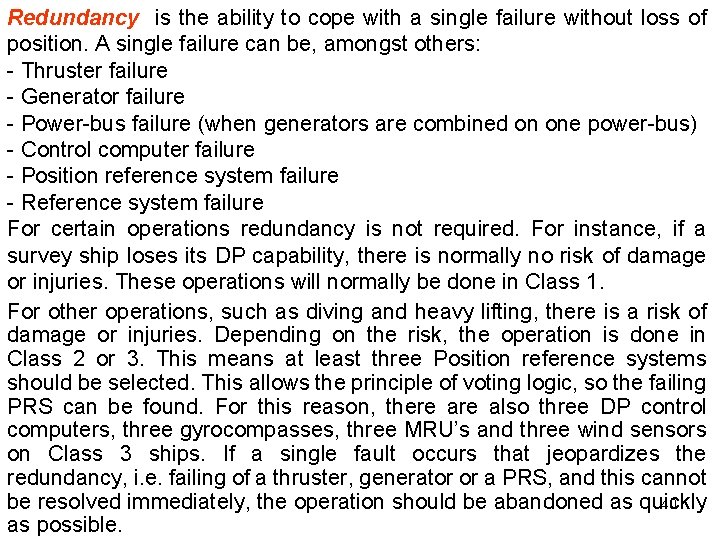
Redundancy is the ability to cope with a single failure without loss of position. A single failure can be, amongst others: - Thruster failure - Generator failure - Power-bus failure (when generators are combined on one power-bus) - Control computer failure - Position reference system failure - Reference system failure For certain operations redundancy is not required. For instance, if a survey ship loses its DP capability, there is normally no risk of damage or injuries. These operations will normally be done in Class 1. For other operations, such as diving and heavy lifting, there is a risk of damage or injuries. Depending on the risk, the operation is done in Class 2 or 3. This means at least three Position reference systems should be selected. This allows the principle of voting logic, so the failing PRS can be found. For this reason, there also three DP control computers, three gyrocompasses, three MRU’s and three wind sensors on Class 3 ships. If a single fault occurs that jeopardizes the redundancy, i. e. failing of a thruster, generator or a PRS, and this cannot be resolved immediately, the operation should be abandoned as quickly 40 as possible.
To have sufficient redundancy, enough generators and thrusters should be on-line so the failure of one does not result in a loss of position. This is left to the judgement of the DP operator. For Class 2 and Class 3 a Consequence Analyses should be incorporated in the system to assist the DPO in this process. Disadvantage is that a generator can never operate at full load, resulting in less economy and fouling of the engines. The redundancy of a DP ship should be judged by an FMEA study and proved by FMEA trials. Besides that, annual trials are done and normally DP function tests are completed prior to each project. 41
42
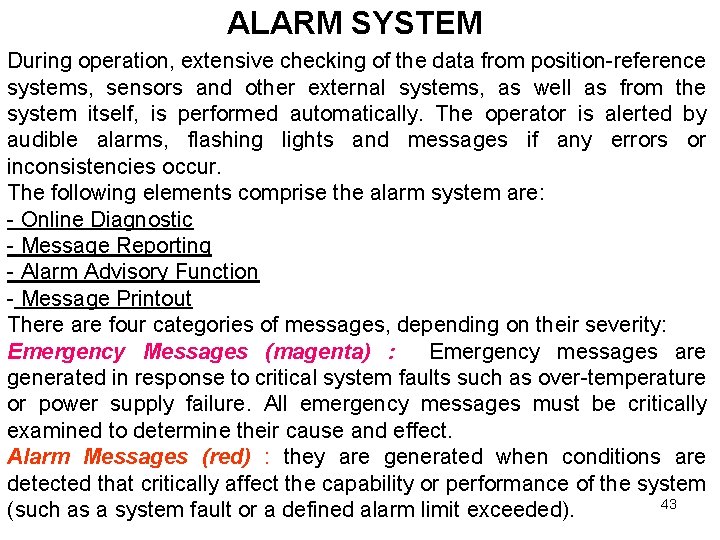
ALARM SYSTEM During operation, extensive checking of the data from position-reference systems, sensors and other external systems, as well as from the system itself, is performed automatically. The operator is alerted by audible alarms, flashing lights and messages if any errors or inconsistencies occur. The following elements comprise the alarm system are: - Online Diagnostic - Message Reporting - Alarm Advisory Function - Message Printout There are four categories of messages, depending on their severity: Emergency Messages (magenta) : Emergency messages are generated in response to critical system faults such as over-temperature or power supply failure. All emergency messages must be critically examined to determine their cause and effect. Alarm Messages (red) : they are generated when conditions are detected that critically affect the capability or performance of the system 43 (such as a system fault or a defined alarm limit exceeded).
Warning Messages (yellow) : they inform you of the occurrence of conditions in the system that, if ignored, could result in unwanted system response or eventual failure (such as incorrect operator actions, intermittent position-reference data or a defined warning limit exceeded). Information Messages (grey) : they inform you of conditions that are noteworthy, but that have no serious effect on the performances of the system. Emergency and Alarm messages are accompanied by an audible alarm which continues until acknowledge the message. There are no audible alarm associated with Warning or Information messages. Emergency, Alarm and Warning messages are accompanied by the relevant lamp flashing in the Alarms button group until you acknowledge the messages 44
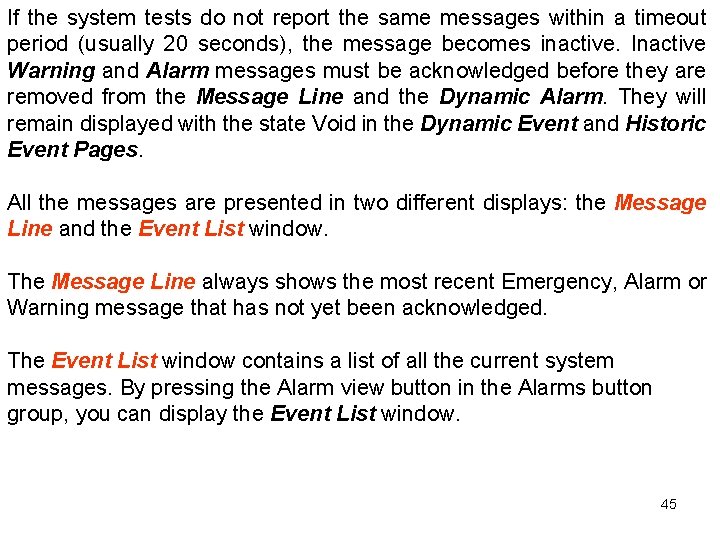
If the system tests do not report the same messages within a timeout period (usually 20 seconds), the message becomes inactive. Inactive Warning and Alarm messages must be acknowledged before they are removed from the Message Line and the Dynamic Alarm. They will remain displayed with the state Void in the Dynamic Event and Historic Event Pages. All the messages are presented in two different displays: the Message Line and the Event List window. The Message Line always shows the most recent Emergency, Alarm or Warning message that has not yet been acknowledged. The Event List window contains a list of all the current system messages. By pressing the Alarm view button in the Alarms button group, you can display the Event List window. 45
In the first column: if you have not yet acknowledged a message, an asterisk (*) is displayed and the background colour is displayed flashing. A vertical bar (|) is displayed in place an asterisk for an unacknowledged message that is in a command group over which the operator station does not have control. Origin: Identifies the originator (source) of the message: - SDP-OS# Operator Station - Dp. Main Controller Group - Equipment monitoring system. 46
Member: Members of the originator of the message (not relevant when the originator is an Operator Station or a controller group with only one member). If the message is form a controller group with more than one computer, this column identifies the members of the group. It may contain up to three characters, depending on the redundancy level. For example, for a triple-redundant system: A B C = The messages was reported by all three computers and is still active. C = The message was reported only by computer C and is still active. B = The message was reported by computers A and B. The message from computer A is now inactive. --- = The message was reported by all three computers and is now inactive (but is not yet acknowledged). Name: Identifies the source of process events and system events. Time: Time and date when the message was first reported. Prior: Message priority: Emergency, Alarm, Warning or Information. State: The state of the event: High, High Scale, Low Low, Low Scale (here all these are commonly referred to as Active), Normal or Void. 47
- Active: Indicates that the alarm condition is present. - Normal: Indicates that the alarm condition is no longer present. - Void: Used in the Dynamic Event Page and the Historic Event Page. Indicates that the message is removed from the Dynamic Alarm Page. Text: Message text. Additional Information: Up to three blocks of additional data may be included in the message. The meaning of this additional data varies for each message. 48
There are three lamps in the Alarms button group: COMPUTER – POWER – ALARM 1 – Computer. This lamp flashes in response to a hardware-generated alarm indicating that the Operator Station computer has stopped communicating with the operator panel controller via the serial line. This may indicate that the Operator Station computer is “dead”, or that the serial-line software has stopped executing. 2 – POWER. This lamp flashes in response to a hardware-generated alarm indicating a power supply or UPS failure to the operator panel controller. Two power supplies are normally supplying the Power lamp and the audible alarm, and if one of these fails, the alarm is active. 3 – ALARM. This lamp flashes in response to a software-generated Emergency, Alarm o Warning message from the Operator Station computer; for example, heading or position deviation beyond limits or sensor error. These messages are generated by the controller computer 49 and do not indicate failures in the OS.