
DP CAS Creativity Activity Service CAS Strands Creativityexploring

- Slides: 18
DP CAS Creativity, Activity, Service
CAS Strands ■ Creativity—exploring and extending ideas leading to an original or interpretive product or performance ■ Activity—physical exertion contributing to a healthy lifestyle ■ Service—collaborative and reciprocal engagement with the community in response to an authentic need
DP CAS ■Designed to strengthen and extend personal and interpersonal learning ■Required for all DP candidates and award of the IB Diploma
CAS Portfolio ■ Students maintain a digital CAS Portfolio in their student Google drive ■ Collection of evidence of CAS engagement – Inventory sheet – Profile sheet – CAS hour forms – Reflections with learning outcomes – CAS project form – Artifacts
CAS Hours ■ Students complete 8 – 10 CAS hours per month with a reasonable balance between the three strands ■ Hours are due the first of the month. Example: October hours are due on November 1 st ■ 8 th hour teachers enter grades for hours
CAS Hours ■Turn in hours via a google form on CHMSIB. com ■Students will keep the forms in a folder in their CAS portfolio
CAS Reflections ■ Students will complete monthly reflections on their CAS experiences during 8 th hour ■ Reflections should tie to a CAS learning outcome ■ Students will reflect on challenges, personal growth, skills learned, community engagement, growth as an IB student…
CAS Reflections th ■ 8 hour teachers enter grades for CAS reflections ■ Reflections are due the second Thursday of each month ■ Students will keep all CAS reflections on a single document in their CAS portfolio
CAS Learning Outcomes ■ Students must show evidence of the seven CAS learning outcomes for completion of DP CAS ■ Evidence is shown through – Monthly reflections – CAS project
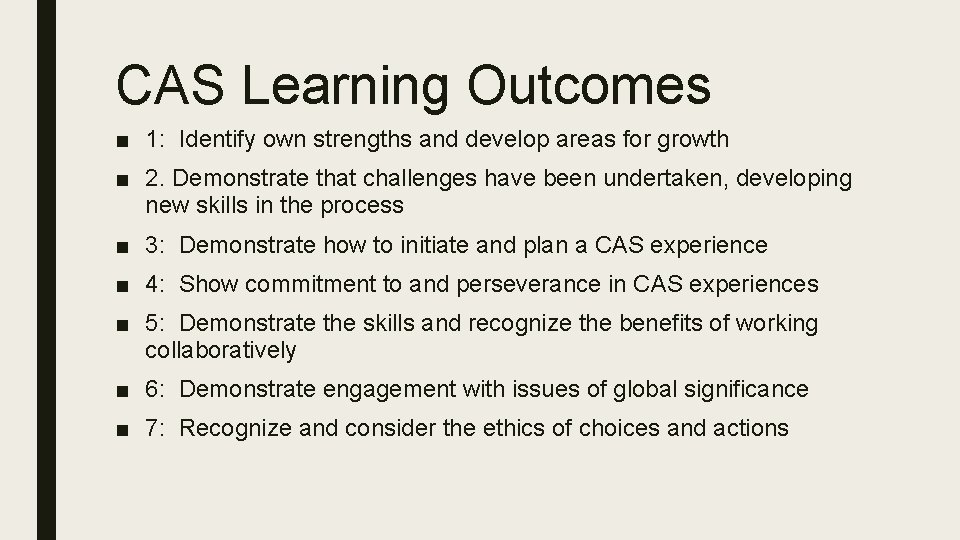
CAS Learning Outcomes ■ 1: Identify own strengths and develop areas for growth ■ 2. Demonstrate that challenges have been undertaken, developing new skills in the process ■ 3: Demonstrate how to initiate and plan a CAS experience ■ 4: Show commitment to and perseverance in CAS experiences ■ 5: Demonstrate the skills and recognize the benefits of working collaboratively ■ 6: Demonstrate engagement with issues of global significance ■ 7: Recognize and consider the ethics of choices and actions
CAS Project ■ Students must complete a CAS project ■ The project must last at least one month ■ The project must be student initiated student led ■ Students can work alone or in groups ■ The project can address any single strand of CAS, or combine two or all three
CAS Project ■ Students use the CAS stages (investigation, preparation, action, reflection and demonstration) as a framework ■ Students will complete the CAS project google form and keep it in their CAS portfolio ■ Students must complete their own CAS project form, even if the project is done in a group
CAS Project Stages Students must describe their engagement with the CAS stages as they complete the project ■ Investigation – Identify interests, skills and talents, as well as areas for person growth. – Determine the purpose for their CAS experience. – Identify a need they want to address. ■ Preparation – Clarify roles and responsibilities – Develop a plan of action – Identify resources and timelines – Acquire any skills
CAS Project Stages ■ Action– Students implement their plan – Make decisions, problem solve, collaborate ■ Reflection– Students describe what happened – Express feelings, generate ideas, and raise questions – Reflection may lead to new action. ■ Demonstration– Students make explicit what they learned accomplished – Share their CAS experience through their CAS portfolio or with others – Solidify their understanding and evoke response from others
CAS Artifacts ■ Students will need to have at least three artifacts from their CAS experiences ■ Include an artifact to represent each strand of CAS ■ Artifacts can include – Pictures of yourself engaging in CAS experiences – Video or audio recordings of CAS experiences – Things that were produced as a result of CAS experiences – Things such as medals, awards, or certificates that you were given as a result of CAS experiences
CAS Interviews ■ CAS coordinators will meet with students alone or in small groups during the Diploma Programme ■ CAS coordinators will share CAS requirements, answer questions related to CAS, and check students’ progress with CAS engagement
CAS Interviews ■ Students will meet with a CAS coordinator at the end of the Diploma Programme for an exit interview ■ Students will share their portfolios and discuss their experiences, reflections, and projects ■ The CAS coordinators will verify that students have met the CAS requirements and are eligible candidates for the IB
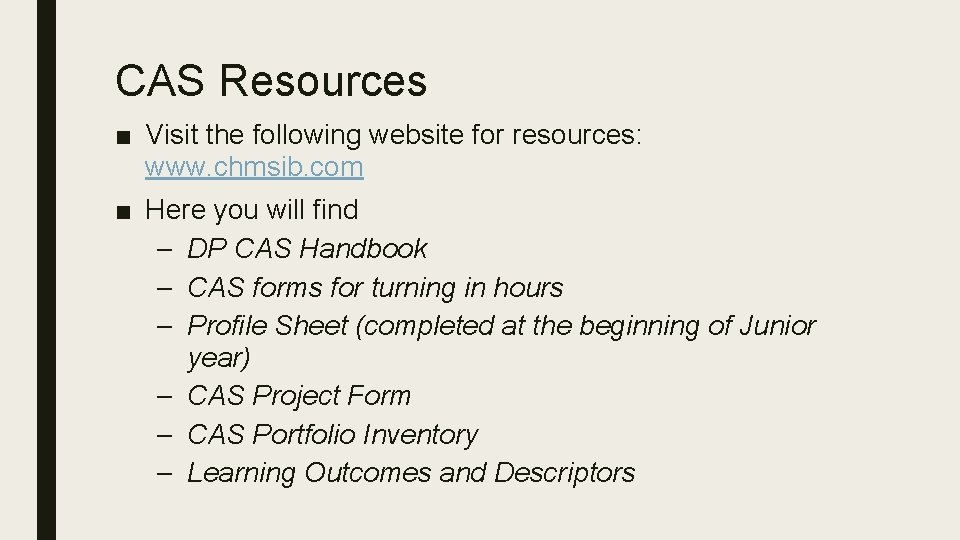
CAS Resources ■ Visit the following website for resources: www. chmsib. com ■ Here you will find – DP CAS Handbook – CAS forms for turning in hours – Profile Sheet (completed at the beginning of Junior year) – CAS Project Form – CAS Portfolio Inventory – Learning Outcomes and Descriptors