
DP Biology Unit 9 3 Growth in plants
DP Biology Unit 9. 3 Growth in plants
9. 3. U 1 Undifferentiated cells in the meristems of plants allow indeterminate growth.
Growth in plants Apical and lateral meristems Growth in plants restricted to embryonic regions called meristems ◦ Unlike animals which grow everywhere Meristems are regions where cells continue to divide and grow ◦ Often throughout the life of the plant ◦ Cells in meristems are small and go through the cell cycle quickly to produce more cells through mitosis and cytokinesis
Growth in plants Apical and lateral meristems Apical meristems ◦ Sometimes referred to as primary meristems ◦ Produce upward growth stems and downward growth in roots Lateral meristems ◦ Sometimes referred to as cambium ◦ Produce an increase in girth/width

9. 3. U 2 Mitosis and cell division in the shoot apex provide cells needed for extension of the stem and development of leaves.
Growth in plants Apical and lateral meristems Apical meristem ◦ Found at the root and stem tips Shoot Apical meristem is more complex compared to the Root as it makes cells needed for leaves and flowers growth ◦ Tends to add in units ◦ Site of leaf and flower growth ◦ Tissue can remain embryonic for a very long time Unlike leaves and flowers which have a definite end
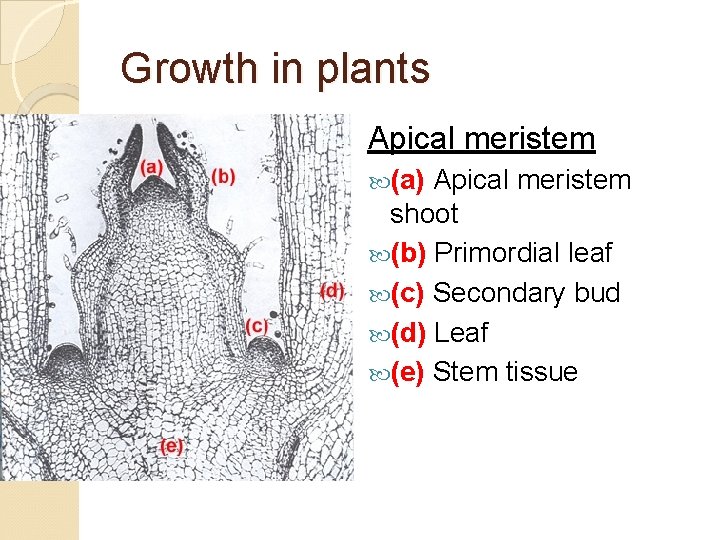
Growth in plants Apical meristem (a) Apical meristem shoot (b) Primordial leaf (c) Secondary bud (d) Leaf (e) Stem tissue
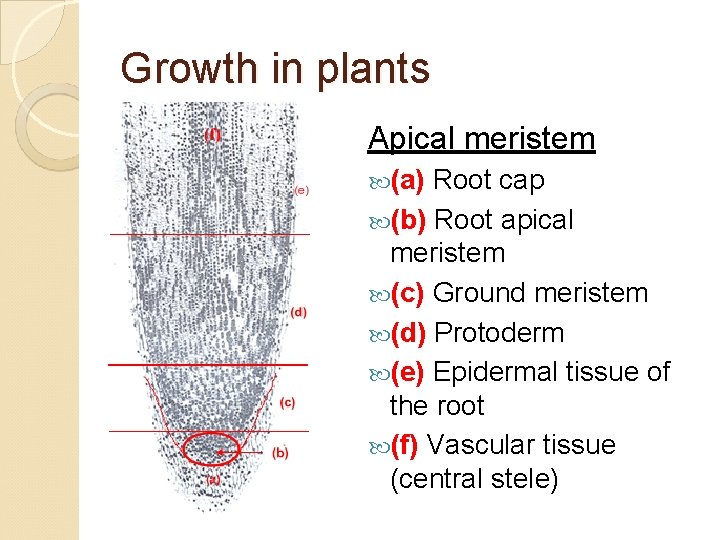
Growth in plants Apical meristem (a) Root cap (b) Root apical meristem (c) Ground meristem (d) Protoderm (e) Epidermal tissue of the root (f) Vascular tissue (central stele)
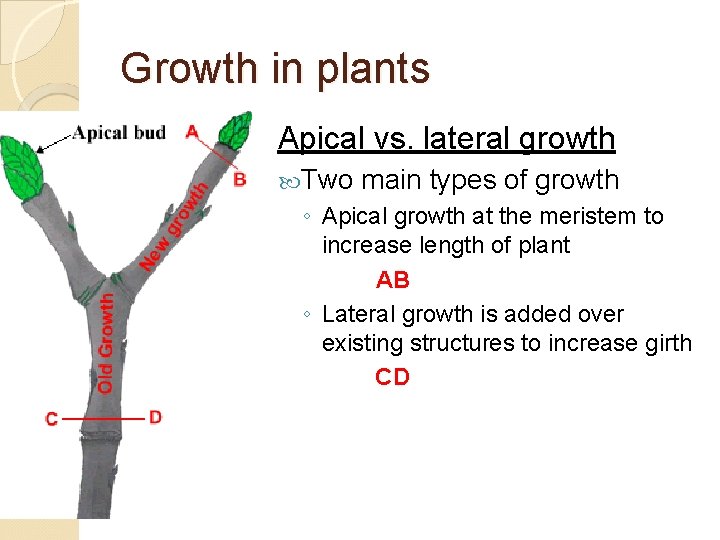
Growth in plants Apical vs. lateral growth Two main types of growth ◦ Apical growth at the meristem to increase length of plant AB ◦ Lateral growth is added over existing structures to increase girth CD
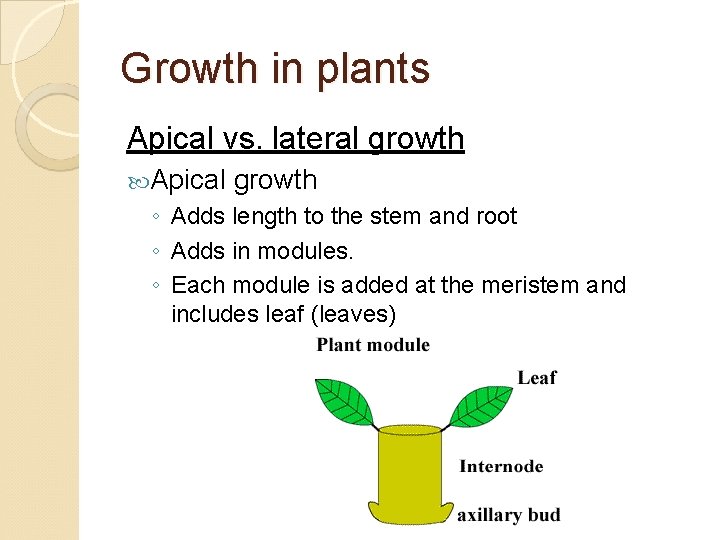
Growth in plants Apical vs. lateral growth Apical growth ◦ Adds length to the stem and root ◦ Adds in modules. ◦ Each module is added at the meristem and includes leaf (leaves)
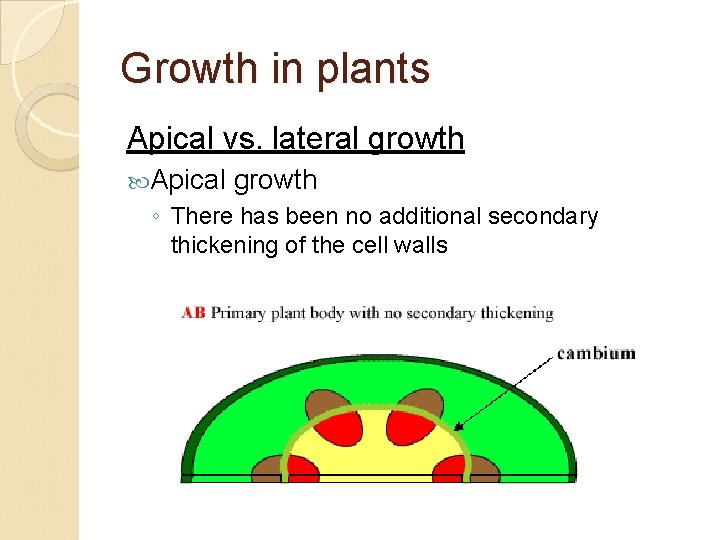
Growth in plants Apical vs. lateral growth Apical growth ◦ There has been no additional secondary thickening of the cell walls
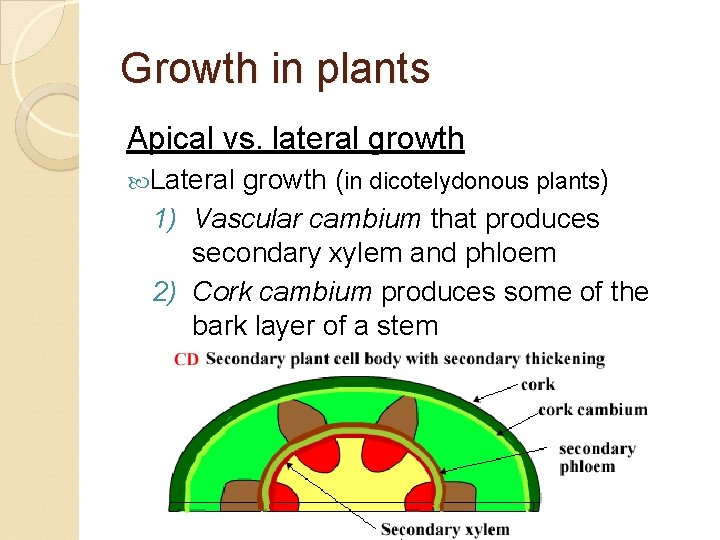
Growth in plants Apical vs. lateral growth Lateral growth (in dicotelydonous plants) 1) Vascular cambium that produces secondary xylem and phloem 2) Cork cambium produces some of the bark layer of a stem

Growth in plants Apical vs. lateral growth Apical meristems ◦ Located at the tip of the root and stem ◦ Increases the length of the plant ◦ Produces new leaves and flowers Lateral meristems or cambium ◦ Found in vascular bundles ◦ Increases the diameter of the plant (stem and root) by producing xylem and phloem
Growth in plants Apical vs. lateral growth In the stems of younger plants, the vascular cambium is located discretely in bundles In the stems of older plants, the vascular cambium is a complete ring
9. 3. U 3 Plant hormones control growth in the shoot apex.
Growth in plants The role of auxin in phototropism Hormone ◦ Chemical message that is produced and released in one part of organism to have an effect in another part Cytokinins (hormones) ◦ Produced in the root, promote axillary growth Gibberellins (hormones) ◦ Contribute stem elongation ◦ Released in germination of a seed
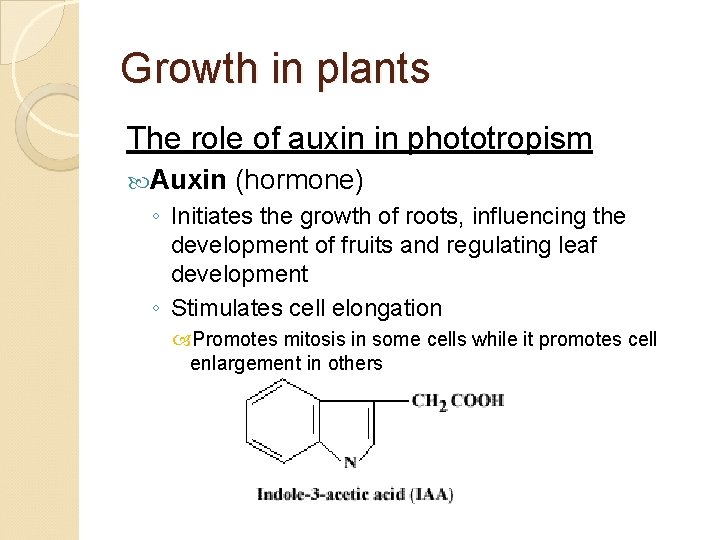
Growth in plants The role of auxin in phototropism Auxin (hormone) ◦ Initiates the growth of roots, influencing the development of fruits and regulating leaf development ◦ Stimulates cell elongation Promotes mitosis in some cells while it promotes cell enlargement in others
9. 3. U 4 Plant shoots respond to the environment by tropisms.
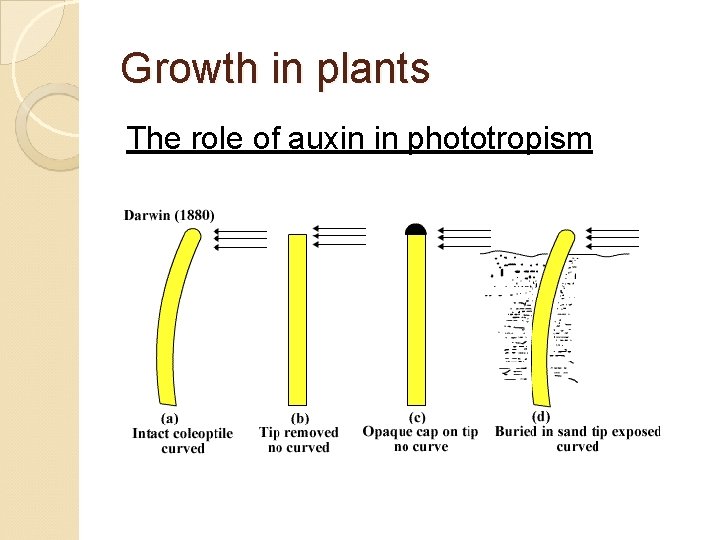
Growth in plants The role of auxin in phototropism A tropism is a bending-growth movement either toward or away from a directional stimulus Light and gravity can affect the direction in which stems grow ◦ Stems grow towards the brightest light ◦ In the absence of light they grow upwards (opposite direction of gravity)
Growth in plants
Growth in plants The role of auxin in phototropism Phototropism ◦ Directional growth toward the source of light ◦ Controlled by auxin Gravitropism ◦ Growth in response to gravitational force
Growth in plants The role of auxin in phototropism Phototropism
9. 3. U 6 Auxin influences cell growth rates by changing the pattern of gene expression.
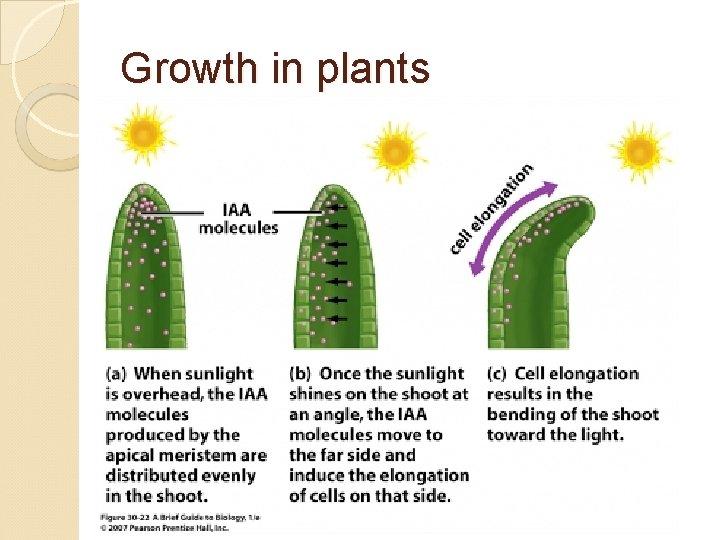
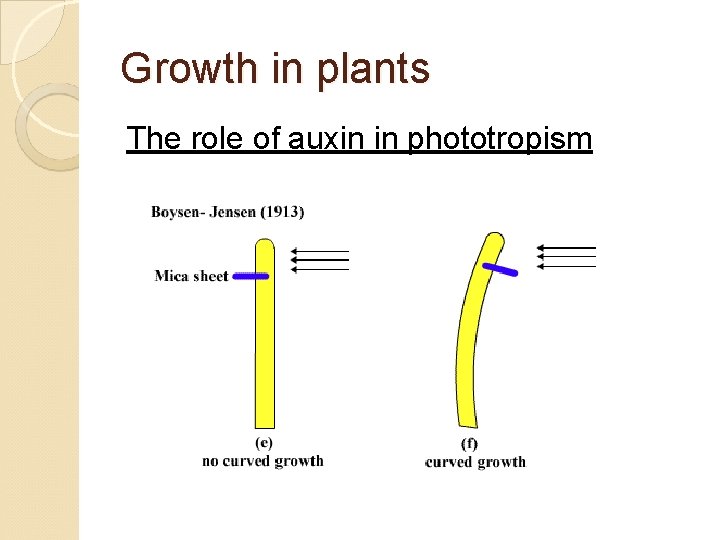
Growth in plants The role of auxin in phototropism Auxin is produced by the tip of the stem/shoot tip Auxin is moved to side of stem with least light… the darker side ◦ Gene expression altered by auxin to promote cell growth ◦ Causes cells on dark side to elongate and grow faster
Growth in plants The role of auxin in phototropism In shoot tips, proteins called phototropins absorb light ◦ Changing shape due to auxin in response to certain light wavelengths Phototropins in a light-induced shape bind to receptors ◦ Stimulate transcription/translation of genes for growth
9. 3. U 5 Auxin efflux pumps can set up concentration gradients of auxin in plant tissue.
Growth in plants The role of auxin in phototropism Phototropins change shape more in one side of the shoot tip ◦ This side has more light intensity than the other side ◦ Activates pumps that move auxin is transported from brighter side to shaded side
Growth in plants The role of auxin in phototropism Auxin causes transport of protons from cytoplasm to cell wall ◦ Decreases in p. H Acidity breaks bonds between cell wall fibers ◦ Makes cell walls flexible Auxin makes cells enlarge/grow;
Growth in plants The role of auxin in phototropism Stem grows in a curve towards the source of bright light ◦ So leaves attached to the stem will receive more light and do more photosynthesis
Growth in plants The role of auxin in phototropism
Growth in plants The role of auxin in phototropism
Growth in plants The role of auxin in phototropism Gravitropism is also auxin-dependent If root is placed on its side, gravity causes organelles to accumulate on lower side of cells ◦ Causes auxin transport to the bottom of cells
9. 3. A 1 Micropropagation of plants using tissue from the shoot apex, nutrient agar gels and growth hormones.
Growth in plants Micropropagation of plants Micropropagation ◦ A technique to produce large numbers of identical plants (clones) from a selected stock plant ◦ Plants can reproduce asexually from meristems Meristems are undifferentiated cells capable of continuing growth
Growth in plants Micropropagation of plants ◦ When a plant cutting is used to reproduce asexually in the native environment it is called “vegetative propagation” Bananas are grown this way ◦ When plant tissues are cultured in the laboratory (in vitro) in order to reproduce asexually it is called micropropagation
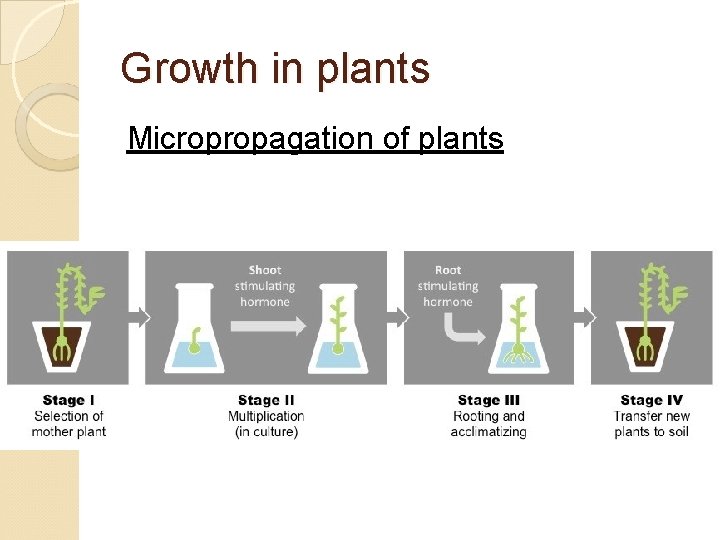
Growth in plants Micropropagation of plants The process of micropropagation: 1. Specific plant tissue (usually undifferentiated shoot apex) is selected and sterilized 2. The tissue sample (called the explant) is grown on a sterile nutrient agar gel 3. The explant is treated with growth hormones (ex. auxins) to stimulate shoot and root development
Growth in plants Micropropagation of plants The process of micropropagation: 4. The growing shoots can be continuously divided and separated to form new samples (multiplication phase) 5. Once the root and shoot are developed, the cloned plant can be transferred to soil
Growth in plants Micropropagation of plants
9. 3. A 2 Use of micropropagation for rapid bulking up of new varieties, production of virus-free strains of existing varieties and propagation of orchids and other rare species.
Growth in plants Micropropagation of plants Micropropagation is used to rapidly produce large numbers of cloned plants under controlled conditions: ◦ Rapid Bulking Using micropropagation to make many copies of plants with characteristics you want to use Can copy plants made by genetic modification
Growth in plants Micropropagation of plants Micropropagation is used to rapidly produce large numbers of cloned plants under controlled conditions: ◦ Virus-Free Strains In plants, viruses usually travel through vascular tissue (xylem and phloem), which the cambium does not have Using micropropagation makes it easier to make many virus-free plants
Growth in plants Micropropagation of plants Micropropagation is used to rapidly produce large numbers of cloned plants under controlled conditions: ◦ Propagation of Rare Species To increase rare species To help increase plants that don’t breed sexually To increase number of plants for commercial purposes

MAJOR SOURCES Thank you to my favorite sources of information when making these lectures! Chris Paine (Shanghai, CH) www. bioknowledgy. weebly. com John Burrell (Bangkok, TH) www. click 4 biology. info Dave Ferguson (Kobe, JA) http: //canada. canacad. ac. jp/High/49 Brent Cornell (Melbourne, AU) http: //ib. bioninja. com. au/ Gretel von Bargen (WA, USA) http: //www. biologyforlife. com/ Andrew Allott – Biology for the IB Diploma C. J. Clegg – Biology for the IB Diploma Weem, Talbot, Mayrhofer – Biology for the International Baccalaureate Howard Hugh’s Medical Institute – www. hhmi. org/biointeractive Mr. Hoye’s TOK Website – http: //mrhoyestokwebsite. com And all the contributors at www. You. Tube. com
- Slides: 45